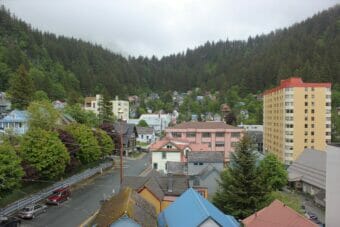
Homes in downtown Juneau, photographed on June 6, 2023. (Katie Anastas/KTOO)
Juneau residents who run short-term rentals may soon have to register their businesses with the city.
It would be a first step toward regulating short-term rentals, like those listed on AirBnB or VRBO.
Deputy City Manager Robert Barr said a registration program would help the city collect sales tax and track how many units an owner or property manager is operating.
“That enables us to have a more comprehensive understanding of short-term rental activity in Juneau,” Barr said in an interview.
A year ago, 170 short-term rental businesses had registered with the city’s sales tax office. But data analysis this spring found that Juneau had nearly 600 active and intermittently active short-term rentals.
The city’s short-term rental registration system would assign a unique number to each unit and require owners to include that number in online listings. They’d face a $25 fee each time they list their short-term rentals online without proper registration.
Short-term rental operators are legally required to pay sales tax and hotel bed tax. Barr said assigning a unique number to each unit could help the city track down which operators are paying and which aren’t — and make them more aware that they have to pay sales tax at all.
“Part of the reason we’d move forward with this registration ordinance is to get a better understanding of what our compliance rate is,” he said.
Sitka requires short-term rental owners to live on the property for half of the year. Wasilla issues just 75 permits per year, and one property owner can have up to three permits.
If approved, Juneau’s registration program won’t include those kinds of restrictions, at least for now. But Assembly members discussed the possibility at a committee meeting Monday night.
Assembly member Alicia Hughes-Skandijs said she’d be interested in exploring limits to the number of rentals one person could run, prioritizing those who rent space in their primary residences and collecting permit fees that could go to the city’s affordable housing fund.
Wade Bryson urged fellow Assembly members to be cautious.
“I agree that we’re going down the correct path. We need to register short term rentals, we need to make sure they’re not literally displacing our residents,” he said. “We still have to keep in mind that we’re now trying to figure out what to tell people they can do with property that they own. That’s always a very slippery slope.”
Last month, Anchorage Democratic Rep. Andrew Gray introduced a bill requiring short-term rental owners to register with the state. Owners would be limited to registering just one short-term rental. Assembly member Carole Triem said she would oppose the bill if it came up again in the next legislative session.
“We should get to make our own rules,” she said.
Barr said the registration program likely won’t yield useful data until it’s been running for a year or more. But he said it’s a good first step in understanding the growing short-term rental market in Juneau.
“Regulation becomes more painful for more people the longer you wait to do it,” he told the committee.
The Assembly will vote on whether to create a short-term rental registration program at its June 12 meeting. If approved, it would take effect in July.
Paint cracks and window frames rot outside Juneau’s City Hall on May 22, 2023. (Katie Anastas/KTOO)
The Juneau Assembly is one step closer to putting a new city hall bond on the October ballot.
At a meeting Monday night, Assembly members expressed support for a $27 million bond proposal. Voters narrowly rejected last year’s proposal for a $35 million bond.
“We did not, I think, put our best foot forward last year when we did not appropriate funds to advocate for the project,” City Manager Rorie Watt told Assembly members on Monday. “If we’re going to go forward, we need to more affirmatively position ourselves to advocate on the reasons why.”
Watt says there are several problems with the existing space. City Hall needs substantial upgrades, and it’s too small to fit all city workers. Meanwhile, the city pays $820,000 each year to rent other office space, and one of those buildings has its own plumbing issues.
Watt has recommended that the Assembly put $10 million toward the project in this year’s budget. That would let them lower the bond from $35 million to $27 million. He’s also suggested spending $50,000 to educate the public on the need for a new building.
This wouldn’t be the first time the city brought a proposal back to voters after it failed on the first try. Ballot measures to fund construction of projects like the downtown parking garage, Marine Park expansion and the Treadwell Ice Arena all succeeded after the city changed how they were funded or the amount.
“When the voters tell us no, it doesn’t mean no forever on any variation — it means you didn’t get it right that time,” Watt said. “We have a long history of trying to find the sweet spot of what the voters want.”
At Monday’s meeting, Assembly member Wade Bryson proposed reducing the size of the bond by $4 million – the estimated cost of building underground parking at the new city hall.
“I strongly believe that it’s important for us to remove the parking and show we could reduce the scope of the building,” Bryson said. “Asking the voters to support $23 million is going to be a heck of a lot easier.”
The committee decided to keep the funding for underground parking. The preferred location for the new city hall is near Centennial Hall and the Zach Gordon Youth Center, and member Michelle Hale said she didn’t want to limit parking in the area.
“We just don’t have the opportunity to build a building and put parking under it very often,” she said.
The Assembly will introduce an ordinance to put a $27 million bond on the ballot on June 12. Members of the public will be able to comment at the July 10 meeting.
Lucy Potter, principal at Sít’ Eetí Shaanáx – Glacier Valley Elementary School, sits in her office. Staff covered the floor in balloons. (Katie Anastas/KTOO)
School is out for summer in Juneau. For retiring teachers, principals and other school staff, this end of the year is especially bittersweet.
Over the last two decades or more, they’ve watched the district expand to new campuses, weather the pandemic and incorporate Alaska Native language and culture into the curriculum.

Three retirees reflected on their time in the Juneau School District and shared what’s next.
Henry Hopkins, teacher at Yadaa.at Kalé Juneau-Douglas High School
Henry Hopkins (left) and Donald Héendei Gregory teach students at Juneau-Douglas High School: Yadaa.at Kalé the science and tradition of Tlingit halibut hooks on March 5, 2019. (Photo by Zoe Grueskin/KTOO)
For nearly 20 years, Henry Hopkins’ outdoor biology class has been at the forefront of Juneau’s efforts to incorporate Alaska Native knowledge and language into local schools.
“I spend a lot of time in that in-between world,” Hopkins said. “If you want to get detailed knowledge about the environment, I think a good place to start is with the people who live there. If you’re ignoring that as a Western scientist, you’ve lost a whole lot of information.”
Hopkins was working as a fish biologist in Western Alaska when he first considered teaching.
“I was standing in a river, measuring fish, late in the fall with ice chunks coming by, and I figured I wasn’t going to be doing that for the rest of my life,” he said. “The next step for a biologist was to be in a cubicle writing reports, and that did not seem attractive.”
So he returned to UAF – where he’d moved to from Germany to get his biology degree – and earned a teaching credential. Then he taught in Dutch Harbor, then Wrangell, then Delta Junction before settling down in Juneau.
He’s been in the Juneau School District for 23 years.
“My classroom overlooks Gastineau Channel,” he said. “There aren’t too many teachers that can watch orcas swim by as they’re teaching.”
After working as a technology mentor for teachers and helping set up the district’s homeschooling program, Hopkins started teaching outdoor biology. He transformed the class into one that highlighted Lingít science and subsistence. He invited classroom guests like Donald Gregory, who taught the students about halibut hooks.
Conversations in those classes eventually led to the school adopting a Lingít name.
“In my outdoor biology class, we talk a lot about names, names of the landscape,” he said. “In English, we name things after people many times. In Lingít, you name things after their properties, after their character.”
After retiring, Hopkins plans to work with Sealaska Heritage Institute to mentor other teachers as they incorporate Lingít knowledge into their science classes.
“I think, historically, our school system has done very poorly with Native students and the Native community,” he said. “I’ve been trying to bridge that gap from the first day I taught.”
Gretchen Kriegmont, counselor at Thunder Mountain High School
Thunder Mountain High School counselor Gretchen Kriegmont sits at her desk. (Katie Anastas/KTOO)
Counselor Gretchen Kriegmont has been at Thunder Mountain High School long enough to work with the children of former students.
“I had a kid come in the door, and I was like, ‘Who is your dad? I am 100% sure I taught your father,’” she said. “Seeing whole families grow up, from kindergarten all the way through, it’s pretty amazing.”
After she retires, she’ll lead educational psychology classes for aspiring teachers at the University of Alaska Southeast.
“It’s really timely now,” she said. “Giving the teachers tools to realize that they’re not just going to be teaching their content. They’re also going to be teaching psychology, and there has to be a philosophy.”
Kriegmont started teaching at Yadaa.at Kalé Juneau-Douglas High School in 1997, after she and her husband moved to Juneau from the Midwest.
“It was the most school-spirited place I’d ever seen,” she said.
Once Thunder Mountain High School opened, Kriegmont moved there to teach history, psychology and sociology. She got her master’s degree and became a school counselor.
Kriegmont said she wanted to help students grow academically, emotionally and socially – and help teachers encourage that growth in their students. During the pandemic, that balance became more important than ever.
“We persevered, and I think that’s what education is about and what high schoolers are about,” she said. “You see the resilience that high schoolers offer and the magic that they bring to society.”
That magic has started to come back in full force, Kriegmont said. She’s watched students who had virtual seventh and eighth grade become successful ninth and tenth graders. Students who missed out on homecoming dances enjoyed prom earlier this month.
As these seniors look ahead, Kriegmont said more and more of them are wanting to travel or pursue a trade before jumping into four-year degree programs.
“It’s reframed how I have conversations with students,” she said. “I think students are reevaluating their goals.”
Kriegmont hopes her UAS students will enjoy teaching as much as she has.
“The classroom is a microcosm of society,” she said. “You will teach every type of person, and they will enrich your life if you allow them to.”
Lucy Potter, principal at Sít’ Eetí Shaanáx – Glacier Valley Elementary School
Lucy Potter, principal at Sít’ Eetí Shaanáx – Glacier Valley Elementary School, sits in her office. Staff covered the floor in balloons. (Katie Anastas/KTOO)
Lucy Potter’s office was filled with colorful decorations during the last week of school. Staff filled her office with balloons, and students wrote cards.
“I want you to be happy when you quit your job,” one student wrote on neon pink paper. “You are the best principal ever.”
Potter is hopeful she will be happier. She’s been the principal of Sít’ Eetí Shaanáx – Glacier Valley Elementary School for the last nine years and watched some of Juneau’s youngest students go through the pandemic.
“I don’t want to compare myself to being a nurse in the medical field, but we were first responders,” she said. “It was a really difficult couple of years. Very, very demanding in a very different way.”
Teachers quickly moved classes online. Potter oversaw distribution of food and laptops for kids who needed them. Once students came back in person, one positive test could send a whole classroom back home again.
Potter said teachers are still trying to help kids catch up academically. They’re also seeing more behavioral and emotional challenges among students.
Potter teared up when she talked about the changes, and how they’ve left teachers exhausted.
“They put their whole hearts into educating our students,” Potter said. “What I’m seeing as a result of that – not only teaching but doing a lot of social-emotional learning with them and helping them through these really difficult residual effects from COVID – I think they’re really tired.”
Potter is, too. That’s one of the reasons she’s retiring. She said between Superintendent Bridget Weiss leaving and the Alaska Reads Act going into effect in fall, it was a good time to move into a less stressful job.
The Reads Act requires teachers to develop reading plans for individual students, meet with their families and consider holding them back at third grade if they’re not reading at grade level. Potter is worried about how it will affect teachers who are already feeling overworked. And she thinks holding students back can do more harm than good.
“Many of our families are just making it by – they’re working two and three jobs to provide for their family,” she said. “And some of them aren’t as involved in their children’s education. I worry that the Reads Act is creating even more of a divide for families that are economically disadvantaged.”
Potter has seen all of these factors – bigger workloads, more behavioral challenges among students and a lack of appreciation for teachers – lead to a decline in the number of people applying for teaching jobs. She said it’s more important than ever for new teachers to find supportive communities at their schools.
“It’s super rewarding, but you can’t do it alone,” she said.
School district leaders and many legislators were hopeful that the base student allocation – part of a formula that determines how much money schools get from the state – would increase significantly this year. And they say the one-time funding passed instead won’t resolve ongoing budget problems.
“Until we make structural reform to school funding, we’ll always be in these conversations where we’re talking about deficits and budget cuts and pink slips and layoffs,” said Anchorage School District Superintendent Jharrett Bryantt.
Districts plan for deficits
The Anchorage School District expects to get nearly $50 million from the one-time boost, if Gov. Dunleavy approves it. But Chief Financial Officer Andy Ratliff said the lack of a permanent funding increase makes it hard to plan for 2025.
“It incentivizes you to just save it and not spend it, knowing you’re going to have a bigger deficit the following year,” Ratliff said.
Juneau School District officials are also anticipating budgeting challenges for 2025. Cassee Olin, director of administrative services, said the district expects to get $5.4 million of the $175 million boost.
“Basically, we’ll start building our budget in FY25 already in a deficit of $5.4 million,” Olin said.
That means the district likely won’t put the money to new, recurring costs — like hiring teachers. Instead, she said, they might spend it on online classroom materials or maintenance projects.
“We’d like to try to focus on non-personnel expenses with the additional funding – something that we don’t necessarily have to have in the following years,” she said.
Without a permanent funding increase, districts may have to resolve deficits in other ways, like closing schools, making class sizes bigger and reducing bus service.

A safety valve until next year
Several legislators spent this year’s session pushing for a permanent increase in school funding.
Sen. Löki Tobin, D-Anchorage, chaired this session’s Senate Education Committee. She advocated for the Senate version of a bill to increase the base student allocation by $680.
“There seemed like, up until the end, a pathway forward,” she said. “I think we – in Senate Education and again Senate Finance – were able to really articulate why an increase under the BSA was the best, most equitable and fair way to support our education system.”
Instead, the base student allocation will only go up by $30 – an increase Dunleavy approved last year – bringing the base number to $5,960. The exact number a district gets per student can change based on factors like school size and whether a student has intensive needs.
Tobin said that without a significant increase to the base student allocation, a one-time funding boost was the next best option. She called it a “safety valve” to hold schools over until the Legislature can resume talks about the base student allocation next year.
Tobin said she’s feeling optimistic that Dunleavy will approve the one-time boost.
“I know that he is an advocate for our schools. I know that he recognizes the value of a good quality public education,” Tobin said. “I’m hopeful that he sees this balanced budget and uses his veto pen very little.”
School boards and district administrators around the state will meet in the coming weeks to discuss next steps. Dunleavy has 20 days to review the Legislature’s budget once he receives it.
The Sealaska Heritage Institute has proposed renaming the part of South Seward Street that runs through its campus, between Front Street and Marine Way. (Katie Anastas/KTOO)
The Sealaska Heritage Institute has proposed renaming the part of South Seward Street that runs through its campus.
President Rosita Worl announced the proposal in April at a ceremony celebrating the installation of Kootéeyaa Deiyí, the totem pole trail along Juneau’s waterfront.
“The city recommends that we have a community meeting to discuss the proposed change,” Worl said to the crowd. “I would say that our citizens here today constitute a community meeting.”
Worl handed Deputy Mayor Maria Gladziszewski an application to rename the part of the street between Front Street and Marine Way to Heritage Way.
The Sealaska Heritage Institute has proposed renaming the part of South Seward Street that runs through its campus, between Front Street and Marine Way. (Katie Anastas/KTOO)
According to city code, applications to change street names go through the city planning commission. The process includes a public hearing. If the commission approves the name change, SHI will be responsible for replacing the street signs.
A change in street name also requires approval from the majority of property owners there. On that part of Seward Street, the only other property owner is the city.
At a Juneau Assembly committee meeting Monday, Assembly member Wade Bryson said he wanted to know how much it would cost to change City Hall’s address on official documents.
“There is a cost to this,” he said. “I’m interested in what SHI is trying to do, but at the same time, if it costs us a million dollars to properly re-address all city functions, we have to have a real conversation about that.”
City Manager Rorie Watt said the cost would be minimal.
“It’s not like we have reams and reams of pre-printed paper that we’re putting in typewriters,” he said. “There will be a transition – as people order new business cards and things, we can update it – but I don’t see a reason we need to throw out perfectly good stationery.”
Assembly members agreed to support renaming South Seward Street between Front Street and Marine Way. The proposal now goes to the Planning Commission.
Close
Update notification options
Subscribe to notifications
Subscribe
Get notifications about news related to the topics you care about. You can unsubscribe anytime.