Katie Anastas

Local News Reporter, KTOO
Juneau Assembly approves budget with lowest property tax rate in decades

The 2023 budget includes $10 million toward a new city hall. (Katie Anastas/KTOO)

The Juneau Assembly approved a city budget on Monday based on the lowest property tax rate in decades.

The mill rate of 10.16 means that for every $1,000 in taxable property value, there would be a tax of $10.16. It’s lower than the 10.28 mill rate city staff proposed at the start of the budget process, which was already lower than last year’s rate. 

It’s the lowest mill rate since at least the late 1990s, according to city Finance Director Angie Flick. But because property values have gone up, some residents will still pay more tax than last year. 

Auke Bay resident Tom Williams asked the Assembly to consider an even lower mill rate.

“It just doesn’t do well for families that are struggling already with large increases in their cost of living, seniors subject to limited revenue, and it pushes up the price of housing,” he said.

But Assembly members said 10.16 was as low as it could be this year. Originally, it would have left the city with a $1.1 million budget deficit. To make up for that, the Assembly reduced the amount put into savings from $4 million to $3 million.

The budget leaves $9.2 million in the unrestricted general fund and $19.6 million in the restricted budget reserve, according to Flick. 

“We do have a good amount in savings because of past assemblies and past city managers and past staff that have saved money,” Deputy Mayor Maria Gladziszewski said on Monday. “We passed a balanced budget, we lowered the mill rate as much as we could to provide the services people ask for.”

The largest portion of general government funds – $33 million – goes to the school district. That’s followed by the police with $21 million, then fire and emergency medical services with $15 million.

The budget draws $2 million from reserves for recurring costs. Assembly member Alicia Hughes-Skandijs expressed some hesitation about that, saying the Assembly should be prepared to pay for what they add to the budget.

“I don’t think you can have both, where we add to our ongoing costs and we also look for the lowest mill rate,” Hughes-Skadijs said. “The math doesn’t add up.”

Member Carole Triem, who chairs the finance committee but was absent from the meeting where the committee set the mill rate, agreed. 

“Responsible fiscal policy would say we should not be deficit spending at the moment, and I disagree with the overall combination of choices that we’ve made,” she said. “But I know I’m in the minority.”

Michelle Hale, who proposed the 10.16 mill rate last month, said the Assembly had the money this year to make up for the $1 million deficit. She said the city regularly gets more sales tax than anticipated.

“I think that is also good fiscal stewardship, to not continue to just endlessly tax our people and then have the extra money at the end of the year,” she said.

The budget includes $10 million toward a new city hall. The Assembly is expected to vote on whether to put a $27 million bond proposal on the October ballot next month.

Downtown Juneau street to be renamed Heritage Way

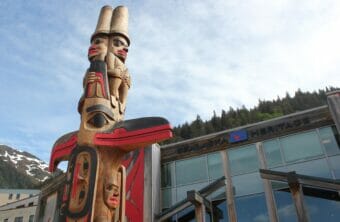
South Seward Street runs between the Sealaska Heritage Institute building, Heritage Square and the Sealaska Corporation headquarters. (Katie Anastas/KTOO)

Part of a street in downtown Juneau will have a new name this fall. At a meeting Tuesday night, the city’s planning commission approved a request to change South Seward Street to Heritage Way.

The nonprofit Sealaska Heritage Institute made the request. SHI President Rosita Worl announced the proposal in April at a ceremony celebrating Kootéeyaa Deiyí, the totem pole trail installed along Juneau’s waterfront this spring.

“I think naming it Heritage Way really celebrates the heritage of Alaska’s first people,” Worl said at Tuesday’s meeting.

South Seward Street runs from Front Street to Marine Way, between the Sealaska Heritage Institute building, Heritage Square and the Sealaska Corporation headquarters.

“I would like to thank the city administration for all the support we’ve had as Sealaska Heritage Institute,” Worl said. “I think we’ve become a model for many communities in terms of the partnership between citizens, organizations and the city.”

Juneau’s City Hall is also on that street. The name change won’t go into effect until Nov. 1 so that it won’t interfere with voter information materials for the October election.

“We have to put out voter information as far as where to mail back ballots and also where voting locations are, which is City Hall,” said Jill Maclean, director of Juneau’s community development department.

The Sealaska Heritage Institute proposed renaming the part of South Seward Street that runs through its campus, between Front Street and Marine Way. (Katie Anastas/KTOO)

The city’s planning commission approves name change requests. The Juneau Assembly agreed to support the change last month. The city is the only other property owner on South Seward Street. Seward Street begins at the crosswalk between Heritage Coffee’s downtown cafe and Juneau Drug Co.

The planning commission unanimously approved the street name change.

“We’re headed in the right direction,” said Mandy Cole, who chairs the commission. “It’s a good day for Juneau.”

William Seward was the secretary of state in 1867 when the U.S. bought unceded Alaska Native land from Russia. In 2020, hundreds of people signed a petition to remove a statue of Seward near the Alaska State Capitol, saying the purchase of Alaska reflected U.S. imperialism.

Correction: A previous version of this story attributed the final quote to CDD Director Jill Maclean. It has been updated to attribute it to planning commission chair Mandy Cole.

State plans stopgap safety measures at dangerous Juneau intersection

Evening rush hour traffic zooms down Egan Drive where it intersects with Yandukin Drive in Juneau on Dec. 12, 2017. Traffic experts have counted 60 car crashes in the crossing over a 10-year period.
Evening rush hour traffic zooms down Egan Drive where it intersects with Yandukin Drive in Juneau on Dec. 12, 2017. Traffic experts have counted 60 car crashes in the crossing over a 10-year period. (Photo by Jeremy Hsieh/KTOO)

The intersection by Juneau’s Fred Meyer grocery store has long been one of the borough’s most dangerous. One person died and four were medevaced after a crash there on Saturday — the latest of 50 crashes that have happened there over the last decade.

State transportation officials hope to eventually put stoplights at the intersection, add a pedestrian bridge and make other major changes. But there’s no timeline for that work.

“Our plans have been drawn up and all that, but it hasn’t been funded,” said Sam Dapcevich, a spokesperson for the Alaska Department of Transportation.

In the meantime, they’re planning smaller changes: extending the medians, painting clearer markings and introducing a seasonal speed limit reduction

From Nov. 1 to Jan. 31, the speed limit from Mendenhall Loop Road to the Sunny Point interchange will be 45 mph. It will reduce the speed limit near the Fred Meyer intersection by 10 mph. 

“The majority of the crashes take place during those darker months,” Dapcevich said.

Dapcevich said longer medians will get drivers closer to the turn. The idea is to make it easier for drivers to see oncoming traffic.

Saturday’s crash occurred as one driver turned left toward Fred Meyer and another was driving north on Egan, according to Juneau police. It’s the first fatality at that intersection recorded in state data, Dapcevich said.

In Nov. 2019, five people were hospitalized after a crash during a similar turn. Between 2005 and 2017, most crashes at the intersection happened during left turns, either onto Yandukin Drive or toward Fred Meyer.

As DOT works to find funding, Juneau may have other avenues to make the intersection safer. 

Katie Koester, Juneau’s engineering and public works director, said the city recently received a Safe Streets For All planning grant. In partnership with DOT, the city will analyze all streets in the borough – both city streets and state streets like Egan. 

“From that plan, we’ll be able to identify not just the highest priority areas for safety improvements, but also an implementation plan for both small and large projects,” she said. 

Those projects could include low-cost improvements for pedestrians and more expensive ones, like major intersection improvements. Koester expects the planning process to take at least a year.

“I can’t promise that that will be the solution for this particular problem,” Koester said about the Fred Meyer intersection. “But I can tell you that that intersection will definitely be highlighted in that plan, just given the accident history there.”

At an Assembly meeting on Monday, member Michelle Hale said she plans to work on a resolution asking DOT to expedite safety improvements at the Fred Meyer intersection.

New City Hall bond proposal likely only one headed for Juneau’s October ballot

City Hall doesn’t have enough room to fit all city workers, so the city rents office space next door on South Seward Street. (Katie Anastas/KTOO)

City leaders won’t ask Juneau voters to help pay for upgrades to the Dimond Park Field House – a public indoor track without wheelchair access – through a bond this year. Instead, the Juneau Assembly plans to only ask for city hall funding.
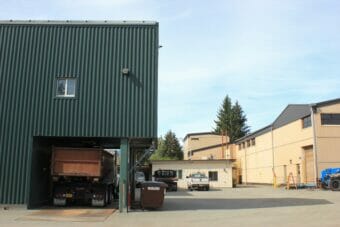
The Assembly is set to vote on whether to put a $27 million bond for the city hall project on the October ballot next month. 

At a finance committee meeting Wednesday night, outgoing Finance Director Jeff Rogers said one benefit of using bonds to finance projects is that it aligns who’s paying for a project with who uses the finished product.

“Debt is a structure that allows you to say, ‘We’re going to build something today with money we don’t have, and it’s going to be paid over the next 25 years by those people who use it,’” he said.

Rogers said if the Assembly wants to keep the debt service mill rate at 1.2 – which it generally uses as its limit – the city could take on $48 million in debt.

Assembly member Greg Smith floated the idea of a $2 million bond for the Dimond Park Field House, either on its own or as part of a larger bond package with other parks projects. Stairs connect the field house’s turf field and indoor track, but there’s no ramp or elevator.

“We realize there’s an ADA issue, the turf needs replacements, there’s some energy efficiency issues there,” Smith said.

But member Wade Bryson said putting a second, smaller bond on the ballot would draw support away from the city hall bond. Last year, the $35 million bond proposal for city hall narrowly failed, while the $6.6 million bond proposal for parks projects passed.

“If we bring another bond forward, we will get the exact same results that we received last time,’” he said.

Mayor Beth Weldon and Deputy Mayor Maria Gladziszewski agreed. They said it was too late in the Assembly’s budget process to thoughtfully come up with another bond proposal.

“I think having another bond on this ballot would just muddy the waters for a very important vote that we need to have for City Hall,” Weldon said.

Smith agreed and said he supported only putting a city hall bond on the ballot. 

For the field house, the Assembly rejected a $1 million request in May to fund an elevator but did allocate $150,000 from the city’s deferred maintenance fund for ADA improvements there.

Members of the public can comment on the city hall bond proposal at the Assembly’s July 10 meeting.

Juneau water and sewer utility rates will rise in July

Juneau’s Mendenhall Wastewater Treatment Facility, photographed on June 7, 2023. (Katie Anastas/KTOO)

Juneau’s utility rates are going up next month.

Water and sewer utility rates will go up 2% on July 1. They’ll go up another 2% in July 2024.

Water and sewer rates have gone up 2% each year since 2020. The Juneau Assembly approved the increases in 2019 to keep up with inflation. Revenue goes toward operating and maintaining the city’s water and wastewater systems.

Bill-Pay customers will need to manually update their accounts to match the new rates.

Site notifications
Update notification options
Subscribe to notifications