
Katie Anastas

Local News Reporter, KTOO

City manager asks Juneau Assembly to put $10M toward new city hall

Paint cracks and window frames rot outside Juneau’s City Hall on May 22, 2023. (Katie Anastas/KTOO)

Juneau’s City Hall was built in the 1950s. The outside shows peeling paint and rotting window frames. Inside, walls are cracking and a tarp covers a leak that damaged some of the city clerk’s files. A plywood box covers a broken urinal, to keep people from using it.

Looking down at his office carpet, City Manager Rorie Watt said any one repair project would set off several others.

“We can’t replace the carpet without abating it, because there’s asbestos in the mastic that holds the carpet down, so you’d have to tent the building off,” he said. “It becomes this cascading series of things as soon as you start to touch it.”

A tarp covers the corner of an office’s ceiling at City Hall. A leak damaged the city clerk’s files. (Katie Anastas/KTOO)

A block over, the city rents space in the Marine View building with constant plumbing issues. Employees there recently complained to OSHA about the lack of working bathrooms and sinks. Watt said the city and the building’s owner will likely get fined.

“It seems like the water gets shut off almost as frequently as every week,” Watt said.

Watt has recommended that the city include $10 million in next year’s budget for a new city hall. That would reduce the amount of money the city would ask from voters through a bond, if they put one on the ballot this year. Last year, Juneau residents narrowly voted down authorizing the city to borrow up to $35 million for the project.

But maintenance problems are just part of the conversation as the Juneau Assembly resumes discussions on a new city hall.

The city pays $820,000 each year to rent office space. And Watt said having all staff in one building would help the city save money and make it easier for them to work together. It would also make the building a one-stop shop for Juneau residents who want to reach city officials.

Buying another building in Juneau isn’t really an option, according to a real estate consultant the Assembly asked to analyze the market.

Tracey Ricker, a broker with Ricker Real Estate Consulting, outlined her findings in a memo shared with the Assembly Finance Committee. She said the city would need 46,200 square feet. That’s hard to find in the borough, especially downtown.

Most properties that could work for the city have been leased – sometimes to multiple tenants – for at least the next five years. Downtown, many of those tenants are government agencies.

A plywood box covers a broken urinal at City Hall to keep people from using it. (Katie Anastas/KTOO)

“Even if there was more interest in selling in the market, there would be a huge displacement of State workers with minimal options for relocation,” Ricker wrote.

There are two properties the city could buy, but both have major drawbacks.

The first is Nugget Mall, where renovations would cost at least $7 million, according to Ricker. It would also involve displacing some businesses in the mall, which are on month-to-month leases.

The second is the Capital Office Park building the Alaska Department of Fish and Game uses. Ricker said the building’s owners might be open to selling it, but it wouldn’t be available to the city until 2028. The city would also need to build a new space for Assembly meetings there.

Watt thinks a new city hall would most likely be built on Whittier Avenue near Centennial Hall and the Zach Gordon Youth Center. In the meantime, he’s proposed spending $50,000 to educate the public about the reasons why a new building is needed.

The Assembly will vote on the budget on June 12. If the Assembly decides to put a city hall bond on the ballot this year, it must be introduced by its July 10 meeting.

Planning to park at the airport this summer? Juneau officials would rather you not

The entrance to the parking lots at Juneau International Airport in May 2020. (Photo by Jeremy Hsieh/KTOO)

City officials suggest Juneau residents avoid parking at the airport this summer during renovations.

The long-term parking lot will close on May 31. There’s already a temporary long-term lot north of the terminal, with detour signs on Shell Simmons Drive leading to it. Parking in the temporary lot will be limited to 14 days.

Locations for short-term parking, taxi staging and rental car parking will change throughout the summer, though short-term parking will stay where it is until mid-June.

The payment system is changing, too. Starting in June, drivers will pay for short-term parking before entering the lot – either at kiosks or on the REEF Mobile smartphone app – instead of paying on their way out. The change has already gone into effect at the temporary long-term lot.

City officials expect all of the lots will often be full. They’re asking residents to consider taking public transportation or other rides to the airport.

This story has been updated to reflect that the pre-payment system has already gone into effect at the temporary long-term parking lot.

Juneau Assembly Finance Committee votes to lower mill rate

People walk in front of Juneau City Hall on Tuesday May 10, 2016 in Juneau, Alaska.(Photo by Rashah McChesney/KTOO)

The Juneau Assembly Finance Committee voted to set this year’s mill rate at 10.16 on Wednesday.

The mill rate determines how much property tax the city collects from residents. One mill is equal to $1 dollar per thousand dollars in property value. That means that for every $1,000 in taxable property value, there would be a tax of $10.16.

Because property values have gone up, the city would get more property tax, even with a lower mill rate.
Assembly member Michelle Hale proposed the 10.16 rate. She said that would get the average property tax increase close to the rate of inflation since 2020, which is 16%.

“Just as households are experiencing inflation, so is city government,” she said. “Unless we want to reduce our services dramatically, I believe we need to have a mill rate that both does something to reduce the total property tax but also make sure we can pay for city services.”

At the start of its budget process, city staff proposed a mill rate of 10.28 – a slightly lower rate than last year’s. That would have allowed the city to put $4 million into savings. Assembly member Christine Woll spoke in favor of that proposal.

“I commend city staff for putting together a budget that is balanced,” Woll said. “Obviously there’s assumptions in there. If we want to challenge those assumptions, we probably should have done that earlier. But I’m much more comfortable passing a balanced budget.” 

The 10.16 rate proposed by Hale would have left the city with a $1.1 million budget deficit. To remedy that, the Assembly voted to reduce the amount put into savings from $4 million to $3 million.

Assembly member Alicia Hughes-Skandijs said that could work this year, but not long term. 

“I certainly couldn’t live with doing that for more than a year,” she said. “I think it starts to emulate what they do up the hill, as far as not making real decisions and then paying for our underfunding the government through our savings, which I think is a bad long-term plan.”

Assembly member Greg Smith proposed lowering the mill rate even further, to 10.0. 

“I think we can provide relief to the property owner this year,” he said. “If the growth isn’t as large, if the market cools, we can adjust that in the future.”

Smith’s proposal was voted down. 

The 10.16 mill rate passed in a 6-1 vote, with Woll voting no. Members Carole Triem and ‘Wáahlaal Gíidaak were absent.

The full Assembly will vote on the budget on June 12.

Juneau Assembly makes by-mail elections permanent

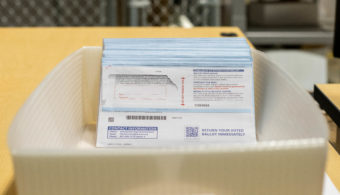
Example mail in ballots used for a demonstration during a tour of Juneau’s ballot counting center on Sept. 12, 2022. (Photo by Paige Sparks/KTOO)

By-mail voting is now the default in Juneau, thanks to a change to local election code made by the Juneau Assembly on Wednesday.

The city has used mail-in ballots in local elections for the last three years. Wednesday’s code change makes by-mail voting the default “unless otherwise directed by the Assembly.”

Five residents spoke against the idea at Wednesday’s meeting. Most were concerned about election fraud. 

Karen Lewis said by-mail voting had changed the outcomes of the 2020 and 2022 elections, a theory widely debunked by national experts

“Mail-in ballots should strictly be used for military people who are overseas and people who cannot vote in person due to physical disabilities,” Lewis said.

Frank Bergstrom questioned whether it would significantly improve voter turnout.

“If the primary reason for going to ballots by mail was not achieved,” he asked, “What is the justification now for continuing on and expanding this policy?”

In October 2022, nearly 33% of registered voters participated in the municipal election. Nearly 31% did in 2021, while 43% did in 2020. Voter turnout was 31% in 2019.

Assembly member Christine Woll said it’s true the original intent was to increase voter participation. When analyzing the numbers, she said, it’s important to remember that voters are generally more likely to participate in highly contested Assembly races. 

“Someone just brought up that this last year, it actually decreased from the year before,” Woll said. “You’ll also remember that the Assembly races were completely uncontested last year.”

Mayor Beth Weldon said, in her experience, voter fraud isn’t a concern in Juneau.

“I would disagree with the folks that talked about the integrity of the elections,” she said. “It would be very, very hard, especially in the city – I can’t speak for the state or the federal – to vote twice or anything else.”

Weldon still objected to the ordinance. 

“I feel that Election Day is kind of sacred,” she said. “By voting by mail, I think we’ve taken some of the emphasis off of how wonderful it is to go out and vote.”

The ordinance passed in a 5-2 vote, with Weldon and member Wade Bryson voting no. Members Carole Triem and ‘Wáahlaal Gíidaak were absent.

Site notifications
Update notification options
Subscribe to notifications