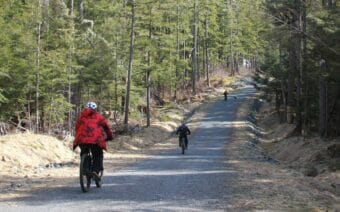
Cyclists ride on the West Douglas Pioneer Road on April 18, 2023. (Katie Anastas/KTOO)
The Juneau Assembly voted down a motion on Monday to reconsider leasing the West Douglas Pioneer Road to iRide Alaska for guided electric bike tours.
The Assembly voted against leasing the road to the company at last month’s meeting. But in a rare move, member Wade Bryson gave notice of reconsideration. That required the Assembly to vote on whether to take it up again.
iRide Alaska hoped to offer e-bike tours during the tourist season for up to 10 people each, three times per day on Mondays through Saturdays. Bryson had voiced support for the tours, citing the company’s local ownership and willingness not to offer tours on Sundays.
Some North Douglas residents had spoken against the tours, saying the road was one of the few spots left for locals in the summer.
On Monday, Assembly member Christine Woll said they’d already discussed the pros and cons enough.
“I think reconsideration is a useful tool when new information has become available, or Assembly members were confused about an issue and have now gotten clarity,” she said. “I don’t think that applies to this situation.”
The motion to reconsider the lease failed in a 3-5 vote, with Bryson, Michelle Hale and ‘Wáahlaal Gíidaak voting in favor.
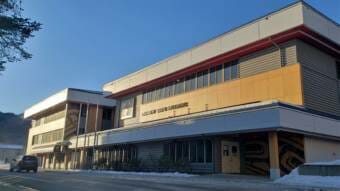
The Andrew Hope Building, pictured here on Feb. 10, 2021, houses the headquarters of the Central Council of Tlingit and Haida Indian Tribes of Alaska. (Photo by Jeremy Hsieh/KTOO)
The Central Council of the Tlingit & Haida Indian Tribes of Alaska announced Monday that it would withdraw from the Alaska Federation of Natives.
AFN, which has a membership of more than 200 tribes and corporations, promotes cultural preservation, political advocacy and economic development. It’s the largest statewide Alaska Native organization.
Tlingit and Haida is Alaska’s largest federally recognized tribe. Its executive council voted to withdraw from AFN at a meeting on May 1. At a press conference Tuesday morning, President Richard Chalyee Éesh Peterson said AFN membership “doesn’t feel as necessary” as it used to.
“As you take a look at the work we’re doing, the membership dues and everything else, it just seemed like time,” he said. “We’ve had the conversation numerous times.”
Peterson said Tlingit and Haida paid about $65,000 in membership dues each year.
The Fairbanks-based Tanana Chiefs Conference also announced it would leave AFN on Monday. In a statement, the conference said the time and money required to participate in AFN should be “utilized to their maximum potential to advance TCC’s Tribal priorities.”
Those priorities include salmon and subsistence protection, which Tanana Chiefs Conference says AFN hasn’t taken significant action on.
Peterson said he supports their decision.
“Their reasons are different than ours,” Peterson said. “We stand united on many of their issues. We support TCC just like we will any region that asks for our support.”
Peterson said Tlingit and Haida’s decision isn’t meant to show opposition to AFN or a lack of unity with other members. Instead, he said, it’s about Tlingit and Haida’s growing capacity to advocate for regional causes and manage relationships with the state and federal governments on its own.
“I don’t want it to look like a divorce,” Peterson said. “We’re the kids who grew up and are moving out of the house.”
The withdrawal from AFN is the latest in a series of major moves for Tlingit and Haida this year. In January, Peterson signed a deed to put a parcel of land into federal trust, which the state is challenging in court. But the Tribe has strengthened its relationship with the state, too — it’s one of five tribal organizations to receive a state-tribal education compacting grant. And in March, the Tribe purchased another acre of property in downtown Juneau as part of an ongoing effort to return ownership of traditional lands.
Spokespeople for AFN did not reply to requests for comment Monday.
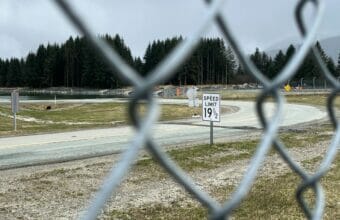
A sign at the airport tells drivers to go no faster than 19 1/2 mph. (Katie Anastas/KTOO)
On a rainy afternoon at the Airport Dike Trail, Laura Minne is walking her dog, Bodhi. Over on the airport side of the fence, a speed limit sign tells drivers to go no faster than 19 ½ miles per hour.
When asked if she has a theory for why it’s such a specific number, Minne laughs.
“I can only imagine,” she says. “Whoever did it has to be pretty wonderful to have that humor.”
Airport Manager Patty Wahto says that person was a member of the airfield crew several years ago. The idea was to get the attention of the many workers who were driving faster than the actual speed limit of 20 mph.
“When the 20 mph signs were posted, you could ask people what the speed limit was,” Wahto wrote in an email. “They would either answer that they didn’t know, or that they didn’t think there was a speed limit posted.”
Studies show drivers remember fewer details about routes they’re more familiar with. Dwight Hennessy is a professor at Buffalo State University who studies traffic psychology.
“The reality is, we can’t pay 100% perfect, focused attention on everything all the time,” Hennessy said. “If you have a monotonous environment, where everything is the same, breaking it up grabs our attention. We’re more likely to process things once we’ve paid attention to them.”
That’s why the 19 ½ sign works, he said. It stands out, which makes drivers think about the speed limit more.
The explanation gave Minne, the trail goer, an idea.
“So let’s just try that on Egan, right?” she said.
In fact, the Alaska Department of Transportation will try out a slower speed limit on Egan Drive this winter, though not quite as low as 19 ½ mph. From Nov. 1 to Jan. 31, the speed limit will be 45 mph from Mendenhall Loop Road to the Sunny Point interchange — a reduction of 10 mph. New radar speed signs will let drivers know how fast they’re going.
Nathan Purves, a traffic and safety engineer for the department, said the goal is to reduce winter crashes near Fred Meyer.
“That was where the majority of crashes were happening,” he said. “When it was icy out, people were trying to make that turn through traffic. The goal is by slowing people down, we’ll have bigger gaps in the traffic, and it’ll be easier to make the crossing.”
But a reduction much bigger than 10 mph could do more harm than good, he said. Drivers make assumptions about the correct speed limit based on the characteristics of a road, like its width and what kinds of buildings surround it. If DOT suddenly changed Egan’s speed limit to 25 mph, Purves said, most drivers would probably feel more comfortable driving faster.
“There would be the outliers that are like, ‘It says we’re supposed to go 25 on Egan, I’m going 24 because I’m not going to speed,’ and then here comes somebody going like, ‘Well I’m comfortable at 65,’” he said. “This person that’s following the law is being endangered.”
Time will tell whether the temporary speed limit and radar signs will reduce wintertime crashes on Egan. But, at the airport, the 19 ½ sign seems to be doing the trick.
Curious Juneau
Are you curious about Juneau, its history, places and people? Or if you just like to ask questions, then ask away!
A bingo card at the Filipino Community Hall in Juneau on Oct. 6, 2022. (Photo by Ian Dickson/KTOO)
The Central Council of the Tlingit & Haida Indian Tribes of Alaska will soon offer bingo at Elizabeth Peratrovich Hall.
The Tribe announced plans this week to hold bingo every Tuesday, Wednesday and Thursday starting May 9. Doors will open at 5 p.m. and games will run from 7 to 10 p.m. They’ll also sell pulltabs.
Proceeds will support the Tribe’s statewide programs, including scholarships and elderly services.
The Tribe’s Community Council already runs bingo in Twin Lakes, but those proceeds can only fund services for tribal members who live in Juneau. If the Central Council runs bingo, proceeds can benefit tribal members no matter where they live.
“Bingo is just one more way we are pursuing economic sovereignty and broadening the Tribe’s reach to better serve our citizens beyond Southeast Alaska,” President Richard Chalyee Éesh Peterson said in a statement.
Janice Hotch, the Tribe’s business and economic development director, said more bingo also means a return to normalcy for elders.
“For them, it’s a fun gathering place to see friends,” she said in an interview. “During the pandemic, all of that was taken away from them. I think we’re providing an opportunity for that gathering.”
Before the pandemic, Hotch said, Juneau residents could play bingo seven days a week, alternating between the Tribe’s game nights others, like those hosted by Filipino Community, Inc.
FilCom hosts bingo on Thursdays and Sundays. Bingo Manager Cyla Garcia said she’s worried about competing for Thursday night players.
“Our numbers are going to be greatly impacted,” Garcia said. “Our hall is already small. We don’t have a big crowd over there sometimes. It’s very concerning.”
Hotch said she hopes bingo players continue to support all organizations that host games.
“We hope that folks will visit our bingo and all the other bingos, because certainly there is a need out there and it’s all charitable gaming,” she said.
The Tribe is hiring six new staff to run the games at Elizabeth Peratrovich Hall.
Close
Update notification options
Subscribe to notifications
Subscribe
Get notifications about news related to the topics you care about. You can unsubscribe anytime.