Katie Anastas

Local News Reporter, KTOO

Newscast – Friday, May 12, 2023

In this newscast:

  • An Alaska Airlines plane featuring art by Crystal Worl lands in Juneau
  • The Alaska House of Representatives passes a bill that would increase penalties for people who distribute fentanyl
  • The federal government has agreed to buy millions of dollars worth of Alaska sockeye and ground fish products
  • The Alaska Legislature passes a bill to establish October as Filipino American History Month in state statute

Juneau celebrates first arrival of Crystal Worl-designed jet: ‘Just so proud of her’

People wearing regalia watch the inaugural arrival of Xáat Kwáani, the new Alaska Airlines plane featuring formline art by Crystal Worl, at the Juneau International Airport on May 12, 2023. (Photo by Andrés Javier Camacho/KTOO)

Gasps and cheers filled a room at the Juneau International Airport when X̱áat Ḵwáani landed on Friday morning.

The Alaska Airlines plane — its name means Salmon People in Lingít — features a giant, colorful design by Crystal Worl depicting salmon in Northwest Coast formline. 
Juneau dance group Yees Ku.oo performed a song called “Admiration” to celebrate the design’s inaugural flight. Nancy Barnes, who leads the group, said she’d been excitedly pacing back and forth all morning.

“I’ve known Crystal since she was a tiny little girl,” Barnes said. “I’m just so proud of her.”

Listen to Yees Ku.oo perform a song called “Admiration”here:

Worl was on the plane for its flight from Anchorage.

“I saw our Lingít language on the plane and heard everyone on the plane say ‘X̱áat Ḵwáani,’” she said. “I just feel immensely proud. There’s no English words for how I feel right now.”

In a speech to those gathered to celebrate, she spoke about the salmon’s cultural and spiritual importance. She said restoring salmon runs in the Yukon and Kuskokwim Rivers would require both traditional and modern techniques, an approach she uses in her art.

“We won’t be able to harvest again until the numbers get better, and the younger generations are not able to learn these fishing and preserving skills that have survived for generations,” she said. “We must make change in our actions and thinking about the environment.”

Juneau artist Crystal Worl (center) celebrates the inaugural arrival of Xáat Kwáani — the new Alaska Airlines plane featuring her formline art — with friends and family at the Juneau International Airport on May 12, 2023. (Photo by Andrés Javier Camacho/KTOO)

According to Alaska Airlines, this is the first time they’ve featured a language besides English on the main door of an aircraft. University of Alaska Southeast language Professor X̱ʼunei Lance Twitchell helped Worl decide on the name.

“It’s such a wonderful thing to have people speaking Indigenous languages in Indigenous places,” he said, before teaching the group how to say X̱áat Ḵwáani.

Listen to Twitchell’s pronunciation lesson here:

Worl’s grandmother, Sealaska Heritage Institute President Rosita Kaaháni Worl, thanked the airline for highlighting Alaska Native art and language, “our language that previous generations had tried to suppress.”

X̱áat Ḵwáani is the same plane that Alaskans long knew as Salmon Thirty Salmon.

Marilyn Romano, Alaska Airlines’ regional vice president for Alaska, said the process began when it was time to repaint the Salmon Thirty Salmon II, which flew the Milk Run from Seattle through Southeast Alaska for more than a decade

“Knowing it had to be repainted, that’s when we had the opportunity to pause and really think about, ‘What could we do different?’” she said. 

Romano had seen a woman wearing a sweatshirt designed by Trickster Company — a design shop owned by Worl and her brother, Rico — at Fred Meyer in Anchorage. She bought a sweatshirt of her own in Juneau and then learned more about Worl’s art — including her murals in Juneau and Anchorage

When it was time to repaint the plane, Romano said she knew who to call.

X̱áat Ḵwáani continued on to Sitka, Ketchikan and Seattle on Friday. It’ll fly throughout Alaska Airlines’ network.

Xáat Kwáani, the new Alaska Airlines plane featuring Juneau artist Crystal Worl’s formline art, arrives at the Juneau International Airport for the first time on May 12, 2023. (Photo by Andrés Javier Camacho/KTOO)

Alaska Senate passes bill to increase school funding

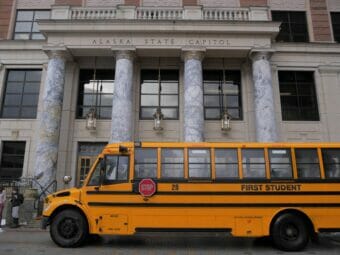
A school bus full of preschoolers, their parents, caregivers and advocates pulled up to the Capitol building on Monday to hand out Valentine’s Day cards to state legislators on Feb. 13, 2023. (Katie Anastas/KTOO)

The Alaska Senate has passed a bill that would increase how much the state funds public schools.

“We’ve had huge inflation spikes, we’ve had school closings across the state being proposed, we’ve had thousands of teacher positions and other school administrator positions unfilled,” Sen. Bill Wielechowski, D-Anchorage, told reporters late Thursday afternoon. “There’s still more work to do, but this is a huge day.”

The bill would increase the base student allocation by $680 starting in July. The amount of per student funding hasn’t increased since 2017, and many teachers and administrators say the $30 increase planned for next year isn’t enough.

Earlier this week, the Senate Finance Committee added two amendments to the bill, one that would increase transportation funding and another that would increase room and board stipends for residential students.

Sen. Shelley Hughes, R-Palmer, introduced several amendments Thursday, though none passed. One would have withheld some of the new funding for underperforming schools unless they improved. Another would have given parents and teachers money if their students did well on certain tests.

Two other amendments addressed school policies for LGBTQ+ students. One would have banned transgender students from single-gender sports teams that match their gender identity. The other would have required written permission from parents before students could take sex education classes, change their names, use different pronouns at school or join clubs related to gender and sexuality – essentially mirroring Gov. Mike Dunleavy’s “parental rights” bill. Both of those amendments were ruled not germane, meaning they were too unrelated to the main bill.

Hughes and Sen. Robert Myers, R-North Pole, introduced amendments that would require 70% of the bill’s funding increase to go to classroom instruction and teacher salaries.

“Ensuring that we have high-quality teachers is one of the best ways to ensure that we’re spending money that actually solves our performance issues, rather than just throwing money at the problem,” Myers said.

Both amendments failed. Sen. Bert Stedman, R-Sitka, said addressing inflation more broadly should be the starting point.

“Regardless if you agree that schools are near perfect or totally dysfunctional, we’ve got to address the funding level,” he said. “This is a stopgap measure.”

Sen. Löki Tobin, D-Anchorage, said districts needed to have the power to spend the money how they see fit. 

“Our schools have fixed costs. They still have to heat the classrooms, they still need to pay for the internet, they need to make sure the lights stay on,” she said. “And as their purchasing power has been eroded due to high inflation, they are experiencing this struggle where they have to balance retaining their teachers or trying to make sure their buildings stay habitable.”

The bill passed in a 16-3 vote, with Hughes, Myers and Sen. David Wilson, R-Anchorage, voting no.

This story has been corrected to reflect that one of the amendments would have reduced the funding boost for underperforming schools unless scores improved.

A Crystal Worl-designed Alaska Airlines plane will make its inaugural flight to Juneau on Friday

Juneau artist Crystal Worl stands in front of an Alaska Airlines Boeing 737-800 named X̱áat Ḵwáani (Salmon People), which bears her design. The airline says it’s “the first aircraft in the history of any domestic airline to be named in an Alaska Native language and to depict the ancestral importance through Northwest Coast formline art.” (Photo by Ingrid Barrentine, courtesy of Alaska Airlines)

An Alaska Airlines plane now features formline art by Juneau artist Crystal Worl.

On Friday, it will make its inaugural flight from Anchorage to Juneau, landing at 9:23 a.m. before continuing on to Sitka, Ketchikan and Seattle.

Worl has imagined designing plane art for years – in 2020, she tagged Alaska Airlines in an Instagram post sharing an idea.


View this post on Instagram


A post shared by Crystal Worl (@crystalworl)

Now her blue, white and pink design — depicting salmon in Northwest Coast formline — completely covers a passenger jet.

“Every time I looked at an Alaska plane, I couldn’t help but visualize the salmon being in formline, or having some sort of design that represents identity,” she told the airline in a press release. “I can’t help but look at things and see how to Indigenize them.”

The plane is named X̱áat Ḵwáani, or Salmon People in Lingít. According to Alaska Airlines, it’s the first time they’ve featured a language besides English on the main door of an aircraft.
A detail on the plane’s wing. (Photo by Ingrid Barrentine, courtesy of Alaska Airlines)

“For me, this plane is confirmation that the art, language and culture that our Ancestors practiced and hoped to pass on to future generations is not only alive and well but is thriving,” Dawn Smith, co-chair of Alaska Airlines’ Native Employee Network, said in a statement. “It is a statement for all Indigenous people that we are still here.”

Earlier this year, Worl designed a stamp for the U.S. Postal Service. She painted the Elizabeth Peratrovich mural in Juneau, and her art appears on a Juneau ambulance. Last year, she replaced an Anchorage mural depicting local history with one featuring a colorful formline nature scene

Alaska Airlines’ Salmon Thirty Salmon II, which flew the Milk Run from Seattle through Southeast Alaska for more than a decade, took its last flight in April.


Juneau School District considers late start on Wednesdays

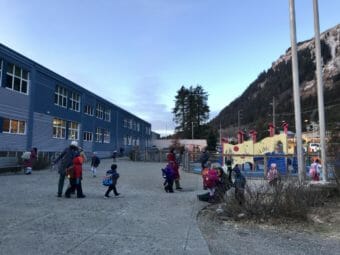
Parents greet their children in front of Harborview Elementary School in Juneau at the end of the school day on Dec. 21, 2022. (Photo by Jennifer Pemberton/KTOO)

Juneau students could start school half an hour later on Wednesdays next school year if the school board approves a proposal by district administrators.

The late start would give teachers more time to work together without students. Administrators say it would help elementary school teachers meet the new requirements of the Alaska Reads Act, which include teacher training, student testing and contact with parents. It would also give middle and high school teachers more training and planning time.

“The research is really clear: we get the best educational outcomes when adults have time together without children,” Superintendent Bridget Weiss said at a school board meeting Tuesday.

The Alaska Reads Act, which goes into effect in July, is meant to improve reading proficiency by third grade. Board President Deedie Sorensen said she recognized the need for more training and prep time, but that many parents and teachers had told her they opposed the late start.

“I know how beneficial it was when I was a teacher and we were implementing new programs in our building, and we had the opportunity to actually think about it and work on it,” she said. “I haven’t heard from one person that thinks a late start is a grand idea.”

Virginia Behrends has four kids in the district. She told the board that putting the late start in the middle of the week would disrupt kids’ sleep schedules.

“Monday’s always hectic. After coming back from a weekend, the kids never want to get up,” she said. “Tuesday you finally get them going, and then Wednesday you’re going to say, ‘You can sleep in five more minutes, 10 more minutes,’ and then we’re going to go back on Thursday and do it again.”

Board member Elizabeth Siddon asked administrators to consider releasing students half an hour early once a week instead. But Ted Wilson, director of teaching and learning support for the district, said an early release could be disruptive to after school activities.

Board member Emil Mackey said either option would be hardest on working parents, who might have to adjust their work schedules and find additional child care. Wilson said the district may need to hire more staff for its child care program, which is already struggling to hire workers amid a citywide shortage.

Other board members asked whether the late start or early release could be reserved for elementary school, since the Alaska Reads Act only adds new requirements for younger grades. Weiss said there aren’t enough school buses to handle different schedules for just one group of schools.

Weiss said she’s seen late start times work in other districts. The key for either option, she said, is to do it every week.

“I’ve been in other districts where we did early release, and it was some weeks to try to minimize the impact,” she said. “It doesn’t last, because nobody can keep track if it’s this week or that week.”

The school board will discuss the proposal again, likely with changes from administrators, at its next meeting on June 13.

Education funding bill heads to full Senate, with boosts to transportation and residential stipends

Juneau preschoolers walked the halls of the Capitol building on Feb. 13, 2023, to hand out Valentine’s Day cards to legislators. (Photo by Katie Anastas/KTOO)

The Senate Finance Committee has advanced a bill that would increase per-student funding for public schools. It now goes to the full Senate for a vote.

On Monday, Sen. Löki Tobin, D-Anchorage, asked the finance committee to support the bill, which would increase the base student allocation by $680 starting in July.

“After 99 days of public testimony, hearings and meetings, it is very clear to us that the Alaska public education system is struggling,” Tobin said. “We need to do something drastic. This bill does just that.”

The Senate Finance Committee added two amendments to the bill.

The first increases monthly room and board stipends for students who attend residential schools. 

The second amendment increases school transportation funding. Ken Alper, a staff member for committee co-chair Sen. Donny Olson, D-Nome, said it would add $8 million in annual transportation funding, an 11% increase from the amount set in 2016.

Tobin said flat funding from the state has caused many school districts to use base student allocation money to help pay for busing. Districts across the state have faced driver shortages and rising fuel costs.

“This will significantly go to help our schools get kids to the classroom,” Tobin told the committee.

The House version of the BSA bill remains in the House Finance Committee. If the Senate passes its bill, it will go to the House, which will likely refer it to the House Finance Committee.

Site notifications
Update notification options
Subscribe to notifications