KBBI - Homer

KBBI is our partner station in Homer. KTOO collaborates with partners across the state to cover important news and to share stories with our audiences.

Study indicates Alaskan gulls carry drug-resistant E. coli

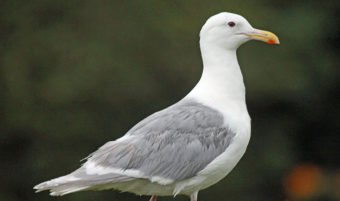
Glaucous-winged Gull in breeding plumage at Seward, Alaska.
Glaucous-winged Gull in breeding plumage at Seward, Alaska. (Wikimedia Commons photo by Dick Daniels)

As antibiotic-resistant superbugs become more common, they’re beginning to show up in places we wouldn’t expect.

A new study has found antibiotic-resistant E. coli in gulls living on the Kenai Peninsula.

There aren’t many people in the world who get excited about gull poop.

But Andy Ramey is one of them. He’s a research geneticist with the USGS Alaska Science Center in Anchorage.

It’s not the gull poop itself that gets Ramey excited. It’s what might be hiding inside. He’s part of a team of researchers studying antibiotic-resistant bacteria in seabirds.

The first thing you have to understand, says Ramey, is that humans put a lot of antibiotics into the environment. Even the simple act of using the bathroom can release antibiotics.

“Most water treatment plants don’t treat for antibiotic residues. So all these residues might end up going through the water treatment system and end up in the environment. So for instance, when you take antibiotics, most of that is probably passed through your system and gets flushed down the toilet,” Ramey explains.

Bacteria in the environment come in contact with these antibiotic residues and slowly become more and more resistant to them.

And where do the gulls come in?

“Gulls really seem to use a lot of habitats with lots of human inputs. We see gulls using places where people are. We see gulls at parks, we see gulls at landfills. We see gulls on the Kenai Peninsula where people are fishing. They’re feeding on the fishing waste,” says Ramey.

Ramey’s team had a hunch: gulls could be picking up antibiotic-resistant E. coli near places with lots of human activity. So they collected gull poop using Q-tips at two “urban” areas in Alaska: near the mouth of the Kenai River and at the Soldotna landfill. To compare, they collected poop samples from an isolated location in Alaska: Middleton Island.

Then they cultured the poop samples in lots and lots of petri dishes.

“The simplest test we did was to culture it and then add little discs with antibiotic residues.  Then we can watch the bacteria grow towards those discs. If the E. coli was susceptible to the antibiotics, what we’d expect is there’d be a little halo around these discs. That is, they aren’t able to grow close to the antibiotic,” says Ramey.

A test for antibiotic resistance. The cloudy film on the petri dish surface are E. coli bacteria and the little white discs contain different antibiotics. If the E. coli are resistant to the antibiotic, they grow right up to the edge of the white disc. If the disc has a little "halo" around it, that means the E. coli are susceptible to the antibiotic.
A test for antibiotic resistance. The cloudy film on the petri dish surface are E. coli bacteria and the little white discs contain different antibiotics. If the E. coli are resistant to the antibiotic, they grow right up to the edge of the white disc. If the disc has a little “halo” around it, that means the E. coli are susceptible to the antibiotic.
(Photo courtesy Jonas Bonnedahl)

The results were astounding.

In the urban locations, like the garbage dump, over half of E. coli in gull poop were resistant to at least one antibiotic. In the remote location away from human populations, just 8 percent of E.coli were drug-resistant.

So in urban environments near humans, gulls are harboring E. coli more resistant to antibiotics.

Ramey is quick to point out that we don’t know if these antibiotic resistant E. coli can be transmitted from gulls to humans. What we do know, he says, is human activity is causing these antibiotic-resistant infections in gulls.

“This shows that our impacts and our inputs into the environment are far-reaching. Antibiotic resistance that we might expect at more normal settings, say in a hospital setting where there are lots of antibiotics being used are now showing up in places that we might not expect, say in the environment,” says Ramey.

Ramey and his colleagues are continuing to investigate antibiotic-resistant bacteria in Alaskan gulls. Recently, they’ve begun tracking satellite-tagged gulls to better understand whether these birds might disperse drug-resistant bacteria around the state.

The study was published this month in the journal Infection Ecology and Epidemiology.

Kenai Borough Assembly overrides mayor’s veto of invocation policy resolution

The Kenai Peninsula Borough Assembly has voted to override Mayor Mike Navarre’s veto of the Assembly’s new invocation policy resolution.

Alaska’s ACLU executive director Joshua Decker said he is disappointed in the Assembly’s action.

“As we wrote in our letter to the Assembly last week, we think this resolution is unconstitutional,” Decker said. “We had hoped that they would do the right thing and go back to the way things used to be in terms of letting anyone who wanted to give invocations to sign up first-come-first-serve. Unfortunately, they chose to double down on a policy that we think is unconstitutional.”

The veto and the subsequent override came at Tuesday evening’s regular Assembly meeting in Soldotna.

American Civil Liberties Union of Alaska sent an attorney who reiterated their concern during the public testimony period.

The policy was enacted by a resolution approved on Oct. 11, which restricts who is allowed to give the invocation, or prayer, that begins each Borough Assembly meeting.

Decker said the ACLU wrote to the Kenai Peninsula Borough Assembly on Oct. 20, warning them their new invocation policy was unconstitutional.

“In our letter to the Borough Assembly we had asked them to let us know what they were going to do and to fix the unconstitutional policy by the end of November, by Monday, November 28,” Decker said. “They have one more Assembly meeting before the end of November and so we hope that they are going to carefully consider our concerns and do the right thing. If not, if going to court is what the constitution requires, then that’s what the constitution requires.”

The policy violates the constitutional rights of equal protection and religious freedom, he said.

ACLU officials told the assembly they had two options: either return to the old policy of allowing anyone to give the invocation or eliminate invocations completely.

The Assembly overrode the veto in a 6-3 vote.

Assembly members Cooper, Willy Dunne and Brandii Holmdahl were the “no” votes.

The next Kenai Peninsula Borough Assembly meeting is scheduled for November 25.

Homer council debates centralized 911 dispatch service

Homer City Council debated the pros and cons of a centralized emergency dispatch service at their Oct. 24 meeting.
The Kenai Peninsula Borough Assembly has proposed consolidating dispatch services with the communities of Homer, Kenai and Seward.

The centralized dispatch facility would be housed in Soldotna.

Homer City Council passed a resolution in a 4-2 vote, authorizing City Manager Katie Koester to either accept or reject the Borough’s proposal for centralized dispatch services.

Council member Heath Smith argued the Council needed more information before making a decision on the issue.

“I think the fear and emotion of it, it makes it really easy to punt the ball on this, because we don’t have all the answers,” Smith said. “I want the answers. To say no right now is to not give it a chance.”

But Council member Catriona Reynolds said the cost-savings of consolidating dispatch services appear to be minimal.

“I haven’t been convinced whether this is a beneficial move forward,” Reynolds said.

Council member Tom Stroozas also pointed out that consolidating dispatch services in a central location could lead to a loss of valuable local information.

“Local knowledge is more than just knowing the local geography and our landmarks,” Stroozas said. “If keeping it here locally saved one life, what kind of money do you attribute to that? You can’t put a price on anybody’s life.”

Homer City Council originally passed a resolution Oct. 24 in a 4-2 vote, authorizing the City Manager to either accept or reject the proposal for centralized dispatch services.

But Council member Donna Aderhold, who voted for the resolution, submitted an official notice of reconsideration on Oct. 25.

Under Homer City Code, a council member who voted on the prevailing side may move to reconsider the council’s action within 48 hours of the original vote.

The resolution will now return to the Homer City Council for discussion on Nov. 21.

Folk school teaches skills in carpentry, gardening and medicine

The Homer Folk School recently opened its doors, offering a variety of hands-on classes in everything from beekeeping to kayak building.

On Oct. 8, the Folk School hosted a lively open house at the Ageya Wilderness Center to give the community a preview of some of the courses offered.

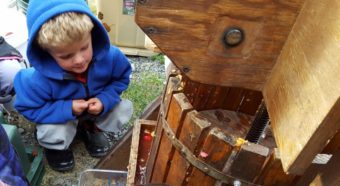
At one of the interactive demonstrations, Neil Wagner stands next to a wooden contraption about three feet tall. It looks a little like a medieval torture device, but it’s actually an apple press. Wagner leads a group of kids as they learn how to make homemade apple juice.

The kids stand on tiptoe and drop apples into a whirring grinder powered by a small motor.

“Just throw ‘em, there you go. Just keep your hands out,” Wagner says, carefully shielding the kids’ fingers from the spinning metal teeth.

Neil Wagner helps local kids grind up apples to make apple juice.
(Photo by Shahla Farzan/KBBI)

The grinder spits the chopped apple pieces into a large wooden bucket. Wagner likes to use a mix of sweet and tart apples to make juice. This year, he has baskets of Cortland, Parkland and American Beauties.

Once the bucket is full of chopped apples, he covers it with a wooden top.

“How are you gonna squeeze the juice out?” a boy asks, eyeing the bucket.

“Well, you’ll see right now,” Wagner answers. He turns a large metal screw by hand, pressing down the wooden top on the chopped apples.

The kids squat near the bottom of the press, watching a plastic tub slowly fill with apple juice. They crowd around the apple press, waiting for a cup of the sweet juice. To Wagner, the sight looks familiar.

“It’s kinda like hornets flyin’ around,” he says, laughing.

Waiting for homemade apple juice.
Waiting for homemade apple juice. (Photo by Shahla Farzan/KBBI)

A few steps away, in a nearby yurt, Maligiaq Padilla explains how to build a kayak by hand.

“When you build a kayak, you want to make sure you have a nice straight grain of the wood,” Padilla explains.

Padilla lives in Anchorage, but he’s originally from Sisimiut, Greenland, an Inuit town 30 miles above the Arctic Circle.

He kneels next to the 17-foot kayak and runs a finger along the curved oak ribs inside. There are 52 wooden ribs, each cut and bent by hand.

“You steam the wood or you soak the wood and steam it for about an hour, then you start bending the ribs,” he says.

Padilla points out the little details that make this kayak special.

“There’s the whale baleen, there’s walrus teeth here and some antlers on the tips to protect the kayak. And this one is a sealskin rawhide,” says Padilla.

Maligiaq Padilla will teach a class on kayak building. This kayak includes a handmade sealskin skirt, walrus teeth, antler and whale baleen.
Maligiaq Padilla will teach a class on kayak building. This kayak includes a handmade sealskin skirt, walrus teeth, antler and whale baleen. Photo by Shahla Farzan/KBBI)

For Folk School Board Member Robin McAllistar, the opportunity to learn about other cultures firsthand is just one of the reasons why folk schools are so valuable.

“There’s a continuum that all humans need in order to have joy, sustenance, sustainability, community and culture. Those are the things that Folk School brings,” McAllistar says.

Having a folk school in Homer just makes sense, she explains.

“It’s perfect for our town and our community, which is so rich with artisans and craftsmen,” McAllistar says.

You don’t have to be a master craftsman to teach a class at the Folk Homer School. At the open house, McAllistar herself led a seed saving class.

“This is called a wet set. I’m going to take just a piece of paper towel and I’m going to spread these seeds on it,” McAllister explains.

There have been several past attempts to get a Folk School up and running in Homer. But this time, it’s here to stay, McAllistar says.

“Homer Folk School is something that’s going to be here for a long time. So hop on and enjoy the ride,” she says.

The Homer Folk School currently offers a variety of classes, including carpentry, winter gardening and wild plant medicine. In the coming months, they plan to add more classes and expand their reach in the community.

ACLU says Kenai’s invocation policy is unconstitutional

The American Civil Liberties Union of Alaska wrote to the Kenai Peninsula Borough Assembly on Oct. 20, warning them their new invocation policy is unconstitutional.

The policy, approved on Oct. 11, restricts who is allowed to give the invocation, or prayer, that begins each Borough Assembly meeting.

ACLU of Alaska executive director Joshua Decker said people who wish to give the invocation must now pass an unconstitutional “five-part religion test.”

“What the Kenai Peninsula Borough Assembly did is set part five discrete requirements that someone has to pass before they’re allowed to give an invocation,” Decker said. “They have to be an appointed representative of a religious association that has an established presence in the Kenai Peninsula Borough, that regularly meets for the primary purpose of sharing a religious perspective.”

These requirements clearly prevent some groups of people from giving the meeting invocation, he said

“This discriminates against people who for example may be members of a church, but their church meets outside Kenai (Peninsula Borough),” Decker said. “It discriminates against people who may belong to a church but it does not regularly meet. And it discriminates against people who may not belong to a church.”

According to the ACLU of Alaska, the new Borough Assembly invocation policy violates constitutional rights of equal protection and religious freedom.

The Assembly has two options: either return to the old policy of allowing anyone to give the invocation or eliminate invocations completely.

“It’s our hope that we do not have to sue, but if that’s what it takes to uphold the Constitution, we’re not going to rule anything out,” Decker said. “We hope though that the Borough Assembly is going to carefully consider the concerns we raised in our letter and that they’re going to do the right thing.”

Because of the legal nature of the issue, Borough Assembly members are not allowed to comment unless the matter is officially raised at an Assembly meeting.

The next meeting of the Kenai Peninsula Borough Assembly is scheduled for Oct. 25.

Nonprofit awarded contract to run Homer animal shelter

Homer City Council awarded a new contract for the City Animal Shelter to the nonprofit Alaska Mindful Paws on Oct. 10.

The group will manage and operate the shelter as part of a two-year contract for $179,150 per year.

Amy Ware will be the new shelter manager as of Jan. 1, 2017. She’s had previous experience rescuing and fostering stray animals, and expects it to be a natural transition.

“I think it will be a smooth transition, but it will definitely be a work in progress,” Ware said. “I just know that come Jan. 1 not every program I want to implement is going to be there, but yeah. It’ll be a change. It’ll be a change right off the bat.”

Ware plans to set up a webpage for the Homer Animal Shelter that will include a list of all animals currently held at the shelter.

She also would like to start a foster care program for animals waiting to be adopted.

Running the shelter as a nonprofit will be the biggest change in its operation, says Ware.

“I think it’s great going in as a nonprofit,” Ware said. “It’ll just open up a lot more opportunities for the shelter as far as writing grants and taking donations.”

She hopes the transition to nonprofit status will help increase community involvement.

“I just encourage the public to come and check it out, and really consider volunteering whether it’s walking dogs, we’d love new foster homes, just to come hang out with the cats; just get community involvement, y’know?” Ware said. “The shelter is run by the city and I just feel like we should all take part and really embrace it.”

Current manager Sherry Bess has run the Homer Animal Shelter for the past 26 years.

Bess chose not to bid on a renewal of the contract.

Site notifications
Update notification options
Subscribe to notifications