KBBI - Homer

KBBI is our partner station in Homer. KTOO collaborates with partners across the state to cover important news and to share stories with our audiences.

Mysterious beak deformities may be caused by virus, researchers say

It’s been almost 20 years since large numbers of birds with unusually long beaks first appeared in Alaska.

The birds, whose beaks grow at twice the normal rate, often die from starvation because they can’t feed themselves. Researchers now believe a virus may be causing the beak deformities.

Homer resident Michael Craig first noticed the bird at his feeder about six years ago. It was a black-capped chickadee, and he knew right away that something wasn’t right.

“I watched it over a period of perhaps three months. I watched the bill growing longer and longer and watched it having more and more trouble getting sunflower seeds,” Craig said.

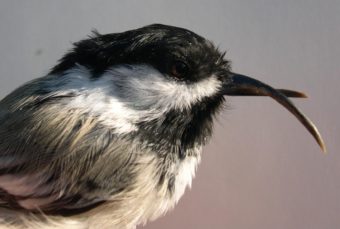
Each day, the chickadee returned to Craig’s bird feeder. As he watched, its beak grew almost two inches long – about four times longer than normal. Over time, it began to look a little scruffy.

“Where normally their feathers are smooth, it was just rough. I mean, it was little feathers sticking up all over the place. And at the time, we had not a clue what was going on,” Craig said.

Normally, beak deformities occur in less than 1 percent of wild birds. But in Alaska, researchers have found so-called “twisted beaks” in over 6 percent of black-capped chickadees and 17 percent of northwestern crows.

Wildlife biologist Colleen Handel works at the USGS Alaska Science Center in Anchorage.

She’s been investigating this issue for nearly 20 years.

Handel says beak deformities can be debilitating for birds, because they can’t pick up seeds or crack them open. Birds with deformed beaks also have trouble grooming themselves.

“Their feathers will get dirty and matted. A lot of them look like they have a mohawk. They just can’t keep their feathers clean. Essentially they lose their little down jacket in the wintertime and they can’t stay warm enough to stay alive,” Handel said.

Handel and her colleagues think they may have finally pinned down the cause of the beak deformities: a virus.

“In 100 percent of the birds with the beak deformities that we tested, 100 percent of those birds had this virus present,” Handel said.

But what virus was it?

Every organism has a unique genetic code – like a fingerprint. To identify the virus, Handel her colleagues used a computer library of known genetic sequences and looked for a match.

“What we found was there was no perfect match for this virus,” Handel said.

Scientists have never seen this particular virus before, but it’s related to a family of viruses that affect ducks, chickens and other domesticated birds.

Handel points out that just because birds with deformed beaks have this virus, we can’t assume it causes the deformity. The next step is to test whether birds experimentally infected with the virus develop beak deformities.

“This new discovery of the virus is the strongest lead we’ve had thus far,” Handel said. “We’re really excited that we’ve actually found the cause, so now the fun begins in terms of designing an experiment to demonstrate whether or not it actually is causing them.”

She’s dedicated years of her career to solving the mystery of beak deformities in Alaska’s birds, but Handel says that’s the just the nature of science.

“It does tell the story of how long sometimes scientific research takes to unfold the answers and part of it is persistence,” Handel said. “Part of it is also technological advances. These techniques that we’re using now for genetic screening, we didn’t have those 20 years ago.”

Her research team isn’t wasting any time. They’re already planning their next study to determine whether the newly-discovered virus causes beak deformities in birds.

If you see a bird with a deformed beak, you can report it online to researchers at the USGS Alaska Science Center.

Coast Guard, troopers search for missing Port Graham man

The U.S. Coast Guard and Alaska State Troopers are searching for a 34-year-old Port Graham man missing since Wednesday.
Ryan Meganack was last seen leaving Port Graham about 2 p.m. in an 18-foot skiff heading toward Passage Island.

A number of search parties are looking for Meganack,

said U.S. Coast Guard spokesperson Bill Colclough.

“The Coast Guard, the Alaska State Troopers, a NOAA research vessel, the Village of Port Graham and several good Samaritan vessels conducted an extensive search area that encompasses approximately 15 miles by 11 miles from English Bay to Cook Inlet,” Colclough said.

Alaska State Troopers are currently searching the surface waters using the P/V Augustine. Search parties combed the shoreline from the village of Port Graham to Nanwalek using flashlights Wednesday.

A good Samaritan vessel found Meganack’s skiff near the southeast side of Passage Island. It was swamped, with the keys in the ignition and debris in the water.

Colclough said the search conditions have been challenging.

“It’s currently snowing,” he said. “This afternoon, conditions on scene were about one to two foot seas and winds of about 23 miles per hour.”

Anyone with information about Meganack’s whereabouts is asked to contact the U.S. Coast Guard’s Anchorage Command Center at 907-428-4100.

Orca ‘swims again’ thanks to Homer skeleton builders

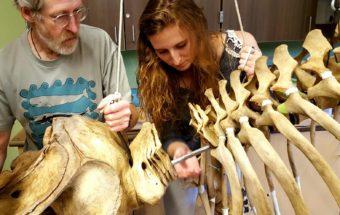
Instructor Lee Post and student Jamie Knaub slide a baby orca skull into place as the undergo the arduous task of reassembling the skeleton. (Photo by Shahla Farzan/KBBI)

Knowing how to assemble a whale skeleton is a rare skill.

For a small group of students at Kachemak Bay Campus of Kenai Peninsula College in Homer, rebuilding skeletons is all in a day’s work.

This fall, they assembled a baby orca skeleton as part of an eight-week class.

It looks like an amateur archeology dig, but with one key difference: they’re digging up a baby orca whale.

The discolored bones peeking through the dirt look like they’ve seen better days. But don’t hold it against them; they’ve been buried for two years.

The orca washed up dead in July 2014 in Bear Cove, near the head of Kachemak Bay.

After a necropsy was performed, a team of volunteers removed the organs and blubber. Then they laid the carcass inside the raised garden bed and covered it with 4 feet of fresh horse manure.

Over time, the microbes in the manure slowly ate away the whale flesh, leaving only the bones and a pile of rich compost.

Lee Post, also known as the Boneman, is a self-taught skeleton builder and the instructor leading the course.

Post leans over the garden bed, examining the newly-exposed jaw bone.

“Believe it or not, this is state of the art for cleaning whale skeletons in America right now,” Post said. “This is exciting stuff for us bone nerds!”

Small whale bones look just like rocks, especially when they’ve been buried for two years.

Student Jamie Knaub demonstrates one way to tell the difference.

“You actually tap it against your tooth. The rock feels like metal and the bone is more of like a plastic-y feel,” Knaub said.

Knaub is one of two students helping to prep the bones before the class starts. She said rebuilding a skeleton is a hands-on way to understand what makes an animal go.

“There’s no better way to learn anatomy than touching it yourself. It’s a puzzle,” she said.

Once they’ve finished digging up the bones, the students dip them in soapy water and scrub them with bristle brushes.

Next the bones take a bath in a 25-gallon tub of hydrogen peroxide. The frothy brown liquid pops and bubbles, as they slowly whiten.

After nearly a month of excavating, cleaning and bleaching the bones, the students are ready to get down to business. On the first day of class, the 12 students divide into teams, each in charge of one skeleton section. There’s a rib team, a flipper team and even a skull team.

The students quickly discover that some bones are missing. Because this was a baby orca, some of its bones were made of a temporary cartilage that rotted away after it died.

Alayna Hawkins is on the flipper crew. They’re missing almost 30 flipper bones, which they’ll have to build out of water putty.

Hawkins uses dental tools to add texture to the fake bones. The secret, she said, is to make sure they don’t look too perfect.

“When I was first doing it, I was so careful about it, like placing this dot here and this dot here,” Hawkins said. “Now I just do it random wherever and not care if it looks pristine and perfect.”

Building fake bones isn’t the only challenge.

When this whale was alive, its bones were held together with tendons and cartilage. As a substitute, the students use a sturdy metal rod as the backbone of the skeleton.

Knaub, who is on the spine crew, drills holes through each vertebra and threads them onto the metal rod, like beads on a string.

The sound of drilling through bone doesn’t bother her. It’s the smell.

“It’s kind of like a musky, burning flesh smell,” Knaub said.

Post erects a 12-foot long wooden frame in the classroom. Using rope, the students hang the spine from the frame and gradually add each section of the whale.

Post flits from group to group, trying to supervise the entire process.

One of the most important steps is making sure the ribs are symmetrical.

Imagine a picket fence where the pickets are all over the place. “It just wouldn’t look right,” Post said.

Finally, it’s time for the last piece: the skull. Everyone holds their breath as Knaub and Post struggle to slide the skull into place.

For Knaub, who has been involved in the entire process, it’s a proud moment.

“It’s not just an object. This was an animal. This had a life, it had a spirit. It swam in our waters,” Knaub said “It’s cool to put it back together, because you feel like it’s alive again.”

This is the third class Post has taught. For years, assembling skeletons was a solitary activity for him.

Working with students brings back some of the old excitement he felt when he was first learning.

“Now the thrill is having enthusiastic people who thought they could never touch something like this because they weren’t museum Ph.D’s or something,” Post said. My cheap thrills is doing it through their eyes again.”

The class is finished, but Post isn’t resting on his laurels. For him, there’s always another skeleton waiting to be assembled.

Tuesday morning fire destroys mobile home in Homer

An early Tuesday morning fire destroyed a mobile home on Kent Street, just across the street from the Homer Golf Course on East End Road, Homer.
The fire occurred outside of the Homer Volunteer Fire Department’s response area, according to Fire Chief Bob Painter.

Kachemak Emergency Services is responsible for the area and requested back-up from the Homer Fire Department, Painter said.

“They requested mutual aid, a tanker and personnel,” he said. “We responded with a tanker, a chief vehicle and seven personnel.”

The fire department responded to the fire just after 3:30 a.m. The mobile home was completely engulfed in flames, Painter said, but all occupants were safely evacuated.

“Basically, the entire structure was on fire. When we got there, we heard there was an all-clear, which means that nobody was in the structure,”  Painter said.

Homer Fire Department personnel left the scene just before 7 a.m., Painter said.

No injuries were reported.

The cause has not yet been determined.

Kenaitze tribe promotes traditional values through moose camp

Kenaitze Indian Tribe in Kenai is taking an innovative approach to drug, alcohol and tobacco prevention. In addition to more overt prevention efforts, like signs and education, the tribe offers culturally-relevant healthy activities through their Yaghanen Youth Center, located in Soldotna, including a moose camp in the fall for young men.

Yuzhun Evanoff carefully strips the outside layer off a large, burgundy leg of moose.

“This meat was hung — it develops a crust on it. So right now we are stripping it off so we can butcher this meat and give it to our elders,” said Evanoff.

Evanaff is Dena’ina from Nondalton near Lake Clark. He grew up in Soldotna and now works as a youth advocate for the Kenaitze Indian Tribe’s Yaghanen Youth Center in Soldotna.

A few weekends ago, the group of young men had a successful hunt on the Kenai through the center.

Evanoff shows 15-year-old Wally James how to peel a piece of white tendon off the meat.

James is a freshman at Kenai Central High School. Yup’ik and originally from Russian Mission, he moved to Kenai last year. He has been moose hunting before.

“It reminds me of when I go hunting and fishing in my hometown with my sister and family,” said James.

Standing in the large warehouse-like building surrounded by seven young men butchering meat at four tables, Yaghanen Youth Center administrator Michael Bernard said it’s not just about putting food in the freezer.

“The concept is that we are providing a safe, positive atmosphere where young people can come and learn that it is OK to be substance free,” said Bernard.

Yaghanen is a prevention and early intervention organization that provides a safe environment for youth.

The harvest and processing of the moose, Leonard said, is also a way to convey critical, traditional values to young men.

“The activities that we do have a cultural relevance to them. We are touching on several if not many of the cultural values, the hard work, sharing, teamwork and providing for our elders,” said Leonard.

Moose is a traditional food for Kenaitze Indians. The camp is free and open to all young men in the community — Native and non-Native alike.

The young men receive training on gun safety, knife-handling, butchering and food handling. They also learned about moose natural history and how to build survival shelters.

Bernard said they try to schedule the camps during school vacations and are working with the Kenai Peninsula Borough School District to allow students to earn elective credit for attending the camps.

Gideon Collver is a junior at Soldotna High School. The 16-year-old is not Alaska Native and said he had never gone moose hunting before. He said the best part was being in the woods and learning about respect for the animal.

“Kind of an inward respect. Treating it with respect. We were all fairly silent when we got it. Seeing that it had given its life so that we could have food. It gave me more respect for the Dena’ina and how their survival depended on something else’s death,” said Collver.

Kenaitze tribal member Sandy Wilson is a Youth Advocate at the Yaghanen Youth Center. She said the camp is also about building pride and confidence.

“Teaching our culture makes them proud of who they are and teaches them where they come from and so when we teach our culture it gives them a sense of pride,” said Wilson.

Wilson is also the mother of several children involved in programs at the youth center.

Her oldest son, 23-year-old Jonathan Wilson, started attending activities at the youth center when he was in sixth grade. Now he’s a mentor in the program.

“I’m the oldest of eight and all of them are coming up through this program, so it is kind of something for me to watch them grow,” said Wilson.

In Kenai at the tribe’s senior center, the young men deliver the meat to elders.

Kathleen Zaukar, originally from Sleetmute, has lived Kenai for several years. She said she does not have any moose meat in the freezer this year and she is happy to have some freshly delivered from the young men.

“I got me a kidney,” said Zaukar.

A delicacy that Zaukar said she will eat fried.

“And it’s great that they teach them how to do that. Because that’s our culture, and if we don’t have our culture anymore then we don’t got nothing,” said Zaukar.

Next time, Zaukar said she’s putting in a request for moose ribs. Her favorite.

In addition to the moose camp, Yaghanen Youth Center hosts a fish camp, an archeology camp, a science camp and a construction camp. They also have after school programs that prepare students for Native Youth Olympics and that teach archery, Native dance, and drumming. All the camps and programs are open to Native and non-Native students alike.

Latest effort to revise Kenai Peninsula Borough Assembly invocation policy stalls

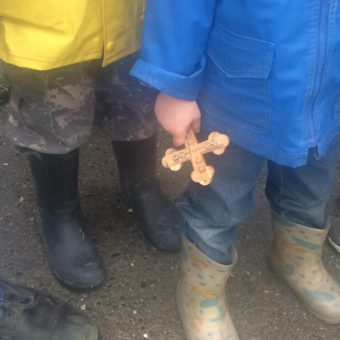
Some children took part in the Aug. 23, 2016, protest with their parents. (Photo by Daysha Eaton/KBBI)
Some children took part in an Aug. 23, 2016, protest of the Kenai Peninsula Borough Assembly’s invocation policies with their parents. (Photo by Daysha Eaton/KBBI)

For the past four months, the Kenai Peninsula Borough Assembly has debated whether it should restrict who is allowed to give the invocation, or prayer, that begins each meeting.

The controversy began in early August, when a member of the Satanic Temple gave the invocation. In response, the borough assembly instituted a new policy in which only people or associations on a pre-approved list may give the invocation.

Critics say this restrictive policy may put the Borough at risk of a lawsuit, but efforts to amend it have stalled.

According to a memo released from Borough Mayor Mike Navarre’s office on Nov. 9, the assembly has received “numerous comments challenging the legality” of the invocation policy.

Borough Assembly President Kelly Cooper and assembly member Dale Bagley introduced a resolution on Nov. 22 that would have amended the current policy.

In a statement to the borough assembly, Cooper argued that they should not restrict who is allowed to give the invocation.

“In my opinion, the policy we now have has many problems. The very notion that any belief system would want to exclude another belief is beyond me. We represent every single person in this Borough,” said Cooper.

For nearly an hour, the assembly heard public testimony on the resolution.

Nancy Hendrickson of Kenai expressed frustration about the amount of time the assembly has spent debating the invocation issue.

“That you would even consider spending any more time or money on this issue troubles me. Each of you has a responsibility to uphold the Constitution. I’m charging you with that responsibility this night,” said Hendrickson.

Sterling resident Peggy Peterson asked the assembly to reconsider the idea of replacing the invocation with a moment of silence.

“Having a moment of silence does not prohibit free exercise of religion. Every person here would be free to pray as they saw fit. That would not only protect religious freedom, it would avoid alienating members of the community. An added bonus? It doesn’t violate the Constitution,” said Peterson.

Eric Glatt, staff attorney for the ACLU of Alaska reiterated that the borough should not control who is allowed to give the invocation.

“Tests that control which members of the public may offer invocations before assembly meetings violate core constitutional principles. The ACLU believes the best policy is the simplest policy. Return to the successful practice of allowing anyone in the borough to give an invocation on a first come, first served basis or do without invocations altogether,” said Glatt.

After some debate, the assembly approved an amended version of the resolution in a 5-4 vote, which would have eliminated the invocation policy altogether. Assembly members Blaine Gilman, Wayne Ogle, Dale Bagley and Stan Welles voted against the amended resolution.

But as the meeting came to a close, Gilman gave notice of reconsideration. This temporarily halts any action on the issue and returns the assembly to the current invocation policy.

Any assembly nember can give notice of reconsideration unless a resolution passes by supermajority.

The Kenai Peninsula Borough Assembly now has the option to reconsider the resolution at its next meeting Dec. 6.

Site notifications
Update notification options
Subscribe to notifications