KBBI - Homer

KBBI is our partner station in Homer. KTOO collaborates with partners across the state to cover important news and to share stories with our audiences.

Mushroom hunting brings risks and rewards

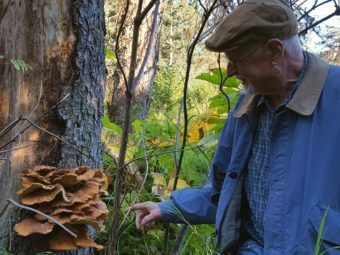
In Alaska, passion for hunting runs deep. For many, the thrill of hunting big game is second to none. But there’s another group of hunters in Alaska tracking a different kind of prey: mushrooms.

Neil McArthur has one rule when he’s mushroom hunting.

“When in doubt, move on,” he said.

McArthur would know. He’s been hunting mushrooms in Homer for 25 years.

This year, he published “Alaska’s Mushrooms: A Wide-Ranging Guide,” along with University of Fairbanks Professor Gary Laursen.

Mushroom hunting can be a dangerous business, McArthur said.

Some mushrooms, like the infamous Amanitas, are lethal to humans.

“Some of the amanitas are extremely toxic. They’re reputed to taste wonderful,” he said. “The only thing is that three days later you need a liver transplant.”

One of the challenges with identifying mushrooms is that their appearance changes dramatically as they age.

When it first pops out of the ground, an immature mushroom often looks like something you might find in a grocery store: a little button.

At this stage, it’s easy to confuse an edible species with a poisonous one.

“The gill structure isn’t really visible, the gill color isn’t really visible. They tend to be white and small and rolled up in a button,” McArthur said.

The sheer number of mushroom species can also make identification difficult. There are about 70,000 species of fungi worldwide.

In Alaska alone, there are thousands of mushroom species.

A mushroom hunter’s first question is usually “Can I eat it?”

Unfortunately, many of the species in Alaska are inedible.

With names like dung dome and belted slimy cort, it’s not hard to imagine why.

On a crisp fall day in September, McArthur leads a small group of amateur mushroom hunters on a collecting trip near the Homer Airport.

The group fans out across the forest, eyes glued to the ground.

A thick layer of cushy sphagnum moss carpets the forest floor.

One hunter spots a mushroom peeking out from behind a log.

McArthur tells her not to bother picking it.

“Is this fungus poisonous? No, but it has the texture of a hardwood plank, I don’t think you want to eat it!”

But mushroom collector Pat Esperanto isn’t deterred.

He’s holding out hope that he might find his favorite mushroom, the King Bolete, also known as the porcini.

“They’re wonderful. They taste delicious, they taste like steaks. They’re just phenomenal,” Esperanto said.

McArthur spots a patch of mushrooms that looks promising.

He sloshes through a puddle and crawls under the low hanging branches of a spruce tree to take a closer look.

“This is a relation of the grocery store mushroom. It’s usually edible,” McArthur said.

“Okay, you go first,” quips one mushroom collector.

“Well, I made an omelet out of a couple of ‘em that I found in my driveway last week,” said McArthur, laughing.

It’s a patch of horse mushrooms, Agaricus arvensis.

None of them are poisonous, but only one of the mushrooms in the patch is edible.

McArthur cuts open the other two to show why you probably wouldn’t want to eat them.

“See the little tiny holes? They’ve probably gone clear up through and into the cap. I’m sure the maggots are edible, but they’re not really appealing,” McArthur said.

The hunters find dozens of mushrooms in the forest, but not many of them are edible.

Most leave empty-handed.

But McArthur isn’t disappointed.

For him, mushroom hunting is really just an excuse to spend time enjoying the great outdoors.

“Even when you’re finding no mushrooms you get a nice walk in the woods,” McArthur said.

The mushroom hunting season is nearly over for the year, but McArthur says there’s still a chance to find edible mushrooms before the first hard frost.

City of Seldovia hires new police chief

The city of Seldovia has hired Robin Daniels as new chief of police.

Daniels is the current Chief of Police in Louisville, Alabama. In addition to his experience working in law enforcement, Daniels also worked as a civilian contractor in Iraq for two years.

Seldovia City Manager Tod Larson was part of a three-person hiring committee that reviewed seven applicants before selecting Daniels for the position.

Larson says that he was specifically looking for a new police chief who would be comfortable living in a remote location.

“When I’m looking for someone in a rural Alaska, they really need to want to be here. It is a little bit inconvenient being off the road network,” Larson said.

Daniels was a stand-out candidate, particularly because of his dedication to community involvement, Larson said.

“He’s really impressed me with how he wants to spend time getting to know people themselves and getting around to different events in the community,” he said. “As opposed to sitting in his patrol car and pulling people over, he wants to go get among the people.”

The position has been open since April, when former Seldovia Police Chief Hal Henning took a new position in Washington State.

Chief Daniels will be arriving in Seldovia in mid-November.

Homer voters elect new mayor and councilmembers, reject new police station

Homer has a new mayor and two new city council members, according to unofficial Homer municipal election results, but voters rejected Proposition 1, saying no to a new police station.

Homer City Council Member Bryan Zak won the mayoral race, defeating fellow City Council Member David Lewis by just 74 votes.

Zak spent Tuesday afternoon waving an election sign with his supporters in front of WKFL Park in Homer.

“I never quit campaigning. I never quit running the race, right up until the end,” said Zak.

Zak says he’s ready to serve as Homer City Mayor.

“Already this morning, I called over to City Hall and talked to the City Manager and let her know that I’m in it with her and with the city council, building a team as we move forward together,” Zak said.


Voters formed long lines Tuesday evening while waiting at Cowles Council Chambers to cast their ballots.

Voter turnout was 32 percent in this year’s municipal election, which is higher than the average turnout for the past four years, which was about 26 percent.

Shelly Erickson and Tom Stroozas were elected to Homer City Council.

Erickson received 922 votes, while Stroozas took 639 votes. Candidate Kimberly Ketter came in third with 181 votes.

Newly elected City Council Member Erickson said she’s already thinking more about the issues before the council, especially finances.

“The first thing that’s going to be in our face is going to be the budget. That’s probably going to be our first priority,” Erickson said.

Stroozas will be looking for ways to increase the efficiency of city services As a member of the City Council, he said.

“The main focus is to make sure that the city is doing everything the city needs to do in an efficient and cost-effective manner,” Stroozas said. “All I can say is that I will do my very very best and give 110 percent or more to do the job as it needs to be done.”

Perhaps one of the most controversial aspects of this year’s municipal election was Homer Ballot Proposition 1.

Voters narrowly rejected Prop 1, with 53 percent voting no.

The bond proposition would have authorized the city to borrow up to $12 million dollars to build a new police station in Homer, financed by a six-month seasonal sales tax.

The Canvass Board will meet Friday, Oct., to count approximately 300 questioned, special needs and absentee ballots.

It’s possible the outcome of the mayoral race and Homer Ballot Proposition 1 may change after these votes are counted, Homer City Clerk Jo Johnson said.

The election will be certified on October 10 at the regular Homer City Council meeting, where the new mayor and city council members are scheduled to be sworn in.

Editor’s note: On October 4, KBBI incorrectly reported that candidate Tom Stroozas did not have sufficient votes to be elected to Homer City Council. According to Homer City Code, a candidate must receive at least 40 percent of the vote in order to be elected, which translates to 356 votes based on this year’s voter turnout. Stroozas received 639 votes.

New iPads allow Port Graham students to explore and engage with culture

Students at Port Graham School test out their new iPads with teacher Devin Michel-Way. (Photo by Shahla Farzan/KBBI)

For students and teachers in the tiny Alaska Native community of Port Graham, this school year promises to be very different.
That’s because each of the school’s 36 students will now have an iPad to use during class as part of a program to improve the curriculum and help students become better connected with their own Native culture.

Nancy Kleine, the principal of the school in Port Graham and Nanwalek. is passionate about bringing technology to the classroom.

Last year, Kleine headed up an effort to bring iPads to 80 students at Nanwalek School.

The iPads can help improve instruction and train kids how to be technologically savvy, she said.

“We’re all kind of running toward the same goal of deepening instruction and really allowing these kids in remote villages to have some of the same opportunities with technology that other kids have enjoyed for a lot of years”

Funding for the iPads was provided through a combination of grants from Chugach Alaska and Port Graham Corporations, as well as rollover funding the school had saved from last year.

The total cost of the iPads was about $17,500.

Kleine said that in this isolated village, technology allows kids to be more engaged with the outside world, but she also points out that it offers ways to share and preserve Native culture.

“Kids can take videos of some of the traditional plants that they’ve learned about and preserve some of that knowledge,” she said. “Some of the language, some of the old photos that are in books. It’s just wide open.”

Devin Michel-Way teaches kindergarten-through-fourth grade at Port Graham School. In the classroom next door, her husband Colby Way, teaches fifth-through-12th grade.

Michel-Way described how she’s incorporating technology into her curriculum.

Improving reading fluency is an important goal for her.

“The students do a lot of reading comprehension and reading fluency, where they’ll read directly to the iPad, record themselves,” she said. “They’ll be able to hear where they’re making mistakes, they’ll be able to fix it and get better.”

Technology is also a great way to keep kids engaged, she said.

“Since we’re fighting with screens all the time as teachers now, this is a way for them to learn that screens are not just for playing games, not just for watching YouTube, not just for Facebook,” she said. “They’re for educational purposes and they can be used for betterment.”

But using iPads in the classroom takes a lot of logistical planning. Michel-Way passes out a “contract” to each student, detailing what they can and cannot do with their iPads.

“Should you bring the iPad into the bathroom? How about the gym?” she asks.

The classroom is abuzz with excitement as the students set up their iPads.

It’s not long before they’re tapping away at the screens, exploring and learning how to use them.

Homer residents question association deregulation

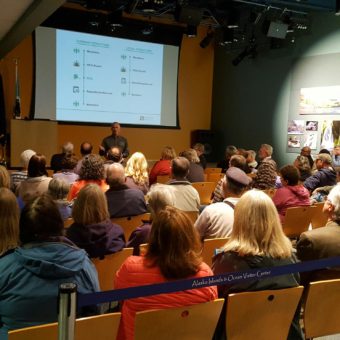
Homer Electric Asssociation holds an informational meeting in Homer on September 28, 2016. (Photo by Shahla Farzan/KBBI)

Homer Electric Association held an informational meeting on September 28 to answer questions about the upcoming vote on deregulation.

The meeting, which was held at Islands and Ocean Visitor Center, attracted more than 100 people. The overwhelming majority were HEA customers who expressed concerns about the consequences of deregulation.
Some Homer residents, like Melanie Meeker, are worried about the potential for drastic rate increases.

“I did talk to one board of director a few days ago and one of his comments was that the regulatory commission fee on our bills would disappear,” Meeker said. “I went and pulled my bills and on this particular bill, the regulatory cost charge is 17 cents. My argument to that would be, I would much rather pay 17 cents than a $20 per month increase.”

HEA claims that more local control could reduce regulatory operating costs.

Officials at the Wednesday meeting acknowledged that customers would probably not see a rate decrease.

Under local control, HEA would operate without oversight from the Regulatory Commission of Alaska, or RCA.

Homer resident Mike O’Meara said members would have fewer options for appealing HEA board decisions if the cooperative is deregulated.

“RCA acts as an intermediate source of appeal presently. Whereas under deregulation, the only appeal you’ll have beyond the board is to go to Superior Court,” O’Meara said.

HEA is the only power provider for much of the Kenai Peninsula, with about 23,000 members.

Ballots for the deregulation vote will be mailed to HEA customers in October.

The final results will be released in December.

Citizen scientists track crane population on southern Kenai Peninsula

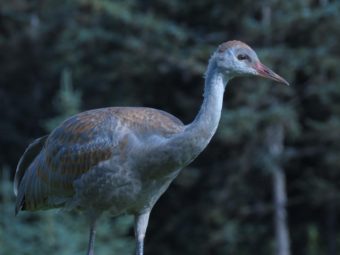
Lesser sandhill cranes in Homer, Alaska. (Photo courtesy of Nina Faust)
Lesser sandhill cranes in Homer, Alaska. (Photo courtesy of Nina Faust/Kachemak Crane Watch)

A sandhill crane looks and sounds like a modern day dinosaur.

They stand about 3 feet tall and have a 6-foot wing span.

They use their sharp 4-inch beak for probing in the dirt and catching insects and small mammals. And sometimes, they use that long beak for defense.

“That beak is a very very lethal weapon,” said Nina Faust, co-founder of Kachemak Crane Watch, a non-profit organization dedicated to the conservation of sandhill cranes.

“I think they’re very majestic birds,” Faust said. “A lot of people describe them as regal, they move like royalty and they’re just very elegant. When they dance, it’s just the most gorgeous thing you’ve ever seen.”

A flock of 20 lesser sandhill cranes forages in a grassy field at Inspiration Ridge Preserve in Homer.

Faust points to a group of three cranes standing close together.

“You can see a family right there,” she said. “The adults have red on the top and they have a yellow eye. The young are totally golden colored with no red top and a dark eye.”

They’re getting ready to migrate 2,400 miles to their overwintering grounds in Sacramento, California. But before the cranes leave in mid-September, Faust has a job to do.

Every fall, she organizes a “citizen science” survey of the crane population on the southern Kenai Peninsula.

On three specific days, residents contact her to report sandhill crane sightings. Using this information, she’s able to estimate how big the population is each year.

Habitat loss and predation can have a big effect on the crane population, Faust said. Around Kachemak Bay, bald eagles are a constant threat.

“It’s interesting to watch because sometimes they’ll see the eagle way off in the distance and they’ll start giving this little brrr growling call. Everybody stands up and looks and they all get ready. If it gets closer, poof, they’re gone!” Faust said, laughing.

A large-scale die-off of Common Murre seabirds in early summer attracted bald eagles to the Homer area. Many of the eagles appear to have stayed behind and are now preying on other animals, including cranes, Faust said.

Another potential hazard? Humans.

“You almost never see them on roads,” she said. “But this year, there’s been a problem because someone who lives on a busy road started feeding them. And they’ve been starting to walk all over the neighborhood. I’ve had people stopping me in the post office, calling me on the phone, saying what’s with the cranes marching down the middle of the road in Homer?”

Cranes strolling in downtown areas risk getting hit by cars. They can also fly into power lines.

“I mean, my gosh. They get panicked and they can fly right into ‘em,” she said.” It breaks their wings, it can rip their beaks off. Just a horrible death.”

Despite these threats, this year’s survey showed that the lesser sandhill crane population in Homer is holding steady at about 200 individuals.

The population produced 47 babies this year, but only 30 survived to the end of the nesting season. That’s about normal.

In early September, the sandhill cranes left Homer and headed back to California’s Central Valley.

Faust and her fellow “craniacs” watched the last cranes depart for the year, a time that always feels bittersweet.

“It leaves a big hole in your heart,” she said.

In California, Bart McDermott eagerly awaits the arrival of the cranes. He manages Stone Lakes National Wildlife Refuge, just south of Sacramento. The cranes start arriving in early October, he said.

“You start to hear them first. If you’re fortunate enough, you can hear their prehistoric sounding cackle,” McDermott said.

The cranes roost in wetlands at night and go out into neighboring agricultural fields during the day to forage for grain. But the cranes are facing a growing list of threats in the Sacramento area, McDermott said.

“Unfortunately there’s a lot of urban development. So we’ve seen a lot of these fields that cranes typically go out and forage in start to be converted into housing developments ,” he says.

The ongoing drought in California also poses a risk to cranes.

“In order to have a wetland you need water,” McDermott said. “And you need a lot of water. The birds also rely on the farmers having water to grow those crops. There’s also concerns of wildlife diseases. You get smaller areas where you have higher concentrations of birds roosting in water and there’s the risk of disease communication and outbreaks.”

The cranes will remain in California through the winter, before heading north in late February.

For now, craniacs in Homer will have to wait until spring before these graceful giants return to nest.

Site notifications
Update notification options
Subscribe to notifications