KBBI is our partner station in Homer. KTOO collaborates with partners across the state to cover important news and to share stories with our audiences.
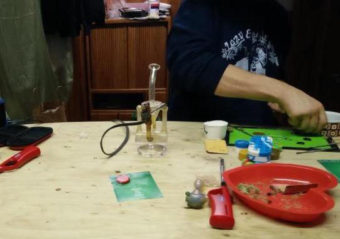
An image from inside the cannabis club that was open in Homer earlier this year. (Photo by Quinton Chandler/KBBI)
In Homer, cannabis club members are reacting to the opinion issued by Alaska Attorney General Jahna Lindemuth on Wednesday, which said that private clubs that allow people to consume marijuana in exchange for a fee are illegal. They say the are looking forward to a legal battle.
Besides clubs being illegal, the Attorney General says that offering marijuana samples to paying patrons may violate state criminal law that bars distributing marijuana without a valid commercial license.
A cannabis social club existed for two months in Homer earlier this
year, founding member Lindianne Sarno says she would like to see the issue
go to court with arguments on both sides.
She says that Homer club members were just following their First Amendment right to assemble, and they shouldn’t be treated any differently than people going to other private clubs.
“When we passed the ballot initiative the title of the initiative was to tax and regulate marijuana like alcohol and so we saw ourselves, our club, as really no different from the VFW. They freely assembly, they have a club, it’s a private club, you can’t get into it unless you are a member – but they serve alcohol and we serve cannabis. So in very many ways we are being discriminated against,” said Sarno.
Timothy Clark, who also helped start Homer’s cannabis club, agrees and says cannabis clubs are key for integrating responsible use of the pot into communities.
“To me it is a bit of an outrage. I am on the cannabis advisory commission for Homer. I’m doing everything I can to try to help these laws come through in a responsible way. I would like to see it kept out of teenagers and children’s hands. I want to prove that this can be done responsibly. And I think that all of the clubs did prove that we can do this responsibly without harming people,” said Clark.
Another founding member of Homer’s club, Scott Owens, says he believes the Attorney General’s opinion will be challenged in court because voters like him expected marijuana to be treated just like alcohol.
“We’ve all voted it legal, as alcohol. If I drank, I would go to a bar and have a beer and socialize and hang out with my friends. And if I smoked, I would go to a cannabis club and hang out with people who smoke cannabis because I do not want to be around people who drink. You know, why can’t we have both?” said Owens.
Members say they hope to eventually bring the club back to Homer once the issue is worked out in court.
The city of Homer has received a Staffing for Adequate Fire and Emergency Response, or SAFER, grant through Homeland Security for an assistant fire chief at the Homer Volunteer Fire Department.
The goal SAFER grants is to enhance the ability of recipients to attain and maintain 24-hour fire department staffing, and to assure that their communities have adequate protection from fire and fire-related hazards.
This is a two-year grant that fully funds an assistant chief position, something that has been unheard of for many years because of budget constraints.
The grant first has to be officially accepted by the Homer City Council, which will take two meetings.
At a recent Homer City Council meeting the council unanimously approved an ordinance that updates city code related to domestic animals.

The change is based on recommendations from the Sustainable Animal Control Review Committee.
The ordinance came to the assembly from the city manager and the police chief.
It revised code and adjusted fees and fines associated with the animal shelter, made modifications related to kennels and redefined an animal at-large, among other things.
Council member Donna Aderhold introduced an amendment to the ordinance that changed the tethering requirement for dogs and other animals in vehicles.
“The ordinance that came to us, specifically stated that animals needed to be tethered in the back of a vehicle through cross-tethering,” Aderhold said. “I suggested an amendment to that to make it a little bit more lenient. So that animals would remain completely within the back of a vehicle.”
One of Aderhold’s suggestions was to add the phrase “in a humane manner” to the ordinance, when speaking of preventing the animal from falling, jumping or being thrown from vehicles.
By humane manner, Aderhold means in a way that retains the animal’s front and hind legs within the vehicle, without harming the animal itself.
The ordinance makes it illegal to let an animal move about freely in the bed of a vehicle, or within the vehicle causing a distraction to the driver – for example having a dog sitting in a lap of a driver.
At the Aug. 22 regular Homer City Council meeting, Council Member Heath Smith said he was torn about the ordinance.
“I understand the concern, but I also understand ‘where do we draw the line on what we’re going to legislate and regulate?’” Smith said. “So anyway, I just would caution us not to over regulate in areas that maybe we don’t have any business regulating. And on the other hand, how is this going to get enforced?”
Law enforcement officers will enforce the code.
No one testified in a public hearing on the ordinance.
One resident submitted letters about it.
Aderhold believes that the leash requirement is what people will notice most from the new ordinance.
If your dog or other domesticated animal is not on your property, then it must now be on a leash, she said.
Fines for animals at large now range from $50 to $200.
If a law enforcement officer finds that your dog or other domesticated animal is loose in the back of your vehicle or interfering with your ability to operate the vehicle, then the fine per incident is now $75.
Some children took part in the Aug. 23, 2016, protest with their parents. (Photo by Daysha Eaton/KBBI)
Invocations, or prayers, will continue to be said at the beginning of Kenai Peninsula Borough Assembly meetings, despite recent debate about whether they are appropriate.
The Assembly voted at their regular meeting Tuesday not to introduce an ordinance that would have eliminated the invocation and another that would have changed the invocation to a moment of silence.
Both the ordinance that would have done away with the invocation and the one that would have replaced it with a moment of silence failed to advance to introduction after a 4-4 votes.
But that was only after impassioned testimony from deeply divided residents.
Religious leaders testified like Dr. Keith Hamilton, the president of a local Christian College, who spoke in support of keeping the invocation.
He said that a moment of silence would be just filling in time.
“A moment of silence is an uneasy and somewhat distracting and awkward time,” Hamilton said. “No one really knows what to do at that time. I always pray quietly but there is a pervasive uneasiness that always fill(s) in the room.”
Earlier this month an invocation by a member of the Satanic Temple was offered before the Assembly sparking a protest and a counter-protest.
Some residents have said that prayer at a public meeting is inappropriate and that the invocation, as practiced, seems exclusionary to non-Judeo-Christian faiths.
Many want it eliminated or a moment of silence instituted.
Others, such as Christians, say it must stay, but most do not want faith leaders from other religions to be allowed to participate.
Velvet Danielson of Soldotna is one of them.
She cited a Peninsula Clarion newspaper poll that said that the majority of local people surveyed preferred Christian prayer.
“The majority, 64 percent are not in favor of a non-Christian prayer, which I am definitely not either,” Danielson said. “I was very, very appalled that this would be let to go on in this building. And I would like to publicly un-hail Satan.”
Homer Assembly Member Kelly Cooper asked a follow-up question: “So you believe the invocation should only be from Christian denominations?”
“Absolutely,” Danielson said.
“And do you not believe in freedom of religion?” Cooper said.
“I believe in the Constitution,” Danielson said. “I support the Constitution but it is common sense that biblical denominations would be the ones that honor God and our community and our country.”
South Peninsula Assembly Member Willy Dunne pressed Danielson further.
“My question was similar to Ms. Coopers, but I guess specifically, you would think the Borough Assembly should prohibit say Buddhist or Muslim or Hindu believers from giving the invocation?” Dunne asked.
“Absolutely,” Danielson said. “This is a Christian Nation.”
On the other side of the issue was Carrie Henson of Soldotna.
Henson, who considers herself atheist, said community members need to stop labeling each other and explained her beliefs.
“Because I am free from religious dogma I judge others not based on their opinions or ideologies, but by their actions and how they treat people, and especially those that they may not have much in common with,” Henson said.
Debbie Carey from Ninilchik suggested the Assembly read a mission statement instead of the invocation.
“State what you want to accomplish, how you are going to accomplish it and why you are here in the first place,” Carey said. “This could be read at the end of the pledge by either an Assembly Member or a constituent of the borough.”
Assembly Member Gary Knopp, who representing the Kalifornsky area, said that he believed removing the prayer could lead to removing the Pledge of Allegiance, which is also said at the start of meetings, and he questioned Carey’s idea.
“If we don’t draw the lines (then) at what point do we quit saying the Pledge?” he said. “I want to throw that at you, that’s what is coming next.”
“I don’t see the mission statement as taking God out of the room,” Carey said. “I think the mission statement is inclusive of God because God wants us to do good and wants us to state that we are doing good.”
State Sen. Peter Micciche, who represents the Central Peninsula, said he hopes the Assembly can follow the model of the state Legislature, allowing people from diverse belief systems to say the invocation.
“It is not just about your individual beliefs; it’s recognizing everyone’s beliefs,” Micciche said. “So I hope that you will put some sideboards on what happens when someone provides an invocation.”
But instead the Kenai Peninsula Borough Assembly decided not to address the issue that has been bubbling up for months and is unlikely to go away anytime soon.
Campers range in age from 9 to 15, but they have one thing in common: they’re seriously into marine mammals.
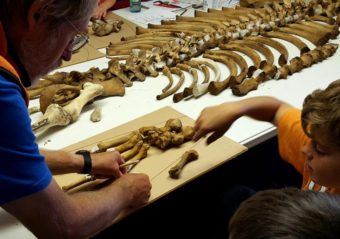
Homer resident Lee Post, aka “Mr. Bone,” helps the campers arrange the 10-foot Stellar sea lion skeleton on three folding tables.
“For a lot of these kids that’s the first time they’ve gotten to hold real bones or look at ’em,” Post said.
The curved rib bones and knobby vertebrae look like weathered pieces of wood. Putting the skeleton together has been a little difficult, Post said, because some of the bones are missing.
“It’s a total missing piece puzzle!” Post said.
With a total of 20 kids, this is the biggest marine mammal camp they’ve had since it began in 2011.
They do a variety of activities, but a whale watch is clearly the highlight of the week.
The next morning, the campers pile onto the Torega, a 30-foot boat painted canary yellow.
Captain Karl Stoltzfus carefully maneuvers around Gull Island in Kachemak Bay. The rocky little island is covered in dozens of seabirds.
Local naturalist and one of the counselors leading the camp Axel Gillam points out the different seabirds.
“The ones with the long weird necks? Those are called cormorants,” Gillam explains.
Captain Karl scans the horizon, looking for the spray of a whale surfacing. Although humpback whales are the most common species in Kachemak Bay, he said that you can sometimes see orcas and other fin whales.
“You never know what’s gonna be out here,” he said, squinting into the sun.
In the back of the boat, Axel tells the campers what to expect.
“What you guys want to look and listen for is the blow. So when the whale comes up to the surface, it’ll go ‘PSSHH’,” Gillam said, mimicking the sound of a whale.
They peer through binoculars, jostling for a spot at the edge of the boat.
“There she blows!” one camper shouts.
The glossy dark skin of a humpback appears above the water for a few moments, then the whale dives again, showing its curved tail flukes.
Axel lowered a special piece of underwater equipment called a hydrophone, or a small golf ball-sized microphone on a long cord, into the water.
“Since we’re listening for humpbacks, it’s going to sound like a classic whale noise,” he said.
The kids pressed their ears against a big speaker, straining to hear the sounds of the whale.
The humpback appeared again in the distance, but the speaker was silent.
Later in the week, the campers return to Homer. They clustered around a plastic folding table under a pop-up tent. They’re about to watch a sea otter necropsy, which is like an autopsy, but for animals.
Adriana Ferello-Shehan, who works with the U.S. Fish and Wildlife Marine Mammal Management office, lays out her dissection tools on the table along with a pile of plastic vials.
The otter on the folding table is 5 feet long from head to tail and about 80 pounds. He was found washed up on the Homer spit, but Adriana isn’t sure why he died.
That’s what the necropsy is for.
“Do you guys know what rigor is? Yeah, rigor mortis,” she said. “He’s still a little stiff, which is good because that means that he’s fresh.”
Ferello-Shehan is a bit like a detective collecting evidence. She takes samples from a tooth, whiskers, fur, urine and feces. She also collects tiny pieces of the otter’s organs to send away for analysis, including his heart and liver.
She carefully dissected the heart, revealing a huge blood clot.
“I opened it up and you guys can see how much clotting there is,” she said, holding the otter’s heart in her hand.
The kids leaned in for a closer look.
Inside one of the otter’s main arteries near its legs is another big clot.
“You see how thick it is. And you can actually feel the jello feel that we were feeling with those clots,” Ferello-Shehan said.
Clotting in the heart and arteries is a good indication that this otter died from a bacterial infection, she said.
Last year, several hundred otters died around Kachemak Bay from Streptococcus bacterial infections.
She’s quick to point out that while this type of bacteria can be fatal for otters, humans can’t catch it.
The Center for Alaskan Coastal Studies provides a variety of programs throughout the year for all ages. More information is available at http://www.akcoastalstudies.org.
The State Department of Health and Social Services is warning residents to exercise caution when collecting shellfish in Homer harbor.
Recent tests have shown elevated saxitoxin levels in blue mussels.
Catherine Bursch, the harmful species program coordinator at Kachemak Bay Research Reserve, samples blue mussels every two weeks in Homer harbor to monitor for toxins.
“We did pick up over the regulatory limit of toxins in the shellfish that we sample regularly from the Homer harbor,” said Bursch.
These naturally occurring toxins are produced by microscopic one-celled creatures called phytoplankton.
Phytoplankton are eaten by larger species of plankton, which are prey for filter-feeding animals, including clams and mussels.
The toxins become more and more concentrated as they move up the food chain.
When humans eat contaminated shellfish, it can cause an illness called paralytic shellfish poisoning.
The symptoms include tingling lips and mouth, nausea and difficulty breathing.
The toxins can cause paralysis and death when consumed in large enough quantities.
Although these toxin-producing plankton are almost always present in the water, at certain times of year, their populations increase. That’s when the risk of paralytic shellfish poisoning is highest.
While commercially produced shellfish are tested regularly, recreational shellfishing areas may not be, Bursch said.
“If you dig shellfish recreationally, you have to understand that no one is testing the beach,” Bursch said. “The state does not have a program that tests random beaches for the recreational harvesters.”
According to Alaska state policy, recreational shellfish harvesters dig at their own risk.
Close
Update notification options
Subscribe to notifications
Subscribe
Get notifications about news related to the topics you care about. You can unsubscribe anytime.