KBBI - Homer

KBBI is our partner station in Homer. KTOO collaborates with partners across the state to cover important news and to share stories with our audiences.

Wasps pose a painful problem in Southcentral Alaska

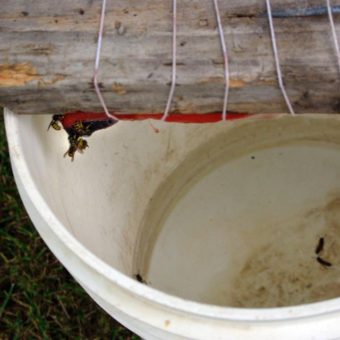
A homemade wasp trap at Harry and Erin Lockwood's house. Fill the bottom of a five-gallon bucket with water and a little cooking oil or dish soap. Wrap some meat around a stick placed on top of the bucket. If the wasps fall in the water, they can't get back out. (Photo by Jenny Neyman/KBBI)
A homemade wasp trap at Harry and Erin Lockwood’s house. Fill the bottom of a five-gallon bucket with water and a little cooking oil or dish soap. Wrap some meat around a stick placed on top of the bucket. If the wasps fall in the water, they can’t get back out. (Photo by Jenny Neyman/KBBI)

Southcentral Alaska is abuzz with winged things that pack a sharp sting.

Wasps are an all-too-common problem.

Southcentral Alaska has seen an increase in wasp activity this year.

Mild winters are good for overwintering queens, and more queens means more nests come springtime.

“There’s a lot of nests out there and we’re having a lot more interactions,” said Casey Matney, agriculture and horticulture agent with the University of Alaska Fairbanks Cooperative Extension Service, Soldotna.

Paper wasps and yellow jackets are the most prolific and problematic this year, he said.

They’re difficult to tell apart, and it doesn’t really matter. Both are classified as wasps, both can build nests on or around your home, both like to eat what people like to eat and both will sting — repeatedly — to protect their food or nest.

“They can get you multiple times,” Matney said. “If they start to sting you, make sure you get them so they don’t keep going. And then, also, there may be a reason why you’re getting stung, why they’re attacking you. If they start buzzing you — that’s telling you that you’re somewhere that they don’t want you to be, and so you need to make sure not (be) walking toward a nest.”

That can be easier said than done if you’re dealing with multiple nests around a home.

Erin and Harry Lockwood, off Sport Lake near Soldotna, have dedicated much of their summer to waging war against wasps.

It’s been a tough battle.

“I’m tired of getting bit and I’m tired of not being able to sit outside,” Erin Lockwood said.

“We want to sit on the deck and eat on the deck and we couldn’t because we get swarmed,” Harry Lockwood said.

Gardening is no longer relaxing, the hot tub is staying covered, cookouts are cooked in the garage and lawn care is a gladiatorial event.

Harry Lockwood was weed-eating around a tree in the back yard, not realizing there was a nest under the roots.

“There was nothing that I noticed,” he said. “Then all of a sudden I was just swarmed.”

They’ve had the occasional wasp nest before but never an infestation to this extent.

It’s been so miserable outside that Erin allowed something she swore she never would.

“We’ve been in this house 38 years,” she said. “Never have we cleaned …

“I had two reds to clean,” Harry Lockwood said.

“And so I was finally like, ‘OK.’ He cleaned two fish in my kitchen. That’s never happened,” Erin Lockwood said.

They sprayed all the nests they could find — in the eaves (one the size of a volleyball), under the deck, in the shed and in the ground.

They ordered special sticky wasp traps to hang around the house and searched for do-it-yourself ideas.

One was to hang paper lunch sacks filled with newspaper in the eaves. Wasps apparently won’t build a nest if they think there’s another already in the vicinity.

Erin and Harry Lockwood made a wasp trap out of a water cooler jug. (Photo by Jenny Neyman/KBBI)
Erin and Harry Lockwood made a wasp trap out of a water cooler jug.
(Photo by Jenny Neyman/KBBI)

They’ve got two types of traps in the yard. One is made from a plastic water cooler jug.

Using a grinder, they cut a hole about 6 inches up from the base and filled the bottom with water. Then they hung a chunk of fish from a round fishing lead that sits in the opening of the jug. The meat attracts the wasps, and they drown when they fall in the water.

The Lockwoods also have a few 5-gallon buckets around the yard.

Those have water in the bottom, mixed with dish soap or cooking oil to lessen the surface tension. There’s fish tied to a stick laid across the top of the bucket. Same idea — wasps comes for the meat, fall in the water and drown.

Though the Lockwoods have exterminated thousands of wasps this summer, they probably won’t be free of the problem until the first fall frost.

Until then, Matney said the best solution is to avoid wasps.

If you have outside activities to do that will attract wasps — like cleaning fish — do it early in the morning, late in the evening or when it’s cool and rainy.

If you are stung, watch for signs of an allergic reaction — if swelling, dizziness or shortness of breath occur, then seek medial attention immediately.

Covering up is Matney’s best strategy against being stung. Wasps unfortunately aren’t as easily deterred as the more common Alaska summer pest.

“They’re very strong little guys and they don’t stop for mosquito repellent or anything like that,” he said. “If they smell food or think you’re food or are defending, nothing like that will stop them. So it’s just best to kind of armor yourself up through protective clothing, stay away from them and minimize your contact during the hours they’re most active.”

The Cooperative Extension Service has more information on wasps available on its website, www.uaf.edu/ces.

AVTEC closes Anchorage campus due to budget cuts

Alaska’s Institute of Technology, also known as AVTEC or the Alaska Vocational Technical Center, had to close the doors to their Anchorage satellite campus Aug. 15, because of budget cuts.

Alaska Workforce Investment Board executive director Heather Beaty also is a spokesperson for the Department of Labor and Workforce Development. She said the closure was because in part because of the 33 percent budget cut to the State General Funds.

Budget cuts are not a new thing for AVTEC, though.

The agency has already made many money-saving cuts in the past, Beaty said.

“With those cuts have come many efficiencies,” she said. “We’ve combined two of our divisions, we’ve eliminated vacant positions, we’ve had to do some lay offs, we’ve consolidated our lease spaces, [and] we’ve cut back on travel. We’ve looked for saving everywhere, but unfortunately these cuts are so deep that we are at a point where we’re having to close some of our offices and we’re having to eliminate some of the programs we have to offer.”

The state of Alaska opened AVTEC in 1969 in response to the coming pipeline.

The state knew they would need to increase the number of highly trained workers in certain skillsets to accommodate for the pipeline’s construction.

AVTEC programs include maritime, culinary, welding and many other training programs.

Last year, nearly 1,400 students completed long-term training at AVTEC.

The Allied Health Program had been offered through AVTEC’s Anchorage Campus.

Now that the campus has closed, AVTEC can no longer offer their main nursing programs.

The Allied Health Program typically served about 100 certified nursing assistant candidates each year, Beaty said, and about 20 people each year enrolled in the register nursing and the LPN programs.

The last group of licensed practical nurses graduated in November 2015, before the LPN program was shut down because of previous cuts. However, the Medical Office Assistant program is one of the few medical programs that are offered at AVTEC’s main campus in Seward.

As for the future of AVTEC, Beaty said that they hope for a fiscal program to be passed so that there can be more certainty for the programs that they offer.

“It’s so important to be able to offer good quality job training in our state so that people have the skills they need to go to work in careers that are going to help them earn a good wage and provide what they need for their families,” Beaty said.

AVTEC’s main campus in Seward is to remain open.

Kenai Assembly to consider moment of silence after Satanic invocation, protests

Earlier this month, a member of the Satanic Temple performed the invocation at a Kenai Peninsula Borough Assembly meeting, a prayer that sparked protest and counterprotest.

Two groups gathered Wednesday, August 17 in the steady rain in front of Planned Parenthood Soldtona Health Center.

On one side Catholic protesters carrying rosary beads and a life-sized wooden cross said a prayer; on the other side a group of women held signs that said “my body my choice” and “reproductive health is not a sin.”

Kenai Peninsula Assembly Vice President Brent Johnson plans to introduce an ordinance at the meeting Tuesday, August 23, that would replace the invocation or prayer said at the beginning of meetings with a moment of silence.

Several months ago, Kenai Peninsula Borough Assembly President Blaine Gillman introduced an ordinance that would have done away with the invocation, but withdrew it under pressure from local Christian leaders who wanted the prayer to continue.

The Assembly heard repeated public testimony this summer from residents who said that prayer at a public meeting was inappropriate – and also that the invocation, as practiced, seemed exclusionary to non-Judeo-Christian faiths.

Local religious leaders testified in support of keeping the invocation.

Kenai Peninsula College student Iris Fontana, 27, invoked the power of Satan on Tuesday, August 9, as part of an effort by the Assembly to make the meeting prayers more equitable.

She ended the invocation with “It is done. Hail Satan.”

That prayer sparked protest and counterprotests, and now a moment of silence is under consideration as an alternative.

Outside Planned Parenthood, Catholic parishioner Toby Burk said he was there to address what he calls, two “evils going on in the community.”

“First and foremost the evil of abortion, the destruction of innocent life, for one,” Burk said. “We are out her in front of Planned Parenthood because they make all the or most of the local referrals to the abortionist. And two, you may have heard about the invocation at the borough building last week. So this is like, we are going to start praying her and we are going to eventually process over to the borough building.”

Praying is the Catholic group’s way of fighting back, he said.

On the other side of the Planned Parenthood issue were protesters including Michele Vasquez. She supports the clinic which provides many important services.

“It’s actually the healthcare provider for millions of low-income women across the country,” Vasquez said. “They provide pap smears; they provide cancer screenings, breast exams, and prostate exams for men. It is just so crucial that we have that. Only 3 percent of their services are abortion. So, I just find it reprehensible that these people would want to see such a great organization just disappear.”

Fontana also was at the protest and said she supports Planned Parenthood and free speech.

“The invocation that I used was written by the spokesman for the Satanic Temple and so I could have left ‘hail Satan’ off but why?,” she said. “There should not be a reason to have to rein myself in. It is free speech. Everyone has free speech. You know, I should not have to hide.”

Fontana’s grandmother, Judith Jenkinson, a retired school teacher and self-described Christian, stood with her at the protest. Jenkinson said she’s proud that her granddaughter is fighting for separation of church and state in the local government.

“It is 2016, people ought to have rights,” Jenkinson said. “This whole protest is so dark ages, it just scares me to death.”

Fontana is pleased that the Assembly is now considering doing away with the invocation and instituting in its place a moment of silence, she said.

“That would be perfect,” Fontana said. “I think that’s reasonable.”

Homer art gallery hosts “Decolonizing Alaska” exhibit

An innovative new exhibit at Bunnell Street Arts Center has turned a spotlight on Alaska’s long history of colonization. Asia Freeman, the curator of “Decolonizing Alaska”, says colonization has had a powerful influence on the state.

“As a resource state, Alaska has been colonized by forces for centuries now, that have defined and shaped our identity as a state,” said Freeman.

The exhibition tells a multitude of stories from many perspectives.

"Counting on Liberty" by Rebecca Lyon. (Courtesy of Bunnell Street Arts Center)
“Counting on Liberty” by Rebecca Lyon. “I have printed her image on a combination of a US twenty dollar bill and the American flag and given her a cartoon crown of the Statue of Liberty.” – Lyon (Courtesy of Bunnell Street Arts Center)

Rebecca Lyon’s mixed media piece “Counting on Liberty” represents the long struggle for women’s rights.

“It’s a piece of artwork that I silkscreened an image of my great grandmother, Anastasia Nutnaltna,” said Lyon.

Lyon’s great grandmother was sold into slavery as a young girl. According to family history, she was later purchased by Lyon’s great-grandfather, an immigrant from Sweden.

“She had a very difficult life but if you look at the photograph and the demeanor of her look, as she looks out in the audience, you can see such pride, strength. Even in an age when she had little or no rights,” said Lyon.

Her grandmother wears a cartoon crown similar to the Statue of Liberty. Lyon says that she hopes to draw more attention to the issue of who should be on U.S. currency. Surrounding the image of her great-grandmother, Lyon has positioned a contemporary Athabascan counting cord. The knotted deer hide is covered with buttons and memorabilia, documenting the history of the women’s rights movement.

“It’s all in this bright Plexiglas color and bright colors to get your attention, to scream at you across the room and say ‘let’s talk about women’s rights,’” said Lyon.

Across the room, Joel Isaak’s “Visions of Summer” is playing on a loop. He describes his artwork in pretty simple terms.

“It’s a fish screen TV screen,” said Isaak.

A hazy video of his family at fish camp is visible through translucent salmon skins that he whipstitched together.

Silhouetted on the screen is a video of him dancing. To create the video, Isaak danced for hour-long stretches at night, when the studio was empty.

“I’d go to the dance studio at my school and I’d dance all night long,” said Isaak.

For Isaak, his art not only celebrates his Dena’ina heritage, it captures some of what makes the natural world so extraordinary.

“The sense of wonderment, kind of intrigue, otherworldliness. When I’m dip-netting at the beach, I feel fish run into me and you can’t see it. So it’s kind of a little portal into another world,” said Isaak.

Artist Mike Conti stands beside his black and white photograph of a young Yup’ik woman named Jacquie.

“I call it Yup’ik Ena, which means “Yu’pik house” and then in quotes “White gaze,” said Conti.

"White Gaze" by Michael Conti.
“White Gaze” by Michael Conti. (Courtesy of Bunnell Street Arts Center)

The photograph shows the woman wearing jeans and a kuspuk. She’s standing inside of an Alaska Native diorama full of stiffly posed mannequins in traditional dress.

“It’s like a cross-section, so you’re looking through glass and Jackie has her hands up, like she’s pressed against the glass. Then in the glass, you can see a reflection of me, the photographer. So that’s the white gaze part,” said Conti.

As a self-described “white guy”, Conti is acutely aware of how often the Alaska Native narrative has been in the hands of outsiders.

“The control of the perception is in the viewer. In this case, the white photographer,” said Conti.

For curator Asia Freeman, this collaboration of native and non-native artists is part of what makes the show so groundbreaking.

“I think the thing that is most exciting is to actually say out loud that this type of show hasn’t happened before. I can’t think of an example where native and non-native artists come together to explore and challenge the longstanding effects of colonization through their work,” said Freeman.

The “Decolonizing Alaska” exhibit at Bunnell Street Arts Center runs through the end of August. Over the next year, it will travel to Valdez, Washington DC, Juneau and Anchorage.

Homer Tribune back in print with new owner

The Homer Tribune has new owners as well as a new look.

The weekly newspaper is issuing a print edition again right in time for its 25th anniversary this August.

Jason Evans said that although he and his wife own two other newspapers, they were not in the market for a new one.

“We weren’t actually looking for newspapers, but we do have some talented staff that live in Homer and so it was a natural to pick up the Homer Tribune and start publishing it as well,” Evans said.

Evans and his wife, Kiana Peacock, owns Alaska Media LLC, the company that recently bought The Homer Tribune.

The company already publishes two other weekly community newspapers— the Arctic Sounder and the Bristol Bay Times – Dutch Harbor Fisherman.

The Tribune stopped publishing its paper edition June 8 and went to a web-only version. Shortly thereafter Evans and Peacock picked it up. Evans said they want to maintain the local, community flavor of the paper.

“We feel it is important to have community voices in a newspaper and did not want to see that newspaper go away,” said Evans.

The Tribune will continue its online version along with a printed edition, Evans said.

“Online is a really active and important piece of the puzzle, especially in today’s day and age,” Evans said. “But we feel a printed paper is also really important. It is something that people can take with them to their camps. They can cut out photos and hang them on their refrigerator. As a weekly paper we feel like a print edition is still critical to the success of it and also adds to the community.”

Evans is Alaska Native, Inupiaq, originally from Nome. Highlighting Alaska Native voices in rural parts of the state is important to the company, he said. He hopes the Tribune will dedicate more coverage to the Native communities on the southern Kenai Peninsula.

Longtime Tribune owner and publisher Jane Pascall is working with the paper for a couple more months during the transition to help primarily with advertising. She is very pleased with the sale.

“I’m excited and thrilled because we can celebrate our 25th anniversary this month, my employees will have a job – they are getting their jobs back, and Homer will be able to read The Tribune again. So I couldn’t be happier,” said Pascall.

Jim Hornaday started the Homer Tribune in 1991. Pascall first worked as a salesperson, but purchased the paper in 1992.

Pascall sold the paper because she’s now focusing on a new restaurant business and preparing to become a grandmother. She’s confident that Alaska Media will do a good job.

“I think that Homer’s different from the rest of Alaska and I think they understand that,” Pascall said. “With Carey Restino being the editor and the main reporter –she’s been here for many years. She’s written for me, she understands the community.”

Carey Restino has worked in the reporting and editing business for years.

She first arrived in Homer in 1993 and studied journalism at the University of Alaska Anchorage before taking a job for the Homer News as a general assignment reporter.

In 2004, she took the position of editor for the Homer Tribune, where she worked for several years. She continued to write freelance articles for the Tribune, while also working as the editor of Alaska Media’s other newspapers in 2011.

Restino’s passion is community journalism.

“Real community focused – what happens in an elementary school is just as important as what goes on in a city council meeting and ultimately you are responsible to the community that you are serving,” Restino said.

At a local grocery store, issues of the new Tribune are flying of the racks.

Homer Chamber of Commerce and Visitor Center events coordinator Jan Knutson said having the Tribune back in print is good for both the businesses her office serves and for visitors.

“We’re just really pleased that its back in print again. It’s very accessible to locals and visitors alike,” Knutson said.

The Tribune has been redesigned with a cleaner look: more white space and other style changes that bring it in line with the company’s other papers.

Another change that Alaska Media has made is switching the day that the Tribune comes out, from Wednesday to Thursday.

That’s the same day that the town’s other weekly newspaper, the Homer News, is issued.

Knutson said that’s good.

“Yes it may be rare to have two newspapers in each town but business competition is good. Some people prefer the Tribune, some prefer the Homer News, some of us prefer to have access to both newspapers,” Knutson said.

Owner and publisher Evans said more news sources will be better for residents.

“You know I think place like Homer is really lucky to have two papers,” he said. “It is hard for a community weekly to catch everything that happens in these dynamic communities like Homer and having two papers and more reporters and then a really great radio station as well, writing and creating news for the community –I think just really adds to the community in the long-term and so I think there is a good fit for two papers and we are happy to be one of them.”

The Tribune plans to maintain a content-sharing agreement with Alaska Dispatch News, the state’s largest newspaper.

The parties have not disclosed the purchase price.

Homer council shows concern over proposed naval training

Homer City Council passed a resolution on Aug. 8, formally requesting changes to U.S. Navy training exercises in the Gulf of Alaska. The proposed training area is 24 nautical miles from the Kenai Peninsula shoreline, just south of Prince William Sound and east of Kodiak Island.

It covers more than 59,000 square miles, an area slightly larger than the state of Georgia.

Emily Stolarcyk, program manager for Cordova-based non-profit group Eyak Preservation Council, spoke in support of a resolution requesting changes to the proposed training August 8 at Homer City Council.

“These trainings are aimed at maintaining military readiness,” Stolarcyk said. “Everything used in the exercises is actually the same weapons that are used in war. So these are real bombs, real missiles, torpedoes, heavy deck guns and then of course, the active sonar.”

Although military preparedness is important, she said the needs of local communities and ecosystems should also be taken into account.

“We certainly can’t understate the need for national security, but we could go about it in a more sensitive way,” Stolarcyk said. “Sensitive to the people that live here, the communities, our industries, and then wildlife as well,”

Homer City Councilmember David Lewis sponsored the resolution. He’s concerned about the impact of Navy training on wildlife.

“It matters because all that comes into Kachemak Bay basically comes from the Gulf,” Lewis said.

The proposed training would begin in May 2017, but the resolution requests the Navy wait until mid-September to avoid impacts on migrating marine species.

Cook Inletkeeper executive director Bob Shavelson said the environmental impacts of naval training could be lessened by scheduling it later in the fall.

“These are migration corridors for our salmon and our halibut and our whales,” Shavelson said. “And we could reduce those impacts considerably if we change it to later in the year and push it further from the coast.”

Navy representative Alex Stone said the longer days and calmer waters in the summertime allow them to do more training exercises.

“We get more value for our investment if we can plan the exercise when it has a greater probability of better weather, better conditions for flying and for training,” Stone said.

The resolution also requests the Navy avoid using live ordnance and sonar in Marine Protected Areas. One concern is that these activities produce loud underwater sounds, which can physically harm marine mammals and alter their behavior.

Beaked whales appear to be particularly sensitive to sonar. said Scripps Institution of Oceanography professor John Hildebrand.

“There was an exercise in the Bahamas around 2000 where the Navy was conducting an exercise in a relatively confined space along a channel,” Hildebrand said. “And then you could see the beaked whales strand themselves along the channel pretty much in lock step with position of the sonars.”

Although the effect of sonar on larger whales isn’t well known, many of these species are endangered.

Any activities that could harm them receive an extra level of scrutiny, Hildebrand said .

“We’re worried about these animals already so we have kind of an extra layer of concern because there are already endangered,” Hildebrand said. “And now here’s another thing that could potentially impact them, even though we don’t know the details of how it might.”

Currently, the Navy visually monitors the area around vessels to look for marine mammals.

“Sonar could cause impacts to marine mammals if they’re close to the sonar source,” Navy representative Alex Stone said. “We have a safety zone around that area. So we observe that area and if there are marine mammals in that area we’ll power down the sonar or turn it off.”

In this case, Close is 1,000 yards, according to the Navy’s Environmental Impact Statement.

The resolution requesting changes to Navy training was unanimously approved by members of Homer City Council.

It now goes before Alaska Sen. Lisa Murkowski and Reps. Dan Sullivan and Don Young.

The final Environmental Impact Statement for the proposed training is available at goaeis.com. The 30 day public comment period ends August 29.

Site notifications
Update notification options
Subscribe to notifications