KBBI - Homer

KBBI is our partner station in Homer. KTOO collaborates with partners across the state to cover important news and to share stories with our audiences.

Governor visits Homer to address Alaska’s fiscal crisis

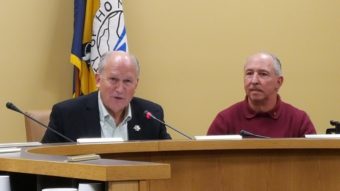
Dozens turned out to hear the message of Gov. Bill Walker who visited Homer on Tuesday to talk with residents about the state’s looming budget crisis.

As he described the enormity of the $4 billion state deficit, Walker didn’t mince words. He began by quoting David Teal, Alaska’s Legislative Fiscal Analyst.

“He said, ‘Alaska is in the midst of the greatest fiscal crisis in state history’. And he was right.” Walker said.

Walker emphasized that the deficit is an issue for every Alaskan.

“I tend not to broadbrush the legislature,” he said. “Really it comes down to individual legislators. There were those that came to the table with suggestions and ideas and those that said as though it was just my problem. I’m not sure the deficit became just my problem.”

Until the state balances its checkbook, so to speak, state leaders can’t address projects that would build a more sustainable economy, the governor said.

“It’s a matter of looking at Alaska differently than we’ve had to for the last 30 years,” Walker said. “We’ve been riding the coattails of resource development and that’s not working anymore.”

In order to create new industries in Alaska, people have to start thinking differently, he said. For the governor, reducing the cost of energy is critical.

“I just think there’s so much more that we could do on renewable energy,” Walker said. “We should be on the cutting edge of renewable resources in Alaska because we have the most options and the biggest need. If we reduce the cost of energy, the economy looks very very different.”

But as he explained to Rotary Club members later in the day at Land’s End Resort, he understands the discipline required to balance the state budget may cost him.

“It takes somebody who’s not looking at a political career to make these decisions and make the decisions for the vision and the future of Alaska,” he said. “Not necessarily for my political career, which I don’t think I’m gonna have one.”

Those who turned out to hear him speak seem to support his plans to get the state back on track.

Maynard Gross says the fixes the governor is proposing makes sense.

“I think an income tax is clearly the best way to go because that least affects the folks at the lower end of the economic spectrum,” Gross said.

Will Files praised the governor’s unifying message.

“We have come to think of ourselves as Democrats or Republicans and we take that to the finest point possible. If we would listen to the governor and suggest we all become Alaskans, working together for a common goal, I’m willing to be on that team,” said Files.

Daisy Lee Bitters was impressed with the governor’s outreach efforts.

“I’m so pleased to see that the governor when he comes to a community he covers so many groups. Like with being at the senior center and then the city council and then the Rotary Club,” said Bitters.

The governor is traveling around the state to talk with Alaskans about the budget crisis. He plans to continue visiting with residents and local leaders in the coming months.

Marijuana Control Board Chair under fire for initiative to ban commercial pot

Marijuana Control Board Chair under fire for initiative to ban commercial pot on Kenai Peninsula
Marijuana. (Creative Commons photo by Katheirne Hitt)

The chair of the Alaska Alcohol and Marijuana Control Board is gathering signatures to have Kenai Peninsula Borough vote on outlawing commercial cannabis operations in areas of the borough outside cities.

That isn’t sitting well with members of cannabis industry on the peninsula.

Soldotna police chief Peter Mlynarik who’s community instituted a two-year ban on commercial cannabis activity, chairs the state Alcohol and Marijuana Control Board, tasked with regulating the fledging industry created with the passage of Ballot Measure 2 in 2014.

Mlynarik is a registered signature gatherer on a voter initiative to ban commercial marijuana in the Kenai Peninsula Borough outside the cities that have legal authority to determine their own rules.

Legally, there’s no problem with the intersection of these rolls.

Harriet Milks, legal counsel for the board, has advised that a board member’s participation in political activity, even on issues relevant to the board, doesn’t violate the Alaska Executive Branch Ethics Act.

Outside activity only constitutes an ethical violation when a board member would personally — primarily financially — benefit from an issue before the board.

Legal doesn’t mean acceptable to many in the commercial cannabis industry on the Kenai Peninsula. Dollynda Phelps is working toward opening Peace Frog Botanicals in Kenai in October.

“I know from a legal perspective he’s not violating any legal code of any type, but I think, morally, to play both sides is wrong,” Phelps said. “I believe that the chair of a board that’s set to regulate an industry should not on his free time turn around and work against that industry.”

Mlynarik wanted to be on the board to help regulate the new industry, particularly with an eye toward public safety, he said.

“Trying to make sure that, as you’re starting this new industry, you keep those kind of matters, the public safety-type issues, in mind as regulations are being crafted, as licenses are being approved or if there’s any enforcement action that needs to be taken,” Mlynarik said.

He said his involvement gathering initiative signatures doesn’t affect his work on the board, nor would his personal opinion of commercial marijuana. In fact, he’s voted to approve every complete license application that’s come before the board.

“You can look at my voting record on the board. And you’ll see that I’m pretty consistent in the way I vote. And I’m not always the most conservative. I didn’t deny any of the licenses that came out on the principle that I did or did not like the establishments. We are there to regulate, and that’s our job for the board,” Mlynarik said.

He said he supports the initiative because Ballot Measure 2 gives municipalities the right to opt out of commercial marijuana if residents so choose. He wants the borough to exercise its right to decide.

“So when people voted for Ballot Measure 2 they also voted to allow local governments the option of whether or not they wanted to opt out. My hope is that people will be allowed to vote on that,” Mlynarik said.

Phelps said she doesn’t question Mlynarik’s right as a citizen to participate in the political process, nor does she say he’s been obstructive to the industry in his work on the board. Her concern is the combination of the two.

“We’re not talking about a conflict of interest being collecting signatures. The intent to work against the industry is the conflict of interest. You cannot work for the industry on a regulatory board and against the industry in your free time,” Phelps said.

Kenai Peninsula Borough Assembly Member Stan Welles is another registered signature gatherer. Phelps isn’t bothered by that, though.

“We all know where Stan Welles stands. He’s not working on one side to regulate an industry, he’s just 100 percent against it,” Phelps said. “Welles being a signature-gatherer was no surprise. I was surprised with Mlynarik, simply because of his role to create a regulated industry.”

Mlynarik’s actions erode trust in the board among the business owners who are investing a lot of money to participate in the new industry, Phelps said.

“Denying licenses that are outside (cities) of the borough, some of which have invested hundreds and hundreds upon hundreds of thousands of dollars, who are members of the community, who have children here in our community, who we all own businesses here in our community,” Phelps said. “Every one of us will be financially burdened by this.”

If the initiative passes, Phelps said it will be a blow to the legal commercial marijuana industry, as well as to public safety.

“Banning only outside of city limits is not going to get rid of commercial cannabis in our area,” Phelps said. “It’s going to push all the commercial cannabis into the very cities where most of the people that are involved with this don’t want to see it.”

“Not allowing legal, licensed, regulated, inspected facilities, you are absolutely giving all the power back to the black market. The only way to shut down the black market is to support their competition. And the legal market is the only competition for the black market.”

If the initiative petition is approved, the question will appear on the October municipal ballot.

Ninilchik tribe sets net in Kenai River

The Ninilchik Traditional Council has for years sought approval to use a more effective method for catching their subsistence allocation of sockeye salmon on the Kenai River and late last week, they got that opportunity.

On July 27, the Federal Subsistence Board approved the tribe’s emergency special action request to operate a community subsistence set net fishery on the Kenai.

Approval came after a lawsuit filed in 2015.

The change has drawn stiff opposition from other fishermen and fisheries managers who worry about the new gear type’s potential effect on king salmon and trout.

As of July 31, the Ninilchik tribe had harvested 33 sockeye since they began fishing on July 28.

Ninilchik is allowed to harvest all species of salmon with a single net. The tribe is allocated 2,000 sockeye and voluntarily agreed to restrict its harvest to 50 kings for the shortened 2016 season.

The special action allows the tribe to operate the subsistence set net fishery in the federal waters of the Moose Range Meadows for the next two weeks, until Aug. 15.

Homer police handling more calls involving intoxicated people

Homer Police Chief Mark Robl says the department has been responding to more calls involving intoxicated people this summer.

“We’ve had over 56 calls now on just inebriated people – people drive by they see someone passed out on the park bench laying on the grass, stumbling, staggering, hard to walk, they’re going in and out of traffic and falling off the sidewalks, those types of calls. And in addition to that, we have other call – a shoplifting call where here’s a guy that’s stuffed three bottles of cooking sherry in his clothing, you know,” said Robl.

Robl say the department typically handles about two dozen such cases all summer.

He says it’s hard to pin down exactly why the numbers have suddenly increased but he believes some of the drunk people the department is interacting with are coming from elsewhere.

“We definitely have some homeless inebriates that move down here from Anchorage for the summer and that’s what they’ve told my officers. They just wanted to get out of the city and there are less people down here and they feel more comfortable,” said Robl.

Besides the number of calls involving intoxicated people going up, Robl says that the level of intoxication they are seeing is also higher. He told the Homer City Council last week that the city may need to look at a plan to handle issue.

“Something we discussed with Council on Monday night is that we might need to come up with community patrols and a sleep off center and some better way to deal with these folks than tying up a lot of police officers’ time,” said Robl.

Robl says the Homer jail has four cells and at times this summer, two and sometimes three of those cells have been occupied by intoxicated people.

Senior tax exemption will go to Kenai Peninsula Borough voters

Kenai Peninsula Borough voters will have their say on whether the borough’s optional senior property tax exemption will be phased out.

Currently, seniors in the borough receive $350,000 in property tax exemptions — $150,000 mandated by the state, $150,000 offered by the borough and another $50,000 from the borough for all residential property owners.

“The minimum exemption you will ever receive is $200,000. It simply phases out the optional $150,000,” assembly member Gary Knopp said.

Current seniors and anyone turning 65 years old next year will continue to receive $350,000 in exemptions. After that, residents turning 65 in the next six years will get lower levels of exemption, which they will continue to receive in perpetuity. Seniors turning 65 in 2024 or after won’t get any additional exemption.

Larry Persily, assistant to the mayor, says that’s still generous, compared to the rest of the state. Only the North Slope Borough, with $600 million in savings, offers more.

“But we’re competitive. We’re equal or stack up very well against the next two, Skagway and Mat-Su, and have a better senior benefit than 32 other municipalities in the state,” Persily said.

Borough Mayor Mike Navarre says the phase-out was created to address changing demographics in the borough. From 2000 to 2030, the senior population is expected to grow at a rate of 300 percent compared to the rest of the population of the borough, according to state estimates. That means the property tax burden will increasingly shift to younger residents, Navarre says.

The borough will continue to offer its hardship exemption for low-income seniors, so their property taxes can’t exceed 2 percent of their annual income. But the state doesn’t allow a hardship exemption for those under 65, Navarre says.

“There are many seniors on fixed incomes. Many other people are on fixed incomes. Many are low income. People at various ages have a hardship,” Navarre said.

The majority of public testimony over the past few meetings has been against the ordinance. Linda Hutchings of Soldotna spoke in favor Tuesday.

“I look at young families paying a higher price for their taxes. As a senior, I like my exemption, but I understand we need to tighten our belt and give more to younger people to encourage them to come back to our area and build an economy,” Hutchings said.

The assembly voted seven to one to put the measure on the ballot, with assembly member Wayne Ogle opposing the ordinance.

Borough voters will see the question on the municipal ballot Oct. 4. More information on the measure can be found on the mayor’s page on the borough’s website, www.kpb.us.

The borough assembly voted at its meeting Tuesday to place a question on the October municipal ballot, seeking voter approval to phase out the borough’s $150,000 property tax exemption for seniors.

Former Kenai Peninsula hockey coach arrested for sexual abuse of minors

A former hockey coach at Kenai Central and Soldotna high schools has been arrested on charges of sexually abusing minors over a span of 14 years. So far, seven victims have been identified, according to Alaska State Troopers.

Bradley Elliot, 55, was arrested July 13 and remanded to Wildwood Pretrial Facility in Kenai after a search warrant was served on his Sterling home. He faces 37 counts, including sexual abuse of a minor, child pornography and misconduct involving a controlled substance. He allegedly provided steroids to victims as a form of bribery, according to troopers.

Kenai Peninsula Borough School District spokeswoman Pegge Erkeneff said that Elliot worked for the district as a junior varsity hockey coach at Kenai Central High School for the 2005-06 school year. She also confirms that Elliot was involved with the hockey program at Soldotna High School for three seasons, from 2007 to 2010, but is still investigating in what capacity Elliot participated.

“We’re still verifying the level of involvement, whether he was a volunteer, or in what position or role,” Erkeneff said.

Erkeneff said the district has a four-step process when hiring coaches. First, the position would be made available to certified staff at the school. If no one wanted it, the job would be posted on the district’s website. Any candidate who is selected as a potential hire after completing the application process would then undergo a background and reference check.

“Everything we do for an employee, and we also look for felonies and misdemeanors in that process. And then, if they pass that, we would offer them the position,” Erkeneff said.

The process to volunteer in the district was made more rigorous in the 2009-2010 school year, Erkeneff said.

“The district decided that they wanted to take this more seriously so there was a pilot program in 08-09 and then it was implemented districtwide in 09-10. So what happens if somebody volunteers in a school or is a volunteer coach they would go through a background check,” she said.

Troopers say the investigation against Elliot began in December 2015, on a tip from a citizen who was concerned that Elliot had abused a family member.

Erkeneff said she can’t comment on whether any complaints had been filed with the district regarding Elliot, citing employee confidentiality requirements. But she did say that the district’s policy is to investigate all such claims.

“If the district receives a complaint from anybody, generally it starts at a school site, and then it would go to the director level, and then potentially the superintendent, and there would definitely be an investigation,” Erkeneff said.

Erkeneff said that the safety and welfare of its students is the district’s first priority.

“I think that we’re continuing to improve and refine our background checks, so that all of our schools are safe places. We love our volunteers, we need our volunteers, our staff and we’re committed to safety for our students. And the school district stands against any employee or volunteer that is abusing a child or another employee and it’s never acceptable.” Erkeneff said.

Anyone who knows of other minors potentially victimized by Elliot is asked to call trooper investigator Austin MacDonald at 907-260-2737.

Site notifications
Update notification options
Subscribe to notifications