KCAW - Sitka

KCAW is our partner station in Sitka. KTOO collaborates with partners across the state to cover important news and to share stories with our audiences.
Sitka woman rescues capsized kayaker who spent 30 minutes in Starrigavan Bay

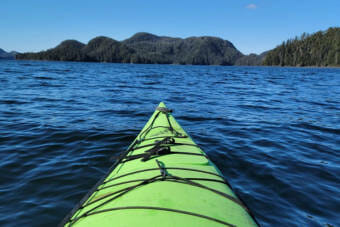
The front of a neon green sea kayak on the water, with forested shores in the distance
A photo Roman Solar took from his kayak on April 10, shortly before he fell into the water. (Photo courtesy of Roman Solar)

A Sitka man who spent half an hour in the ocean after his kayak capsized last weekend was rescued by a quick-thinking passerby who swam from shore and pulled him to safety. The good Samaritan was aware of the risks — she’s a five-year veteran of Sitka’s search and rescue team.

Roman Solar moved to Sitka in February, and with spring’s arrival he’s been getting a taste of the outdoors with kayaking. He went for the first time in early April, but on his second planned trip, his friends couldn’t go.

“We planned a group of people, but the other people were busy, and some people kind of changed their minds,” Solar said. “So I was kinda like, the only one left over.”

Around 5:30 in the afternoon on April 10, he set out on his first solo kayaking trip in Starrigavan Bay. He paddled three miles toward Nakwasina Sound. As the sun dipped, he turned around to go back.

As he was nearing the Starrigavan boat launch area on his return trip, the water began to get a little choppy. A wave hit his kayak, dumping Solar into the ocean and swamping his boat. He tried flipping the kayak sideways to empty it.

“I flip it sideways, and instead of water going out, even more water gets in. And now it’s like 100%,” Solar said. “The compartment where I sit is 100% full of water, and the compartment behind me is 100% full of water.”

Solar estimated he was about 2,000 feet from the shore. He swam for it.

“I tried swimming as hard as I could for maybe 15 or 20 minutes up to the shore, but then I look back and the kayak is right next to me, and nothing changed,” Solar said. “I’m like, where I was, you know. I just spent so much energy.”

He tried swimming the backstroke, too. Then he just held on the kayak and yelled for help. At one point a boat drove by in the distance. Solar yelled out to them, but they didn’t hear him over their engine.

Then, after about half an hour, Solar saw something moving toward him in the water.

“And I’m thinking this could be one of those buoys,” he said. “Or this could be someone’s head going towards me.”

It was Sheila Swanberg, and Solar was in luck — she’s a five year veteran of Sitka’s search and rescue team.

Swanberg was walking her dog Charlee on the bridge at the Starrigavan Estuary that evening when she heard a strange noise.

During the day, Swanberg works with birds at the Alaska Raptor Center. That night, she was at work trying to identify one.

“There was definitely a noise that I was like, ‘That’s a bird. But what bird is that? I was trying to listen very closely to it because I didn’t recognize it,” Swanberg said.

Nearby were a bunch of ducks, and Swanberg tried to identify which duck the weird noise was coming from.

“Then I was like, ‘Oh, that’s a person. That’s not a bird,’” Swanberg said. That’s when she saw the overturned kayak on the water.

She took off running, flagging down a car that was driving by. She told the driver to call 911, then she tied up her dog, set down her phone, and swam to Solar’s aid.

“I was just super, super impressed that, after all that time in the water, he was still calling, because I don’t know if I could have been calling after 30 minutes of just being in that cold,” Swanberg said.

She helped him swim back to shore with the kayak.

“I was really glad that that she was so brave,” Solar said. “She risked her life going [in] this very cold water and swimming such a long distance towards me.”

While Swanberg was responding, police were on their way, and the fire department was assembling a boat crew to rescue the kayaker. But Swanberg managed to get Solar to the shore fast enough that the fire department had to trade the boat for an ambulance. They cared for Solar and took him to Mt. Edgecumbe Medical Center, where he was treated for hypothermia.

Solar is on the mend now, and incredibly thankful to Swanberg for saving him that day. He says at first he was embarrassed about the accident, but now he’s hoping others can learn from his mistake.

“Maybe my mistake will actually save some other people from from doing the same or getting into very dangerous situation,” Solar said.

He says in the future he probably won’t kayak alone — he’ll go with a group, get better gear and maybe pick a warmer day, too.

“I just really liked that Roman was loud. That’s the best thing he could have done — keep making noise,” Swanberg said. “So I definitely want to make sure everybody knows that if you’re in the water like that, don’t give up calling for help.”

Fire Chief Craig Warren says kayakers should be aware of their skill level and the weather — it was gusty on April 10. He says Solar was lucky Swanberg was there.

“Sheila’s really the hero of the day though,” Warren said. “She just did what Sitkans do. We help each other out. She had no idea who this person was. And she didn’t think twice about it. She just went in to rescue this person. She didn’t have any of her response equipment. She was just being a good person.”

Company estimates more than 5,000 gallons of diesel spilled in Neva Strait after tugboat grounding

A container barge is surrounded by smaller vessels while a tugboat lays pushed up on the shore
Western Mariner, an 83-foot tug, ran aground in Neva Strait March, 21, 2022, while towing Chichagof Provider, a 286-foot containerized barge. No injuries were reported. (USCG Photo)

The company that owns a tugboat that crashed around 18 miles north of Sitka last month now estimates that 5,307 gallons of diesel fuel were spilled into the ocean as a result of the accident.

The Western Mariner was towing an Alaska Marine Lines barge in Neva Strait early on the morning of March 21 when a steering failure caused the two vessels to collide, pushing the tugboat onto the shore. The wreck caused a diesel spill, leading to a coordinated response from multiple state and federal agencies. The cleanup effort is ongoing.

The Western Mariner can hold around 50,000 gallons of diesel, but the Western Towboat Company estimates that the boat was only holding about 43,000 gallons of fuel when it crashed.

A situation report published by the Alaska Department of Environmental Conservation on April 5 reported that salvage crews had recovered around 33,000 gallons of fuel directly from the boat. A mix of oil and water recovered by skimmers yielded an additional 4,000 gallons of fuel.

The boat was towed back to Sitka on March 29 and remains moored at the Samson Tug and Barge dock.

Efforts to assess the nearby environmental impacts are ongoing, with crews still flushing nearby beaches with water last week. The DEC reports that shoreline monitoring will continue in the coming weeks.

Sitka hiker recalls the misstep that started his thousand-foot fall

A selfie taken by a man standing on a mountain with bays and snowy mountains in the background
Jeffrey Wright took this selfie from a vista atop Mt. Verstovia in Sitka just minutes before he fell over 1,100 feet down the side of the snowy peak. Wright lived to tell the tale, albeit with serious injuries. (Photo courtesy of Jeffrey Wright)

61-year-old Jeffrey Wright is a lifelong Sitkan and an avid outdoorsman.

“I’ve always been interested in the outdoors, and it kind of declined a bit when my father passed away in ’98. We did a lot in the outdoors, boating and stuff,” Wright told KCAW in an interview on April 4.

But a heart attack in 2018 moved hiking to the forefront of his life.

“And I realized at that point that I needed to make a change in my lifestyle,” he said. “I started watching what I ate, and then we started, you know, hiking parks all over the West Coast.”

He’s hiked every trail in Sitka, but Mt. Verstovia is his favorite. The trailhead is only a 15-minute walk from his home. He’s hiked it at least 14 times in the last year.

He always has a plan, and tells his girlfriend, Carrie, where he’s going. But he really likes solo hiking.

“There’s something about doing something by yourself,” Wright said. “You’re in the moment. You’re absolutely awake, absolutely alive.”

So far this winter, he’d hiked up Mt. Verstovia at least half a dozen times with one goal in mind: hiking the full trail in the snow.

But every time he tried, the conditions weren’t quite right to make it far beyond Picnic Rock, a granite outcropping situated just over 2,500 feet above the trailhead. It was either too windy or the snowpack was too soft, even with snowshoes, to traverse the saddle to the summit, which rises another 800 feet.

But on March 26, the snowpack was firm and the skies were clear.

“I knew pretty much right away that was the day,” Wright said. “I had snowshoes on, and I wasn’t sinking that far. And I was able to pretty much scamper up that slope to Picnic Rock. You know, compared to the previous seven times — much, much easier.”

He made it about two-thirds of the way from Picnic Rock to the next landing, and the snow got harder. He took off his snowshoes, replacing them with spikes. And then, just shy of 3,000 feet elevation, he took a photo, smiling into his cell phone’s camera with a panorama of peaks and a bluebird sky behind him.

“It was just absolutely beautiful up there,” Wright said. “It’s really indescribable.”

Climbing a bit higher and arriving at a narrow ridge that’s generally known as the sketchiest part of the summit route, Wright said he underestimated the snowpack. That’s when he slipped.

“I made a mistake. I shouldn’t I shouldn’t have crossed at that point,” he said. “Because once I fell, I was on the way. And there was no stopping.”

At first he was aware enough to reach for nearby branches to try to stop himself. But then he picked up speed.

“It was basically like a luge, you know, like an Olympic luge,” Wright said, describing the feeling he initially had while falling. “It was kind of like, you know, a swervy-type path. And I was going really, really fast.”

As he slid down the side of the mountain, he hit snow boulders that would explode and spray him in the face with powder at first.

“But then things changed, and everything went like a yellow, whitish — and then it was clear,” Wright said. “That’s what I was seeing. And I got very calm. There was no pain. I had no fear. Yeah, it was very peaceful. And then, the next thing I know, I’m reaching for my phone.”

Wright had been knocked unconscious for over half an hour. When he sat up, there was a pool of blood beneath his head. His GPS remained on, and he would later calculate that he’d fallen more than 1,100 feet over the course of a couple of minutes.

Likely in shock, he stood up, hoping he could hike out of the snowfield.

“I felt a pop in my right hip,” Wright said. “Now, it wasn’t painful. And it ultimately turned out to be a fractured pelvis. But I knew I couldn’t hike out of there. And that was very, very concerning to me.”

Wright’s phone somehow survived the fall. He was able to dial 911 and reach dispatchers in Sitka. About 45 minutes later, he guided an Air Station Sitka helicopter to his location.

“I was, like, waving furiously. And they saw me — of course they did — and they turned the nose of the [helicopter],” Wright said. “It was a very emotional moment. I knew I was going to live.”

Just as a Coast Guard rescuer was pulling Wright to safety in the helicopter, snow began hurtling down the side of the mountain — an avalanche that’s visible in the Coast Guard’s rescue video.

“Just an incredible, extraordinary act of bravery on his part,” Wright said of the rescue swimmer who brought him to safety. “You know, I’m very impressed that he would put his life out there for someone he didn’t even know, but I guess that’s what they do.”

Wright spent several days in the hospital. Now he’s out and about, on crutches and healing. In addition to the broken pelvis, he suffered an injury to his lower spine, a laceration on the back of his head requiring five stitches and a bruise “the size of a turkey dinner plate” on his hip.

“People are surprised that I’m alive. And I understand that,” Wright said. “But you know, I’ve survived things far greater in my life. I had a heart attack. And I rate that fall with this heart attack as far as severity. And there’s other things that have happened that I’ve overcome that were much, much greater.”

“And that helps me — not downplay what happened to me — but it puts it into perspective,” he said.

Wright says he’s thankful for the first responders from the Coast Guard and Sitka Mountain Rescue, and he won’t make the same mistake in the future. He says fellow hikers should do what they’re comfortable with and what they’re prepared for.

And while solo hiking isn’t for everyone, it’s still for him.

“This isn’t gonna change who I am. I learned from my mistakes. I’m still gonna go back to Yosemite, I’m still gonna go back to Zion, [and the] Grand Canyon,” Wright said.

“This isn’t going to break my spirit,” he said. “I’m going to continue to enjoy the outdoors and enjoy hikes and maintain my good health.”

Board of Fish bans spearfishing for sockeye at Sitka’s Redoubt Lake Falls

A man with a dipnet next to a river
A subsistence fisherman dipnets for sockeye at Redoubt Lake Falls several years ago. The author of proposal 132, Sitkan Floyd Tomkins, argued that spearfishermen at the base of the falls dispersed schools of sockeye for up to an hour, in much the same way as a seal or other predator. (Photo by Rebecca Danon/KCAW)

A subsistence fishing method that has become more popular with sockeye harvesters in Sitka in recent years is now banned.

The Alaska Board of Fisheries last week prohibited the use of spear guns in the Redoubt Lake management area.

Proponents of the ban argued that spearfishing was inefficient, dangerous and disruptive to schooling sockeye — and likely illegal in any case.

The Redoubt Lake Falls are about a 15-mile skiff ride from Sitka. The Forest Service fertilizes the lake every year, and the sockeye run there typically produces large numbers of fish that are a bit bigger than their cousins at Necker Bay and Klag Bay — both of which are farther away and more challenging to reach.

Dipnetting at the falls and snagging in the bay are the most common techniques for subsistence harvesters, but over the past few years more people have been putting on wetsuits and snorkels to fish with spear guns at the base of the falls.

Sitka’s Fish & Game Advisory Committee voted on dozens of management proposals last fall, in preparation for the Alaska Board of Fisheries meeting this March in Anchorage, but it didn’t vote on the proposed spearfishing ban.

Committee chair Heather Bauscher explained the situation to the Board.

“This was a funny proposal at our meeting because the folks that have been involved in this emerging spear fishery for the sockeye kind of showed up in force, because there’s been people doing this for years, and it’s been growing,” Bauscher said. “We had this long conversation trying to figure out how to draw lines to allow them some sort of space until we realized that actually it wasn’t legal. And part of what was not legal about it is you could do the spear from the shore, but you couldn’t be submerged in the water with the spear.”

Bauscher is correct: A spear is legal gear for subsistence, provided you use it from shore. Proposal 132 presumably would ban the use of a spear by an individual who is immersed. Being immersed – anywhere in the frigid waters of Alaska – means using dive gear.

Troy Tydingco, acting regional sportfish manager for ADF&G, suggested that connecting these dots meant that spearfishing underwater was already prohibited.

“The Redoubt Management Plan only lists spear and not dive gear,” Tydingco said. “So spear is a little gear type. However, dive gear is not. Which would basically mean that being submerged and using specifically your snorkel gear would not be legal in the subsistence fishery.”

The Board of Fish struggled a bit to clarify what it was being asked to regulate. Board member Israel Payton sympathized with the proposer, Sitkan Floyd Tomkins, who wrote that divers disrupted schools of sockeye as they prepared to head into the falls, and the divers were entering and exiting the water with a loaded weapon in close proximity to fishermen on shore.

Payton recounted his own experience dip-netting for salmon near Homer with a spear fisherman in the water.

“It’s disruptive to all the other dipnetters and snaggers in the area,” Payton said. “And it’s not an efficient means to harvest these fish. So I don’t know how it’s going to shake out, but I would like to not see this happen at all. I’m for banning people swimming underwater, by any means, harvesting a fish and kind of disrupting traditional means of harvesting fish.”

Member John Wood was less sympathetic. He believed that sorting out user conflict wasn’t in the board’s purview.

“In this particular case, yes, (spearfishing is) disruptive, but I don’t know that we have the responsibility of making sure that the grounds are peaceful,” Wood said. “So I’m having trouble supporting it. I understand the sentiment.”

Proposal 132 banning spear fishing for sockeye at Redoubt Falls while immersed in the water passed 4-2, with board members Jensen and Wood opposed.

Work on Neva Strait spill continues after tugboat is refloated and towed to Sitka

A pair of tugboats approaching a dock
The towboat Western Mariner (center) was towing an AML barge on the morning of March 21, when it ran aground in Neva Strait. It returned to Sitka on Tuesday (Photo courtesy of Rowan Chevalier)

A tugboat that ran aground in Neva Strait last week has been towed back to Sitka.

The Western Mariner was refloated shortly after noon on Tuesday and arrived back in Sitka around 5 p.m. It’s currently moored at the Samson Tug and Barge utility dock.

According to a situation report from the Alaska Department of Environmental Conservation, a light diesel sheen remained in the area where the boat was grounded. They’re still monitoring the containment boom left in the area to capture any remaining diesel sheen.

The state is trying to determine how much diesel is on shore in Neva Strait and nearby areas. On Monday, a shoreline cleanup team identified three beaches in Neva Strait that were “lightly oiled” and recommended flushing the areas out with low-pressure sea water. A crew began those beach cleanup efforts on Tuesday.

The Western Mariner was towing an Alaska Marine Lines freight barge on the morning of March 21, when a steering failure led the boats to collide, pushing the Western Mariner onto the beach. One of its fuel tanks ruptured in the accident, and diesel began spilling into the ocean.

It took salvage crews around three days to slow and finally to stop the spill. The Western Mariner can hold 50,000 gallons of fuel. Crews recovered around 32,000 gallons of fuel and around 11,000 gallons of mixed oil and water. The DEC reports that the exact amount of diesel spilled remains unknown.

Seafood safety advisory issued following diesel spill in Neva Strait

An oily sheen on a narrow passage of water seen from an airplane
Observed sheening from Whitestone Narrows north through Salisbury Sound as seen around 8:00 a.m. on March 23rd. As of March 26, five days after the spill, the state Department of Environmental Conservation was reporting no visible fuel sheen outside of Neva Strait. (ADF&G Photo)

It’s been over a week since a tugboat ran aground north of Sitka, leading to a large diesel spill. Now that the spring herring run is in full swing, the state is advising against harvesting herring eggs in some areas where fuel has been seen.

The wrecked tugboat, the Western Mariner, has been beached since March 21 in Neva Strait. While salvage crews managed to patch the leaks and remove just over 32,000 gallons of diesel and around 11,000 gallons of mixed oil and water from the boat directly, it’s still unclear how much fuel leaked into the ocean.

In the following days, fuel sheen was observed throughout the strait and in nearby coves. On March 24, three days after the spill, the widest spread of sheen was observed during aerial surveys, as far north as Salisbury Sound and as far south as Krestof Sound.

Pacific herring began their annual spring spawn over the weekend, however, meaning it’s time for subsistence harvesters to set hemlock branches and kelp along the shoreline to be coated with eggs.

The timing of the spill could not be worse. KCAW spoke with subsistence harvester Paulette Moreno on March 25, shortly before she went out to survey the areas where she plans to set branches.

“The oil spill and the sheen that recently happened here in Sitka is much more serious and heart-wrenching than originally presented,” Moreno said. “There has been much effort made. However, with the turn of events, it is every person who loves this land’s opportunity and responsibility to respond to this crisis.”

On March 26, the Alaska Department of Health and Social Services and the Department Of Environmental Conservation issued a joint seafood safety advisory, recommending that no herring eggs be harvested from Neva Strait or St. John Baptist Bay until further notice.

Rachael Krajewski is an on-scene coordinator with the DEC, who says they’re recommending harvesters avoid those two areas because it’s where the heaviest diesel sheens have been observed.

“We issued that statement out of an abundance of caution, until we have more information to confidently say that it is safe to go ahead and harvest there,” Krajewski said. “So we’re just trying to make sure that we’re being as cautious as possible.”

The advisory also says to avoid harvesting or eating any eggs that smell or taste of oil, to avoid setting gear in areas where oil or sheens can be seen and to relocate harvest efforts outside of the area where a surface sheen has been observed.

Sarah Yoder works for DHSS, managing the Environmental Public Health program. She says the risks of eating herring eggs or seafood that has been contaminated by diesel fuel is hard to gauge because it’s hard to know how much diesel they’ve been exposed to.

“In the case of diesel oil, just like with other toxic substances, the likelihood of any health problems depends on things such as how much, how often, or for how long someone has been exposed,” Yoder said. “An occasional meal of some herring roe is less likely to increase risk potential health effects than eating it every single day for a long period of time.”

Yoder said that in general, the longer time passes after a fuel spill, and the longer an area has been without visible sheen, the safer things become. But diesel can cling to fine grain sediments, which can prolong the time it takes for fuel to dissipate.

“As time passes, and in areas flushed with clean water, the risk becomes less and less,” Yoder said. “It’s really hard to have a ‘safe or not safe’ determination without a lot of data.”

Krajewski, with the DEC, says the advisory applies to all types of harvest, including commercial harvest of herring. The Alaska DEC communicates its situation reports with the Alaska Department of Fish and Game daily.

So far, the spill has forced the commercial fishery to relocate its efforts to the eastern shore of Kruzof Island. The fishery opened twice, on Saturday and Sunday in the Hayward Strait area, where sheen hadn’t been reported.

“The partnership is working as such where we’re keeping them informed, and and then they can make an informed decision regarding whether or not to conduct a commercial fishery,” Krajewski said.

As of March 26, five days after the spill, the state Department of Environmental Conservation was reporting no visible fuel sheen outside of Neva Strait, but sheening was still present directly around the vessel and between Entrance Island to just south of Wyvill Reef, the large shoal on the eastern side of Neva Strait.

Krajewski says they’re still monitoring the area 24 hours a day and replacing sorbent boom regularly. She said their cleanup team was in the field on Monday, March 28.

“Hopefully soon we’ll have have a full report from them that will identify any beaches that need extra attention or any beaches that were walked and found to be clean,” Krajewski said.

She said they hope to refloat the Western Mariner in the next few days. They’ll have a large team on site monitoring the boom surrounding the vessel, prepared to respond in the event that more diesel leaks into the water.

While the situation is still in flux, Moreno said that for subsistence harvesters, this year feels different, as she braced herself to see the effects the spill has on the surrounding environment.

“What we were going out to find was a place that the herring would come to hopefully lay their eggs. What a different sort of contrast there is, in the feeling that we have of going out — there’s a an anxiety level plus, knowing that the commercial fleet is out there right now, potentially doing an opening,” Moreno said.

“It’s a lot, not only on our minds, but on our hearts,” she continued. “This is a different year. What would our Elders say?”

Site notifications
Update notification options
Subscribe to notifications