KCAW - Sitka

KCAW is our partner station in Sitka. KTOO collaborates with partners across the state to cover important news and to share stories with our audiences.
Southeast Native Radio aired for just 16 years, but its voices live on in a new digital archive

A group photo of 11 people, standing and kneeling
KTOO transferred the Southeast Native Radio tapes to Sealaska Heritage Institute in a ceremony in 2010. The show was produced by a team of volunteers, including Arlene Dangeli, Joaqlin Estus, Cy Peck Jr., Kathy Ruddy, Kim Metcalfe, Andy Hope III, Jayne Dangeli, Laurie Cropley Nix and Rhonda Mann. (Photo courtesy of Sealaska Heritage Institute)

Hundreds of hours of Southeast Native Radio broadcasts are now archived on the internet and available for anyone to listen to.

Southeast Native Radio was broadcast over KTOO in Juneau for 16 years, from 1985 to 2001. The volunteer-produced show played as current affairs at the time, but twenty-one years later it’s become a window into the lives of the people and events that shaped Native culture in the region over the last century.

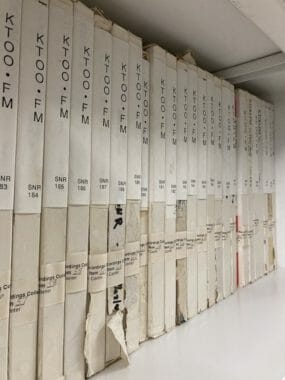
A shelf of old tapes labeled "KTOO" and "SNR"
The Southeast Native Radio collection includes over 400 programs broadcast from 1985-2001. (Photo courtesy of Sealaska Heritage Institute)

The catalog of recordings is lengthy and populated with names that make it a who’s who of Southeast Native culture at the turn of the 21st century.

Nora Marks Dauenhauer, for example, was a leading Lingít language scholar and historian, as well as Alaska’s Poet Laureate. She died in 2017, but her words are now just a click away.

The Southeast Native Radio Recordings collection is available through the Sealaska Heritage Institute, which received the donated DAT tapes, reel-to-reels, and CDs from KTOO in 2010. In all, there are 400 recordings.

Even the most seemingly mundane shows are abuzz with history because the people represent a generational bridge to an even deeper past.

In one of the archived recordings, Roy Peratrovich, husband of Elizabeth Peratrovich, talks about the first of five times he was elected Grand President of the Alaska Native Brotherhood, when he lobbied to bring the Grand Camp to Klawock:

Peratrovich: When you’re young, you do a lot of foolish things…

Host: Was this 1929?

Peratrovich: No, 1939.

Host – 1939, okay.

Peratrovich: So I told the group that if we are going to build up this group, this ANB, we’re going to have to do it big. Pride is going to help us. Not knowing some screwball was going to nominate me for Grand President. So I got elected.

Peratrovich died in 1989, a year after that appearance on Southeast Native Radio.

And there’s basketball, which is a large thread in the cultural fabric of Southeast Alaska. One of the stars of the annual Gold Medal Tournament was Sitkan Herb Didrickson.

He told Southeast Native Radio that the Sitka team had to catch a ride on a seine boat each March for the trip to Juneau.

“As I started to put my gear up in the top bunk, I found this old man was laying up there already,” Didrickson says. “He kind of got on board a little early, and no one knew that he was there. So he was trying to stowaway, you know. So we figured, well, the old fellow wants to go and see some games, and we all couldn’t sleep at the same time.”

Didrickson to this day is considered one of the greatest players produced in Southeast Alaska, whose chances at a pro career were thwarted by WWII. Didrickson died in 2017.

Sealaska Heritage Institute refers to the archive as a “treasure trove,” and that’s not far off. The recordings include a 13-part series produced in 1986 on the history of the ANB. There are also a number of Lingít language segments with fluent speakers like Dauenhauer and Walter Soboleff conversing on a range of subjects.

Note: The Southeast Native Radio Recordings project was supported by a Digitizing Hidden Collections or Recordings at Risk grant from the Council on Library and Information Resources. The grant program is made possible by funding from The Andrew W. Mellon Foundation.

Eagle that died in Sitka park tests positive for bird flu

A bald eagle takes off near Unalaska Bay. (Photo by Berett Wilber/KUCB)
A bald eagle takes off near Unalaska Bay. A handful of bald eagles have tested positive for the virus in Alaska so far this month, including several in Dutch Harbor, two in Anchorage and one in the Mat-Su Valley. (Photo by Berett Wilber/KUCB)

An eagle that died in the Sitka National Historical Park this month tested positive for the avian influenza. A second eagle that died in the park was also tested for the virus, and results are pending.

Jennifer Cedarleaf is the avian director at the Alaska Raptor Center. She said a Sitkan reported a third eagle in his yard on Lance Drive that was exhibiting symptoms of the virus.

“The last time I heard he was laying under a bush … in the gentleman’s yard, and I told him, ‘Just leave the bird be and let me know what’s happening, and I can come check it out later,” Cedarleaf said.

She said a handful of bald eagles have tested positive for the virus in Alaska so far this month, including several in Dutch Harbor, two in Anchorage and one in the Mat-Su Valley. The highly pathogenic bird flu is the worst the country has seen since 2015 and has a high mortality rate for raptors.

Cedarleaf says neurologic symptoms are one indicator that a bird may be suffering.

“Like holding its head strange, or having tremors or having a hard time walking, like stumbling, almost,” Cedarleaf said. “Those are really good signs for avian influenza.”

Once a bird has been tested, it takes a couple of weeks to get results from the samples. Dr. Vicki Vosburg at Pets’ Choice is collecting local samples and sending them to the Washington State University Lab through Alaska’s state veterinarian.

Vosburg says has been challenging for her office and the Raptor Center to suspend their bird rehabilitation services in response to the outbreak.

“Please be understanding when we can’t go out and save a bird,” Vosburg said. “If there’s a situation where an eagle gets hit by a car and its clearly got a broken wing, I will definitely pick up that bird. Unfortunately I won’t be able to do surgery and rehabilitate it. But I will be able to euthanize it and prevent it from suffering out in the wild.”

Cedarleaf said people who own chickens should keep a close eye on their coops. Those with indoor birds should be very aware. She recommends leaving shoes outside in a bucket to prevent tracking in infected bird feces.

If anyone notices a bird behaving strangely, they can call the Alaska Raptor Center’s emergency line at 738-8662 for next steps.

As concerns mount over bird flu, Alaska Raptor Center in Sitka temporarily suspends some services

From the archive: Handler Hannah Blanke holds Zappa while Sheila Swanberg performs an exam. The eagle was treated at the Alaska Raptor Center after running into an electric line (Photo courtesy Britainy Wright)

Alaska reported its first case of the highly pathogenic avian influenza in early May, furthering the spread of what is now an international bird flu outbreak.

In response to the rising number of cases, the Alaska Raptor Center in Sitka has temporarily suspended its bird rescue and rehabilitation services.

“They’re saying [there’s a] 99% chance that raptors that get it will die,” said Jennifer Cedarleaf, the center’s avian director. “So we’re doing everything we can to protect them.”

Bird flu is spread through contact with saliva or feces of an infected bird. Cedarleaf said they’ve moved the eagles that live in the outdoor habitat into their cages, to reduce their risk of exposure to the virus.

“Unfortunately, that means that they’re not on display for the public to see,” she said. “But at this point, we’re more concerned about the safety of our birds.”

Cedarleaf said, unlike COVID, there’s no rapid test for the bird flu. It can take up to two weeks to get the results from a sample. So far, no cases have been reported in Southeast, but Cedarleaf believes that the Alaska Raptor Center may be the only organization in the region that’s currently testing for the virus. So far they’ve tested around 10 birds. All results have come been negative. She said an eagle died in the Sitka National Historical Park earlier this week. They’re waiting on sample results, which she suspects could come back positive.

Cedarleaf said researchers are saying the virus doesn’t like warm weather, and she’s hopeful that cases will die down nationally once the summer hits. But Sitka’s summers aren’t really that warm.

“It likes cold, it likes water, you can’t kill it in the freezer. So once it gets warmer, they’re hoping it will die down,” said Cedarleaf. “And I keep asking them, ‘Well, what is warmer?’ Because we don’t get that warm. I mean, is 65 degrees warm enough? I don’t know. So I’m hoping that it will start to die down once a once we get into the 60s on a more regular basis.”

She said she thinks that, at least for a while, Raptor Center staff will need to be on high alert.

“It takes a lot of brain thought to remember to change your shoes before you go inside a building. To make sure you’re washing your hands constantly before you go from one bird to another bird,” Cedarleaf said. “It’s just like, I’m sure, very similar to what the medical profession was dealing with with COVID. You know, you don’t want to spread it any more than you possibly can… So, it’s hard.”

The center is still open for visitation. And while they’re not currently accepting outside birds, if you encounter a sick or injured bird, you can call their emergency phone line at 907-738-8662 for support.

In far out Yakutat, surfers say community is key

A man squats next to a border collie-looking dog on a beach
Freddie Muñoz with his dog Chula on Cannon Beach (Photo by Tash Kimmell/KCAW)

There are few places in the world where world-class waves meet unobstructed views of a temperate rainforest. For Freddie Muñoz, that’s just a small part of what makes surfing in Yakutat so special.

“It’s pretty amazing when you can be in the water and you’re surfing, and you look down, and there’s salmon that are swimming underneath you. And then there’s terns that are flying above you,” he said. “I’ve surfed in Australia, in Panama. I’ve surfed in Hawaii. I’ve been to these places — and it’s been incredible.”

Muñoz paused and pointed excitedly at a cresting wave.

“There’s sea lions right there that are surfing a wave,” he said. “See that sea lion in the wave right there on the left?”

While the scenery is breathtaking, it’s the community itself which Muñoz finds most unique.

“It’s very welcoming here,” he said. “We wanna surf with other people. We know it’s hard to surf here. You’re in colder water, the currents are really strong.”

People waxing surfboards among driftwood on an Alaskan beach
A group of surfers wax their boards before hopping in the ocean (Photo by Tash Kimmell/KCAW)

It was snowing sporadically at the beach, and a group nearby was trying to get a fire going.

“You kind of need almost, you know, local information, local knowledge,” Muñoz said. “If you plan on getting some really good waves, you have to be able to work with other people.”

Muñoz started surfing 15 years ago after relocating to Yakutat for high school. He says he’s watched the surf community skew younger since he first started.

“It’s just really amazing to see how these kids are just, it’s so intuitive. And they just naturally are just really good at surfing,” Muñoz said. “You know, they’ve looked at the ocean as a way of putting food on their table. And now you can look at the ocean and see it as a form of play.”

A surfer walks toward the water
A surfer heads out toward mild waves near Yakutat in July 2021. (Photo by Jennifer Pemberton/KTOO)

The younger generation getting more involved in the surf community is due in large part to Yakutat’s annual surf camp, which will celebrate its fourth year this summer. That’s where 15-year-old Zoé Bulard first got on a board.

“I never really paid attention to surfing. I’ve never really acknowledged the waves and you know, everything about that,” she said, clicking her long acrylic fingernails together. “But I kind of had the idea in the back of my head, like ‘That would be, you know, that’d be cool. That’d be fun.’ And last summer, my auntie took me out to surf for surf camp. Like I never put on a wetsuit. I never anything until surf camp.”

A young woman carrying a surfboard in a forest
Zoe Bulard at surf camp last year (Photo courtesy of Bethany Goodrich)

Bulard says she still remembers catching her first wave.

“It was, like, the third day of surf camp. And everybody was all tired and the wetsuits were cold. And it was raining the night before. So we all weren’t feeling anything,” Bulard said.

Although learning to surf was challenging at first, Bulard says there’s nothing like the calming feeling of riding a wave.

“And it was like this big wave and everybody’s like, party wave! And like, nobody caught the wave. And I started paddling super hard. And then I was at the top of the wave, and it just felt nice,” she said.

As a kid who grew up in Yakutat, surfing fosters a deeper connection to her home town. But as an Indigenous person, it also brings her closer to the land her ancestors have been on for millennia.

“We’re tied to this land, Indigenously,” she said. “And surfing adds to that.”

Bulard says she hopes the legacy of surfing in Yakutat will continue for generations to come and open more doors for her community, but for now she’s just excited to get back to surf camp.

“I still see it as dangerous and scary,” she said. “But I also see it as a new door, you know. I see it more peaceful and more like a hug from the world.”

A Sitka high rise apartment’s lone elevator has been out of service for more than a year

A 7-story apartment building next to a church
The Cathedral Arms’ first floor is comprised of businesses. Floors two through seven are one-bedroom and studio apartments, with a penthouse apartment on the eighth floor. Tenants say the lone elevator in the building has been on only intermittently for over a year. (Photo by Katherine Rose/KCAW)

Downtown Sitka’s skyline is small but striking. The distinctive St. Michael’s Cathedral in the center of Lincoln Street always draws the eye, juxtaposed against a snow-capped Mt. Verstovia behind it. But there’s one building that overshadows the spire of St. Michaels — an eight-story structure striped in sea foam green and sandy beige.

It’s the Cathedral Arms building, and it’s the largest apartment complex in town. It was built in the early 1950s.

“It’s a sweet old building, and it’s got a lot of character. There’s a lot of good things about it,” Owen Kindig said. He moved into the building in the spring of 2018. He says at first things were good. The views were great, and at $895 a month, it was comparatively affordable for a one-bedroom apartment. Its location was unbeatable. On the corner of the 7th floor, he had a view of Sitka Sound to the south, and Mt. Edgecumbe to the west.

“We had the two best views in Sitka,” Kindig laughs. “And we had, initially, a cordial relationship with the landlord. Things worked out well.”

But by the summer of 2019, things had changed. Kindig opened an AirBnb to rent out the apartment when he and his wife were traveling. Around the same time, the building’s lone elevator started having mechanical problems. Often, it was out of service — without warning. Kindig says he didn’t mind the exercise, but climbing six flights of stairs bothered his guests.

“We had problems, because they needed the elevator. They were coming in with suitcases. Often they were elderly, and they needed to have the elevator,” Kindig said. “And when the elevator wasn’t working, we didn’t get good information from the landlord.”

And Kindig started to notice some of his neighbors were struggling as the elevator went out of service for longer periods, sometimes weeks at a time.

“We knew one person who was, you know, disabled, and couldn’t walk up the steps. And I don’t know how they managed,” Kindig said. “It seemed impossible for them to manage. And yet, they were still there when we left.”

The Kindigs moved out in the fall of 2019. Since the winter of 2020 through March of 2022, tenants say that the elevator has been off. This spring they invited me to visit Cathedral Arms, and I discovered for myself that it was still off.

I spoke with six tenants who currently live in Cathedral Arms, and two who recently moved out. They all said they had no access to the elevator for somewhere between 13 and 16 months. All except Owen Kindig asked to remain unidentified in this story, some for fear of losing their housing.

I also spoke with the owner of the building, a local businessman named Kelly Pellett, who declined to comment. The elevator, however, I’ve learned has been on intermittently since I spoke to him. Then, on April 4, the state Office of Mechanical Inspection issued a cease and desist order after an investigation determined that he may have been operating the elevator without a valid certificate. Until the owner makes the necessary repairs to get the elevator recertified, the state says the elevator must remain off.

The tenants are frustrated with the situation. Some said they’d approached city officials, reached out to Alaska’s congressional delegation, and called state agencies — all without success. That’s because it’s not necessarily illegal for a multi-story apartment complex to go without a working elevator for over a year. And the reasoning is not straightforward.

“When it comes to civil things where there’s not an immediate threat to life and safety, the Alaska public — the Sitka public — doesn’t have much appetite for enforcement that’s really compulsory,” said Scott Brylinsky, a former Sitka building official.

Brylinsky says the city and state do enforce regulations dealing with life and safety. For example, at the Cathedral Arms — years ago — the state fire marshal required the building’s owner to install an exterior fire exit. It was an expensive but necessary addition.

But an out-of-service elevator doesn’t fall into that category. Sitka has never adopted Chapter 11 of the International Building Code, which spells out accessibility requirements for buildings, including elevators. And Brylinsky believes that adopting these codes retroactively in Alaska is politically and practically impossible, due to the burden it would put on private businesses.

“There’s so many places that it can be an issue that I don’t see in a libertarian state like Alaska. You get the government coming in and telling businesses they have to make changes by a certain date or get shut down, or be subject to enforcement action, or be fined,” Brylinsky said. “It just would never work.”

Sitka’s current building official could not comment for this story. Municipal administrator John Leach released a statement confirming that Sitka has not adopted the accessibility requirements in the IBC, and stating that the city believed that matter fell under the federal Americans With Disabilities Act, or ADA, and that tenants could file complaints with the US Department of Justice.

At the state level, Alaska’s Office of Mechanical Inspection certifies elevators for operation as long as they meet certain safety standards. Although no one in the OMI agreed to an interview, in an email, the state’s Chief of Mechanical Inspection, Scott Damerow, said they inspected the Cathedral Arms elevator last July. It did not pass inspection, so they placed it fully out-of-service, pending repairs to bring the elevator back up to code.

Damerow said as far as OMI is concerned, shutting off an elevator is considered “an acceptable alternative to an expensive repair or retrofit.” Once the owner makes repairs to put the elevator back in service, Damerow says they’ll inspect it. But until then, it’s out of their hands.

Municipal Administrator Leach is likely right that this is a matter covered under federal law — but maybe not under the Americans With Disabilities Act.

“The fact that it’s been like this for so long, and they have been trying to get help is concerning,” Leslie Jaehning said. She’s a staff attorney with the Disability Law Center of Alaska. Jaehning says it’s a common misconception that the ADA covers all residential housing. Rather, it covers public accommodations.

However, most privately owned apartment complexes are covered under the much older Fair Housing Act. The FHA prohibits housing providers from discriminating against people with disabilities.

“If somebody is not able to access their home, you know, because their disability makes it unable to go upstairs or things, that is discriminatory,” Jaehning said.

She says under the FHA, if a building has an elevator, the landlord must keep that elevator in working order and repair it quickly if it breaks down, to ensure tenants with disabilities have equal access to their homes. That, or provide a reasonable accommodation.

Jaehning also says there may be even more protections if the landlord gets subsidies for providing housing to low income tenants. She says tenants who believe they’ve been discriminated against can file a complaint with the Alaska State Commission for Human Rights.

But what about the tenants who don’t have disabilities? Do they have any recourse?

“Probably not under the Fair Housing Act, though I would say that the definition of disability under the Fair Housing Act is very broad,” Dan Coons said. He’s an attorney with Alaska Legal Services, a nonprofit law firm that provides free civil legal services to low-income Alaskans.

“There may be some good arguments that state landlord tenant law applies, and that the landlord has a duty under state landlord tenant law to make these kind of repairs,” Coons said.

He says another step tenants can take is filing a civil suit, if they believe the state’s landlord tenant law is being violated.

“It’s a matter of going to the courts and the tenants asserting their rights under the state Landlord-Tenant Act through a lawsuit, but that’s not a small undertaking. It takes a lot of work to get a lawsuit like that in front of the court successfully.”

Compelling a landlord to make repairs under state law through the courts could be both costly and time-consuming. And it doesn’t help tenants right now, who are holding out hope that the elevator will be fixed soon.

“I think that a landlord has a responsibility to the people he serves to keep them healthy and safe,” said former tenant Owen Kindig.

It’s been more than two years since Kindig lived in Cathedral Arms, but he still worries about his former neighbors. He hopes someone will step in to help them.

“I think it’s unsafe. It’s a nuisance, it’s a danger to the people who are living there to not have a working elevator,” he said.

No, Mt. Edgecumbe is not about to blow, scientists say

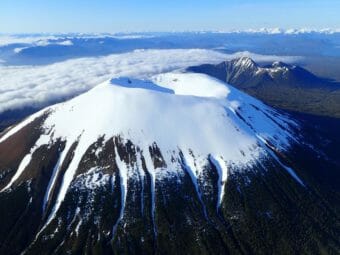
Baranof island’s Mount Edgecumbe volcanic cone rises 3,200 feet from the ocean near Sitka. (Ed Schoenfeld/CoastAlaska News)

Seismologists have detected some unusual activity below the long-dormant Mt. Edgecumbe volcano near Sitka. Its last major eruption was 4,500 years ago.

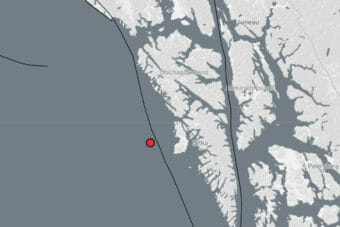
The Alaska Volcano Observatory reports that a swarm of small earthquakes occurred somewhere deep below the mountain beginning on April 11 — but it’s too early to tell if that signals an eruption could be on the way.

Mt. Edgecumbe is just a few miles from the Queen Charlotte Fault, where the North American Plate and the Pacific Plate are slipping in opposite directions at the rate of about two inches per year. So there’s always a lot of ordinary, background tectonic activity in the area.

But the swarm on April 11 was out of the ordinary.

“What sort of makes this current bit of activity different is that there have been some larger earthquakes in sort of the magnitude two range that are locatable, but also many, many that are too small to be located,” said Dave Schneider, a geophysicist with the U.S. Geological Survey’s Alaska Volcano Observatory in Anchorage. The swarm consisted of these larger magnitude 2 quakes accompanied by hundreds of smaller ones – all relatively shallow, at around 5 to 10 kilometers below sea level.

Most series of earthquakes start with a larger earthquake — a mainshock — which is followed by a series of smaller earthquakes called aftershocks. When a series of earthquakes has no clear mainshock that set it off, it’s often described as a swarm.

The vast majority of the earthquakes in this swarm have been too small to be felt, though Sitka is only about 12 miles away from the crater. But some were strong enough to be located accurately with seismic stations in Sitka and elsewhere in Alaska.

“A two is a good-sized, rock-breaking earthquake at a volcano, but also nothing that’s going to make your jaw drop and be really alarmed either,” Schneider said.

Schneider says the April 11 swarm has tapered off a bit, which is a good thing. But that doesn’t mean the event is over. He says that in the medical world, they call it watchful waiting.

“Seismic swarms of volcanoes can wax and wane,” he said. “I mean, they can start off with a bang and sort of fizzle out, they can sort of start with a with a whimper and increase, or they can sort of oscillate back and forth. And so, we’re just going to be in a period of just watching and sort of seeing what’s going on.”

“We’re a long way off from an imminent eruption, or an eruption at all,” said Jacyn Schmidt, the geoscience coordinator at the Sitka Sound Science Center. When she heard from a community member that there was a quake below Mt. Edgecumbe, she called the USGS and learned about the swarm, even before the Alaska Volcano Observatory issued its preliminary report.

“I had been talking to seismologists there who assured me that the earthquakes were very small,” she said, “which is true, but it’s unusual for them to be happening beneath Mt. Edgecumbe in the pattern that they’re seeing now.”

Schmidt considers Mt. Edgecumbe an exciting research opportunity. There are no concrete plans yet, but she hopes the Science Center can assist the USGS with local monitoring of the volcano.

Dave Schneider shares Schmidt’s enthusiasm. There are 90 volcanoes in Alaska, four of which are currently erupting along the Aleutian chain. There’s even another seismic swarm occurring at the Davidoff volcano, far out in the chain.

If the activity is tied Mt. Edgecumbe, Schneider says that wouldn’t be all that unusual.

“The best case scenario for everyone — if you don’t like eruptions — is that is that a dies out,” he said.

Another possibility is more appealing to fans of eruptions, and it doesn’t necessarily mean disaster.

“The oral tradition is that 800 years ago, there was some activity, but it was minor,” Schneider said. “So if you look at the big scale of volcanic activity, minor activity is much more common than big activity.”

Schneider says that the Alaska Volcano Observatory will keep more than an eye on Mt. Edgecumbe. Satellite radar data collection is already underway to monitor the crater for deformation, in the event that magma or hydrothermal fluids cause the mountain to bulge.

Schneider says other signs that could signal a possible future eruption would more earthquakes, larger earthquakes or gas emissions.

Site notifications
Update notification options
Subscribe to notifications