KCAW is our partner station in Sitka. KTOO collaborates with partners across the state to cover important news and to share stories with our audiences.
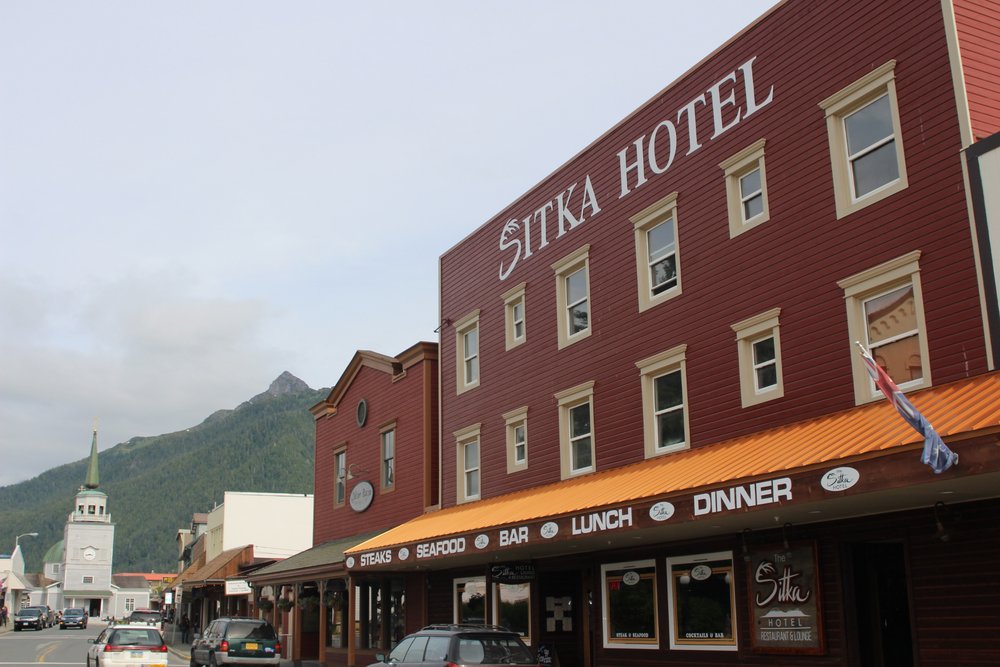
The owners of the Sitka Hotel have approached the city about purchasing Sitka Community Hospital. Their interest is in unexpected development in Sitka’s ongoing effort to decide the future of health care in the community. (Photo by Emily Kwong/KCAW)
The owners of a local hotel and restaurant are interested in purchasing Sitka Community Hospital.
Their inquiry comes less than two weeks before the Assembly is scheduled to consider a competing offer by the Southeast Alaska Regional Health Consortium.
Rob and Deborah Petrie own the Sitka Hotel and in scoping out their next business venture, they’re looking seriously at Sitka Community Hospital.
Rob Petrie said they plan to come before the Assembly on July 25 with an offer pending a tour of the facility and a look at the hospital’s financial statements.
Right now, the major offer on the table is from the Southeast Alaska Regional Health Consortium who want to merge operations.
The Petries are originally from Fort Worth, Texas, where they have a modest but diverse portfolio.
“Every business is the same,” Rob Petrie said. “We own car dealerships, we own storage facilities, we own tunnel car washes, we own several doctor’s offices that we lease back to hospitals.”
Moreover, he believes the business of a hospital is the same as that of a doctor’s office – just scaled up.
“You don’t have to be a doctor. You don’t have to have a special degree,” he said. “You just have to have the ability and the means to make this type of business work. We wouldn’t buy it if we didn’t think we could make it work and much better than it is now.”
Should the Assembly approve the sale, Petrie said he’d hire a management company or private entity to run the hospital.
His preference is to look internally when hiring staff.
“We’d hire a CEO and a CFO and a couple upper management people to really make sure things are going the way they should and that it’s making money,” Petrie said. “But I wouldn’t be interested in firing anybody and replacing them with anybody without a more thorough evaluation.”
Their offer still is a hypothetical, though quickly in the making. The Petries met recently with city staff.
They have not yet drafted a formal offer, nor named a dollar amount. But they wants their offer to be competitive.
SEARHC has pledged $6.5 million up front, and $600,000 every year for five years to lease the building.
Petrie said he’d pay “a little more.”
He’s also open to a buyback program, where the city leases the hospital from them and it continues it as a non-profit.
No matter the outcome, he wants to provide quality care and buck a national trend of consolidation by keeping two hospitals in Sitka.
“You should have a choice and if one hospital buys the other only hospital in town, what does that sound like to you? Sounds like a monopoly,” he said.
Hospital administration and the board leadership declined to comment on his emergent interest. It’s really for the Assembly to decide how seriously to take their proposal.
They’ll next discuss healthcare Thursday, July 13, at a special meeting with Sitka Community Hospital.
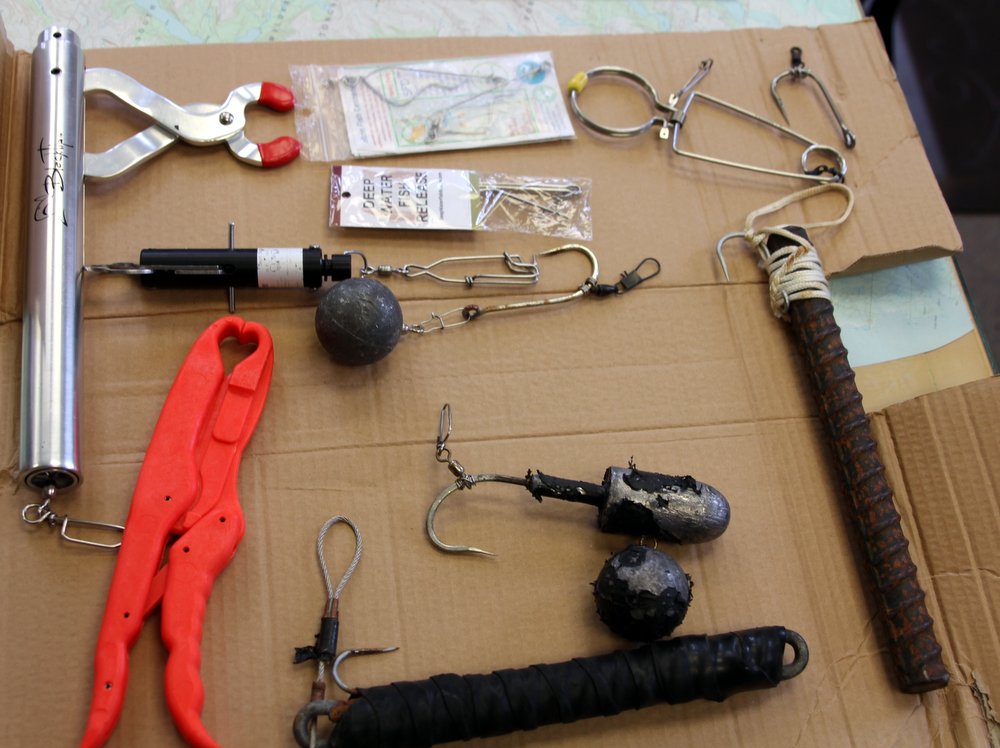
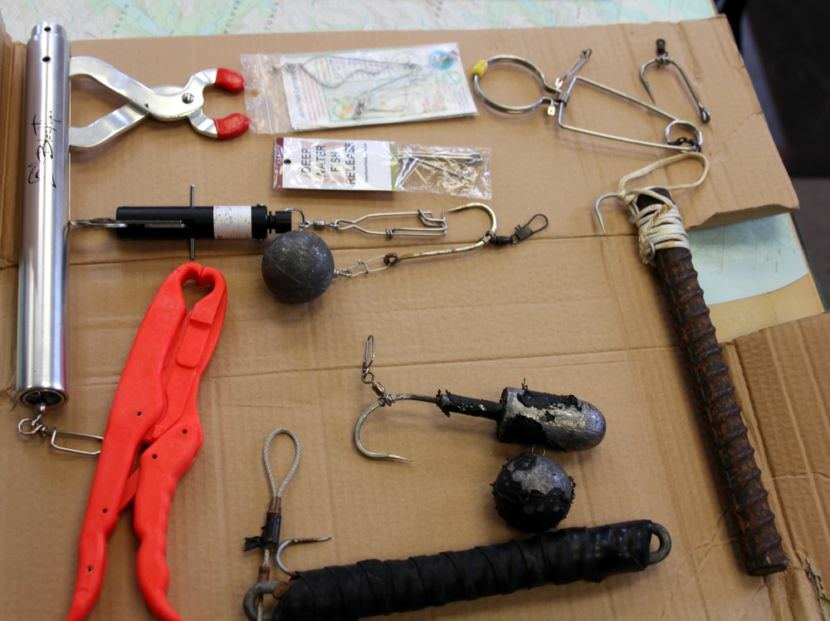
Take your pick: Whether homemade or a commercial design, every sport fishing boat in Southeast Alaska must have a deep-release mechanism on board beginning August 1. (Photo by Robert Woolsey/KCAW)
For sport anglers in Southeast Alaska having a slow day trying for salmon or halibut this August there will be no “plan B” for bottom-dwelling rockfish.
The Alaska Department of Fish and Game is closing all sportfishing for nonpelagic rockfish in outside waters from Yakutat to Ketchikan for three weeks beginning Aug. 1, to conserve these long-lived, slow-growing species.
Those fishing inside waters will have a bag limit of one.
A favorite species of pelagic rockfish — called a black bass, or black bomber — is unaffected by the emergency order. The sport bag limit remains five fish per day.
This is about more than yelloweye, the large, bright orange rockfish that sometimes is called “snapper,” and sometimes saves an otherwise bad fishing trip.
The roster of nonpelagic rockfish sounds like the currency of an exotic country.
“Quillbacks are common. Coppers,” said Troy Tydingco, who’s sitting at table in his office in Sitka, where he’s the sportfish management biologist. “Then there are some small ones that are also common: rosethorns, canaries. I’ve seen some vermillions recently. There are some really interesting ones like the tiger, the China, the red-banded.”
And don’t forget silvergrays, bocaccios, and harlequins.
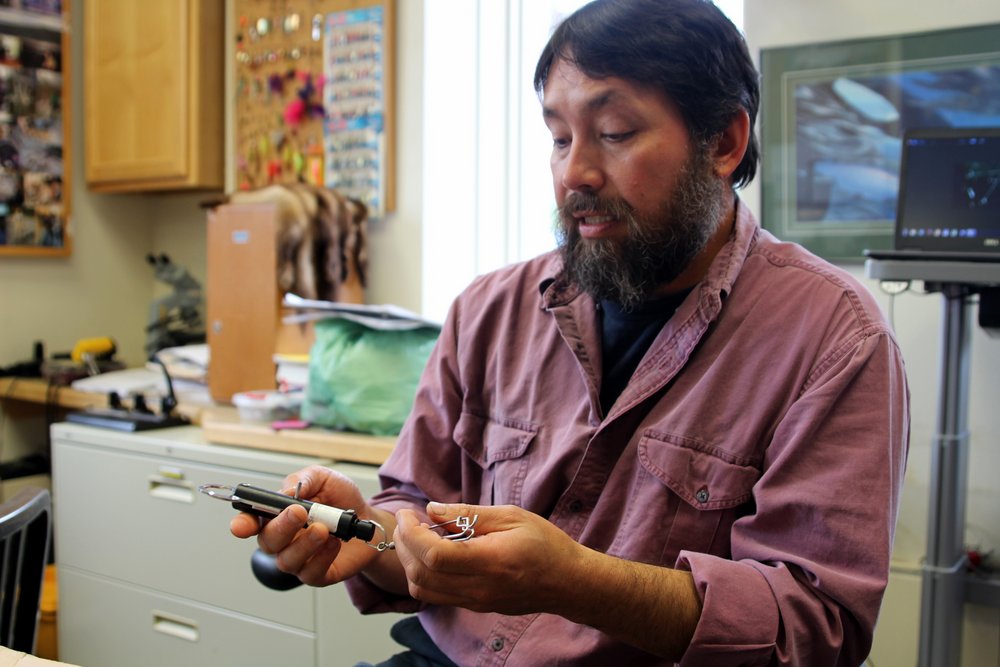
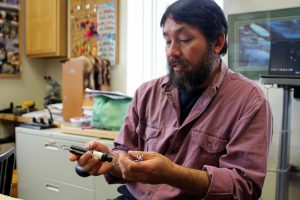
Biologist Troy Tydingco says rockfish can survive barotrauma if they’re promptly released at depth. “Get them back down quickly,” he says. (Photo by Robert Woolsey/KCAW)
Spread out before Tydingco is what appears to be a fairly menacing arsenal of tools to hook, pinch, clamp, or otherwise catch fish.
“The idea with pretty much all of them is that you’re going to be able to get a rockfish back down at depth. Because rockfish have got that closed swim bladder, when you bring them up they’re subject to barotrauma,” he said. “You’ve probably seen where their stomach comes out, their eyes pop out. If you can get them down back quickly where they’re back under pressure, it reverses all those effects.”
Barotrauma is as deadly as it sounds.
Tydingco said only 20 percent of rockfish survive it. The distended swim bladder doesn’t allow them to return to the bottom, and they remain helpless on the surface, easy pickings for an eagle.
On the other hand, 95 percent of the rockfish released with one of these devices live.
For three weeks, from Aug. 1 through 22, sport anglers in outside waters are going to have let all non-pelagic rockfish go — at 100 feet of depth.
Just as charter operators have been doing for several years, all fishermen are going to have to have a deep release mechanism with them on the boat.
It doesn’t have to be fancy — even though it can be.
Tydingco’s got one he’s made from an 8-inch piece of rebar, with a big fishing hook taped to it.
The barb on the hook has been pinched down.
“Usually the way I use this is that same hole that you catch the fish in, put the hook through there, and just send it down.”
Tydingco ties 100 feet of line to his homemade release mechanism, and cleats it off to his boat.
When the rockfish is back under pressure, it recovers instantly, slides off the hook, and heads for the bottom.
Another commercial mechanism has a pressure-activated switch that allows users to choose a depth.
“Some people use these on their downrigger. Send them down and they pop right open.”
There’s a video on the Fish & Game website showing how these things work underwater.
In addition to closing the coastal waters of Southeast Alaska to the retention of rockfish, the emergency order also limits sport anglers on inside waters around Ketchikan, Petersburg, Wrangell, and Juneau to one nonpelagic rockfish.
But the effect is nearly the same: After that first fish, you’ll have to release all the others — also at a depth of 100 feet, if you’re aboard a charter boat.
This is the first time Fish and Game has closed the rockfish sport fishery — but it’s not out of concern that sport anglers have been catching too many.
According to data gathered in the statewide harvest survey, creel survey, and charter logbooks, the harvest has remained fairly constant, at about 16 percent of the Total Allowable Catch (or TAC) for nonpelagic rockfish.
Instead, it’s the TAC itself that’s dropping — from 66 metric tons in 2006, to 35 metric tons this year.
This is of concern. Rockfish don’t rebound the way some other species do. In fact, their lifespans our better than ours.
“They vary by species. A big yelloweye, it’s not uncommon for them to exceed 100 years.”
Tydingco said they’re slow to reproduce.
Again, depending on the species, some rockfish don’t reach sexual maturity for at least 12 years.
Other than conserving stocks, there’s no biological objective behind the August closure.
“We could have chosen any three weeks,” Tydingco said. “We wanted to make sure there were plenty of coho around to target instead.”
Professional basketball player, Carlos Boozer talks with KCAW’s Cameron Clark about his upcoming basketball camp in Juneau.
It will be from July 31 to August 4, at Juneau-Douglas High School, Boozer’s alma mater. All skill levels are welcome.
Along with coaches and staff, Boozer will be helping players, ages 5-18, hone their skills with various drills and scrimmages throughout the camp.
There will be giveaways and other surprises throughout the week too.
“I had a lot of people help me along my journey,” Boozer said. “I want to be able to share what I learned with other kids and hopefully help them along their basketball journey.”
The two-time NBA All-Star played for the Cleveland Cavaliers, Utah Jazz, Chicago Bulls and the Los Angeles Lakers. He also won a bronze medal at the 2004 Summer Olympics and a gold medal at the 2008 Summer Olympics.
Take your pick: Whether homemade or a commercial design, every sport fishing boat in Southeast Alaska must have a deep-release mechanism on board beginning August 1. (Photo by Robert Woolsey/KCAW)
For sport anglers in Southeast Alaska having a slow day trying for salmon or halibut this August, there will be no “Plan B” for bottom-dwelling rockfish.
The Alaska Department of Fish and Game is closing all sport fishing for nonpelagic rockfish in outside waters from Yakutat to Ketchikan for three weeks beginning August 1, to conserve these long-lived, slow-growing species. Those fishing inside waters will have a bag limit of one.
A favorite species of pelagic rockfish — called a Black Bass, or Black Bomber — is unaffected by the emergency order. The sport bag limit remains five fish per day.
This is about more than yellow eye, the large, bright orange rockfish that sometimes is called “snapper,” and sometimes saves an otherwise bad fishing trip.
The roster of nonpelagic rockfish sounds like the currency of an exotic country.
“Quillbacks are common; coppers, and then there are some small ones that are also common: rosethorns, canaries. I’ve seen some vermillions recently. There are some really interesting ones like the tiger, the china, the red-banded.”
And don’t forget silvergrays, bocaccios, and harlequins.
Biologist Troy Tydingco says rockfish can survive barotrauma if they’re promptly released at depth. “Get them back down quickly,” he says. (Photo by Robert Woolsey/KCAW)
Troy Tydingco sits at a table in his office in Sitka, where he’s the sportfish management biologist. Spread out before him is what appears to be a fairly menacing arsenal of tools to hook, pinch, clamp, or otherwise catch fish.
“The idea with pretty much all of them is that you’re going to be able to get a rockfish back down at depth. Because rockfish have got that closed swim bladder, when you bring them up they’re subject to barotrauma. You’ve probably seen where their stomach comes out, their eyes pop out. If you can get them down back quickly where they’re back under pressure, it reverses all those effects.”
Barotrauma is as deadly as it sounds. Tydingco says only 20 percent of rockfish survive it. The distended swim bladder doesn’t allow them to return to the bottom, and they remain helpless on the surface, easy pickings for an eagle.
On the other hand, 95 percent of the rockfish released with one of these devices live.
For three weeks, from August 1 through 22, sport anglers in outside waters are going to have to let all non-pelagic rockfish go — at 100 feet of depth. Just as charter operators have been doing for several years, all fishermen are going to have to have a deep release mechanism with them on the boat.
It doesn’t have to be fancy — even though it can be. Tydingco’s got one he’s made from an eight-inch piece of rebar, with a big fishing hook taped to it. The barb on the hook has been pinched down.
“Usually the way I use this is that same hole that you catch the fish in, put the hook through there, and just send it down.”
Tydingco ties one-hundred feet of line to his homemade release mechanism, and cleats it off to his boat. When the rockfish is back under pressure, it recovers instantly, slides off the hook, and heads for the bottom. Another commercial mechanism has a pressure-activated switch that allows users to choose a depth.
“Some people use these on their downrigger. Send them down and they pop right open.”
There’s a video on the Fish & Game website showing how these things work underwater.
In addition to closing the coastal waters of Southeast Alaska to the retention of rockfish, the emergency order also limits sport anglers on inside waters around Ketchikan, Petersburg, Wrangell, and Juneau to one nonpelagic rockfish. But the effect is nearly the same: After that first fish, you’ll have to release all the others — also at a depth of 100 feet, if you’re aboard a charter boat.
This is the first time ADF&G has closed the rockfish sport fishery — but it’s not out of concern that sport anglers have been catching too many. According to data gathered in the statewide harvest survey, creel survey, and charter logbooks, the harvest has remained fairly constant, at about 16-percent of the Total Allowable Catch (or TAC) for nonpelagic rockfish. Instead, it’s the TAC itself that’s dropping — from 66 metric tons in 2006, to 35 metric tons this year.
This is of concern. Rockfish don’t rebound the way some other species do. In fact, their lifespans are better than ours.
“They vary by species. A big yellow eye, it’s not uncommon for them to exceed 100 years.”
And Tydingco says they’re slow to reproduce. Again, depending on the species, some rockfish don’t reach sexual maturity for at least twelve years.
Other than conserving stocks, there’s no biological objective behind the August closure. “We could have chosen any three weeks,” Tydingco says. “We wanted to make sure there were plenty of coho around to target instead.”
A movement to vote in independent directors and remove CEO/President Ken Cameron is gathering steam online and on the ground. Shareholders made protest signs in advance of the annual meeting last month. (Photo courtesy of Shee Atiká Shareholders Facebook page)
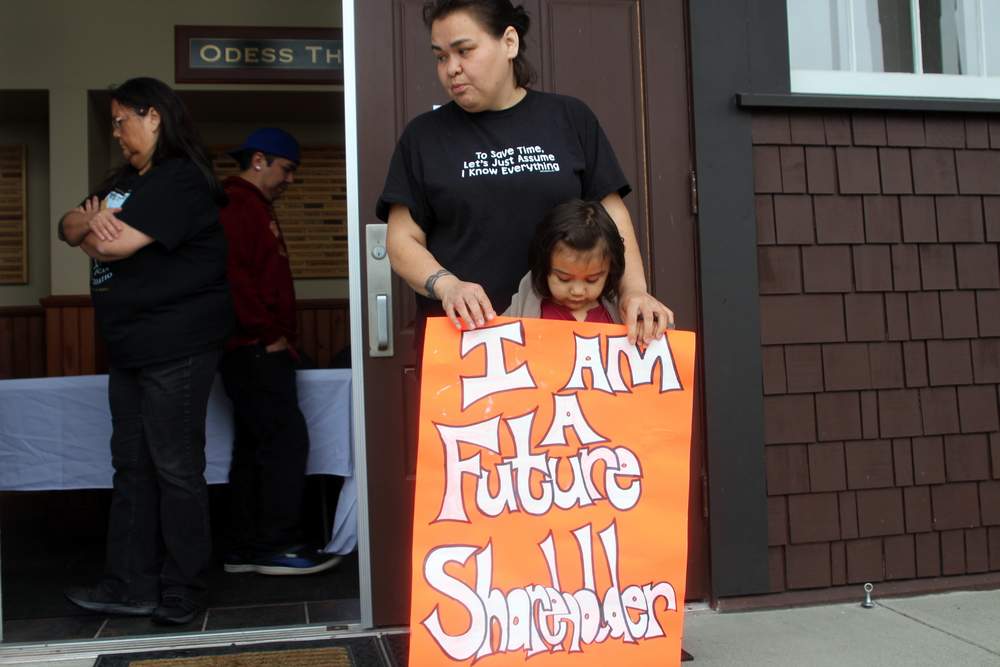
Bunny Blackbird with her mother, Martina Dundas, a partial shareholder born after ANCSA was signed in 1971. Shee Atiká issues distributions to shareholders, funeral benefits, and scholarships. (Photo by Emily Kwong/KCAW)
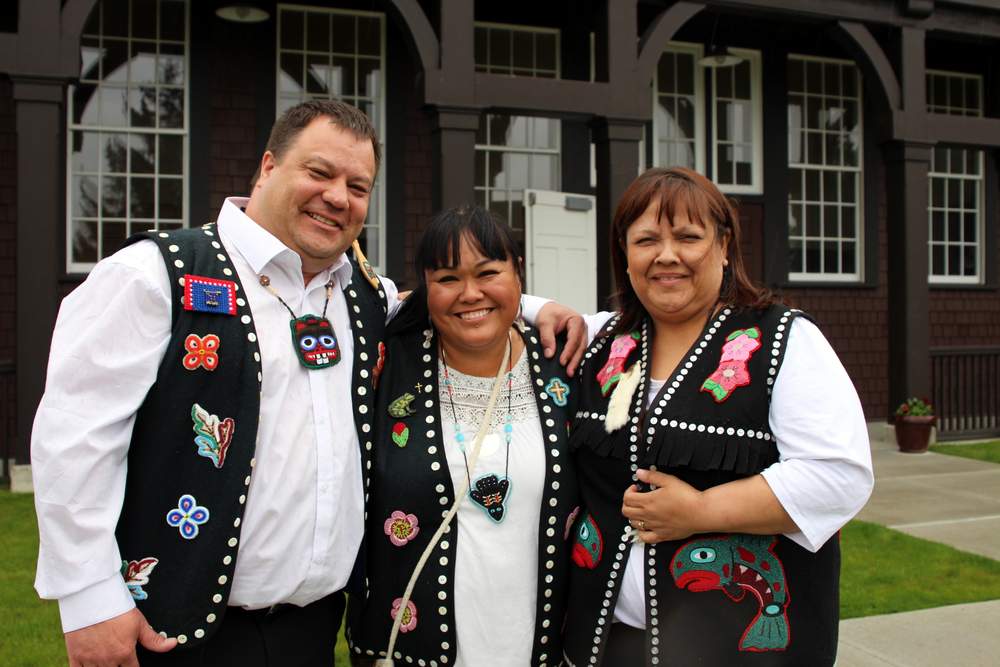
Laurence Garrity, left, Dionne Brady Howard, and Lillian Young pose. Nearly 98,000 independent proxies were handed in, which was enough to put Garrity on the nine-member board of directors. (Photos by Emily Kwong/KCAW)
Shee Atiká called Sitka police to the annual meeting twice out of a concern for public safety. They said shareholders had made threats in person and online in the past. (Photo by Emily Kwong/KCAW)
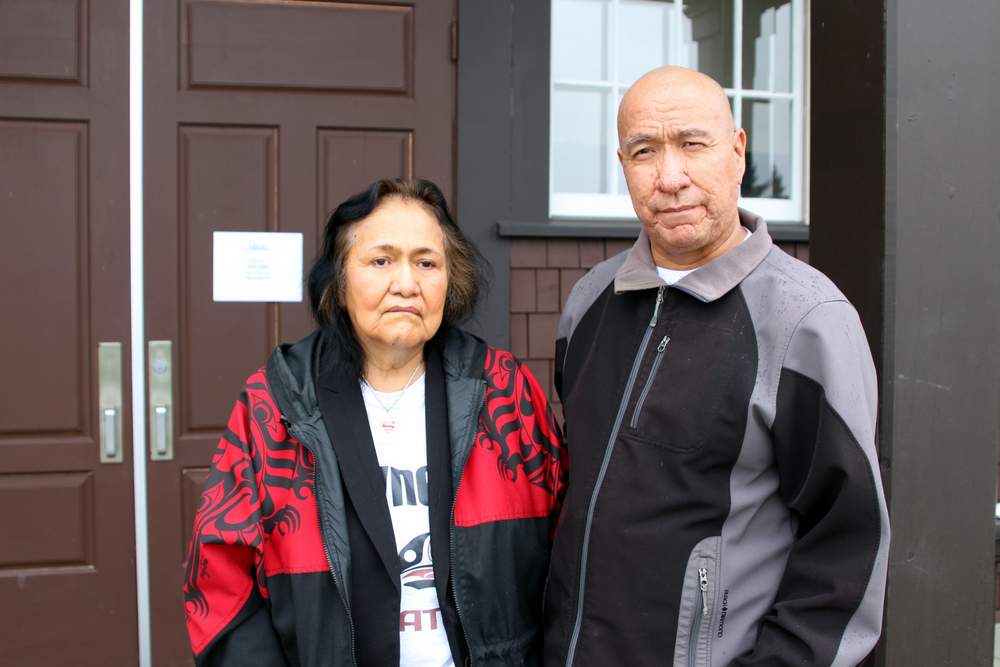
David and Eloise Kanosh return to the meeting after a three-hour recess to count votes. “I used to support the board. I used to support Ken Cameron. The way they’re treating everyone now, things have got to change,” David said. (Photo by Emily Kwong/KCAW)
Tension between a Native village corporation and its shareholders has reached a boiling point.
Shee Atiká called Sitka police to their annual meeting, saying threats had been made against staff and the board.
Shareholders have a different story: one of raising their voices against a corporation in financial free-fall and calling for new leadership.
Shee Atiká has 3,000 shareholders.
Christine Silvanio is one of them. She flew all the way from New Jersey to attend the annual meeting May 20, but was asked to leave when two staff members noticed she was live-streaming the gathering over Facebook.
She stood alongside Margaret Carlson of Sitka. They huddled outside the front door of Allen Hall, as the rain poured and shareholders milled about.
“Basically, they both threatened to have me escorted out,” Silvanio said.
“I interpret it as they’re hiding something,” Carlson said.
The purpose of the meeting is to elect three board members.
The corporation recommended incumbents Joshua Horan, Faleene Worrell and Shirley Yocum for those slots, while a grassroots movement put together their own slate of candidates: Laurence Garrity, Roxanne Drake Burkhart and Lillian Young.
Calling themselves Shareholders for Shee Atiká’s Future, the group organized through a 1,000-plus member Facebook page.
”It’s time for a change,” Carlson said. “All (current leadership) has done is take our corporation down millions of dollars.”
As of the last annual report in 2015, Shee Atiká’s revenue had plummeted to $3 million.
In a letter to shareholders, Cameron attributed this nosedive to a variety of things, from outstanding debts to negative cash flow from Shee Atiká’s hotels to a loss of federal contracts.
To shareholders, the recovery has been slow and questionable. Funeral benefits and scholarships have been trimmed, while Cameron’s salary has only grown. He made $411,000 in in 2016.
Shee Atiká is selling thousands of acres of its land in Cube Cove to the Forest Service to bring the corporation back into the black.
Mike Kinville, a shareholder based in North Pole, is worried the corporation is on the path toward landlessness and bankruptcy.
“It’s not a corporation to me. It’s not a business to me. It represents my legacy,” Kinville said. “As a Tlingit man, it’s my responsibility to pass it to my descendents. But when I see it being run like this … and if you look at the financials, you can see that it’s failing.”
Shee Atiká’s business strategy isn’t the only thing raising tempers today, it’s also how they’re treating shareholders.
Unlike some other Native corporations, independent candidates for Shee Atiká’s board are not allowed to run on the same ballot – called a proxy.
When an independent group of shareholders mailed out their own proxy with their own money, Shee Atiká put up a regulatory block: They claimed one of the three independents – Lillian Young – was ineligible to run.
The morning of the meeting, a huge wave of people showed up – filing past those two police officers Shee Atiká called – to hand in their proxies.
The board closed polls about 9 a.m., as planned, and went into recess for three hours to count votes, refusing to take questions like it had in the past.
This left roughly 200 shareholders, many of them elders, waiting and frustrated.
David Kanosh is blind. He returned with his arm looped around his mother’s, Eloise.
“We just went home after all of this. I was too upset to stay around,” David Kanosh said. “When you can’t see where you’re going and nobody’s helping you, this is disabled abuse. This is elder abuse.”
Shee Atiká did not return KCAW’s requests for comment after the meeting, but later published a statement on their website, saying they didn’t intend to mistreat anyone and the elections inspector needed time to properly count all the votes.
They called police out of concern, claiming threats had been made in the past.
Shee Atiká called Sitka police again around lunchtime. Police Lt. Lance Ewers said they were concerned about public safety.
“They knew it would be very emotional,” Ewers said. “They just don’t want anybody getting in trouble or causing a ruckus.”
Shareholders did come bearing protest signs and boisterous attitudes, but not much else.
Officers determined there was no threat to public safety and left.
Both sides, it seemed, had their defenses up: Shee Atiká stonewalling any attempt by shareholders to speak, and shareholders voicing that outrage at will.
While KCAW was standing in the foyer of the building, the corporation’s lawyer – Bruce Edwards – said no press were allowed in the building.
“If you want to talk to them out there, take pictures out there … but not inside the premises,” he said.
Then, along with staff, Edwards shut the door. Carlson and Silvanio – she’s the one who was livestreaming – were pretty upset.
“See how they treat us. This is how they treat us,” Silvanio said
Many shareholders said the conduct of staff and the board was especially hurtful given Shee Atiká’s history.
Native and Native village corporations were created to protect rights and sovereignty, from the oldest shareholder to the youngest.
Bunny Blackbird came with an orange sign that said, “I am a future shareholder.”
Her mom, Martina Dundas, is a partial shareholder, born after the Alaska Native Claims Settlement Act was signed in 1971.
The way the corporation is going, she’s worried her daughter is going to inherit nothing.
“(Bunny) got on the microphone in there, after they adjourned for the first intermission,” Dundas said. “She said, ‘I want Shee Atiká to be saved.’ And she said, ‘Amen.’ Many people in there had tears in their eyes as they said, ‘Amen’ as well. I don’t want this corporation to go away. I want it to be a legacy of their grandchildren, my great-grandchildren.”
From inside, we hear a chorus of applause and cheering. The independent movement just got a break: enough votes to unseat Shirley Yocum, a board director for 30 years, with newcomer Laurence Garrity.
Dundas let out a big exhale. “Finally, it seems like we have somebody that has our interests.”
The meeting is over. The board is about to convene behind closed doors.
Carrying a huge stack of papers, Garrity hopes his election will send a message to Shee Atiká.
“You know, in nine days, we got 98,000 votes,” Garrity said. “In three weeks, they got 90,000. They need to listen to our elders, listen to our people.”
As for the independent movement? They’re gathering steam, raising money through silent auctions, crowdfunding and other means to support more independent representation and attempt to remove Cameron entirely.
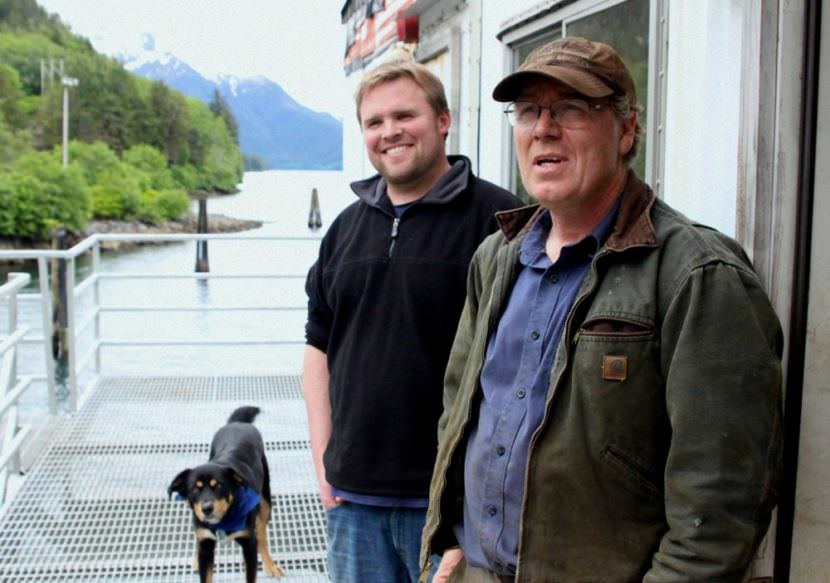
Pat Glaab, right, Ben Blakey, middle, and Roger aboard their processor at Sitka’s Gary Paxton Industrial Park. They’re staking around $2 million on the idea that fish buyers will pay a premium for Bristol Bay sockeye that’s been chilled down immediately after harvest. (Photo by Robert Woolsey/KCAW)
Alaska’s Bristol Bay sockeye fishery is intense, lucrative — and also remote. Much of the fish landed there is frozen whole and shipped long distances for secondary processing.
Although the product is famous, there are some who think the quality could be improved. In Sitka, a pair of entrepreneurs is betting $2 million that they can deliver a better Bristol Bay sockeye. Meet Northline Seafoods.
The relentless pace of sockeye fishing can’t be overstated: two openings a day, four hours between openings, with harvests topping 13 million pounds a day during the peak of the season in June.
Twelve processors buy fish in Bristol Bay. And next year there will be a thirteenth: Northline.
“They’ll go under the deck. There’ll be three more of these ice machines here…”
This is Pat Glaab, who with his partner, Ben Blakey, has bought a 150-foot former helicopter logging barge and is converting it into a floating fish processor.
When it’s done this facility will be able to freeze up to 300,000 pounds of whole sockeye a day — while tied to the banks of the Ugashik River, about 85 miles south of Naknek, where the nearest processors are located.
But right now these guys are over 800 miles away from Bristol Bay, in a makeshift office aboard the barge moored at Sitka’s industrial park.
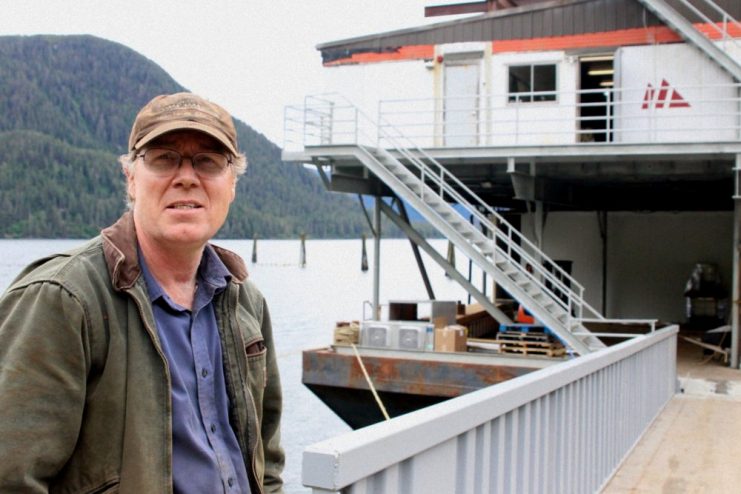
Formerly a heli-logging operation from Dall Island, the Northline barge gets a retrofit in Sitka. The topmost structure — once a helipad — will be used for net storage. (Photo by Robert Woolsey/KCAW)
Not many people get out this way, according to Blakey’s dog Roger. Any other year, both Blakey and Glaab would be fishing in Bristol Bay now, instead of building a seafood plant. Blakey has leased out his boat for the summer.
Blakey: “I spent pretty much every summer in Bristol Bay since I was a kid — that’s actually where I met Pat.”
Glaab: “We were fishing partners when we both started fishing in the bay many years ago. He was in college at the time. Me being just after Leader Creek, building a plant there, getting a little bit into the fishing end of things. So we partnered for a few years, and we’ve kept close since.”
Their idea is simple: ice, where it’s needed. The length of time a Bristol Bay sockeye spends in the hold of a gillnetter or seiner until it’s delivered to a tender or processor is highly variable. The distances between the river systems in the bay are huge. Some fishing boats are equipped to refrigerate seawater to cool down their catch; most are not.
Blakey and Glaab want to close that gap.
“There’s a real need in the bay for chilled fish. There’s nobody in the world who wouldn’t say that there isn’t a portion of that fleet that hasn’t the ability to take care of this fish properly. We feel this thing will fill that need.”
Pat Glaab is a self-taught engineer, and one of Alaska’s most prolific seafood plant builders. He met Blakey after he built the Leader Creek plant. He also built the Silver Bay Seafoods plant in Naknek — and its plant across the harbor here in Sitka. This barge is actually his 11th processor.
And Blakey thinks the completely self-contained, floating plant may be one of Glaab’s best ideas. Technically a tender, this barge will operate with around 20 people, as opposed to the 200 or so needed to run a processor on shore.
“There are a lot of communities in Alaska that can’t support a full-time cannery or a processor with that many people because they don’t have enough volume. If an outfit like this can get by with less overhead, lower labor costs, they might be able to park it in front of an isolated area and process the fish at a more effective cost.”
The barge has four levels. Topmost is the former helipad, which will be used for net storage. Below that are the offices and crew quarters. On deck, Glaab’s crew is installing evaporators for the huge freezers, and there is a large area with cranes for offloading fish. Below decks is a massive compressor — one of three planned — and holding tanks for fish and frozen slush.
With eleven seafood plants to his credit, Glaab is far from being a fringe player in the Alaska seafood industry. But a social consciousness underlies his work: The people — mostly young — he recruits have an exceptional opportunity to thrive in a business that has become expensive to enter. “Having young people be able to move into a place — not where they get these things for free, but they’ve earned them — that, to my mind is a comfortable place to live.” (Photo by Robert Woolsey/KCAW)
Glaab will test the barge’s processing capability right here later this summer on pink salmon — around 90,000 pounds a day. In the fall, he’ll haul out the barge on a ramp that the industrial park has authorized him to build on his leased land, and prep the hull for its voyage to Bristol Bay next spring.
The labor on the barge will be devoted to sorting the fish by quality — and that’s where Glaab hopes to find a premium price.
“We’re going to dump ‘em out, take a good look at them. Even pull three fish out. And check them, to see if they test out. And if they don’t test out, we’ll cull them aside. And it’s not a punishment to the fisherman: It’s feedback for our fishermen, and not punishing the market, who will get those randomly if I just dump them in, as they’re doing now.”
This is what Glaab thinks will be the game-changer for Bristol Bay: accurate grading, more high-quality fish, a longer-lasting product, and community-oriented employment in some of the more remote corners of the region.
It’s a forward-thinking vision for this old logging barge, which is slowly becoming a high-tech processing platform. Glaab builds with the future in mind. He introduces me to his son-in-law, and I look around and notice that except for Glaab, there’s no one over thirty at work on this project.
“I often ended up with 15 or 20 people in their twenties who were just coming into the work world in their lives, looking for a career instead of a way to keep their hands busy. And looking for a place that more than just showing up to a job, make some money, and go away and have no commitment. And I’ve very much enjoyed that interaction: to live with people whose lives are expanding.”
And expanding is what Glaab hopes for. If this pilot project is successful, he and Blakey plan to build at least three more processing barges — brand new from scratch — in Sitka’s industrial park. Each will cost around $5 million.
Close
Update notification options
Subscribe to notifications
Subscribe
Get notifications about news related to the topics you care about. You can unsubscribe anytime.