KCAW - Sitka

KCAW is our partner station in Sitka. KTOO collaborates with partners across the state to cover important news and to share stories with our audiences.

‘Real Boy’ a journey through transition and acceptance

An award-winning film airing nationally this week over PBS has an Alaska connection.

Real Boy” is the story of a trangender youth who is building a career as a musician in the Bay Area of California.

The film was directed by Shaleece Haas, a former news intern at KCAW in Sitka.

It is Haas’s first major independent project after receiving a master’s degree in journalism from the University of California, but not her first time on national television.

Her 2010 thesis film, “Old People Driving,” aired on PBS’s “Newshour,” and also traveled to some film festivals — including a screening in Sitka, where Haas had been an intern in 2009.

Looking for a new project, she became interested in documenting the life of a transgender adult vocalist.

Instead, she discovered the story of a trans boy named Bennett, on a different musical path.

“The central relationship in the film is between a young transgender musician and his mom, who is on her own journey from resistance to acceptance of her trans kid,” Haas said. “While she’s working through all the things she needs to work through, Bennett is taken under the wing of his mentor, an older transgender musician named Joe Stevens, who helps guide him while his family of origin are trying to figure out how to support him.”

The film follows Bennett for four years, from age 19 to 23, and examines his life from many perspectives — not just trans issues, but family and peer support, addiction and recovery, mental health, and the healing arts.

Haas has screened it 150 times in 20 countries — sometimes Joe and Bennett perform afterwards, and often there is deeper interaction with the audience.

Haas finds this part of film making gratifying.

“It’s really a pleasure to share the film with community and to allow people to share their own stories and the way the film resonates for them in their own lives,” Haas said.

“Real Boy” has won a pile of awards and is a huge success for Haas in the world of documentary film, where she said “there are many great films and not enough funding.”

She’s grateful to the Independent Television Service for it’s early support of the project.

“Real Boy” is the season’s final installment in PBS’s Independent Lens series.

Haas spent four years working on the film, and a fifth year marketing it. She’s not looking for another movie of her own right now; instead, she’s hiring out her skills and talents to other projects.

“Real Boy” is far from over. There are more screenings, festivals, and fundraising still to come.

“All of that is carried alongside the responsibility that I feel toward people in the film — and how much I love and care about them and want to honor them in telling their story, but how much responsibility there is to get it right,” Haas said.

“Real Boy” will be rebroadcast June 21 and 25 on PBS stations nationwide. Check your local TV listings for details.
‘Funnybug’ holds a serious clue to Ice Age ecology

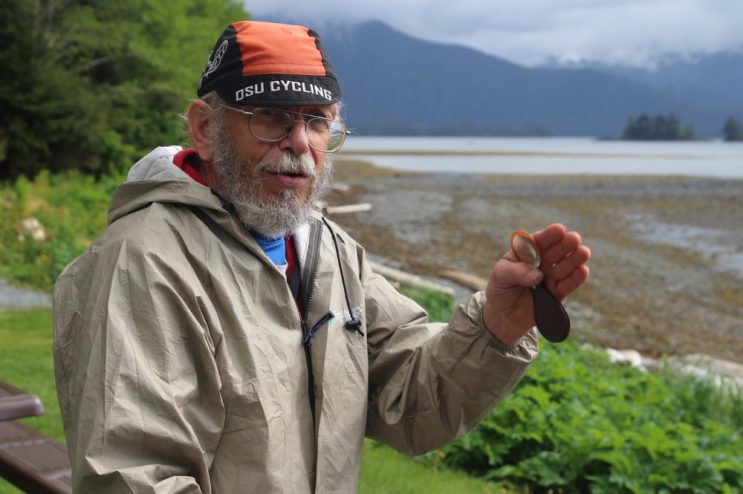
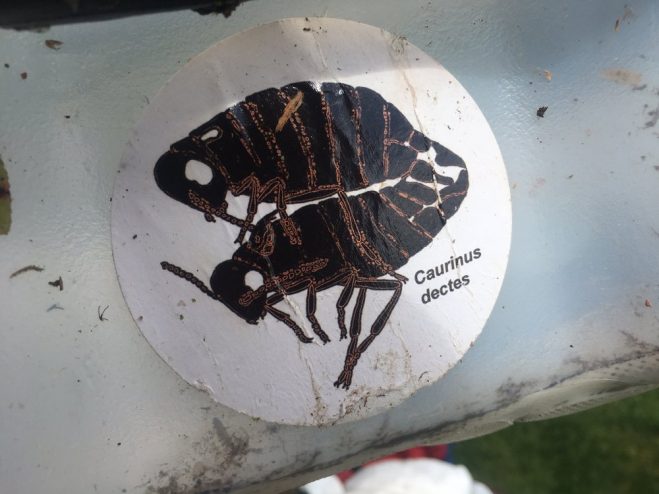
One-tenth of an inch long, C. dectes is easy to miss. Although hardy, the “funnybug” could not have survived glaciation. So what’s it doing in Sitka? (Photo by Robert Woolsey/KCAW)

A lot of science involves happy accidents.

A retired scientist from Oregon stepped off the ferry in Sitka late last month, and on a hunch decided to look around the woods for an old friend.

While his discovery sheds light on one of the more obscure corners of entomology, it also is a clue to how humans may have survived the Ice Age in North America.

Loren Russell discovered a kind of flightless flea 40  years ago while doing graduate research at Oregon State University.

Actually, Russell can’t claim full discovery rights. There was this undergrad, but what do they know?

“I’m the second person to actually look at it in its space, because I was showing the sample to an undergraduate who wandered through, and I said, ‘Hey, look at this one! I thought it was something entirely different,’” Russell said. “He said, ‘No, it doesn’t have that.’ I looked at it. Oh, well. Most people at that point say meh and go on. But I kept it.”

It’s pretty great to find a new anything on the planet, but it’s not like discovering penicillin, or a cure for cancer.

Russell knew there wouldn’t be much buzz around this insect.

“There’s a genus Caurinus. They are related to something that’s sometimes called scorpion flies,” Russell said. “They are so obscure you just have to be into Caurinus to enjoy them. They’re tiny little guys, about the size of fleas. They hop like fleas, and some of them probably evolved into fleas. In Oregon, we call it the Oregon funnybug.”

“When I found the funnybug 40 years ago,” Russell says, “We thought there was a wall of ice from Juan de Fuca to the pole during the Ice Age.” Russell speculates that the non-migratory funnybug may have used coastal refugia — non-glaciated areas — to “ride out” the Ice Age in North America. Anthropologists think humans may have done the same thing. (Photo by Robert WoolseyKCAW)

After earning his doctorate, Russell became a scientist for the Environmental Protection Agency, and — as many a grad student has done — left his thesis and the funnybug behind him.

He believed that the funnybug only inhabited the so-called “fog belt” from the middle coast range in Oregon to the Olympic Peninsula.

But then on a vacation to Alaska in May 2017, Russell takes a stroll through Sitka National Historical Park and easily finds a funnybug. And by doing so, Russell has just joined the ongoing academic debate over how humans migrated to North America.

The funnybug contributes to the mounting evidence that along the coast during the Ice Age, there were many places that had no ice.

The funnybug doesn’t fly. It doesn’t move around much. It’s a vegetarian.

It’s presence in Sitka is a big question mark.

“Some of these insects had to survive in place,” Russell said. “Something with wings, something that rides on other organisms, could recolonize this region. But a little forest critter without wings almost had to have a place to ride it out.”

But it’s not just Sitka.

Caurinus dectes also has been identified in Vancouver, and on Prince of Wales Island.

Russell lent his expertise to that survey about 5 years ago.

Actually, it’s not a pure lucky stroke that Russell found the funnybug in Sitka. He was acting on a solid hunch.

“You have to look,” Russell said. “The odd thing is that this is an insect that’s relatively common. It’s hiding in plain sight. Entomologists don’t typically have the luxury to go out and survey something for some reason. And most entomologists don’t do much in the winter, which is the primary period when these are active farther south.”

“Here, you have to go in the rainforest and — in my case — you have to look at the host plants, the liverworts growing on tree trunks,” he said. “If I look, I can usually find them.”

Russell also was planning to look in Ketchikan on his return trip home.

He’s contributing his samples to researchers back at Oregon State, who are using DNA analysis — a technique undiscovered when Russell first found the funnybug — to identify what might be discreet species of the insect.

What’s next for Russell? Looking even farther afield for the funnybug, of course.

“I think this genus, or something similar could very easily be on the Asian side of the Pacific,” Russell said.

Sitka considers code changes in landslide zones

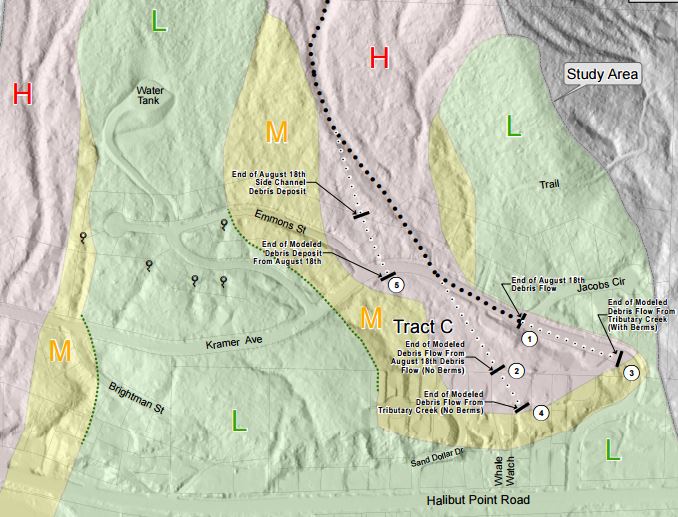
If the critical areas ordinance passes on June 27th, it would change development rules for South Kramer Avenue. An outside firm mapped the area for landslide risk in the aftermath of the August 18, 2015 landslides. (Map from Shannon & Wilson South Kramer report)

The state is currently mapping the potential risk for landslides in Sitka.

This time next year, the Sitka Assembly will be presented with a community-wide map.

Whether they adopt the maps or not, city staff wanted to be prepared for how the information could affect property development.

They presented their critical areas ordinance (Ord 2017-14) to the Sitka Assembly on June 13.

This is a policy rooted in tragedy.

“We all remember August 18th, 2015. Over 65 landslides hit Baranof Island that day,” Sitka Community Affairs Director Maegan Bosak said at the start of her presentation. “We had extremely heavy rainfall in the morning and a shift of wind patterns that left our community reeling over the tragic loss of life and damage to property.”

Future development in Sitka is now a fraught enterprise, particularly in the South Kramer and Gary Paxton Industrial Park areas.

This leaves the city in a tough position and in writing the critical areas ordinance, staff looked to other places with hazardous land, Bosak said.

“We’ve compared other municipalities, specifically Juneau – they have both a hazard, landslide, and avalanche area – Seattle, and Snohomish County,” Bosak said. “We’ve included outside counsel in drafting and review. And really struggled with this ordinance all personally. It’s really the argument of what is the role of government. Where do we step in? And what is that demand for public safety or the need to develop?”

The city currently cannot issue permits in landslide areas unless the homeowner pays for a geotechnical evaluation and any necessary mitigation.

Under this new critical areas ordinance, the homeowner can waive that requirement.

That person would sign a covenant with the city that would be tied to the deed of the land, “stating that essentially that they know and accept the risks and are protecting the municipality from financial liability,” Bosak explained.

Subdivisions and high occupancy buildings would not qualify for this waiver option. Future homeowners could cancel that covenant at any time.

The Assembly had mixed opinions on how this, with some wondering how designating land as “risky” could change its value, development, and financing. Would a bank be reluctant to loan money for a house on the Benchlands?

Planning Director Michael Scarcelli said that is beyond the city’s control and the market for supplemental insurance is growing. Homes in Juneau have been able to access “difference in conditions” insurance, or DIC, that is designed to cover catastrophes the broader insurance market won’t touch.

Scarcelli pointed out that an ordinance like this may be inevitable, as the federal government pushes for GIS mapping. FEMA recently published drafts of a multi-hazard map for Sitka, which the Assembly will review next year.

“Those private (insurance) markets – whether the Sitka Assembly would adopt those (flood) maps – might use those for those risk actuary analysis,” Scarcelli said.

Some on the Assembly were ill at ease with continued hazard mapping in Sitka, with Steven Eisenbeisz worrying about homeowners who suddenly find themselves in a high risk area. As for the critical areas ordinance, he said, “it scares me.”

“It seems like the city is just trying to wash its hands of any responsibility here. We’re just trying to step back and say, ‘Yeah no, let’s not be a part of this.’ But there’s still something in here that’s unsettling to me,” Eisenbeisz said.

Kevin Knox reasoned that landowners have their hands tied as is, under current rules, and saw the ordinance as a move in the right direction. “There are landowners right now that are hamstrung. They can’t do anything,” Knox said.

Mayor Matthew Hunter went so far as to say that this ordinance gives rights back to property owners. “If I owned a lot that was in a risky area and I wanted to use it, I’d say, ‘I own this property but why can’t I use it? I’ll sign a waiver that says I recognize this is dangerous, but just let me do what I want to do.’”

That may come to pass if the Assembly gives the critical areas ordinance final approval at their next meeting on June 27th. They passed the ordinance on first reading 5-2 Tuesday night, with Eisenbeisz and Aaron Bean voting no.

Sitkan shoots bear dead after dog scuffle

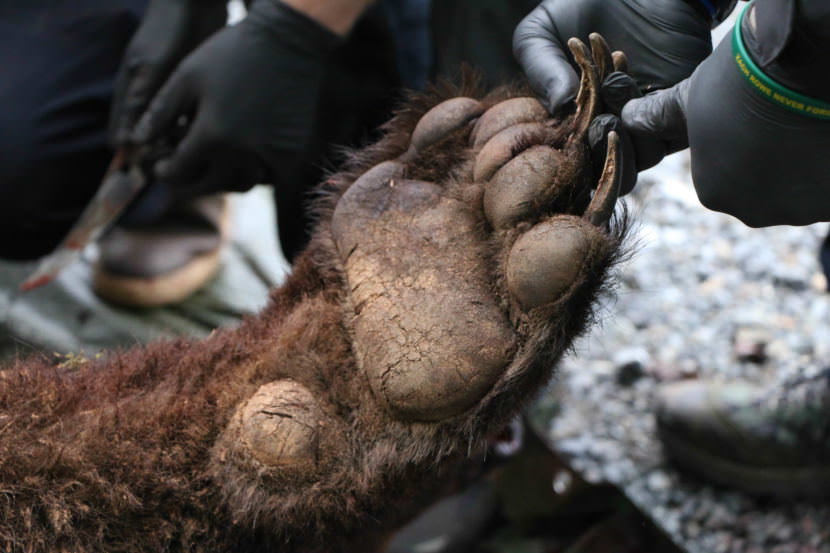
Cadets from the Public Safety Training Academy learn how to skin a bear that was shot earlier Wednesday morning.
Cadets from the Public Safety Training Academy learn how to skin a bear that was shot earlier Wednesday morning. (Photo by Cameron Clark/KCAW)

A Sitka man shot and killed a bear that was threatening his dog early Wednesday morning. Wildlife authorities later located the dead animal in a ravine 100 yards from his residence off of Halibut Point Road.

Alaska Department of Fish and Game Biologist Stephen Bethune assisted troopers to find the bear.

“It was probably a 400-pound bear or so, I’m estimating a 4 to 5-year-old male. It was in good health, but it did have some scarring and looked like it had been in a few scraps in its days,” he said

The dog owner fired a semi-automatic rifle at the bear shortly after 5:30 a.m., prompting a neighbor to call the police and report four gunshots. Officers quickly responded to the residence on Bahovec Court and assessed the situation.

“The homeowner didn’t have garbage out or any attractants on the property that would have brought the bear. It’s just right in prime bear corridor,” Bethune said.

According to police, there are no charges pending because the man was within his rights to shoot. It’s called a DLP, or defense of life and property, which includes pets. In this case, the homeowner did a lot to avoid being in this situation in the first place.

“The homeowner had taken pretty extensive pains to clear some of the woods adjacent to the house to make it less hospitable to bears,” Bethune said.

The bear’s carcass was carried from the woods by cadets from the Public Safety Training Academy. They’ll use it as a wildlife training tool, skin it, and return the salvaged meat to the Alaska Department of Fish & Game, which in turn will transfer it to the Alaska Raptor Rehabilitation Center.

According to Bethune, the hide and skull will eventually be sold at the Hide and Horn auction in Anchorage.

Sitkan focuses lens on climate change in Southeast Asia

The Trump administration’s decision to withdraw from the Paris Agreement last week was regarded as a step backward for Alaska.

Lione Clare presenting her photo story to fellow Sitkans.
Lione Clare presenting her photo story to fellow Sitkans. (Photo by Cameron Clark/KCAW)

Following the president’s decision, Gov. Bill Walker announced that “Alaskans know our landscape is changing at an accelerating pace. We are experiencing social and economic upheaval caused by shrinking sea ice, rising sea level, increasing intensity of storms, and increasing coastal erosion.” And it’s not just Alaska. A college student from Sitka is exploring how climate change is affecting Southeast Asia too.

Lione Clare has created a climate change presentation entitled, Vulnerable Vietnam: A Photo Story Focused on Climate Change in the Mekong Delta. She gave the show at the Sitka Public Library on June 1, the same day President Trump withdrew the United States from the Paris Accord.

Clare studies Resource Conservation, Climate Change Studies, and Media Arts at the University of Montana.

For the last part of December and January, she traveled Southern Vietnam seeing firsthand what climate change is doing to communities halfway around the world.

“Climate change is obviously a global issue there are some countries in the past that have contributed more to the problem through greenhouse gas emissions, ours being one of them, and it turns out that countries like Vietnam have not contributed as much but are feeling some of the impacts of climate change,” Clare said

Clare focuses on four main themes: food security, coastal forests, renewable energy and migration. All of her pictures were organized into one of these categories.

Clare’s photos are rich with color, capturing the beauty of Vietnam, while also showing often-unseen problems in the region.

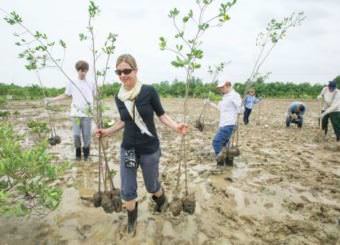
Mangrove forest ecosystems are critical to the coastal zones of Vietnam because they help to sustain food security and ecosystem function. Clare and the rest of her group helped plant some.
Mangrove forest ecosystems are critical to the coastal zones of Vietnam because they help to sustain food security and ecosystem function. Clare and the rest of her group helped plant some. (Photo courtesy Lione Clare)

“This is at Cần Giờ Reserve, we spend half a day here actually participating in a restoration effort that’s been ongoing since the war ended because in this area 20,000 hectares of forest were destroyed to clear war zones during the war. Since then, they’ve been working to rehabilitate the Mangrove Forests,” she said.

The hour-long presentation left members of the audience more interested in the region.

“I was really encouraged by the steps that people in Vietnam are taking to mitigate their problems with climate change, to work with various systems both highly technological and certain basic agricultural systems,” Galen Paine said.

Others in attendance, like Karen Hegyi, can’t wait to see what else Clare will do next.

“I thought she did a great presentation, I’m looking forward to seeing more in the future from her. I think she’s got a great future ahead of her,” she said.

So far, Clare has given her presentation three times at the University of Montana and has a photo exhibit there as well. She will graduate in December and plans to continue her work.

“I’m focused on climate change in school, I’m learning about it, but actually seeing it impact an area in the world and people was pretty eye opening,” Clare said. “Being able to capture that in photos and tell a story was something that was a challenge for me. I never really done it before, but it’s definitely something I would like to do again in the future wherever I might travel.”

Until then, Clare adds Vietnam to her ever-growing list of countries she’s visited and photographed.

Sunken tugboat Powhatan to be raised on crane barge

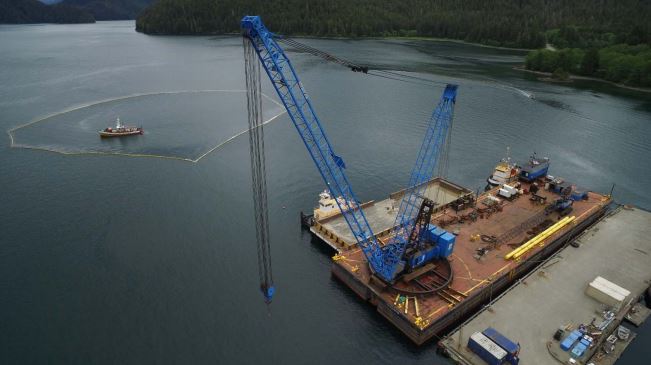
The barge Salvation, the KP-2 deck barge, and two tugs tied up at Samson's dock. The Powhatan tug remains underwater, surrounded by containment boom. The owner plans to raise the tugboat on Thursday, June 8. (Photo courtesy Samson Tug & Barge)
The barge Salvation, the KP-2 deck barge, and two tugs tied up at Samson’s dock. The Powhatan tug remains underwater, surrounded by containment boom. The owner plans to raise the tugboat on Thursday, June 8. (Photo courtesy Samson Tug and Barge Company)

Updated | 3:26 p.m. Tuesday

A sunken Sitka tugboat will be hoisted to the surface on Thursday, June 8.

The Powhatan, a decommissioned tugboat, sank at its dock on April 19 and remains underwater in Starrigavan Bay.

The cause of the sinking is still under investigation.

The tug’s owner, Samson Tug and Barge Company, has contracted Alaska Commercial Divers and Pacific Pile & Marine to raise and dispose of the 81-foot vessel.

The Salvation, a wreck removal barge, arrived Saturday. Using a heavy lift crane, it will raise the Powhatan out of the water and lower it onto a deck barge for transport.

Three assistant tugs and the Neka Bay, an oil spill response vessel with skimming capabilities, also will be on scene to provide back-up.

The public boat launch will remain open, but there will be a no-wake zone during hoisting operations.

The Coast Guard Auxiliary in Sitka also will assist in directing boaters away from the area.

In the 50 days since the Powhatan has been underwater, over 6,800 gallons of oil mixed with water has been recovered.

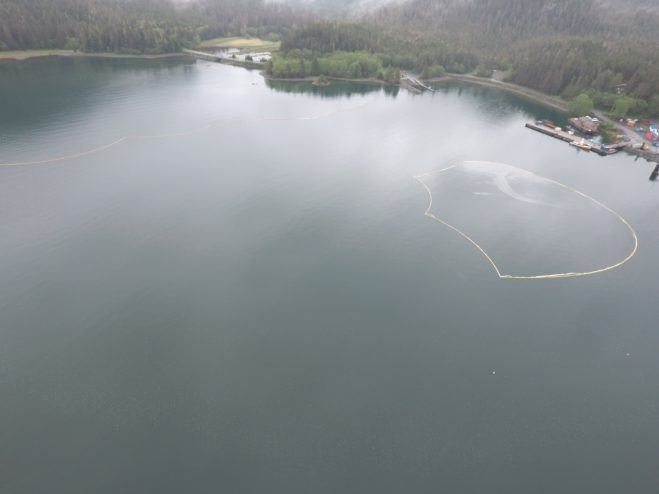
Deflection boom lines Starrigavan Beach and a shellfish advisory remains in effect.

The Southeast Alaska Tribal Ocean Research group also is discouraging locals from digging for clams until further notice.

Samples from Starrigavan Beach show elevated levels of paralytic shellfish poisoning toxins.

The state situation report says those toxins are unrelated to the oil spill.

Emily Kwong, KCAW


Original story | 2:01 p.m. Tuesday

Until the tugboat is salvaged, SEAPRO is maintaining containment boom around the Powhatan and deflection boom off of Starrigavan Beach. (Photo provided by Samson Tug & Barge)

SITKA — Officials are preparing to raise a sunken 81-foot tugboat Powhatan.

A crane barge arrived from Seattle over the weekend, the Daily Sitka Sentinel reported Monday, and divers are going to work over the week to prepare to lift the tug, which sank April 19.

The undertaking is expected to take 10 days, Coast Guard officials said.

Within one day after the tug sank, it slid off an underwater ledge to a resting place 1,500 feet offshore at a depth of 160 to 180 feet.

Officials say the plan is to hoist the boat, which has been out of service since 2006, on a 3-inch chain that will run under the boat’s hull.

The lift is scheduled to start Thursday.

Associated Press

Site notifications
Update notification options
Subscribe to notifications