KCAW - Sitka

KCAW is our partner station in Sitka. KTOO collaborates with partners across the state to cover important news and to share stories with our audiences.

Sitka hospital’s proposed budget eliminates births, reduces surgery

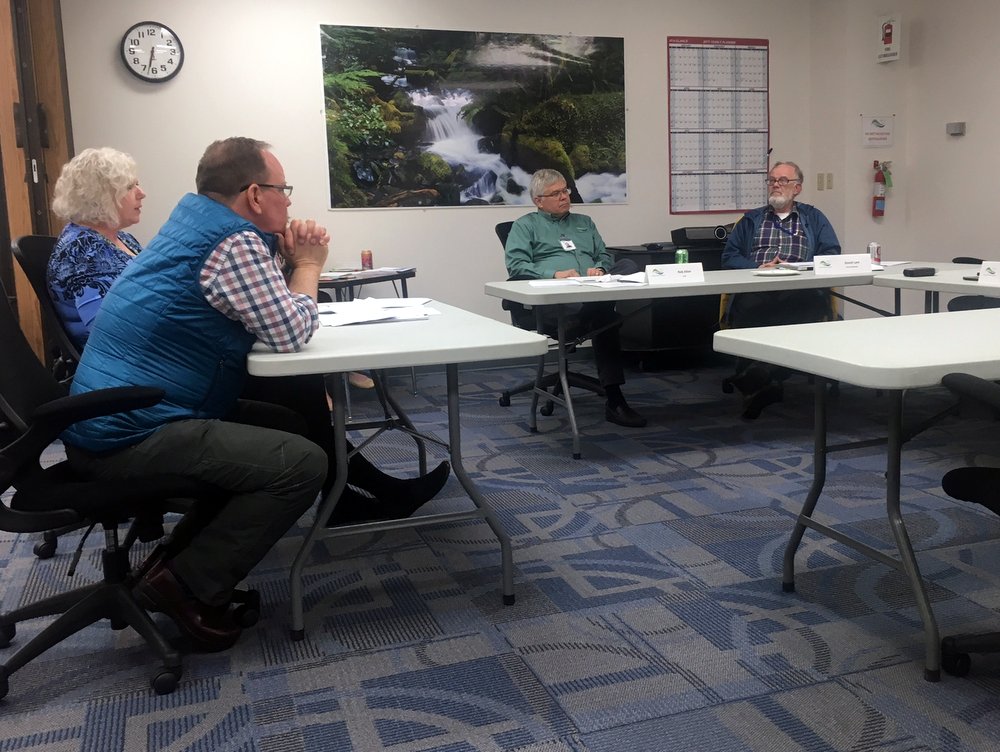
Sitka Community Hospital CFO Cynthia Brandt, left, and physician Charles Rozelle discuss the decision to scale back surgery — and eliminate childbirths — with CEO Rob Allen and board member Dr. David Lam. Brandt described some unexpected pressure on the hospital’s razor-thin budget: Medicare may want up to $1.2 million in a payback next year. (Photo by Robert Woolsey/KCAW)

The Sitka Hospital Board has prepared a budget for next year that cuts back surgical coverage to half-time, and phases out obstetrical services altogether.

Although the plan intentionally hands over childbirths in Sitka to SEARHC’s Mt. Edgecumbe Hospital, the administration at Sitka Community believes their clinic can still provide strong pre- and post-natal services.

While having full-time surgical coverage isn’t required to maintain an obstetrics service, Sitka Community Hospital pretty much had full-time coverage with Dr. Richard Wein, whose contract was not renewed in a dispute this spring.

According to CEO Rob Allen, Wein was “old school,” and was available almost all the time — by choice. Most doctors now prefer a more reasonable call schedule.

Board member Connie Sipe was doing the math.

“This issue’s really linked with the surgeon,” Sipe said. “For us to really have 24/7 surgical coverage, we probably need to hire two surgeons, and that’s a million bucks. It’s kind of this very difficult chicken-and-egg.”

Twenty-four-hour surgical coverage is not necessary to run an obstetrics program.

Family Practice physicians who are trained in C-sections can do the job. But Dr. Charles Rozelle was uncomfortable with the idea.

He’s qualified for routine C-sections, but Rozelle described a scenario where a patient could develop problems, and require an emergency hysterectomy — a higher level of surgical practice.

If that were to happen, he told the board, “We’d be clamping off arteries and riding in an ambulance across the bridge” to Mt. Edgecumbe Hospital, run by the Southeast Alaska Regional Health Consortium.

For Sipe, this did not sound extreme for a typical rural hospital.

“If we were in small-town Kansas and we were doing what we were doing, and the surgeon didn’t happen to be there, and somebody needed an emergency bleed-out hysterectomy, we’d be medevacing them as fast as we could to the next biggest hospital,” Sipe said. “This next hospital is 3 miles away. Some part of me says: If we hope to continue to be in this town, and we’re always going to have this competitor, then maybe we need to figure out what financially works — what’s not perfect, I understand, for the practice — but how do we take advantage of this other resource and say, where we don’t have to duplicate them, we use them?”

Sitka Community Hospital delivers about 40 babies a year. SEARHC about 60.

Sitka CEO Rob Allen said there’s no immediate savings to closing obstetrics, but it does spare the hospital having to invest around a quarter-million dollars in the future (primarily in staffing) to maintain a modern childbirth program.

He’s adding this to the list of decisions he’d rather not have to make, in order to keep Sitka Community above water.

“The risk and the resources to continue on. We can lower our risk, increase our resources and use that space in other ways, and make this a stronger community hospital,” he said. “I know it’s a very emotional issue. It’s a hard one. It would not be popular. I know I’d have another big target on my back, but I’m thinking long term for the hospital, and a way to act now.”

Acting now means reducing surgical coverage and closing obstetrics, but it doesn’t mean giving up all other health care around pregnancy and newborns.

“Most people do not select their doctor based on a hospital. They select their doctor first,” Sitka Community’s head of operations Steve Hartford said. “They pick their doctor, then when they become pregnant that doctor will provide prenatal care. In our case, what will happen is: A person who has a doctor in our clinic will receive prenatal care, and they’ll have a planned delivery at SEARHC, because we won’t be providing that service anymore. Even if our doctors do not do deliveries at SEARHC. Their delivery will be planned at SEARHC.

Hospital board member David Lam replied, “You’d be hard-pressed to sell that to the public.”

The model that Hartford and Allen envision has two tracks: In one version, Sitka Community doctors could request privileges at SEARHC, join the call rotation, and deliver their patients’ babies at SEARHC. Alternatively, SEARHC doctors would handle all the deliveries.

Lam, a physician himself, thought cooperation was essential.

“If we can actually get them to work with us to provide the service, this may be the best of all worlds for everybody,” he said. “Because I agree completely: I want to keep our staffs’ hands in the full patient care cycle.”

Allen disagreed that cooperation with SEARHC was required to implement the budget, but at Lam’s request, he agreed to open negotiations about what — if any — role Sitka Community’s doctors would play in delivering babies at SEARHC.

Lam, in turn, voted to approve Sitka Community’s proposed budget, which eliminates obstetrics as of September 1 of this year.


Note: The board of Sitka Community Hospital will present its budget to the Sitka Assembly in a special meeting 6 p.m. Tuesday, May 2, in Harrigan Centennial Hall. Public testimony will be taken.

Angoon poet Frank Sharp to publish collection of poetry

Frank Sharp, 85, a poet from Angoon, has a new book of poetry published in “Rhymes and Rhythms,” by the Island Institute. (Photo by Emily Russell/KCAW)

Angoon elder Frank Sharp has written a new book of poems, “Rhymes and Rhythms.” The book is scheduled for release this summer.

The first time I meet Frank Sharp he’s shoveling gravel into a wheelbarrow.

Frank is 85 years old. He’s a small guy, but he’s not frail. Underneath his navy coveralls it looks like he could still run a 5-minute mile.

“Believe it or not I could have been in the Olympics,” Frank said.

I’m here to get his life story, Olympic bid and all. But, when I ask him for his life story he recites one of his poems instead.

“I’ve been a soldier, sailor, killed my fellow man.
Sought peace or religion, drugs every way you can.
I’ve felt the eagerness of youth, frustration in the middle years.
I’ve laughed a million laughs, shed a million tears.”

Frank has written hundreds of poems like this one. He stores them in an old cigar box. They’re beautiful– even better when read by the poet himself.

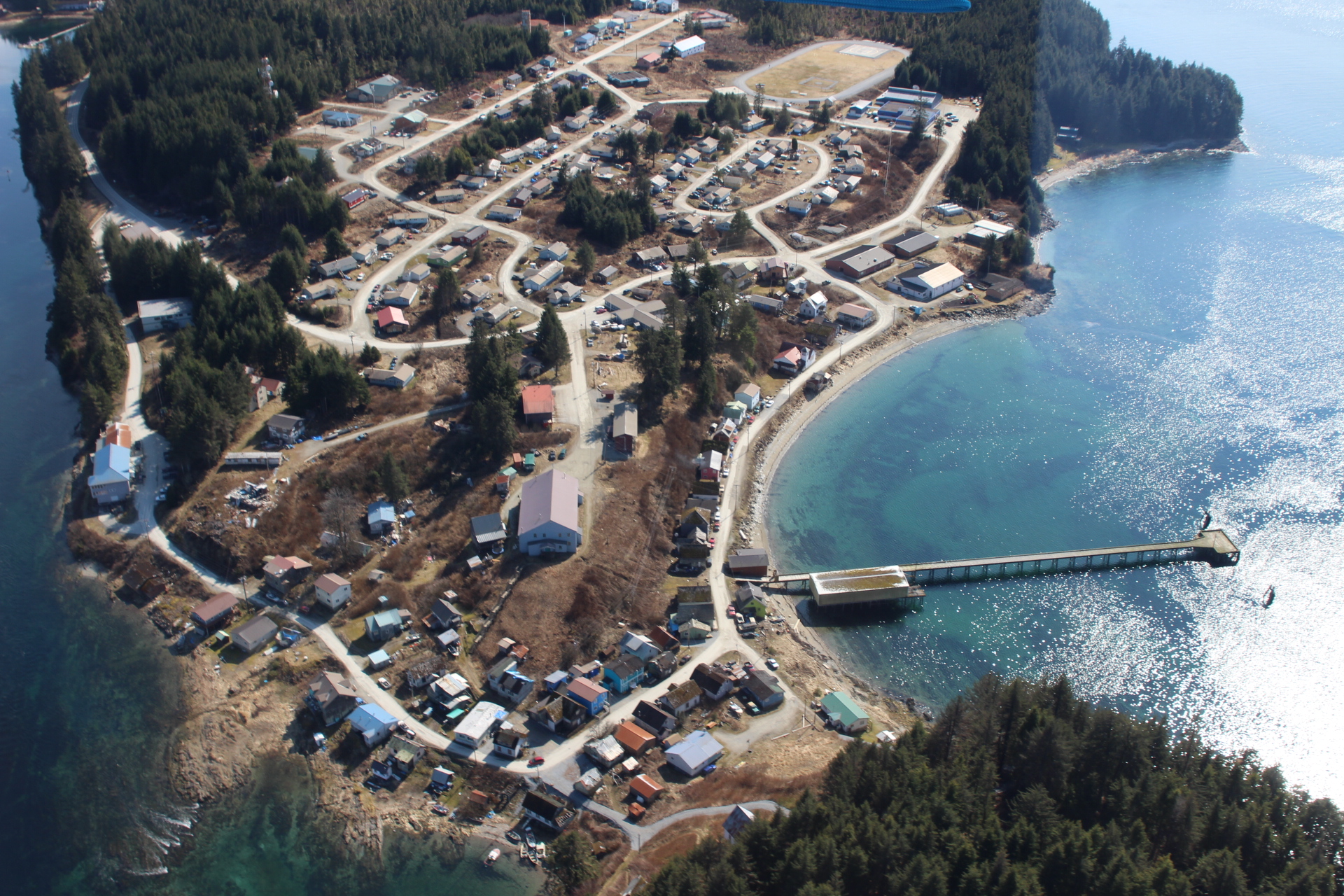
Aerial view of Angoon. (Photo by Emily Russell/KCAW)

But Frank’s life– it was far from perfect. We head inside to his kitchen, which overlooks the ocean.

“Do you want coffee or anything?” Frank offered. “We’ve got some banana bread.”

With hot coffee in our hands, Frank tells me about his childhood in Angoon and Tenakee Springs. He told me about his father’s taste for whiskey and women.

“My dad was a womanizer. I probably have 12 or 13 brothers and sisters,” Frank said. “I know of several already.”

He told me about his mother’s many marriages.

He even told me about how popular he was with German women when he was stationed there with the Air Force after World War II.

“That’s part of the story,” Frank said. “You said (to) tell my life. I’m telling you the truth.”

Somewhere in between all that, Frank lived in Kansas City, where he got wrapped up in the wrong crowd.

“I became a gangster there,” Frank admitted. “My name was Val Udo.”

If that wasn’t enough risk for one lifetime, Frank has nearly died three times – the first when his boat sank in the Gulf of Alaska, the second when he had a massive heart attack, and the third just a couple of years ago when he was out hunting deer in the winter — at age 81.

On the third day, he followed the sound of an Alaska Airlines flight west out of the woods.

“It’s been quite a life,” Frank said. “I could go on for hours, because I told you, I’ve had so many adventures it’s unbelievable.”

And a lot of those adventures are the subjects of the poems being bound into the book, “A Pioneer Alaskan’s Lifetime of Rhymes and Rhythms.” The book will be published by the Island Institute with links to audio, so you can actually hear Frank recite his own poetry.

“I’ve got a lot to do, yet, but I know my time is running out.
My frosting’s wearing thin, I’m fighting a war I’ll never win.”

But he keeps fighting–  fixing up his home, maintaining the miles of walking trails on his property.

I get the sense Frank Sharp has a hard time sitting still.

“I’m still pushing the wheelbarrows up from the beach, though it’s killing me to do it,” Frank said.

“Yeah, why do you do it?” I ask.

“Because it’s there,” Frank replied.

After a while, though, it’s clear there’s more to the story – like the part about his wife, Alice.

“Oh, now you’ll really get me,” Frank’s voice starts to waver. “I’m already watered up.”

Alice died in 2000. The thought of her brings him to tears.

“Why didn’t I tell her then what I can’t tell her now?” Frank asks himself.

He’d tell her he loved her, that she was beautiful. That’s Frank’s biggest regret, so he tries to make up for that through his poetry and this property.

He wants to be remembered for those things. He even moved a boulder to make that happen.

“It weighs above 400 pounds and I brought it up and put it there because it was the only gold-looking rock on the beach,” Frank said.

The gold plaque will be placed on a 400 pound rock Frank Sharp moved up outside of his home in Angoon. (Photo by Emily Russell/KCAW)
The gold plaque will be placed on a 400-pound rock Frank Sharp moved up outside of his home in Angoon. (Photo by Emily Russell/KCAW)

And on that gold-looking rock there will be a gold-colored plaque. It will be placed right in front of his house with a poem on it.

“The Lord gave this man vision, strength and time to work this land,” Frank read off the plaque.

It said his legacy lives on in this land. It lives on in people’s hearts, too.

“Through his poems and stories, he led us on many a journey of laughter, fear, love and tears,” it said.

In “Rhymes and Rhythms,” Frank Sharp lived.

Dock lawsuit argues Sitka’s mayor, administrator personally liable

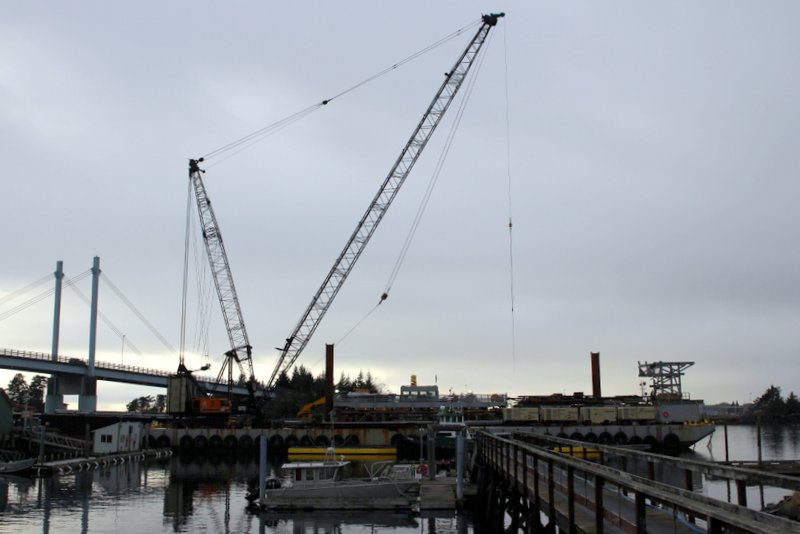
Turnagain’s Brightwater barge and crane at work on the Petro Marine fuel dock last winter. The same equipment will be used to build the dock at the Gary Paxton Industrial Park — unless the court rules the contract illegal.
Turnagain’s Brightwater barge and crane at work on the Petro Marine fuel dock last winter. The same equipment will be used to build the dock at the Gary Paxton Industrial Park — unless the court rules the contract illegal. (Photo by Robert Woolsey/KCAW)

Marko Dapcevich has amended his lawsuit over the Gary Paxton Industrial Park dock contract.The former Sitka mayor now wants to hold both current mayor Matt Hunter and municipal administrator Mark Gorman personally liable for violating the city charter.

Dapcevich filed the amended complaint in Sitka Superior Court last Tuesday (4-18-17), and it was served in municipal offices on Friday. City Hall has 20 days to answer from the date the document was served.

In his original complaint, Dapcevich named only the City and Borough of Sitka and Mark Gorman — in his role as administrator — as defendants. The decision to now include Gorman and Mayor Matt Hunter — as individuals — is based on a provision of the Sitka Charter (XI.13.d) which holds that “officers” of the city may be individually liable for illegal payments made in violation of the charter.

Dapcevich is being represented by Juneau-based attorney Joe Geldhof. Reached by phone, Geldhof says that the decision to amend the lawsuit came after the city rejected two settlement offers from his client.

“After consideration, Mr. Dapcevich elected a phased, escalated approach with opportunities to settle,” Geldhof says. “He was disappointed — but not surprised that two offers to settle have been rebuffed.”

Dapcevich offered to settle his lawsuit if Sitka canceled its $6.5 million contract with Turnagain Marine Construction to design and build a floating dock at the Gary Paxton Industrial Park. Additionally, Dapcevich asked to be reimbursed $1,200 for legal expenses to date, and he asked for the resignation of administrator Mark Gorman.

Sitka declined to settle with Dapcevich. Instead, the city has hired Anchorage attorney Michael Gatti to handle the matter.

Neither Gatti or Geldhof are strangers to legal conflict over Sitka’s industrial park. The city hired Gatti to support its defense against Sitkans for Responsible Government, who tried unsuccessfully to put a voter initiative regarding park land disposals on the ballot in 2008. SRG was represented in its lawsuit by Joe Geldhof. After 4 years of litigation, including a hearing in the state’s Supreme Court, the matter is still largely unresolved.

Sitka municipal attorney Brian Hanson remains confident about the city’s position in the Dapcevich lawsuit. “We’re going to vigorously defend our position, and I have confidence that we’ll prevail.”

Earlier this month Dapcevich exercised his option to replace presiding Sitka Superior Court judge David George. Although the case remains in Sitka, it has been assigned to Judge Trevor Stephens of Ketchikan.

When becoming an Alaskan ninja warrior becomes a family affair

The Kronos gym is a family affair. Cody Johnston owns it with his wife, Tara. Their three children, Riley, 15, and 12-year-old twins Chase and Preslie, help with classes. (Photo Emily Kwong/KCAW)

What do you get when you mix reality television with an obstacle course? “American Ninja Warrior.”

Now in it’s ninth season, the television show is a glitzy display of human strength that one former competitor has decided to take off the road system.

Cody Johnston operates a ninja-style training gym in Sitka where he practices with his family.

The only thing standing between Cody’s 12-year-old daughter, Preslie Johnston, and ninja warrior glory is a wall that’s three times her height.

“I want to see these kids using their imagination to overcome obstacles,” Cody said.

Preslie is about to tackle the warped wall – the most famous obstacle from “American Ninja Warrior.”

Eyes fixed and arms bent, she sprints directly up the 12-foot slope – pushes off her toes – and reaches upward, just catching the ledge with her fingertips. Grinning, she then kicks her feet away and her body is now perpendicular to the ground, like a flag on a flagpole defying gravity.

Cody Johnston’s family’s ninja warrior training gym in Sitka is called Kronos Titan Ninja Training.

Cody’s got three kids — son, Chase, 12, and daughter’s Riley, 15, and Preslie, 12, — and a wife of 18 years, Tara.

“We moved to Sitka and I knew that Sitka was going to be our forever home,” Tara Johnston said. “He came to me and said, ‘This is what I want to do,’ and I said, ‘Okay, let’s find a location.’”

While Cody teaches classes in gym shorts, Tara balances the books in 4-inch heels. Their gym is dedicated entirely to workouts that feel like playtime.

Impressive feats aren’t hard to find at the Kronos gym, which shares space and management with a local gymnastics and circus program. (Photo by Emily Kwong/KCAW)

Instead of treadmills and dumbbells, gym members scale cargo nets, swing from monkey bars, and maneuver obstacles with names like the “Devil’s Step,” and “Salmon Ladder” – all inspired by the famous show.

Johnston got hooked in 2013. “I was in Hot Springs, Arkansas,” he  said, out of the navy and studying for a nursing degree.

“Wasting away a Saturday and then I saw this guy jump on this salmon ladder, doing these crazy looking pull-ups, taking the bar with him up this ladder. I was just amazed. How can anybody even do that?”

The image stuck with him: of a man jumping up a ladder with arm power alone.

He and his kids started looking for rock to climb and scramble across while out hiking. And something clicked.

“Somewhere outside the Navy and somewhere in my undergrad degree, I forgot I had a kid locked away and I just reconnected with it,” Johnston said.

And his kids were super impressed by what their dad could do.

They insisted he apply for “American Ninja Warrior,” season 7. Chase, the boy, even made a model ninja course out of legos, which Cody filmed using stop motion animation.

https://youtu.be/L76yu91zUmM

Out of thousands of entries, Cody’s caught the attention of the producers.

“I got a phone call and they invited me on the show and all they wanted to talk about was that American Ninja warrior video,” he said.

The whole family was invited to watch Cody compete in a special military edition of “American Ninja Warrior.”

The course was awash in Hollywood lighting, staged in front of a huge battleship with cameras from all angles.

Former competitors were milling about. It was pretty distracting and when Cody’s big moment came, he slipped up on something small.

“Well, it looked like he got cocky and stuff and he went to go run and he overshot the trampoline and he buckled his knees and missed the whole cargo net,” Cody’s daughter Riley said.

If Riley sounds disappointed, she’s not.

In fact, she promptly drew up a new workout routine and encouraged her dad to keep trying. Cody was invited to compete again in April 2016 at a qualifying event in Los Angeles, but slipped off the second obstacle and splashed into the water.

Undeterred, he’s hoping for a callback.

The whole Johnston clan seems to work this way – like one unit driving each other up the warped wall. And when they fall, to at least make it look cool.

It’s left an impression on his kids.

KCAW: “What’s your favorite part about your dad?”
Preslie: “Everything.”
Chase: “He’s fun, goofy, and he always plays with us now and then.”
Preslie: “He’s just a really good dad.”

Ninja Warrior isn’t just about the superhuman agility of the contestants.

You need to have a good back story – a reason why you push your body to it’s fullest potential. And for Cody, his reason is pretty clear.

“These kids need something to shoot for in life,” he said. “Why can’t I be the example? I just want to be my kids superhero. That’s how they see me.”

And at the end of the day, perhaps being a superhero is even cooler than being a ninja.

Mariculture poised to come of age in Alaska

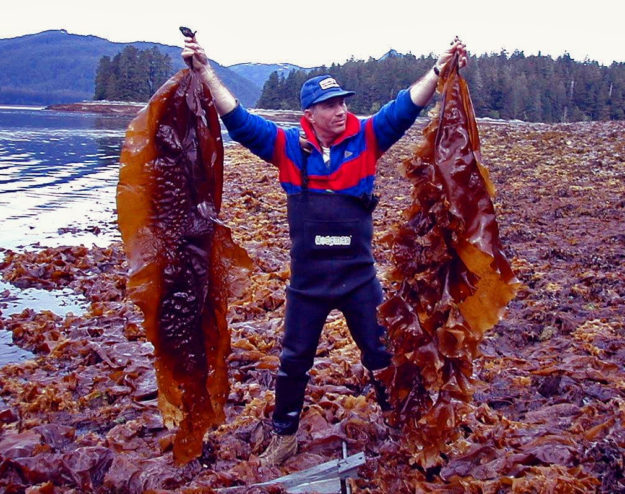
NOAA Researcher Mike Murphy holding Laminaria saccharina sugar kelp algae. Kelp grows over the winter months in Southeast Alaska, and is not difficult to farm. According to Markos Scheer, it’s a $20 billion industry worldwide. (NOAA photo/David Csepp)

Alaska’s mariculture industry is in its infancy, compared with other regions of the world, but it has the potential to be much larger — maybe worth as much as $1 billion within three decades.

Markos “Mark” Scheer is a board member of the Alaska Fisheries Development Foundation, which published the first phase of a study called The Alaska Mariculture Initiative in 2015. He discussed his organization’s hopes for mariculture in front of the Sitka Chamber of Commerce April 19.

Scheer’s message was straightforward. There’s money to be made.

“The plan, the vision that we decided, is to create a billion-dollar industry in 30 years,” Scheer said. “It sounds like a big target and high aspirations, but when you think about the amount of area suitable for mariculture in Alaska, it’s really not that high of a target.”

“For example, there are about 35,000 miles of coastline in Alaska,” he said. “If we developed 1 percent of that coastline and utilized it for producing various species, whether it be oysters or mussels or kelp or things like that, it has the production capacity to exceed the rest of the continental United States. That’s about 450,000 acres total in the state.”

“It’s a fairly small area by percentage and total, but the production capacity — because we have such wonderful resources, clean water and existing infrastructure — is entirely attainable.”

Scheer called mariculture “the low-hanging fruit” of economic opportunity in Alaska. He said that worldwide the harvest of kelp was a $20 billion industry, and showed a video of kelp farmers in Maine who were marketing kelp as “the new kale.”

He said the U.S. supplied only 15 percent of the 4.4 million tons of oysters farmed each year.

The Sitka Chamber was generally receptive, but there were some long memories in the audience.

A mariculture permit application in Sitka Sound about two decades ago encountered significant opposition from residents who already used the proposed area for subsistence or recreation.

Scheer thought barriers could be removed by cultivating a different product.

“Most of the recreational uses of coastal plans in Southeast takes place between May and September,” Scheer said. “I would say the vast majority of that, the tourist industry. Kelp is seeded in September and harvested in April. I think in reality the conflict for that space is going to be pretty minimal, number one. And number two, relative to the amount of area, we’re not talking about covering every coastline with kelp farms.”

The state legislature created the system for mariculture leasing in 1988, and Scheer describe its status now as “a cottage industry.”

Nevertheless, statewide production topped $1 million in 2014.

Scheer cited Oceans Alaska and Hump Island Oysters — two Ketchikan businesses — that were both scaling up.

Scheer thought the economic climate in Alaska was different now than when Sitkans opposed mariculture in the sound.

“The potential for it as another economic development opportunity for the state — for whatever reason — is now much more on the radar,” Scheer said. “It’s due in no small part to the realities of the Alaska budget situation. You’ve got to look to build opportunities. You know there isn’t a timber industry. I think a lot of the resource extraction industries are having a difficult time for any number of reasons. And this is an industry that is supplemental to what currently exists and frankly, is pretty environmentally friendly.”

And finally, in case there was any confusion, Scheer emphasized that mariculture was not salmon farming.

“Commercial fishing is a pillar of our economy and always will be,” Scheer said. “We don’t grow anything with fins.”

Alaska Gov. Bill Walker created the Mariculture Task Force in 2016. Visit the task force website for committee members and meeting schedules.

Tugboat carrying over 300 gallons of oil sinks in Sitka

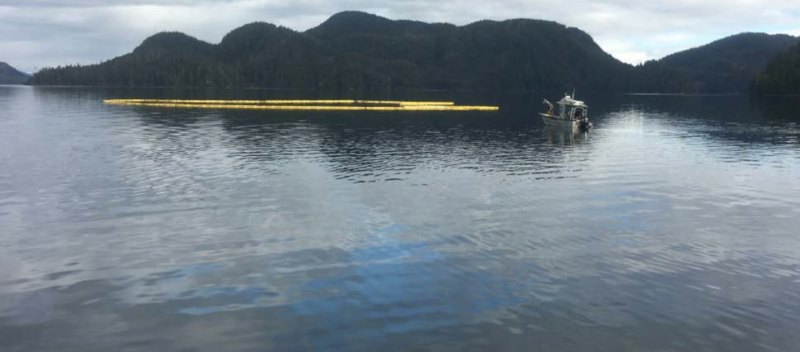
The tugboat Powhatan remains underwater, surrounded by booms to contain the oil spill. (Photo courtesy of SEAPRO)

A tugboat with more than 300 gallons of oil aboard sank Wednesday evening in Sitka.

The Powhatan is owned by Samson Tug & Barge, sank near its dock in Starrigavan Bay.

According to divers from Hanson Maritime Company, the tug Powhatan had drifted offshore and was found about 10:15 p.m.

The divers estimate the Powhatan was 60 feet below its resting location.

On board was 325 gallons of lube oil, 12 gallons of diesel, and possible sledge.

It’s not known how much oil was spilled into the water.

The U.S. Coast Guard, Alaska Department Environmental Conservation and the Southeast Petroleum Response Organization responded to the scene, surrounding the tug with booms to contain the oil.

The response team is monitoring impacts to wildlife, but no incidents have been detected so far.

According to the state’s situation report, an underwater camera may be used to confirm the tug’s location and monitor for fuel leakage.

Correction: The headline on a previous version of this story misstated the amount of oil spilled. About 300 gallons of oil spilled, not 300 pounds. In addition, the day of the sinking has been corrected. The Powhatan sank the night of Wednesday, April 19, not Thursday, April 20. 

Site notifications
Update notification options
Subscribe to notifications