KCAW - Sitka

KCAW is our partner station in Sitka. KTOO collaborates with partners across the state to cover important news and to share stories with our audiences.

Tribe’s Herring Committee drafts proposals to protect subsistence

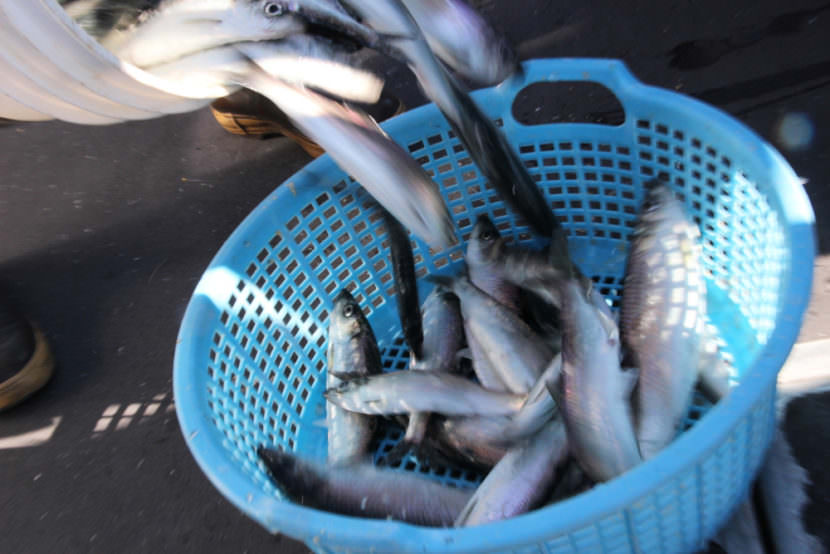
Herring caught during the 2014 Sitka Sound sac roe fishery. A recent study suggests that managers should take a longer view when managing fisheries like this one. (Photo by Rachel Waldholz/KCAW)

The Sitka Tribe of Alaska wants to see more protection for subsistence harvesters when herring season begins next month.

The Tribe’s Herring Committee is recommending a pair of proposals to reserve more areas for subsistence and to cut the commercial harvest by half.

Just a few weeks from now Sitka Sound will flood with commercial seiners and subsistence users all in search of one small fish – herring.

Commercial seiners harvest herring whole and strip the valuable sac roe from the females.

At the same time, subsistence users submerge hemlock branches in the water, which become coated with eggs as the fish spawn.

But Sitka Tribe of Alaska’s Director of Resource Protection Jeff Feldpausch said success rates for subsistence users are down.

“We’re seeing a change in the herring– how they spawn, where they spawn– and it’s making it much more difficult for subsistence harvesters to meet the ANS, or the amount necessary for subsistence,” Feldpausch said.

Feldpausch was speaking at the tribe’s most recent Herring Committee meeting.

He said subsistence needs have only been met half the time in recent years, with 2016 considered one of the poorest subsistence harvests in memory.

From what he’s heard, Feldpausch said it wasn’t always this hard to fill your freezer.

“Back in the ’80s, or earlier in the fishery, there wasn’t really an issue getting your eggs,” Feldpausch said.  “As this biomass as grown you would think it would be even easier, but it’s becoming more and more difficult.”

The biomass, or how much herring are in the water, has fluctuated a lot since the 1980s.

Estimates from the Alaska Department of Fish and Game show spawning biomass ranging between 18,000 tons and 103,000 tons in the last couple of decades.

Fish and Game forecasts a total biomass of 73,000 tons for 2017.

Tribal citizen Tom Gamble said Fish and Game’s forecast model is outdated, that they’re just guessing.

“The 2017 biomass that has been forecast has no scientific proof,” Gamble said.

Gamble told members of the Herring Committee that he’s worried that if the spawn biomass is overestimated, subsistence users will lose out.

But Eric Coonradt, a Fish and Game area management biologist for Sitka, is confident in the forecast model.

“There are going to be skeptics out there, but the data is solid. The methods are solid,” Coonradt said.

The fishery is managed based on a detailed model that accounts for the distribution, size, and age of the herring — and on the success of the annual spawn.

Calculations on the size of the 2017 biomass began last year.

Daily aerial surveys get the length of the spawn and dive surveys get the depth of the spawn.

“We have a total area of spawn,” Coonradt said. “From that, we can calculate how many females would have been able to lay those eggs and you double that to account for males.”

But subsistence users don’t find this data reassuring when they’re pulling up empty hemlock branches.

So, the Tribe’s Herring Committee is drafting two proposals to the Board of Fish.

The first would close off certain areas to commercial fishing, including Katlian Bay, Aleutkina Bay and Nakwasina Sound.

Jeff Feldpausch said the board accepted a similar proposal in the past.

“In 2012 the Board of Fish did grant us a commercial closure zone, or the subsistence zone as we call it,” Feldpausch said. “We got about half of what we asked for. This is basically going in and asking for the whole thing we asked for originally.”

The second proposal asks the Board of Fish to reduce the guideline harvest level – or how much commercial seiners are allowed to catch – to 10 percent of the total spawning biomass, compared to the typical 20 percent.

The Tribe’s Herring Committee plans to review these draft proposals at its next meeting March 6.
Sitka author’s ‘Alaskan Laundry’ wins statewide award

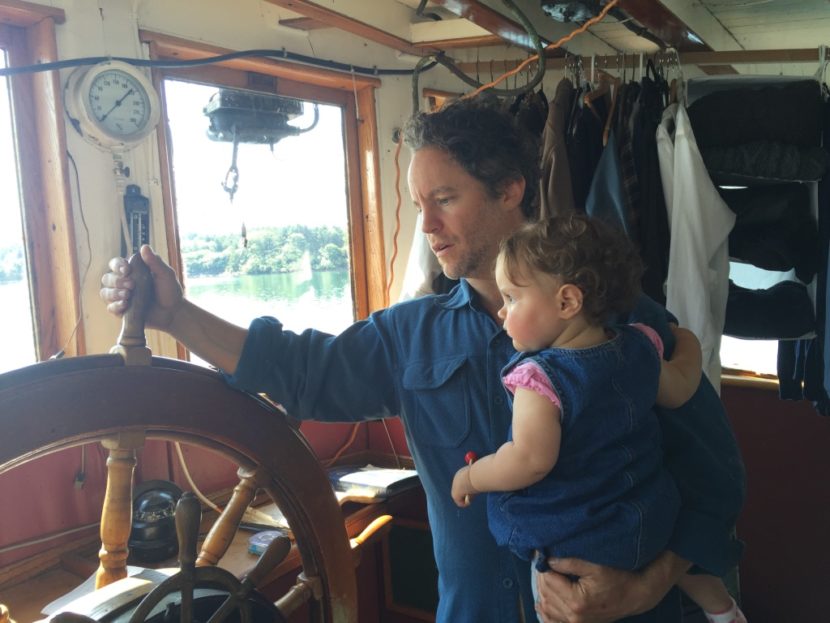
Brendan Jones, pictured with his daughter Haley, has won the Alaskana Award for his debut novel, “The Alaskan Laundry.” The book’s protagonist, like Jones, refurbishes a tugboat. (Photo by Emily Kwong/KCAW photo)
Brendan Jones, pictured with his daughter Haley, has won the Alaskana Award for his debut novel, “The Alaskan Laundry.” The book’s protagonist, like Jones, refurbishes a tugboat. (Photo by Emily Kwong/KCAW)

Sitka author Brendan Jones has won a statewide award for his book “The Alaskan Laundry.”

Created in 1994, the Alaskana Award recognizes one work of fiction or nonfiction that gives “significant contributions to the understanding of Alaska, exhibiting originality and depth of research and knowledge.”

The best part for Brendan Jones, the winner this year, is that the award is decided by librarians around the state.
“You are not going to get a better reader than Greg Mandel down at Sitka Public Library or Patricia Brown over at Haines Borough Public Library or other librarians across the state,” Jones said. “So that they were the ones that nominated and recognized this book just warms my heart. I think it’s just so awesome,” Jones said.

While “The Alaskan Laundry” is fictional, there are strands of memoir. The protagonist, an Italian-American woman named Tara Marconi, was raised in Philadelphia. Jones was too. She lands a job at a salmon hatchery in Port Anna, a community much like Sitka, and settles into a life much like Jones’ – commercial fishing and refurbishing a WWII-era tugboat.

Since its publication last year, the 380-page paperback was a “Pick of the Month” for Oprah’s Book Club and longlisted for the Center for Fiction First Novel Prize. But for Jones, the national awards pale in comparison to a statewide nod.

“I think Alaska has some of the best readers I would argue in the country and probably the world, as the result of our winters in small communities. Even the fishing community,” Jones said. “Some of the best readers are trollers. If the story doesn’t catch their attention, they’re going to put it down. They’re very discriminating in a way that the literati in New York or San Francisco is not. To ring a bell with those folks is just the best and definitely what I was hoping to do.”

Last year, at the Association of Writers and Writing Programs in Seattle, attendees asked whether writing from the 49th state is in the midst of an Alaskan Literary Renaissance.

Jones thinks so, for the same reason there’s been a boom in reality television.

“It could be truckers on the ice road or gold panning or fishing in Alaska,” Jones said. “On the flipside you have a lot of writers interested in writing speculatively and on the level of image, about the state. It’s just kind of poetic. They just tell a good yarn.”

Jones adds that Alaska Natives have been telling stories of the place for tens of thousands of years. Previous recipients of the Alaskana Award include Heather Lende in 2006 for “If You Lived Here, I’d Know Your Name,” as well as Nora Marks Dauenhauer, Richard Dauenhauer, and Lydia T. Black in 2009 for “Anooshi Lingit Aani Ka: Russians in Tlingit America: The Battles of Sitka, 1802 and 1804.”

Jones, who started “The Alaskan Laundry” 11 years ago, takes inspiration from authors like Raymond Carver, Tobias Wolff, and Richard Ford.

He describes his writing mode as “dirt-and-grit realism,” “writing short, declarative sentences that shows things or describes things as they are.”

“It’s kind of the antithesis to magical realism or science fiction or fantasy fiction,” Jones said. “Maybe it’s my own pet theory, but I just think there’s so many magical things that happen in the state that you don’t need to rely on a heavy dose of fantasy in order to tell a fantastic story.”

Jones will receive is award at the Alaska Library Association’s Annual Conference on Feb. 25 in Ketchikan.

Shee Atiká’s revenue fell 98 percent in 5 years; shareholders call for CEO’s resignation

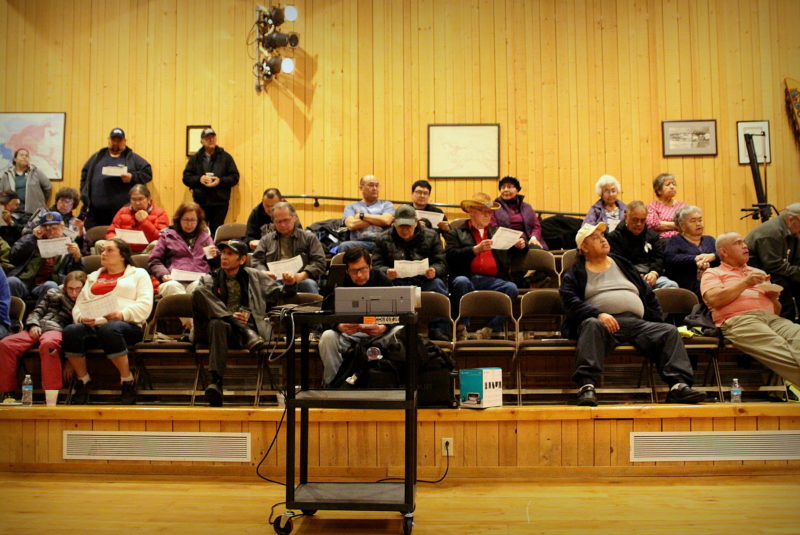
A crowd of Shee Atiká shareholders look over the corporation’s financial statements.
A crowd of Shee Atiká shareholders look over the corporation’s financial statements on Saturday, Jan. 28, 2017 (Emily Russell/KCAW)

Revenue for Shee Atiká, Sitka’s Native corporation, has dropped by nearly 100 percent since 2010. Shareholders packed the tribal community house on Saturday, Jan. 28 to discuss the fate of their corporation, and it’s more than just revenue they’re worried about losing.

It’s a Saturday night in downtown Sitka. Sheet’ka Kwaan Naa Kahidi is packed with people and the stage crowded with dancers in bright red and black regalia.

But this isn’t just a dance performance. It’s a meeting organized by Shee Atiká shareholders.

“We’re losing money. We’re losing our shareholder benefits. We could lose the land our corporation has,” explained shareholder Dionne Brady-Howard.

Brady-Howard isn’t alone. More than 150 Shee Atiká shareholders are here tonight to air their grievances.

Members of Shee Atiká’s board and management were invited to the meeting, but none of them showed. That includes CEO/President and Chairman of the Board Ken Cameron, who has previously declined to comment on the issue.

So, what are shareholders concerns? Let’s start with the money. Shee Atiká’s financial statements show that from 2010 to 2015, total revenue dropped from $182 million down to just $3 million.

Sandi Riggs was Shee Atiká’s Chief Financial Officer for five years. She saw the corporation’s profits begin to skyrocket in 2005. That’s when Shee Atiká started landing contracts with the U.S. military.

“There was eight years of huge cash flow coming in and nothing was really done on the management end to figure out– we’ve got all this cash, what are we going to do?” Riggs explained.

Riggs left the corporation in 2008, and in 2010 revenue began to plummet.

Shee Atiká is now scrambling to slim down its spending, which brings us to of shareholder benefits.

The corporation offers scholarship money and funeral benefits to its more than 3,000 shareholders, like Ethel Makinen. She just lost a son in early January.

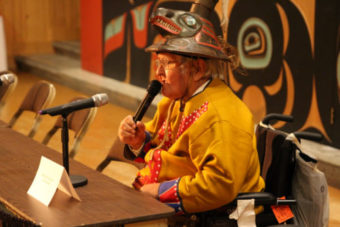
Shee Atiká shareholder Herman Davis addresses the crowd.
Shee Atiká shareholder Herman Davis addresses the crowd. (Emily Russell/KCAW)

“It’s hard to lose your loved ones, and if you can’t afford to pay for it this helps,” Makinen explained.

In mid-January, though, Shee Atiká cut funeral benefits in half, from $1,750 to $875.

But Native corporations weren’t originally set up to pay for funerals or issue dividend checks. They were established to manage Native lands. The Alaska Native Claims Settlement doled out more than 44 million acres of land to newly established corporations.

Shee Atiká got 26,000 of those acres, but now most of the land– 22,000 acres– is being sold to the U.S. Forest Service.

Harvey Kitka voiced his concerns about that during the meeting. He’s the son of one of Shee Atiká’s founding directors Herman Kitka, who he says fought tirelessly for the land.

“The land over on Cube Cove area, right now they’re giving it away for almost nothing,” Kitka said.

The U.S. Forest service is paying $18.3 million for it. An appraisal in the 1980s did value the land at over ten times that much– $176 million– but that was before the land was logged extensively.

Whether it’s the land sale, the loss of shareholder benefits, or decline in revenue, there is one thing shareholders like Larry Garrity agree could be downsized.

“The only place we haven’t cut is our management’s salaries. Everything else is being cut,” Garrity said.

President/CEO and Chairman of the Board Ken Cameron’s salary has gone up in the last five years. According to Shee Atiká, Cameron took home $411,421.50 in 2015.

But removing Cameron or anyone else from the board requires shareholders to vote directly and not just by discretion. When shareholders vote by discretion, which is common, they’re essentially let the board vote for them. By doing so, shareholders are entered to win prizes like 50,000 Alaska Airlines miles, $1,000 dollars cash, and so on.

“After a point it’s going to be up to shareholders to decide that we can’t be bought with door prizes,” Dionne Brady-Howard told the crowd, “and that we to see a change not to just get higher dividends, but to make sure that we still have a corporation that still has land 20, 40 or 200 years from now.”

To make sure, of that, shareholders are calling for the board to remove Ken Cameron, and if that doesn’t work, it will be up to shareholders to vote him out directly.

Sitka to lose Coast Guard Cutter Maple this summer

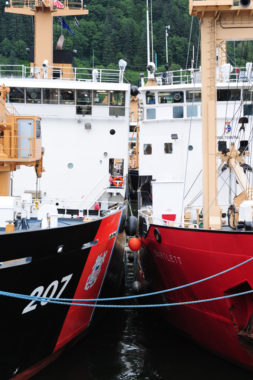
The Coast Guard Cutter Maple and the Canadian coast guard vessel Bartlett sit side-by-side at Coast Guard Station Juneau July 16, 2012. The two buoy tender crews, along with four other U.S. Coast Guard cutter crews, travelled to Juneau for the annual buoy tender roundup. U.S. Coast Guard photo by Petty Officer 3rd Class Grant DeVuyst.
The Coast Guard Cutter Maple and the Canadian coast guard vessel Bartlett sit side-by-side at Coast Guard Station Juneau July 16, 2012. (Photo by Coast Guard Petty Officer 3rd Class Grant DeVuyst)

Sitka’s docks will look a bit different this summer. The US Coast Guard Cutter Maple will sail south for maintenance and then be reassigned a new homeport in the spring, leaving Sitka without a large Coast Guard vessel for at least six months.

Lt. Commander Patrick Armstrong is the officer in charge of the Coast Guard cutter Maple.

“There’s been so many hours put on the engines and the generators and things just need to be rebuilt,” explained Armstrong. “Wiring and a lot of the engineering type stuff needs to be overhauled. So there’s nothing specifically wrong with the ship, it’s just a general mid-life maintenance.”

The Maple was commissioned in the mid-1990s. Armstrong says it’s among more than a dozen other cutters now in need of a tune up.

Once work on the Maple is done, the 225-foot vessel will have a new homeport in Atlantic Beach, North Carolina. Although the cutter will have a new home, Armstrong said its crew wouldn’t go with it.

“Here in Sitka, nothing will change in terms of the personnel or the transfers, only the ship itself,” Armstrong said. “In the end, it will be just a name change for the ship.”

That new name is the Kukui. The 225-foot cutter is currently homeported in Honolulu, Hawaii and has long ties to the state, getting its name from Hawaii’s state tree.

Like the Maple, it too was designed to service navigation buoys.

“It’s essentially the same thing, just a few minor engineering configurations on board, but it’s really the same class of ship,” Armstrong said.

Along with being in the same class, it was also commissioned around the same time, so the Kukui, too, will get midlife maintenance done in Baltimore before sailing on to Sitka.

But, Armstrong said, that won’t happen until 2018, meaning Sitka will be without a Coast Guard cutter for at least six months.

“Without having a ship we won’t be sailing and doing our normal ATON [aids to navigation] missions and search and rescue missions. Instead, our crew will be focusing on training and maintaining proficiency by doing temporary service on other units and also assisting local units.”

Armstrong said search and rescue efforts will be well covered in the area with the help of Air Station Sitka and Coast Guard Sector Juneau, but he does have some bad news for Halloween lovers in Sitka.

“This October unfortunately, because we don’t have a ship, we will have one year here without it, but we fully expect when we have Kukui back in 2018, we do plan to have a haunted ship again,” Armstrong reassured.

The Coast Guard cutter Maple will leave Sitka this summer, probably in July, Armstrong said and he expects the Kukui to sail into Sitka’s harbor in the spring of 2018.

Sitka’s Green Lake Dam back in service

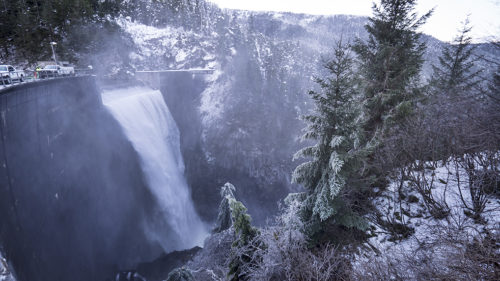
After 84 days out of commission, the Green Lake Dam is up and running again. The dam works in tandem with the Blue Lake Dam to provide hydropower to Sitka. (Photo by Rebecca Danon/KCAW)

On Jan. 7, the Green Lake dam was fully restored to service and Sitka is no longer using diesel fuel.

The dam was shut down in October when part of the intake gate, which controls water into the powerhouse, failed during a routine inspection.

The part — a hydraulic cylinder that raises and lowers the gate — was housed in carbon steel.

After 35 years underwater, it corroded and began leaking fluid. The replacement hydraulic cylinder should last longer, because it’s housed in stainless steel.

It arrived in Sitka by barge Jan. 3 and was installed at 11:30 a.m Jan. 7.

The Green Lake Powerhouse is up and running with one turbine, while the city is making a small repair on the second turbine.

Utility Director Bryan Bertacchi said that making this fix was a group effort, from the mechanics descending 165 feet to the bottom of the dam to city crews keeping road clear to emergency responders standing by, in case there was an accident.

“It was a real incredible team effort in a small community with a small number of people to get that done in the time that it got done,” Bertacchi said.

The city of Sitka owns its electric utility, which is normally 100 percent hydropower – combining both the Blue Lake and Green Lake Dams.

While the Green Lake Dam was out of commission, the city ran diesel generators during cold snaps. All told, the city burned through about 80 percent of its diesel budget for the year.

“It depended on the weather right? On some warm days, we didn’t run diesel at all and then on real cold days, we ran up to like 18 hours days diesel,” Bertacchi said. “We burned through $270,000 of those $337,000 dollars, so we’re still under the budget”

“We don’t anticipate at this time any additional diesel surcharge at this time in our electric rates,” he said.

The Green Lake Power plant is in serious need of an overhaul.

In 2019, Bertacchi said the city plans to shut the plant down for a major repair.

That’s not the only thing that needs to be fixed in the next decade.

“We really need to do a major overhaul of the Marine Street Substation,” Bertacchi said. “That’s really important. That substation serves 80 percent of the entire community. We want to make sure that’s working well during our high peak tourism season and for fish processing.”

To pay for this and other aging infrastructure, the city will also use leftover bond money from the Blue Lake Dam expansion project — which totals about $22 million within the next 10 years.

2 Alaska Airlines flights hit by lightning in Alaska

Update | 1:34 p.m. Wednesday, Dec. 21, 2016

Air travel was disrupted in Southeast Alaska Monday afternoon  after an Alaska Airlines jet was struck by lightning between Juneau and Sitka.

Flight 62 was delayed on the ground in Sitka more than five hours while a replacement aircraft was delivered.

In the meantime, Flight 66 was struck en route between Anchorage and Cordova.

Although aircraft strikes are relatively rare, lightning during a Southeast Alaska winter storm is common.

It takes two things to make thunderstorms in the Gulf of Alaska.

“We have cold air aloft and we still have a relatively warm sea surface temperature,” said Joel Curtis, the warning coordination meteorologist at the National Weather Service in Juneau.

Curtis was a navigator on C-130’s in the Air Force and he spent a lot of time flying around storms then. But sometimes planes and lightning share the same airspace, making strikes a bit more likely.

“The aircraft on approach is on a fairly low level, and the charge difference between what’s going on in the cloud and on the ground is probably a little bit greater in that zone where the aircraft is,” he said.

That two Alaska Airlines jets were struck within a few hours of each other doesn’t seem like such a remarkable coincidence when you realize just how much lightning was happening from Sunday evening to Monday evening. A total of 396 strikes, mostly on the outer coast and over the Gulf, according to new detection equipment in use by the National Weather Service.

“It’s light years. I mean it’s so far ahead of what we used to have about two years ago, that we’re able to watch all this oceanic lightning that we never really had a handle on before,” Curtis said.

Curtis said the lightning detection system is proprietary to the manufacturer, but relies on triangulation to pinpoint lightning.

He saw strikes as far inland as Glacier Bay on Monday, but no farther, since the water toward the mainland side of Southeast Alaska is colder.

But is this unusual weather? Not at all.

“I have to tell you that this is the climatological time of year that we see the most lightning,” he said. “In fact it’s the time of year when a few of us get to experience thunder snow.”

Thunder snow. Curtis says the storms that produce the most lightning also produce a very specific kind of precipitation. There’s a Doppler radar on Biorka Island in Sitka Sound that “sees” rain, snow and everything in between.

“And when I see a type of ice pellet called graupel,” Curtis said.

Graupel is a tiny droplet of water that is rimed in ice. Not hail. Not really snow. And graupel is behind a lot of the lightning in Southeast Alaska.

“They’re not all that big. The water molecules are attaching themselves to this and, of course, water being bipolar with a couple of nice charges on it, really sets up a charge difference between it and the ground,” Curtis said. “You get enough of that, and it’s being thrown up and down, that’s what really gets a charge going. And the next thing you know you need a discharge.”

But of course none of this matters if you’re waiting in an airport.

Sitka librarian Kari Sagel boarded the replacement aircraft sent up from Seattle to continue flight 62. Sagel said she finally got on the plane about 5 hours behind schedule, and the misadventures continued.

“And so much time went by. We had to de-ice. We had to wait for a plane to land, and we finally made it to Ketchikan,” Sagel said. “When we made it to Ketchikan, however, they were trying for a quick turnaround. We left the gate, we taxied away. We taxied for an extremely long time. We seemed to do a 180. And soon we were back at the gate. They de-planed some passengers. A little boy refused to sit and be seat-belted.”

The boy and his father were left behind in Ketchikan.

I reached Sagel as she waited for a lift from cousins at the Cedar Rapids, Iowa, airport.

This was the first time in 23 years she’s gone home for Christmas. A journey she won’t soon repeat.

“I will be in Sitka next year for the holidays.”

Despite all the unexpected complications, Sagel reports that Alaska Airlines handled the circumstances Monday with great style.


Original story 7 a.m. Tuesday, Dec. 10, 2016

JUNEAU — Two Alaska Airlines flights were struck by lightning Monday, causing them to be removed from service so they could be inspected for any damage.

The Juneau Empire reports the first strike occurred as a plane from Juneau prepared to land in Sitka.

The second strike occurred on a flight from Anchorage to Cordova. That flight typically continues from Cordova to Yakutat, Juneau and Seattle, but Alaska Airlines spokeswoman Ann Vininovich says the remaining legs were canceled so the plane could be inspected in Seattle.

While modern passenger jets are designed to deal with lightning strikes, Vininovich says Alaska Airlines policy requires aircraft struck by lightning to be removed from service for a maintenance review.

The National Weather Service issued a notice Monday advising pilots of lightning in the region.

Associated Press

Site notifications
Update notification options
Subscribe to notifications