KCAW is our partner station in Sitka. KTOO collaborates with partners across the state to cover important news and to share stories with our audiences.
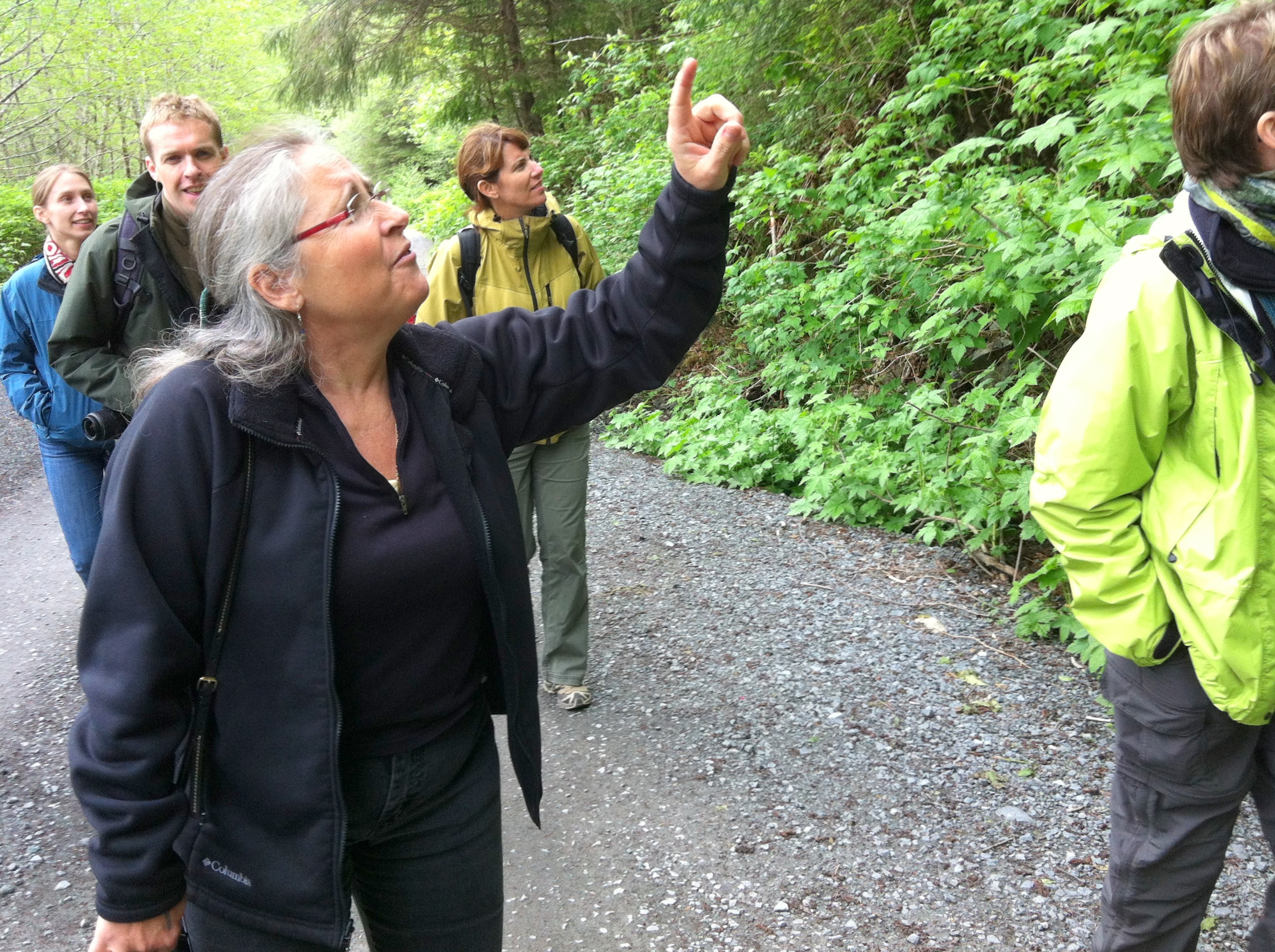
Sitka resident and Tlingit weaver Teri Rofkar takes staff from the National Museum of the American Indian up Blue Lake Road last year. The group was in town for field study, learning about the origins of many of the objects they keep track of in Washington, D.C. Rofkar passed away Friday, Dec. 2, 2016. (Photo by Ed Ronco/KCAW )
Tlingit weaver Teri Rofkar died Dec. 2, 2016. She was 60.
The Sitka resident was internationally renowned for her baskets and textiles, made from cedar, spruce tree roots and mountain goat wool collected along Sitka’s shores.
Teri Rofkar’s “Caprini Tribal Regalia” Ravenstail robe placed first in the Northwest Coast Customary-Inspired Art category. (Photo by Lisa Phu/KTOO)
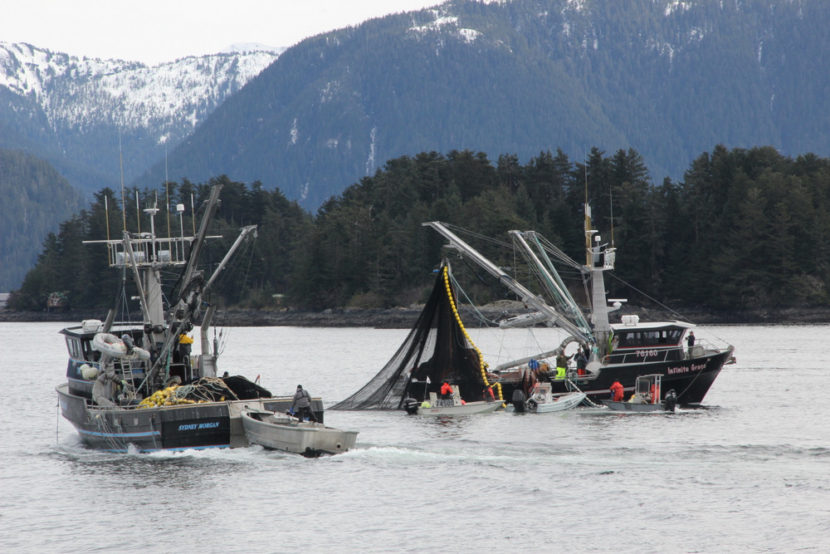
The seiner Infinite Grace pursing up during the third opening in the Sitka Sound sac roe herring fishery, on Wednesday, March 26, 2014. (Photo by Rachel Waldholz/KCAW)
Commercial fishermen are largely at the whim of the seafood market. Prices can vary wildly, while operation costs stays the same — That is, until now. An energy audit aims to help Sitka’s fishermen increase their profit margins.
It’s a sunny morning in Sitka. Usually Steve Fish — yes, that is his real name — would be out on his boat the Kariel, trolling for salmon or longlining for black cod or halibut. But today, the 66-foot fishing vessel and its captain are parked in the harbor.
Fish has surrendered the Kariel to a swarm of engineers, who can’t help but ask about how his gear works. Fish explains.
“The fish hits the cruise fire and then the winch, as it’s hauling the gear, pulls the hook out of the fish’s mouth.”
They’re all aboard the Kariel to conduct an energy audit of the vessel. Fish, along with 17 other fishermen in Sitka, volunteered for the audit.
“It’s dollars and cents,” Fish says.
For Fish and most others in the industry, each year those dollars and cents are spent at the pump.
“We might use somewhere in the neighborhood of 10,000 gallons,” Fish says, which costs between $20,000 and $50,000, depending on the price of diesel.
One obvious way to cut costs is with a more efficient engine, but Mike Gaffney says there are other, less expensive avenues as well. He’s an engineer based in Norfolk, Virginia and usually works on larger ships like cruise liners and Coast Guard cutters.
“But this is my first episode with fishing vessels, so that’s why I keep asking how the operations work,” explains Gaffney.
Gaffney was brought up to help with the Fishing Vessel Energy Efficiency Project. That’s a joint effort by the Alaska Longline Fishermen’s Association and the Alaska Fisheries Development Foundation aimed at energy and cost savings.
But to do that, Gaffney says they need a baseline of data: How much, say, a vessel like the Karieluses without the upgrades.
Gaffney climbs down the narrow ladder into the Kariel’s engine room
“And of course there’s lots of room here to move around,” Gaffney jokes.
The space is tiny. Gaffney tucks himself up against the electric panel and runs wires between it and his power quality analyzer, or PQA, which resembles a clunky, oversized calculator.
“It is the Hioki 3197 model,” Gaffney explains of his PQA. “That one is sexy.”
Engineer Mike Gaffney uses a power quality analyzer to measure the energy use of the vessel’s lighting. (Emily Russell/KCAW).
He starts with the vessel’s lighting. It’s measuring amperage, voltage, and power factor, which together determine how much energy the lights actually use.
“So we’re going to measure what he’s currently drawing and see how long he actually keeps them on,” Gaffney says. “We’ll figure out what his annual cost is to operate these lights and see if it’s cost effective to switch to LEDs.”
Right now the vessel uses high pressure sodium lights, which Gaffney says have a long warm up period, so fishermen tend to just turn them on and leave them on.
“Also every time you cycle them on and off, it shortens the life of the bulb,” Gaffney adds.
That’s not the case for LEDs. There’s no warm up time and it doesn’t hurt to turn them on and off. And they’re brighter.
“If you put an LED lighting in this engine room, it’ll brighten it way up,” Gaffney says.
For fishermen, though, that’s not always a good thing. Some complain about the light being too blue, too harsh on the eyes. Another problem unique to fishermen especially in Alaska: LEDs don’t heat up the way other bulbs do, which means more ice buildup on outside lighting.
It’s the data but also these insights that make the project unique.
Chandler Kemp is an engineer based in Sitka. “I don’t know of anybody who is doing this type of work on fishing boats,” Kemp says.
He’s compiling all of Gaffney’s data and writing up reports for the 18 vessels that volunteered for the audit. Kemp says the end goal is an online tool for fishermen.
“It would be an online interface that people can go on to easily access the information we have collected and enter in a little bit of information about their boats, say the fisheries they participate in, the length, the engine size,” Kemp explains.
The tool, which Kemp expects will be released in 2017, will then generate ways to make the vessel more energy efficient, and for fishermen, that means more profitable.
The world’s oceans are becoming more acidic and, like climate change, it’s happening at a faster rate in the far north waters of Alaska.
A workshop to be held Wednesday in Anchorage aims to bring together scientists and stakeholders to better understand the threat ocean acidification poses to the state.
The workshop is being streamed in nine other communities around the state, including Sitka and Juneau.
Not only are the world’s oceans about 30 percent more acidic today than they were 300 years ago, the rate at which they’re acidifying is faster than at any other time on record.
Chris Whitehead is the environmental program manager for the Sitka Tribe of Alaska.
“So, more carbon in the air getting absorbed by seawater makes it more acidic,” Whitehead said of ocean acidification.
The tribe has been testing toxins in shellfish for years, but soon it will start testing the waters for levels of acidity.
Ocean acidification poses a particular threat to marine animals at the bottom of the food chain, according to Whitehead.
“Like if you’re a little tiny clam or a terapod, which are these little tiny plankton that form really delicate shells,” Whitehead said, “your shell can’t form.”
That’s because the more acidic ocean water is, the more corrosive it is.
That worries people like Hannah Heimbuch, who’s planning on attending the ocean acidification workshop.
“A lot of my questions are around the food web and predator-prey dynamics,” Heimbuch said.
Heimbuch lives in Homer, where she fishes commercially.
“There are so many unanswered questions about how (ocean acidification) will affect the ecology of the marine environment,” Heimbuch said. “As a salmon fisherman, I would like to know how it will affect what the fish I catch eat.”
Along with catching fish, Heimbuch also works for the Alaska Marine Conservation Council as a community fisheries organizer.
She’s been focused recently on ocean acidification, trying to inform people about the effects it may have on Alaska’s waters.
“And one of the ways that we have been doing that is by working with the Alaska Ocean Observing System, AOOS, on the Alaska Ocean Acidification Network,” Heimbuch said.
It’s that network that organized the workshop on the “State of the Science” of ocean acidification.
There will be remarks from researchers and policymakers, panel discussions with scientists from around the state, and presentations on lessons learned from the Pacific Northwest.
The workshop is free online, and will stream directly to some of the state’s major fishing communities like Unalaska, Kodiak and Sitka. Hannah Heimbuch said ocean acidification poses a direct threat to their local economies for those communities.
“I think that folks that are based in coastal Alaska understand that we need to take that long term view and really try to better understand these big-picture changes happening out in the ocean,” she said.
Because, Heimbuch said, at the current rate of ocean acidification, it won’t be long before those changes will be felt on shore.
In Sitka, a remote viewing of the workshop is being held at the Island Institute from 8 a.m. to 5 p.m. Wednesday.
You can find a link to stream the workshop online. The presentation is also being streamed in Cordova, Fairbanks, Homer, Seward, Kodiak, Nome and Unalaska.
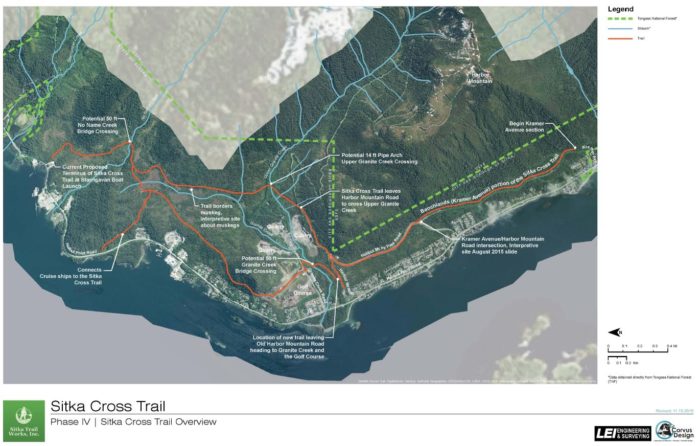
The two proposed routes of the final leg of the Cross Trail connect Kramer Avenue to Starrigavan Boat Launch. (Photo courtesy of Sitka Trail Works)
Sitka’s Cross Trail has won funding for an extension to the far end of the road system. Sitka Trail Works announced last week that $1.8 million in federal funds have been approved for the final phase of the project – provided the next president signs the federal transportation bill.
Lynne Brandon, the executive director of Sitka Trail Works, said this is a major milestone, not just for the project, but for the entire community.
“Anything that we can do to make Sitka a more liveable, healthy community benefits our overall economy.”
For Brandon, that means building the final three miles of trail from Harbor Mountain to Starrigavan Beach, including a trailhead at the ferry terminal.
“We’re hoping that somebody wants to do a tour where they can just get people onto the trail and into town via bike,” Brandon said, “which I would think would be a really attractive option for tourists.”
The trail has always been about more than just attracting tourists and recreational users, though. Brandon explained it also has the capability to serve as an emergency route.
“If, for instance, Halibut Point Road had a (land) slide across it, or was taken out by a tsunami, it will be Herc(ulean) enough – strong enough – to support pickup trucks.”
In fact, in the last phase of the project, Brandon said bridges on the trail were built to withstand 16,000 pounds, or the weight of fully loaded dump truck.
“The Cross Trail is built like a logging road,” Brandon said, “and has a pretty bomb-proof design to it so that it is uber-low maintenance.”
That helps cut down on upkeep costs for the city.
There’s been both concern and confusion about just how much the city has contributed to the Cross Trail project, but according to Brandon, only about $49,000 has come from the city’s general fund.
Instead, federal and state grants have funded vast majority of the work.
The $1.8 million grant just announced is from the Federal Access Lands Program, which is part of the federal transportation bill set to pass in October 2018.
That’s the final hurdle, but Brandon is optimistic, especially with President-elect Donald Trump’s emphasis on infrastructure projects.
“So we’re hopeful that the federal transportation bill will have bipartisan support and make it through Congress without any problem.”
Until then, Brandon said, the focus is on planning.
Sitka Trail Works has proposed two route options for the final three miles of trail.
The first follows Harbor Mountain Road and crosses Upper Granite Creek.
The other is closer to shore, running along the golf course and parallel to Halibut Point Road. Both options end at Starrigavan Boat Launch.
In partnership with the City and Borough of Sitka, Sitka Trail Works is hosting a public meeting and asking for input Tuesday evening at Harrigan Centennial Hall from 5:30 to 7 p.m.
Written comments may be mailed to Sitka Trail Works at 801 Halibut Point Road, Sitka, AK 99835.
Sitka Stands for Standing Rock event will feature an hour of yoga, an art auction, and letter writing. (Photo by Emily Russell/KCAW)
Protests on the Standing Rock Sioux reservation continue this week.
That’s despite rising tensions between protesters and police and dropping temperatures in the Midwest.
An event in Sitka on Saturday aims to raise food and funds for the reservation’s residents, who fear that the Dakota Access Pipeline could threaten their drinking water and destroy sacred lands.
Lakota Harden’s family is from the Lakota nation in South Dakota. “I’m a Minneconjou and Yankton Lakota,” Harden said.
Harden spent part of her childhood in Sitka, where she lives now.
Since protesting against the Dakota Access Pipeline began this summer, Harden said it’s been difficult to be so far away. Actually, she described it as “turmoil.’’
“Every day I wake up and think, ‘What am I doing here? I need to be down there,’ especially when I see pictures of my nephews with rubber bullet wounds,” Harden said.
Harden did travel to Standing Rock in September, but said work is keeping her in Sitka at the moment.
Still she couldn’t sit idly by.
A few months ago she and a few friends helped organize a drum circle downtown.
“And we did come together and we sang and prayed, because that’s what they’re asking people to do, first and foremost, and that’s what we did,” Harden said. “We had a sign that said ‘Sitka Stands with Standing Rock.’”
The Dakota Access Pipeline would pass under the Missouri River, which the Standing Rock Sioux Tribe said threatens its drinking water. That type of message resonates with people in Sitka, Harden said.
“This land– we love this land, we love these waters, we want to protect them,” Harden said. “So people want to make a stand with Standing Rock here (in Sitka).”
And Harden wasn’t the only one wanting to do more.
Matthew Jackson was also feeling restless, especially recently.
“Over the last couple of weeks, myself and some of my friends were growing more and more concerned over Standing Rock,” Jackson said.
But, he said, talking just to his friends wasn’t enough.
“Most of my friend group is white,” Jackson said. “In some places in Sitka it can be hard to break the racial divide, but we knew that solidarity had to start at home, and so we reached out to some folks in the Native community like Lakota (Harden).”
And soon thereafter, they found out a fundraiser was already being planned in Sitka this weekend. So, Jackson said, they all sat down together at a local cafe and built on those plans.
There’s going to be yoga, letter-writing, and an art auction.
Jackson said they’re also hoping to collect traditional foods to send down to protesters.
“Like dried seaweed, venison jerky, smoked salmon– anything that’s canned or jarred,” Jackson said.
Both Jackson and Harden said this won’t be the end of fundraising efforts in Sitka. Like the protesters, they’ll stand with the Sioux Nation until tribal lands and drinking water are out of danger.
A Sitka man has been indicted on 10 counts of possession of child pornography.
A Sitka grand jury on Nov. 10 indicted William Roy Hammock, 41, for allegedly possessing a computer disc containing at least 10 images of underage individuals engaged in sexual activity.
Sitka police discovered the disc in Hammock’s home in December 2012 while executing a search warrant related to a drug investigation.
The disc was one of five discs allegedly containing illegal images, and Hammock was indicted later that year on initial charges of possession of child porn.
However, legal counsel for Hammock successfully argued that four of the five discs were mishandled by police during evidence-gathering — namely, the read/write tabs on the discs were not switched to “read only” when the files were logged by detectives, creating doubts about when the defendant may have last accessed them — if ever.
The read/write tab on the fifth disc, however, was set to “read only” during evidence gathering, and the 10 images contained on it are the basis for the grand jury’s re-indictment of Hammock last week.
Hammock is being held at the Lemon Creek Correctional Center in Juneau, pending $150,000 bail.
His trial is set for Jan. 9 in Sitka.
In other court news:
Sitka Superior Court in October sentenced Carlos Ernesto Macias, 26, to serve five years in prison for second-degree sexual abuse of a minor. Macias was on probation for five counts of assault at the time of his conviction. Probation was revoked, and he’ll serve out his penalties concurrently.
Virgil Leal, 46, of Sitka is also headed to prison for one year. Leal was sentenced in Sitka Superior court for Misconduct Involving a Controlled Substance in the 3rd degree.
According to court records, postal inspectors intercepted a parcel addressed to Leal’s wife in October of last year. The parcel was heavily taped and had a phony return address.
Inspectors subjected the parcel to a sniff by a drug dog, who indicated the presence of drugs.
Inspectors returned the parcel to the mail stream, where it was delivered to Leal’s home, and he was subsequently arrested by Sitka police.
The package was found to contain about an ounce of methamphetamine, with a street value of more than 5,000.
This was Leal’s first felony conviction.
Close
Update notification options
Subscribe to notifications
Subscribe
Get notifications about news related to the topics you care about. You can unsubscribe anytime.