KCAW - Sitka

KCAW is our partner station in Sitka. KTOO collaborates with partners across the state to cover important news and to share stories with our audiences.

Through a student lens: Films focus on place, culture and climate change

Five Mount Edgecumbe High School students took part in a film-making class last year and will showcase their work at a screening in Sitka tonight.

The films focus on place, culture, and climate change in a handful of villages across the state.

Emmett Williams has been in the film industry for decades. His work has taken him to Africa, South America and to big cities like New York and London. Most recently though, Sitka has been the focus of his storytelling career.

“When I came to Sitka I met Peter Bradley at the Island Institute and we became not only good friends, but we had a lot of creative ideas that were similar,” Williams said.

One of those ideas involved students at Mount Edgecumbe.

The Island Institute, a Sitka-based nonprofit, was looking to start a storytelling program at the school.

Williams, on the other hand, wanted to teach students about the more technical aspects of filmmaking.

“I was having a conversation about that with Annika Ord, the program manager of the Island Institute at the time, and we said, ‘We should do it together,’ and so Annika and I started working together and it’s been an amazing partnership,” Williams said.

That partnership resulted in a class at Mount Edgecumbe.

With a $20,000 grant from the Crossett Fund, the Island Institute paid Williams and Ord and purchased eight high-quality audio and video kits for the students to use.

Williams said, in the beginning, students learned the basics of storytelling and documentary film-making.

“We also said, ‘These are examples of climate change stories. These are examples of stories about culture. These are examples of stories about place,’” Williams said. “And then we said, ‘Forget all that, what do you care about?’’”

It was important to let the students decide what each of their stories would be about, Williams said.

Once they had the basic training, each went home for the summer with film equipment in hand and an idea in mind.

“The five stories are based in Craig, Bethel, New Stuyahok, Klawock and Old Harbor,” Williams said.

Their stories ended up being just as diverse as the places where they were filmed.

Williams was careful not to give anything away, but he did say how impressed he is with each of the students.

“You know when you work with teenagers or kids sometimes you think, ‘You know, whatever they come back with I’ll be happy,’” Williams said. “‘I’m just happy they come back with something,’ but we were literally in shock at how amazing the footage and the interviews are.”

Williams has no doubt moviegoers will be just as amazed as he.

The films are being screened 6 p.m. Thursday at Sitka’s Coliseum Theater, followed by a question and answer with the student filmmakers.

The event is free and open to the public.

Three bears shot and killed in Sitka neighborhood

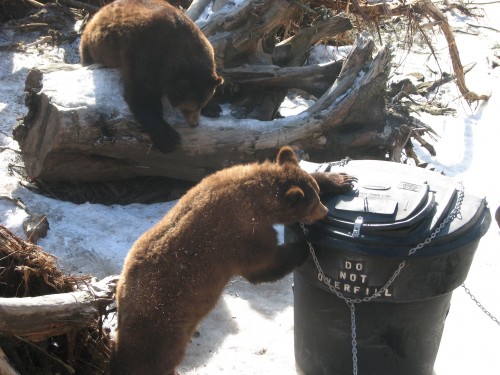
Wildlife troopers shot and killed a brown bear sow and her two cubs in a Sitka neighborhood Thursday, Oct. 20.

While it’s not the first report of an aggressive bear near downtown, the three were the first animals destroyed this year for public safety.

Alaska Wildlife Trooper Kyle Ferguson responded to the bear sighting on Granite Creek Road about 5:30 Thursday evening.

Ferguson said, like most of the recent bear sightings in town, the sow was searching for food.

“The bear grabbed a large trash dumpster, one of the large round ones that are commonly used in town, and rolled it down in an embankment near some homes,” Ferguson said.

Ferguson knew this wouldn’t be a routine case where he could scare the bear away with sirens or rubber bullets, because the sow grabbed the entire Dumpster, and not just one or two bags of trash, is why.

The Dumpster provided the sow and her cubs with more food than they could eat in one sitting, he said.

“So she, like bears do, established a food cache there. (The sow) buried parts of it and remained in the area and was very defensive and aggressive towards people.”

Ferguson compared the scenario to the way a bear would act if it were guarding a deer it had killed and cached for later.

There was no scaring this bear away from her food source.

So, for the sake of public safety, Ferguson shot and killed the aggressive sow.

The cubs, which he said weighed no more than 80 or 90 pounds apiece, were not acting aggressively. They lingered after their mother was shot, not really knowing what to do, he said.

“It’s a sad deal, because all they’ve ever known is mom and they’re going to stay with mom,” Ferguson said.

In a case like this, responding officers have two options.

The first is to capture the cubs and send them off to a zoo or a place like Fortress of the Bear, which rescues orphaned cubs in Sitka.

“But in order for that to happen, there needs to be a pre-existing request,” Ferguson explained. “There has to be some zoo or other organization on record that says, ‘Hey, we’re looking for some brown bear cubs from Alaska.’”

And, Ferguson said, there wasn’t.

So, without any alternative placement options, the decision was ultimately made to kill the two cubs as well.

All three bears are treated the same way a bear killed in defense of life or property would be.

“The bear is skinned, the hide, with claws attached, and the skull are turned over the to the (Alaska) Department of Fish & Game and are property of the state,” Ferguson said. “Then the meat, here locally, we donate to the (Alaska) Raptor Center.”

Alaska Wildlife Troopers and the Sitka Police Department continue to urge residents to be responsible with their garbage.

“While we cannot tolerate an aggressive brown bear in a residential area,” Ferguson said, “there needs to be a greater level of understanding from people in the community that we live in brown bear country and you need to be responsible with your garbage.”

The Dumpster the sow dragged off was secured shut with chains and clips, but even that didn’t deter the bear from prying it open.

Also Thursday, Alaska Department of Fish & Game received a report from a group of hikers of an aggressive bear on the Mt. Verstovia trail in Sitka.

Wildlife Troopers were notified and plan to put up signage at the trailhead.

New faucets combat high lead levels in Port Alexander

Faucet and running water. (Photo courtesy of KCAW)
(Photo courtesy of KCAW)

Homes in Port Alexander are getting new water faucets this month. It’s part of an effort to minimize lead contamination in the community’s residential drinking water.

Cindy Christian manages the Alaska Department of Environmental Conservation’s Drinking Water program. She said samples from both 2011 and 2012 showed lead levels in a few Port Alexander homes exceeded the “action level” set by the state.

“And that means if you exceed the 15 parts per billion, that you have to do something,” explained Christian.

Lead doesn’t usually contaminate water at the source. More often it leaches from lead-lined pipes or faucets, so Christian says Port Alexander had two options– either to replace older faucets or start corrosion control.

“Corrosive water means that it can leach these chemicals out of the pipes,” Christian explained, “and so corrosion control is usually a chemical that is added, like orthophosphate or soda ash, that can raise the pH of the water so it’s not so corrosive.”

But, Christian said, Port Alexander didn’t have the funds needed to implement corrosion control.

“For the bigger systems like Anchorage or Sitka or Ketchikan, you have a lot of people paying their water bills and so you can take that money and pay your operators and you can buy the chemicals and everything that you need,” said Christian. “It’s just not the reality in our smaller communities in Alaska.”

The DEC notified residents of Port Alexander in 2011 and 2012, but since the funds weren’t there, Christian said no further action was taken.

One home remedy for lowering lead levels is to flush the line, leaving the tap running for a minute or two in the morning. That’s doesn’t fix the problem, though, and when the community was tested again this year the DEC again found unsafe lead levels in a few homes.

“That’s when we decided that the faucet replacement for each one of the homes there would be our best option,” said Christian.

Christian said the DEC sought funding help from the EPA. She expects the kitchen faucets for Port Alexander’s ten homes to be installed by the end of this month.

Aggressive bears concern Sitka Police

Sitka Police Lt. Lance Ewers urges residents to keep their garbage indoors until the day of pickup. (Photo by KCAW).

The Sitka Police Department is on a bear hunt.

There’s been a recent spike in bear sightings around town and even a few close calls.

It’s not uncommon for bears roam neighborhoods in search of trash, especially in the months leading up to hibernation, but all the usual tricks for keeping Sitka’s bears at bay haven’t been working.

It’s safe to say it’s been a bad summer for bear encounters in Southeast.

There have been four maulings in the last two months and a few charging bears have been shot in self-defense.

“It’s kind of an unusual year, I think we all can agree,” Sitka Police Lt. Lance Ewers said. “There (have) been so many people that have had to defend themselves from a charging brown bear or actually were attacked by a bear.”

But all of those encounters took place outside of Sitka. While there hasn’t been a violent bear encounter or a bear killed in town this year, Ewers said tensions are rising.

“You had the bear that broke into the car, which is the same bear that broke into two different people’s garages, so that’s three,” he said. “Then you had the bear that chased the man on the bicycle, and that’s four.”

Those encounters have all happened in Sitka within the last two weeks.

That list doesn’t include the handful of bear sightings residents report to the Sitka Police almost every night.

Ewers said, unless they’re tied up with another call, an officer is sent out to respond to each and every one of those calls.

“Sometimes the officer will blare the siren, sometimes they’ll beep the air horn, other times they’ll get out and yell at the bear and 90 percent of the time the bear runs away, which is good,” Ewers said.

But that hasn’t been the case in recent weeks.

Ewers said the two bears that have been charging pedestrians  and tipping over trash cans don’t seem to be scared off by loud noises.

So this past weekend officers used rubber bullets on one of the bears seen wandering between Sitka’s Indian River and Whale Park, but again, to no avail.

“They’ve gotten to the point now where they’re not even affected by the rubber bullets,” Ewers said. “They just walk away.”

The Sitka Police and Alaska State Troopers have been working with the Alaska Department of Fish and Game to find other ways to scare off the bears.

Fish and Game wildlife biologist Steve Bethune said they’ve tried trapping the bears as well, but even then, a live release wouldn’t be likely.

“Almost universally when you move bears they inevitably come back, so it’s really not an effective strategy for eliminating the problem and if they don’t come back you’ve often taken that problem and given it to some other community,” Bethune said.

So now, as Ewers describes it, the strategy is simple to “destroy” the two bears.

“If we have an opportunity to euthanize one of the bears that are between that Indian River area and Whale Park, and the officer could do it safely, then the trained professional officer who practices will destroy that bear,” Ewers said.

Ewers urges residents to continue reporting bear sightings to the police and to stay alert, especially in forested areas.

Another thing he urges the community of Sitka to do? Keep your garbage indoors until the day of pickup. And if you, like Ewers, don’t have a garage?

“I keep my garbage up on my porch until garbage day and then I bring it out there, because I don’t want it to be my fault that, a month after a bear got into my garbage, they’re forced to destroy a bear.”

As for the two bears roaming downtown Sitka, their fates are likely sealed.

Canoe steaming carries on Tlingit and Haida tradition

To transform a hollowed-out log into a dugout canoe requires more than expert carving — it requires steam, and lots of it.

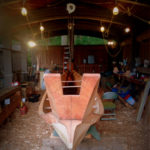
Earlier this week the skies over Eagle Beach in Sitka were filled with smoke and steam, as a carving team worked to transform a cedar dugout into an elegant, seaworthy canoe.

David Katzeek sings and drums alongside the nearly 30- foot long canoe and it’s five-man carving crew. The men stomp their feet to the beat.

Katzeek is a Tlingit leader originally from Klukwan. He traveled down from Juneau for the canoe steaming. Tlingit, Haida, and Tsimshian people have carved canoes for generations. They fought wars and fished rivers from those canoes. Today, the vessel– it’s more of a symbol, but Katzeek says it’s still significant.

“A canoe is not just a vessel that goes over water,” Katzeek explains. “It represents a people’s  journey in life– the journey that we started thousands upon thousands of years ago, and we’re still here on that journey. We are not gone. We are not lost.”

Sealaska Heritage Institute teamed up with Sitka National Historical Park to preserve the  tradition, bringing in master carver Steve Brown to train four apprentice carvers– T.J. Young, Jerrod and Nicholas Galanin, and Tommy Joseph.

After Katzeek offers an invocation, Joseph walks down to a water pump on the beach.

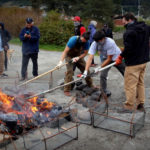
Fire hoses fill the canoe with about 10 inches of seawater. Two bonfires on either side heat up football-sized lava rocks.

“Here in about an hour when these rocks are red hot we’ll start filling the baskets up and put them inside the canoe,” Joseph explains. “We have a big tarp to cover the whole thing.”

The idea, Joseph says, is to let the heat and pressure from the steam widen the canoe, making it sturdier.

“The boat, right now as it sits, it’s a beautiful boat, but it’s not seaworthy, it would be real tippy,” he says. “We’re going to get about 14 to 16 inches wider by steaming the boat.”

‘It softens the wood and makes it so that it will be a seaworthy boat,” Joseph adds. “It will be near impossible to flip over.”

The process is long, but the fires are warm and the mood is light among the friends and family and the park service staff. They’ve all gathered to watch.

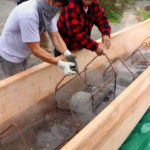
Every hour or so hour, the men rake away embers from the fire and shovel three or four hot rocks into metal baskets. Those baskets are then slowly placed inside the canoe.

Clouds of steam and smoke fill the air. A huge green tarp covers the canoe and the steam gets to work. Jerrod Galanin, one of the apprentice carvers, peeks inside.

“I’m just listening to see if it’s boiling still, if it’s active, if we need to replace the rocks. Put your ear in there and listen,” Galanin urges.

So, I do. It pops and fizzes like a freshly-poured glass of soda. When the fizzing dies down, it’s time to take the tarp off and put in a fresh batch of hot rocks.

I’m standing next to Steve Brown. He’s the master carver Sealaska and the park brought up from Washington.

“There have been canoes we’ve made in Ketchikan, Wrangell, Glacier Bay, Hoonah, Klukwan,” Brown explains. “Did I say Wrangell already?”

Brown is not Alaska Native, but his knowledge and dedication to the craft have won him wide respect among Native people from the region. This knowledge can’t be passed on in books. Steaming a canoe is equal parts art and science.

“It will be significantly bigger than it was,” Brown explains. “The ends will be higher, the bottom will be flat– right now the bottom arches up– and the sides will not only bend outward, but they’ll also be down lower too. So, it radically changes shape.”

After an entire day of steaming, the canoe is 16 inches wider.

Tlingit leader David Katzeek says the vessel isn’t the last thing that changes shape. He’s heard back from men after their first time on the water who say there’s something spiritual about being in a traditionally crafted canoe.

“They’ll come up teary eyed, with smiles on their face and saying, ‘Something happened to me when I was out there on the water with all the others. My life has changed. My life will never be the same.’”

After the canoe dries, the carving team with paint it red and black- traditional Tlingit and Haida colors. A dedication ceremony is planned for next spring.

Bear sighting forces temporary park closure in Sitka

The Sitka Police Department typically receives a handful of calls each night from residents reporting bears wandering the streets or dipping into trash cans.

This week there have been a number of sightings in daytime, even one on National Park property.

Ryan Carpenter, who the acting Chief of Interpretation at Sitka National Historical Park, said a bear was in the park early Monday.

“We had a visitor that sighted a bear along Saw Mill Creek, and that was probably about 7:30-7:45 in the morning,” Carpenter said. “That individual notified park staff and the local police department.”

Carpenter said the park’s trails were closed for about an hour while park staff and the police responded.

The Alaska Department of Fish and Game also tried to locate the bear.

Carpenter explained the bear was then reportedly sighted again just outside park property, but authorities were unable to locate it.

He says a bear sighting in the area isn’t all that rare, especially in the late summer and early fall.

“This time of year, when there are salmon running in the streams, there are bears that come through the park, but it seems like by the time we get those reports, the bears have already left, so one of the things we will do is we’ll put cautionary signs up that there has been bear activity in the park so this time of year that’s not an unusual occurrence.”

The park was reopened to visitors later Monday morning. A warning sign remains posted at the entrance of the park and Carpenter urges visitors to remain bear aware at all hours of the day.

Site notifications
Update notification options
Subscribe to notifications