KCAW is our partner station in Sitka. KTOO collaborates with partners across the state to cover important news and to share stories with our audiences.
Sitka’s Superior Court sentenced a woman to jail last week for possessing heroin and methamphetamine valued at more than $42,000.
Shammar Ferguson, 33, smuggled more than 88 grams of the drugs during a flight from Seattle to Sitka this summer, according to court records.
On Aug. 16, a week after Ferguson arrived, the Sitka Police received a report that Ferguson and Lawrence Johnson Jr. were trespassing on a property on Andrew P. Hope Street. When the police arrived, they found the heroin along with a digital scale containing multiple meth crystals.
The Sitka Superior Court sentenced Shammar Ferguson to 23 months in jail.
This is Ferguson’s fourth felony conviction.
The court also sentenced Lawrence Johnson Jr. to serve six months in jail.
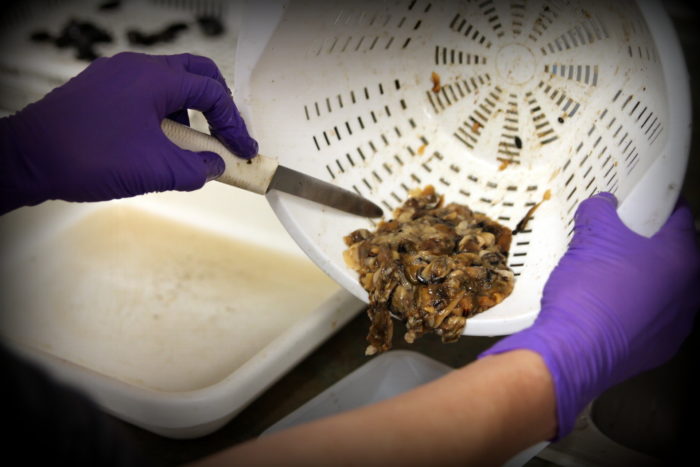
Sitka Tribe of Alaska fisheries biologish Jen Hamblen empties blue mussel meat into a blender. (Photo by Emily Russell/KCAW)
Shellfish is a staple in many homes throughout Southeast Alaska, but it also can be a hazard.
A new lab in Sitka tests regularly for shellfish toxins and now is teaching more than a dozen tribes in the region to do the same.
Global warming could increase the level of toxins, so tribes are working fast to take the mystery out of what’s blooming on their shores.
Jen Hamblen wears purple plastic gloves and a long black apron.
She’s shucking blue mussels, the kind you might find in a seafood restaurant.
“I love chowder,” said Hamblen, a fisheries biologist for the Sitka Tribe of Alaska. “I must say, my appetite for raw shellfish has decreased since I began this position.”
She’s scrapes the meat off the shells into a little white bowl.
When she has at least 100 grams worth of blue mussel meat, she empties the bowl into a blender.
She sets the timer for three minutes and turns the blender on high.
“The fancy word for that is ‘homogenization,’ but ‘shellfish smoothies’ is the other term we like to use,” Hamblen said, joking.
The tribe started blending up shellfish and testing them in the lab because of the growing concern over paralytic shellfish poisoning, or PSP.
Toxic algae blooms can contaminate shellfish, causing the sometimes fatal illness.
“People want to know, ‘Can we go out? Is it safe or is it not?’ Because it is an easy subsistence resource to harvest here,” she said. “There are shellfish everywhere.”
Michael Jamros directs the tribe’s research lab, which opened last year.
“When I showed up a year ago the lab was basically a bunch of boxes and I pretty much had to from there ordering the rest of supplies and getting the lab set up,” Jamros said.
It’s all set up and fully functioning now. That’s a good thing, since a study published last month reports that since 1997, the annual production of algae in the Arctic has risen by nearly 50 percent.
Chris Whitehead, the environmental program manager for the tribe, said warmer ocean temperatures make better breeding grounds for toxins.
“Just like your garden — if you water it and it’s warm and sunny out and you give it fertilizer — everything does really well,” Whitehead said. “It’s the same with these vegetative cells in the marine system.”
That’s why their weekly tests are so important, Whitehead said. And now more than a dozen other tribes in the region are also testing for toxins, including communities like Wrangell, Ketchikan, Juneau, Yakutat and Hoonah, Whitehead said.
“It’s a huge deal here,” said Ian Johnson, the environmental coordinator for the Hoonah Indian Association. “People are out digging all the time.”
“If I was just to guess, I would say over 50 percent of the community consumed clams, probably more. It might be 70 or 80 percent,” Johnson said.
Three people died in 2010 from paralytic shellfish poisoning, including one from Hoonah, and others have gotten sick since.
That’s why Johnson said people are eager for his weekly results, which he started releasing in October.
He soon ran into a problem.
People have different names for the same clams, like the Pacific littleneck clams — some people call them steamer clams.
Others, Johnson said, just differentiate between edible and inedible clams.
So he published an online survey about shellfish names.
“I was just trying to tap into this local base of knowledge and try to understand what people call these different species of clams so I can communicate the results better with them,” Johnson said.
Johnson released results from the survey online and continues testing the water for toxins each week.
If levels are unsafe, Johnson can send in shellfish samples to get blended up and tested in Sitka.
The batch of mussels in the blender right now is from Petersburg, a community 90 miles east of Sitka.
They were flown in just this morning.
After three minutes, the mixture is then run through a series of tests to determine if the mussels in Petersburg are safe to harvest.
Shellfish samples are flown in from other tribes almost every week, which helps Hamblen iron out the kinks in the lab.
Outside of the lab is a different story.
“A problem we encountered today is that there are frozen mussels on the beaches right now,” Hamblen said. “So, we’ll have to look at how to do sampling in Southeast Alaska when we have cold snaps like the one we’re experiencing now.”
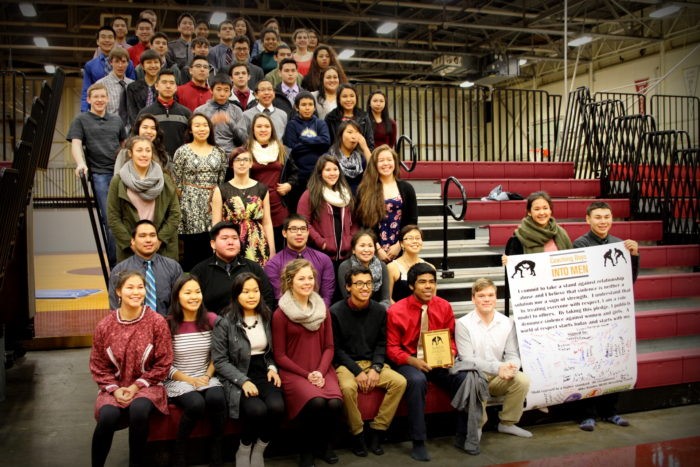
The Mt. Edgecumbe High School wrestling team. Emory Johnson helps hold up the poster. (Emily Russell/KCAW)
This fall, student wrestlers at Mt. Edgecumbe took part in a program called, ‘Coaching Boys into Men.’ The idea is to teach young players how to have healthy relationships even if, in the case of Mt. Edgecumbe, half of them will grow up to be women.
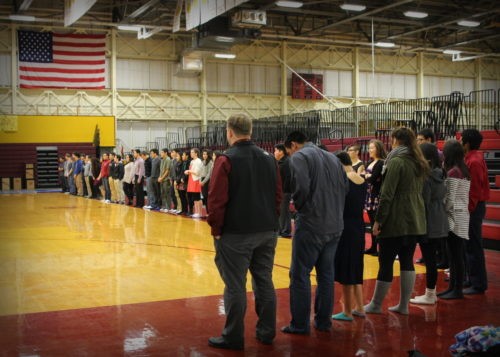
The entire student body of Mt. Edgecumbe, more 400 students from over 100 villages across Alaska, is packed into the school’s gym for a pep rally– a rally that’s about more than just the regional wrestling tourney.
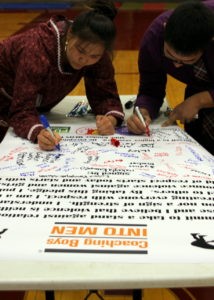
Two student wrestlers sign the poster after completing the ‘Coaching Boys into Men’ program. (Emily Russell/KCAW)
The Mt. Edgecumbe wrestling team is being recognized for completing the ‘Coaching Boys into Men’ program, an effort to promote healthy relationships and reduce abuse and sexual assault.
Emory Johnson, a four-year senior from Bethel is one of the wrestlers.
That’s right, Johnson is a girl. Despite competing in a sport historically geared towards boys, Johnson isn’t shy about her strength.
“My mom never really wanted me to join because she doesn’t like the way the guys beat on the girls. I’m like, ‘Well, it can go both ways,’” Johnson joked.
Johnson is one of more than 20 girls on the team of over 40 wrestlers. Girls have wrestled here for over a decade thanks to their coach, Mike Kimber.
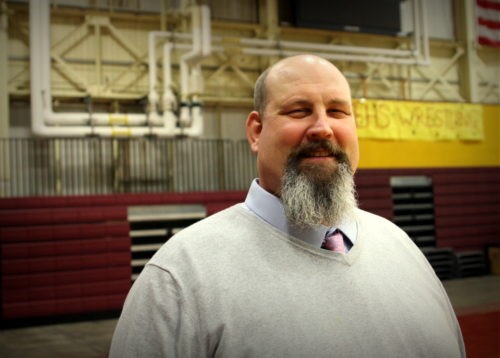
“I’m at teacher at Mt. Edgecumbe,” explained Kimber. “I teach Japanese, English, and a few other classes and I’m the wrestling coach. I’ve been the wrestling coach here for 17 years at Mt. Edgecumbe.”
Mike Kimber has been coaching wrestling at Mt. Edgecumbe High School for 17 years. (Emily Russell/KCAW)
Kimber himself is a graduate of Mt. Edgecumbe. When he was a wrestler, he said his coach worked with the athletes both on and off the mat. It’s that mission, to develop not just a good athlete but a good person, that inspired Kimber to join the ‘Coaching Boys into Men’ program.
“Whether you’re a girl or a boy, everybody needs this information,” urged Julia Smith, the prevention director for Sitkans Against Family Violence.
Smith introduced the program to teachers and coaches at Mt. Edgecumbe a year and a half ago.
“And a lot of them asked, ‘I don’t have all boys on my team, can I still use this?’ So, we called the national folks at Futures Without Violence and they said, ‘Yes, go ahead and use it,’” explained Smith.
The program spans an entire season, with one 15-minute lesson each week. The topics include communicating boundaries, digital disrespect, and the importance of consent. The lesson on consent was the only one Coach Kimber chose to teach separately.
“We kept the boys on the mat and the girls went to another room and did that [lesson],” Kimber said.
Mt. Edgecumbe’s wrestling team was the only one in Sitka to take part in the program this year, but Julia Smith said she’s trying to change that. It’s already caught on in other Southeast communities like Juneau.
“The basketball team in Ketchikan has also used the program,” added Smith. “The basketball team in Kake has used the program, so we’re really trying to build momentum and get this going throughout our state and have all coaches use this as a tool for reiterating the things they’re already teaching.”
There are more than 40 students on the Mt. Edgecumbe wrestling team, half of whom are girls. (Emily Russell/KCAW)
That’s the beauty of the program. The messenger is one that’s usually trusted and the message is one that’s critical for adulthood. Wrestler Emory Johnson gets that.
“Yeah, it’s called “[Coaching] Boys into Men,’ but the questions are still the same. It’s just, ‘What does respect mean to you?’ I mean, respect means respect to everybody,” Johnson said.
And that’s a lesson that every Mt. Edgecumbe wrestler now knows well.
Mt. Edgecumbe will host the Region V wrestling tournament this weekend, with matches on both Friday and Saturday.
An injured fisherman was medevaced from Pybus Bay, 50 miles east of Sitka.
The 37-year old fisherman suffered from a leg laceration and radioed Coast Guard Sector Juneau for help, according to a Coast Guard news release.
After consulting with an on-duty surgeon, an MH-60 Jayhawk helicopter from Air Station Sitka was launched, along with a medium response boat from Juneau.
The Jayhawk crew hoisted the injured fisherman up into the helicopter and transported him back to Sitka for treatment.
According to the Coast Guard, weather on scene was 12-mph winds with 1-foot seas.
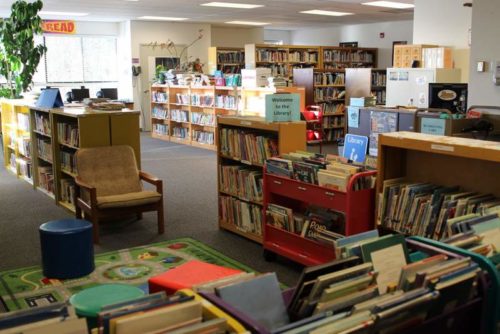
Kake’s library was reopened in October 2015 after a 16-year hiatus. Renamed the Shirly Jackson Library, after a local teacher, the facility is operated by the school district, but open to the public. (Photo by Emily Kwong/KCAW)
For over a decade, there was no place to check out a book in Kake, Alaska.
Tucked into a pocket on Kupreanof Island, the Kake School District closed the library in 1999 because of funding loss.
Through outside partnerships and the hard labor of volunteers, the books were put back on the shelves and the library reopened one year ago.
Christmas has come early for Jocelyn McKinnon-Crowley.
She unpacks a cardboard box, filled to the brim with hardcovers that were donated by a couple in Juneau.
Where to donate
The Shirly Jackson Community Library welcomes donations of novels/graphic novels/picture books, published within the last 10 years. They also welcome any historical Alaska books and documents, as well as Tlingit books and oral histories, no matter the publication date and condition. Monetary donations are welcome as well.
Shirly Jackson Community Library
P.O. Box 450
Kake, Alaska 99830
“Oooo, ‘Heroes of the Frontier.’ Dave Eggers. These are really great,” she exclaims, peering further into the box. On top is a note. It says, “Best wishes on the opening of your library,” written in cursive on sunflower paper.
Kake’s library catalog lists 13,705 titles, but many are old, outdated or missing.
In the Shirly Jackson Community Library, named after a famed local teacher, there are bean bags, potted plants, and six computers beneath a sign, which says “Light up your Imagination and Read.”
The only thing out of date are the books.
A good portion of the collection is pre-1999, when the library closed.
And there are a lot of duplicates and classroom sets, like 20 copies of C.S. Lewis’s “The Lion, the Witch, and the Wardrobe.”
McKinnon-Crowley is the second AmeriCorps VISTA to work on the project.
“We recently removed about 1500 kids books that were all pre-1960s kids books that were falling apart,” she said.
To refresh the collection, the library began seeking donations of gently used books, especially those geared towards kids and about Alaska.
This is the seventh box to arrive.
While the library is operated and paid for by the school district, it’s open to the public and offers programming to both kids and adults.
“Sometimes, Saturdays will be incredibly quiet and then we’ll have knitting and crocheting and it will be super quiet in here,” she said. “Some Saturdays, six or seven kids will show up.”
Re-opening the library has been a major goal of school administration, said Kevin Shipley, superintendent and principal of Kake’s schools.
“Watching the kids have an opportunity to say, ‘Hey, I can actually have a place to learn and use,’ it’s a great thing,” he said.
Shipley said the resurrection of the library mirrors the history of Kake.
In the 1990s, Kake’s economy — built on logging and fishing — collapsed from what Shipley calls a “perfect storm of factors.”
“You had the (federal government) put regulations on logging, you had changes in the fishing program, and then you had prices of fuel go up,” he said.
Jocelyn McKinnon-Crowley is the second AmeriCorps VISTA to work on the Kake Library project, after VISTA Lindsey Bennett helped re-open the library last year. Her job this year is to launch programming, coordinate volunteers, and further organize the collection. (Photo by Emily Kwong/KCAW)
School enrollment dropped as families left, which cut funding. And the library was one of the casualties.
“You cut the fat first, then you cut muscle, then you get down into the bone,” he said. “So we are bare bones here.”
When Shipley arrived in 2012, most of the collection was packed in boxes.
But that year, the school had a lucky break.
Enrollment was 101 and that extra student qualified them for $300,000 through the state’s per-pupil funding formula.
With the extra cash, Shipley hired a principal, Evelyn Wilburn who, alongside community member Marsha Ward, got the library back on its feet.
The one-year anniversary of the reopening was in October.
One came at 10:45 pm from a caller on Andrew P Hope Street requesting an escort to a visitor’s car.
After helping the woman safely to her vehicle, the responding officer located the bear nearby and shot at it with rubber bullets.
“This officer managed to hit the bear twice with the rubber shotgun slugs and the bear wasn’t even fazed,” Sitka police Lt. Lance Ewers said. “He just kept doing his thing.”
Ewers said it’s disturbing how desensitized the bear was. With the sun setting earlier each day, Ewers urged residents in the Indian River drainage area and around Totem Park to remain cautious, especially after dark.
“Please stay bear aware. Please know that bears do operate at night very effectively, they can see a lot better than we can see,” Ewers said. “So be bear aware and be vigilant and hopefully this bear will go to sleep and it won’t be a problem.”
Steve Bethune, a wildlife biologist for the Alaska Department of Fish & Game in Sitka, said bears are usually in their dens by now, but one that’s active so late in the season is not unheard of.
“You can see a bear any time of year, so just because it’s cold and snowy, don’t get complacent with your trash handling,” he said.
It’s that complacency, Bethune said, that makes bears more comfortable rifling through people’s trash. The bear shot at with rubber bullets near Indian River probably wasn’t a first-time offender, Bethune said.
“These bears have probably been hit multiple times by rubber bullets and have learned by now that rubber bullets don’t necessarily mean a negative consequence,” Bethune said.
There were negative consequences for a sow and her two cubs in October.
After trying to bury a dumpster, essentially creating a food cache, Sitka police and Wildlife Troopers agreed to shoot and kill all three bears.
If the bear near Indian River continues coming back to the neighborhood, then it will likely suffer the same consequences, because according to Bethune, “a fed bear is a dead bear.”
Close
Update notification options
Subscribe to notifications
Subscribe
Get notifications about news related to the topics you care about. You can unsubscribe anytime.