KCAW - Sitka

KCAW is our partner station in Sitka. KTOO collaborates with partners across the state to cover important news and to share stories with our audiences.

Cooperative Extension to keep doors open in Anchorage, Sitka

Leadership for Cooperative Extension Service at the University of Alaska Fairbanks announced Aug. 31 a plan to keep two offices open that it planned to close this fall due to state budget cuts –- one in Anchorage and the other in Sitka.

The Sitka office now will be funded largely through grants, some with 4-H and the National Park Service.

The program assistant Jasmine Shaw, based at the University of Alaska Southeast, will continue her work offering programs to the community.

Fred Schlutt, Director of the Cooperative Extension, said this arrangement reduces the cost of running the Sitka office from roughly $25,000 a year to less than $5,000.

The Anchorage office will change in both location and function.

The office will close its doors Oct. 28 and move into the Chugachmiut Tribal Consortium Building. Schlutt said this change will allow the Extension to maintain a physical presence in Anchorage, while significantly reducing the cost.

“(The Anchorage office) cost us almost $300,000 a year in operating costs,” Schlutt said. “With a $1 million cut, that was an easy decision to make because that was 30 percent of the cut. But my goals was to try to eliminate, or rather save as many staff and faculty position s that we have as possible.”

The Anchorage office also will also change in focus, converting from a district office into an “outreach center.”

Classes still will be available, but taught by grant-funded faculty and staff. Among them is an invasive plants instructor, an integrated pest management technician and nutrition educator.

The five Extension agents in Anchorage will no longer be on staff.

Three of them will move to vacant positions at the Fairbanks and Soldotna offices. The fourth is transferring to the MatSu office in Palmer, while the fifth is retiring.

Schlutt said the Extension also wants to modernize distance learning, through mobile and video conferencing technology. Most of their clientele is over 45 years old, and Schlutt wants to attract a younger crowd.

“(The new clientele group) is not as prone to do face-to-face workshops, conferences, that kind of thing. They like to take courses that are offered online when they have time in their lives to do that. And they’re also very attached to, whether it’s a cell phone, an iPad, technology,” Schlutt said. “We really need to make that change, because we really have been using the same delivery method for 86 years in Alaska.”

For fiscal year 2017, the Cooperative Extension was cut by $1 million. To absorb that cut, the program also laid off a half-dozen staff members, reduced contracts and cut down travel and operating expenses.

Despite the depth of the cut, Schlutt is pleased the program found a way to maintain the Sitka and Anchorage locations. He added that, with FY18 budget cuts unknown, the Cooperative Extension may face future shortfalls.

Founded in 1930, the UAF Cooperative Extension Services has a particular focus on food security and safety.

“How can we become more self sustainable by teaching people how to grow more of their own food supply? You can look at health issues, obesity, diabetes, the work that we do there. I think Alaska needs us more than ever before,” Schlutt said.

The Cooperative Extension has nine offices and up to 90 staff members in the summer months.
Seldovia residents warned of leaching lead

The Alaska Department of Environmental Conservation has released a report listing 15 water systems in Alaska that contain lead levels above the federal limit, and the city of Seldovia is among them.

At the last city council meeting, Seldovia city manager Tod Larson responded to the report, stating that old pipes and faucets are the issue.

He advised running water before using it.

“The water from the current water treatment plant is safe,” Larson said. “As it comes into the house, the water goes through some older pipes and some lead is leaching there, so we told them they need to run their water for about two minutes. There also are water testing programs that can test the water from the Department of Environmental Health with the state and finally that there will be a new additive in the water plant that will assist in coating the pipes.”

The additive will coat the pipes, Larson said, in an effort to stop the contamination.

Seldovia’s water system contained 22 parts per billion of lead.

The legal limit is 15 parts per billion.

Three in Sitka indicted for heroin possession

A Sitka grand jury has indicted three Sitkans for possessing and intending to distribute heroin.

On Aug. 26,  A grand jury indicted Lawrence Johnson Jr., 42, Evelyn Calhoun, 29, and Shammar Ferguson, 32, with two felony counts each.

One is for conspiracy to commit misconduct involving a controlled substance in the second degree, which is a class C felony. The other is for misconduct involving a controlled substance in the second degree, a class B felony.

According to courts records, on Aug. 16th, 2016, Calhoun called the Sitka Police Department to report that Ferguson was trespassing on her property.

Johnson, who also was at the scene, then notified police that Calhoun had transported heroin and methamphetamine to Sitka.

Johnson showed an officer a plastic bag containing 88.66 grams of a black, tar-like substance that tested positive for heroin.

The street value of that heroin is $42,000.

Officers then observed other items allegedly associated with drug distribution.

According to a police department news release from Aug. 17, the arrest was made in collaboration with several agencies, including the Alaska State Troopers, Southeast Alaska Cities Against Drugs Task Force, and the Ketchikan police.

Johnson Calhoun and Ferguson were arraigned in Superior Court on Aug. 29, and remain in custody at the Sitka Jail.

Southeastern elementary school evaluated for landslide risk

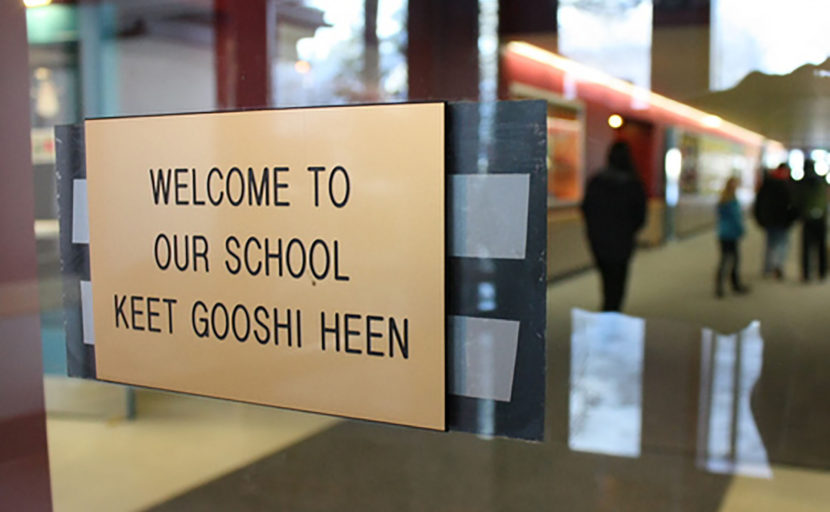
Keet Goshi Heen Elementary School is located at the base of Gavan Hill and may be at moderate landslide risk. (KCAW photo)
The building that houses Keet Goshi Heen Elementary School, formerly Verstovia Elementary School, is located at the base of Gavan Hill. The school may be at moderate landslide risk. (KCAW photo)


A Southeastern Alaska elementary school may be at moderate risk in the event of  a landslide.

The city of Sitka announced Monday, Aug. 29, that the Gavan Hill area, including Keet Gooshi Heen Elementary School, may be at risk.

Shannon & Wilson, a Seattle-based geotechnical firm, identified the landslide hazard zones during an assessment of the area.

Although the final report isn’t complete, they notified the city verbally that Keet Gooshi Heen may be subject to moderate landslide risk.

City administrator Mark Gorman said in a news release issued Monday that the city wanted to get the information out to citizens “as quickly as possible.”

The city has contracted with Shannon & Wilson to develop a comprehensive report of the Gavan Hill area, including proposed mitigation if necessary.

That report should be available to the public in December.

Sitka School District Superintendent Mary Wegner said that safety of students and staff is a top priority.

“We’re really anxious to see what the report has to say,” Wegner said in a phone interview Monday. “I’m not surprised to hear that when a school is close to a mountain that there might be a potential risk of a landslide. I understand it’s a moderate risk. So, it’s not a high risk. It’s a moderate risk.”

“I really appreciate that the city is working hard to get more information, so that we can make appropriate evacuation plans and emergency preparedness plans,” Wegner said.

The district is updating already existing emergency preparedness plans, Wegner said, in consultation with Sitka Police, Fire, and EMS departments. It’s important for the district to not overreact until more information is known, she said.

The city is also working with NOAA and other agencies to develop an early warning system for landslides, based on rainfall, wind speed, and other weather data, Gorman said.

Gorman discussed that project with KCAW earlier this month.

“Could we have a warning system that says we anticipate a storm system that has all the variables in that results in a high probability of landslides in this area? ‘Please take caution.’ If there’s a public facility in this area, the city may say, ‘During this period that this warning, we’re going to have a rain day and this facility won’t be occupied,’” he said.

The city anticipates the Gavan Hill report will be similar to the South Kramer report, published by Shannon & Wilson in February.

The South Kramer analysis included a color-coded map of risk zones and recommendations for future development.

Corrosion found on Sitka’s Blue Lake turbines

The three new turbines were built in England by Gilkes, and generate 5.3 MWhr each. With them, Sitka’s generation capacity increased 30%. (Emily Kwong, KCAW)
The three new turbines were built in England by Gilkes, and generate 5.3 megawatts each. With them, Sitka’s generation capacity increased 30 percent. (Emily Kwong, KCAW)

The Sitka Electric Department has discovered corrosion in the three new blue lake turbines.

Gilbert Gilkes and Gordon Ltd. manufactured the turbines and installed them in 2014.

“We disassembled partially the three blue lake turbines prior to the end of the warranty period,”  said utility director Bryan Bertacchi, informing the Assembly of the issue during its last meeting on Aug. 9. “I just wanted to let the Assembly know that we found kind of unexpected levels of cavitation, erosion, and some corrosion that we didn’t expect.”

Bertacchi also told the Assembly, “There’s no imminent failure that’s going to occur. This is a long-term issue. And we’re working with Gilkes, the turbine manufacturer, to try to resolve it. So we had Gilkes’ (technicians) here from England just a couple of weeks ago.”

The corrosion was discovered at the base, where the impeller is located, Bertacchi said.

Gilkes is studying computer models of the turbines. Using that information, Bertacchi said the department will ascertain what repairs are required, whether there was fault by Gilkes, and how the warranty may cover that.

Bertacchi said the issue was discovered during an inventory of the city’s electrical system.

“Blue Lake (Dam) is a very important asset for the community,” he said in a phone interview. “The community spent a lot of money on Blue Lake and we want to make sure it lasts for 30 to 50 years. We were trying to be proactive, before the warranty is over and while the manufacturer still has significant responsibility. We wanted to make sure the turbines were in top notch condition.”

The electric department nipped another power issue in the bud last winter, replacing a 35-year-old transformer at the Marine Street Substation in danger of failure.

The second transformer, which the Assembly approved, is in construction and will be shipped within the next two months.

Deacon’s music a bell-towering achievement in Sitka

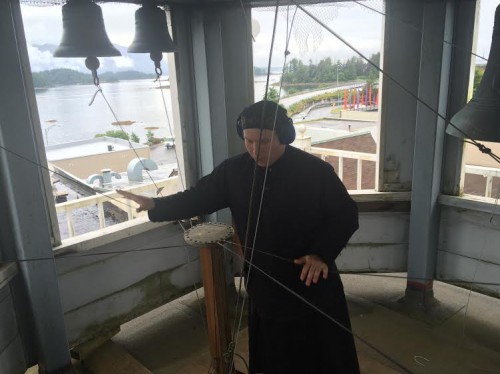
Deacon Herman Madsen plays the bells atop St. Michael’s Cathedral. (Katherine Rose, KCAW)

The bells at St. Michael’s Cathedral in Sitka are ringing again after a temporary hiatus, thanks to a new deacon with musical abilities and no fear of heights.

The bells of the Russian Orthodox church haven’t been played for a while.

That is, until Deacon Herman Madsen showed up.

“I always use the example of the medical field,” Madsen said. “The priest is like a doctor and the deacon is like the nurse to the doctor.”

He and his wife, Mary, moved here at the beginning of the summer to help with tours at the church and assist Father Michael.

It wasn’t always Herman’s plan to work for the Russian Orthodox Church.

“I was a wild child, I grew up with my grandmother,” Madsen said. “My mom and my dad sort of abandoned me. So my grandmother, at 70 took care of me. I nearly ended up in jail, but then my grandfather stuck out his neck for me.”

After spending 11 years at the academy, he debated joining the seminary for quite a while, but didn’t fully commit to the idea until he had an experience at the tomb of St. Herman in Kodiak.

“All of a sudden right next to this tree where St. Herman’s hut used to be,” Madsen explained. “Incense just started pouring out of the ground, and the smell of St. Herman’s relics, surrounded me.”

Deacon Herman said it smelled of roses.

It was unmistakably a religious calling.

“I just hit the deck and said i really need to go to the seminary, I don’t have any choice at this point,” Madsen said.

He’s been in the seminary for three years. Though he has a background in music and performance, playing the bells was a new adventure.

“When I got here there was no one really playing the bells at the time. So I just started taking it up and doing it every day at noon,” Madsen said. “I didn’t take any official classes on bell ringing. Because of my background in singing and playing instruments I had an ear for that kind of thing. I also played the spoons.”

So playing the bells wasn’t too much of a stretch. There are eight bells, a full octave, which makes it easier.

“It’s really nice on sunny days, come up here and read a book,” Madsen said. ‘Whew!”

The bells themselves have an interesting history.

They were made in Holland, and ordered by the Russian American company in St. Innocent. They lasted up to 1966, when an accidental fire broke out and destroyed the cathedral.

“In the fire these bells melted into clumps of metal,” Madsen said. “The men in the community gathered up all the metal, had them resent back to the original foundry, and these bells were recreated from the originals metal.”

The church was rebuilt based on 1961 drawings of the old cathedral, and featured its signature green domes and golden crosses.

Each bell is connected to a thin string, a bit thicker than a strand of yarn. Those strings connect to a podium with holes in it. The two largest bells are attached to two huge wooden pedals.

Madsen plays the bells a little like bongos.

“Instead of pulling the strings, I tap all of the strings, and that’s why I can play it so fast, and in so many different ways. That’s why they sound so awesome,” Madsen said, laughing. “You get some pretty awesome exciting bell ringing that happens that gets you kind of pumped up. It’s really kind of fun.”

Herman and his wife will leave Sitka at the end of the summer with plans to come back next year, and hopefully make Sitka their home.

Site notifications
Update notification options
Subscribe to notifications