KCAW - Sitka

KCAW is our partner station in Sitka. KTOO collaborates with partners across the state to cover important news and to share stories with our audiences.

Murkowski discusses Trump, Tongass during Sitka stop

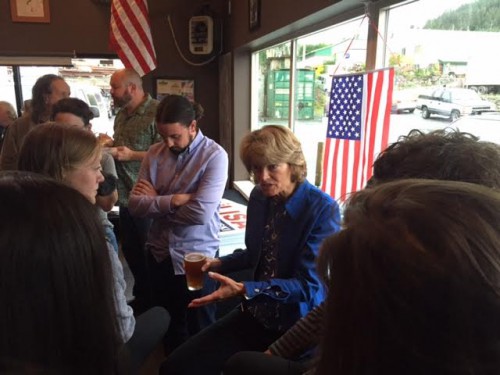
U.S. Senator Lisa Murkowski speaks to Sitkans at a campaign event in Sitka. (Emily Kwong, KCAW)

Alaska U.S. Sen. Lisa Murkowski spoke to a group of constituents over pizza and beer at Baranof Island Brewing Co.

Murkowski kept her remarks brief and circulated through the crowd, talking one-on-one with attendees. Many were wondering which presidential nominee she preferred, Trump or Clinton?

Murkowski hasn’t made up her mind. She has great concerns about some of Clinton’s policies and has issues with Trump in general.

“I’m not a fan of Donald Trump,” Murkowski said. “He’s made statements and raised opinions that I certainly can’t defend. In fact, some of them I find offensive. I am looking a long with a lot of Americans to see, OK, going forward in these next few months – what is he going to be laying down? What is he going to be putting down in terms of policies. How is he going to assure me as a woman, how is he going to assure me as an Alaskan who represents a state like ours, how is he going to assure me that he is going to make our nation safer?”

It’s not all about the presidential race. At the Capitol, Murkowski chairs the Senate Energy and Natural Resources Committee.

“Which essentially makes her one of the most powerful people in the world when it comes to climate change solutions,” said Sophie Nethercut, with the Sitka Conservation Society. Many Sitkans wanted to speak to the senator about the environment, climate change and the state’s dependence on oil.

“Hopefully we’ll be able to talk about how electric vehicles here in Sitka can fit into the climate change picture for Alaska,” Dave Nicholls said.

Murkowski floated around the room, talking to people one-on-one about their concerns.

“I think we need to recognize that we are a state that has been built off of our resources,” Murkowski said. “We are a resource-rich state, and so how we access our resources to the benefit of Alaskans and to the benefit of a larger community is important to the success of our economy. Right now I think we all acknowledge that with the price of oil and with the downward trajectory on projections, it is not something that we can count on with any reliability.”

While we can’t control oil prices, the state has the ability to control production on state land, she said. The problem is that roughly 60 percent of Alaska is owned by the federal government.

“It took Conoco close to seven years to get a permit to build a bridge. There is more that we can do to be a more cooperative process to gain access to the resource.”

Murkowski responded to questions about the Tongass Land Management Plan.

Three Sitkans served on the Tongass Advisory Committee, or TAC, which recommended a plan for transitioning logging from old growth to new growth trees. Murkowski proposed legislation that would halt the transition until a full inventory of the Tongass is completed.

“All I’m asking for is that we have an honest inventory,” Murkowski said. “There have been some that have suggested that it is my attempt to stop the TAC recommendations. That is not the case, that is not the plan, what I want to do is make sure that this transition that we’re moving to with young growth is, in fact, based on the good analysis that we will receive through this comprehensive inventory that was a direct recommendation of the TAC.”
Sitka resident indicted on forgery charges; checks totaled $6,656

A grand jury has indicted a 27-year-old Sitka resident for forging almost 30 checks from a local tour business.

Court documents filed by prosecutors say Jeffrey Baxter stole checks from the business account of Sitka Sound Ocean Adventures. He allegedly forged the signatures of owners Alison and John Dunlap, misspelling their last name as “Dunlop” and signing a few of them as “John Brown.”

Baxter was not an employee of Sitka Sound Ocean Adventures and was not authorized to write company checks.

Baxter was indicted July 21st and appeared before Sitka Superior Court on July 25. All 29 counts are for second-degree forgery, a Class C felony.

Between April and June of this year, he cashed 24 of those checks at AC Lakeside and five checks at Sea Mart Quality Foods, prosecutors said. Combined, the checks totaled $6,656.

Dunlap contacted the Sitka Police Department on June 20 to report the stolen checks.

He provided copies of those checks, which were issued out of the Sitka Wells Fargo bank and paid to Baxter.

Police officer Gary Cranford reviewed security footage from the two grocery stores and observed Baxter cashing checks at both establishments.

His trial is scheduled for October.

Techno contra brings new life to traditional dance in Sitka

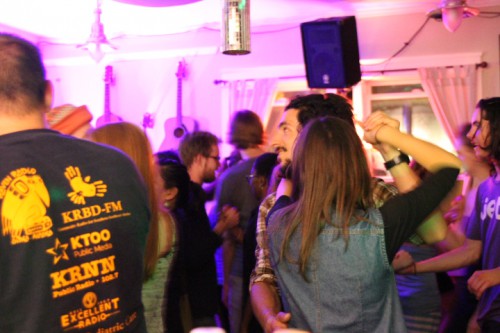
A lively crowd dances at Techno Contra. Photo by Katherine Rose/KCAW
A lively crowd dances at Techno Contra. (Photo by Katherine Rose/KCAW)

If you live in Sitka, you’ve definitely heard of contra dance. And if you live on planet earth, you’ve certainly heard of techno or electronic dance music, or EDM.

You may not expect much of a cross-section between the two communities, but once a month at the Larkspur Cafe that’s exactly what you’ll find.

Contra dancing is a type of folk dance, with European and Appalachian origins. It’s sort of like square dancing, but couples stand in lines. They progress down the line, repeating the dance with the couple standing across from them, all set to folk music.

“I never liked dancing actually,” Ben Timby said. “Then someone roped me into a dance from the band. So I set down my banjo and was like ‘okay.'”

Timby has been dancing contra for a while. He even met his girlfriend, Tiffany Justice at a contra dance in Asheville, North Carolina. Once she tried it, she was hooked. She loves all kinds of dancing, but contra offers a special sense of togetherness.

“I had a few friends who asked me to try it out,” she said. “It seemed like it was very inclusive, which i liked about it. In the same night I danced with a 16-year-old and a 90-year-old. I just really really liked that I felt this sense of community in the dancing and it wasn’t exclusive in any way.”

The couple kindled their relationship at Sitka’s traditional contra dance held once a month with music by a local group, Fishing for Cats. About December of last year, Thimby wanted to try something different.

“There’s a number of us who’d already been doing the traditional contra dancing,” Timby said. “I think we were just sitting around having beers or at a jam and I just mentioned this idea, and Kari (Lundgren) was on board.”

Lundgren is a contra dance caller, the person that teaches the group each of the dances. She is a longtime Sitka caller, but Timby wasn’t sure what she’d think about some of the music.

Lundgren loved the idea, though there were a few logistical challenges. Contra tunes are between 100 and 120 beats per minutes. Techno music is more like 120 to 150 beats per minute. Tempo-wise it’s the difference between a stroll and jog. So, Timby and Lundgren had to find the sweet spot where upbeat music meets danceable meter.

“Ben picked really good music. People can only dance so fast. You have to actually give them time to complete the move,” Lundgren said. “Some of the music has an extra measure in it. Sometimes we have to pause and go ‘and wait’ and wait and wait. Go now!”

Techno contra also attracts a younger crowd, and often participants have little to no experience. Seeing a younger crowd at a contra dance helps keep the tradition alive,” Lundgren said.

“The tradition is graying a little bit. When you look at some of the dance camp footage,” she said. “This is actually bringing in the next generation of dancing, and that’s the important part, is just keeping contra alive and making it relevant. Very likely some of those folks would feel confident walking into a fiddle dance if they were in Minneapolis visiting their sister.”

The group is looking into holding dances in Juneau, Fairbanks, and even Bellingham, Washington and Portland, Oregon. In Sitka, techno contra has become so popular, the partipcants are considering upgrading to a bigger space for the next dance in August.

Sawmill Farm, Tongass farm country

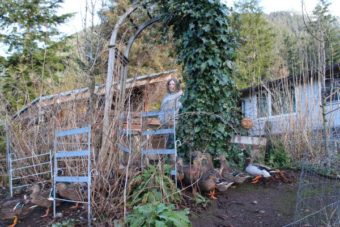
Daniels oversees the ducks. She’s awaiting an order of pigs from Washington, set to arrive in August. In five years, she hopes to secure a USDA processing facility to sell local pork. (Emily Kwong, KCAW – Sitka)
Daniels oversees the ducks. She’s awaiting an order of pigs from Washington, set to arrive in August. In five years, she hopes to secure a USDA processing facility to sell local pork. (Emily Kwong/KCAW)

Bobbi Daniels has struck gold, except it’s green and squishy.”

“I’m getting grapes,” Daniels said. “Everything loves grapes. The chickens, the geese. I won’t give it to the geese.”

The Tongass Rainforest isn’t what you’d picture as a candidate for farm country. The terrain is rugged, the soil unstable, and it rains over 100 inches a year. The vast majority of Sitkans get their meat and dairy products off a barge, shipped hundreds of miles. But Bobbi Daniels of the Sawmill Farm is determined to change that.

If the Sawmill Farm is an ark, Daniels is Noah. She has 500 mouths to feed every day. But rather than order hay or grain online, Daniels collects cast-off produce from the grocery store. Like these grapes.

“People just aren’t going to buy them,” Daniels said. “And so the grocery stores are really in a hard spot.”

That’s where Daniels comes to the rescue, her shopping cart a teetering cornucopia of greens that she loads into her box truck. I hop into the passenger seat and there’s a carton of quail eggs at my feet.

Seamart Quality Foods, where Daniels collects her produce, now sells her product. The quail and ducks eggs will soon be joined by chicken eggs. (Emily Kwong, KCAW – Sitka)
Seamart Quality Foods, where Daniels collects her produce, now sells her product. The quail and ducks eggs will soon be joined by chicken eggs. (Emily Kwong/ KCAW)

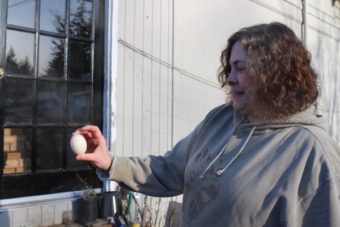
And those eggs, which are a lovely coffee colored shade with brown speckles, are a token of victory for Daniels. Just three weeks ago, Seamart began offering her eggs to customers.

“They keep selling out, so I think that’s the best response you can get,” Daniels said.

Daniels runs her errands with the focus of a honey bee, gathering nectar for the hive. At first glance, you’d think she’s a fisherman, wearing XtraTuffs, but make no mistake, Daniels is a farmer. A farmer on a mission.

“When I was little, it was family farms and by the time I graduated from college, it was big agro-business,” Daniels said.

Daniels worked on some of those farms. And when she moved here from Indiana in 1998, she was troubled by the food cycle in Sitka.

“We’re taking thousands of tons of food that is perfectly good to feed animals and we’re barging it out of Sitka,” Daniels said. “And then we’re barging this factory farmed poor-quality meat back to Sitka. That’s insane.”

So, Daniels started the Sawmill Farm in 2001 to attempt to close that loop. Financially, the farm isn’t breaking in but they’re making some progress. Daniels and her business partner hope to have rabbit and chicken meat on grocery store shelves soon. But the learning curve for island farming has been pretty steep.

Bobbi Daniels grew up in farm country in Indiana. She’s bringing her agricultural knowledge to Sitka, operating the Sawmill Farm since 2001. (Emily Kwong, KCAW – Sitka)

“There’s nobody to turn (to) who did this first to get any advice from really,” Daniels said.

Eagle and mink predation was terrible this winter. And try as she might to get the settings right on the chicken enclosure, the chicks kept piling on top of each other, crushing the ones beneath.

“When you come in the morning and that’s the scene, it just breaks your heart on every single level,” Daniels said. “We don’t want animals living in miserable conditions. That’s the kind of farming we don’t like.”

Even though she was counting on those broiler chickens for profit, Daniels is determined to figure out what went wrong before ordering more. She’s an animal lover first, farmer second. It’s time to visit the farm. We turn out the ducks for the day. And then stop by the goat herd, where Missy from Wrangell is getting milked today. Her goat herd, by the way, is spoiled rotten. She feeds them alfalfa that’s been misted with molasses and allowed to ferment.

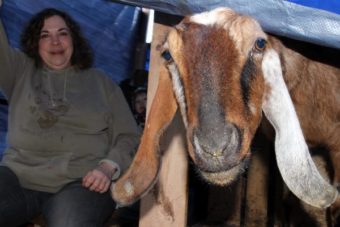
At one point, Missy swings her face towards me and we’re snout to snout.

“That’s how they get to know you,” Daniels said.

Now, selling raw milk is illegal in Alaska, but Daniels gets around that by selling shares of the herd. If you buy the goat, you get the milk. And because you can’t have goat milk without bucks to start the breeding process, Daniels envisions one day loaning her bucks to other farms.

Milly, a milk goat from Wrangell, turned to sniff my breathe. “That’s how they get to know you,” Daniels said. There are fifteen does in the goat herd. (Emily Kwong, KCAW – Sitka)
Milly, a milk goat from Wrangell, turned to sniff my breathe. “That’s how they get to know you,” Daniels said. There are fifteen does in the goat herd. (Emily Kwong/KCAW)

“Kind of have a buck library, where you can check out the buck of your choice for your own goats,” Daniels said.

And that’s really the second part of Daniel’s mission: to support families and small-scale farms around Southeast who want to localize their food.

“When I eat a rabbit, when I cook a rabbit – okay, I still can’t do the killing, I’ll admit that – but I’m there and I’ll do everything else, I’ll skin and gut and all that kind of stuff, but if you waste anything, there’s this huge awareness that something died for my dinner,” Daniels said. “And you look at your plate and what you eat and how you eat differently when you are involved in making it happen. And I think it’s a really good change.”

Daniels is frank that the Sawmill Farm will never be able to keep up with the demand in Sitka. But more important to her than putting meat on the table is telling people the story of where it came from.

Small earthquake adds to Sitka’s holiday blast

A small earthquake rattled dishes along the outer coast of Southeast Alaska on Monday evening. The U.S. Geological Survey reports that a magnitude 3.6 quake occurred about 20 miles west of Whale Bay off the coast of Baranof Island at 7:20 p.m. The epicenter was located at a depth of about 21 miles below the surface of the earth.

USGS Sitka Earthquake July 5 2016

In Sitka, the quake was felt as two sharp jolts in quick succession. Many residents doing routine activities failed to notice anything at all. Some thought it was more Fourth of July fireworks.

There was no tsunami danger from the quake. In fact, the West Coast and Alaska Tsunami Warning Center did not post details of the event. Cara Gately, senior watchstander at the center, said the minimum threshold for reporting on their site is magnitude 4.0.

“Unless,” she said, “there’s a magnitude 3.9 centered in downtown Anchorage at 5 p.m. and everyone calls us wanting to know what happened!”

On the eve of Orlando shooting, Juneau celebrated Two Spirit Pride

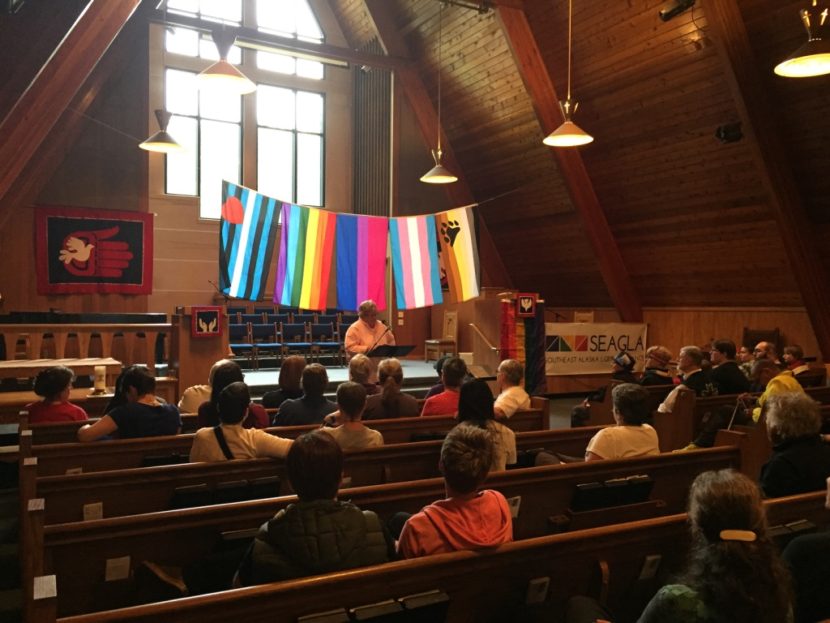
Artist Ricky Tagaban organized a Two Spirit Pride Reception to begin Juneau’s pride week, held on June 11. Speakers included Freda Westman, former Alaska Native Sisterhood Grand Camp President. The next day was the Orlando shooting. (Photo by Emily Kwong/KCAW)
Artist Ricky Tagaban organized the Two Spirit Pride reception to begin Juneau’s pride week, held on June 11. Speakers included Freda Westman, former Alaska Native Sisterhood Grand Camp President. The next day was the Orlando shooting. (Photo by Emily Kwong/KCAW)

In gay communities all over the country, there is a before and an after — a before June 12, 2016, and an after. The shooting at Pulse, a gay nightclub in Orlando, killed 49 people and was the largest act of violence against the LGBTQ community in US History. And it happened as Pride events were taking place all over the country, including a reception at Juneau’s Northern Light Church mere hours before.

The reception on June 11 was organized by artist Ricky Tagaban. He wanted to create a space for others who are two-spirited, embodying both a male and a female person. Like writer Vivian Mork. She was amazed that over 100 people came.

“We gathered at the Northern Lights Church to celebrate two-spirited people – gay native people,” Mork said. “It was the first time I’ve ever known of that happening in Juneau.”

Tagaban set out pilot bread and salmon spread, coffee and tea and an open mic. Rick Peterson, President of Tlingit and Haida Central Council, talked about how the council authorized same-sex marriage in February 2015 — months before the Supreme Court ruling. The media went crazy. He did 20 interviews in one day and a reporter kept asking, “Why are you doing this?”

“If you’ve all watched the movie Princess Bride, there’s a marriage scene in there and the Rabbi, or whatever, he’s like, “Love, Love.” And that was my answer to everything,” Peterson said. “She’s like, ‘Why are you doing this?’ Love. ‘Why are you doing this?’ Love.”

Love, it seemed, was the answer in the room that day. Other speakers reflected – some cautiously, some joyfully – on how far America has come. Gay people can get married now. Come out in school. Tribal court judge Debra O’Gara, who grew up in the era of the Stonewall Riots, marveled at how there was less to be afraid of for the next generation.

“I came out 40 years ago and it was the Native community in Seattle who shunned me,” O’Gara said. “And to stand here and see my community is great.”

It’s not perfect, she said, but every year it gets better. A lot of people came away from the reception with the same feeling. And then, the next morning, it was June 12th.

“My heart sank when I saw the headlines the next morning,” Mork said. “I so wanted it to be a horrible Facebook hoax. I didn’t want it to be true. But it was.”

Mork was up early to catch a plane the Louisiana. James Hoagland, who was at the reception and organized Juneau’s Pride Week, is a well-known drag queen in Juneau. Two of his friends were performing at Pulse that night. Over the phone, he learned how one got out quickly and the other hid in a dressing room for hours, only escaping after a SWAT team removed an air conditioning unit – creating an escape portal for hostages in the wall.

Hoagland identified, strongly, with the victims. “Young people who were just out to dance and be in community and have a good time,” Hoagland said. “And that so easily could have been us.”

If the Two Spirit Pride reception affirmed safety and acceptance, Orlando violently asserted an opposite claim: that being gay in America is still dangerous.

“I’ve had nightmares all week about being shot on stage while performing,” Hoagland said. “Somehow, I had to put that aside enough to go forward with the biggest show that we’ve ever had in Juneau on Friday night.”

That drag show, called Glitz, packed Centennial Hall with 500 people. While the shooting was in Hoagland’s words, the “elephant in the room,” it didn’t stop people from coming out for Juneau’s Pride Week. Quite the opposite. “I think people felt even more comfortable and confident being loud and proud because we know we have an obligation too,” Hoagland said.

But after pride week is over, what do you do? What kind of courage do you need to get up in the morning and continue to be yourself? Hoagland’s husband recently said to him, “I may be killed for being gay in my lifetime. And I’ve found peace with that.”

“The victims in Orlando didn’t die for no reason,” Hoagland said. “I hate that they lost their lives, but the fact that they did has changed the world.”

As for Mork, she spent her plane ride writing and recorded this message from her hotel room in Louisiana.

“This is pride month and odds are there is a gay person near you who is hurting over this. Tell them you support them. Tell them you love them. Gunalchéesh.”

Soon after the shooting, the Juneau Assembly took hearings on an anti-discrimination ordinance, for gender and sexual identity. And in a city with no gay bars, the Southeast Alaska LGBTQ Alliance, or SEAGLA, plans to make the rounds at Juneau business with rainbow stickers for the windows. That way, those in Juneau can be assured that if they enter that bar or restaurant, they will be treated with respect inside, no matter who they love.

Site notifications
Update notification options
Subscribe to notifications