KCAW - Sitka

KCAW is our partner station in Sitka. KTOO collaborates with partners across the state to cover important news and to share stories with our audiences.

Sitka municipal attorney dismissed after lawyering up

Job keyboard button
(Photo illustration by GotCredit)

Sitka’s municipal attorney Robin Schmid was summarily dismissed Thursday afternoon after the assembly received a letter from Schmid’s lawyer suggesting that she had been improperly asked to resign.

The letter was written by Ketchikan attorney Clay Keene, and was not immediately available to the public.

During testimony at Thursday’s special meeting, however, Keene spoke in conciliatory terms about the assembly’s decision to fire Schmid during her closed-door evaluation on April 19.

“And I would hope that this meeting provides the assembly the opportunity to make better what I would call a rushed decision on the part of the assembly in asking Robin for her resignation,” Keene said.

Keene said that Schmid would be willing to work for the duration of her contract, or at least until Jan. 5, when she would become vested in the public employee retirement system. Otherwise, Schmid’s resignation was set to take effect June 1.

But the assembly didn’t bite. Instead, the members who spoke felt it would be difficult to continue working with Schmid, now that she had retained an attorney of her own.

Steven Eisenbeisz thought it would be counterproductive to keep Schmid on.

“I feel, after what’s been presented in the letter, that it would be very difficult for someone in a situation as such to continue on in the best interest of the city.”

Member Tristan Guevin expressed similar thoughts. The assembly went on to vote 6-0 to appoint Brian Hanson as acting municipal attorney. Member Bob Potruzski was absent.

Mayor Mim McConnell then had the uncomfortable duty of informing Schmid — who was seated in her usual spot at the assembly table — that she was done. But Schmid did not go easily.

Here is the entirety of their exchange.

McConnell: So Robin, at this time I’m going to have to ask you to step down from the table and we’ll have Mr. Hanson come up. This is how this works.

Schmid: Nothing has been tendered to me at all, regarding our last meeting. I haven’t been given a chance to speak at all. What the public’s going to be hearing, what they’re going to be thinking, is that there’s something outrageous in the letter. And what was in the letter was a request for conciliation. It was a letter that said, Look you are required under the contract to give me evaluations every April. That hasn’t been done. Up until this last evaluation, I had been given good evaluations — by some of you sitting here — that you liked my communication style. Sure, there’s been a change in some of the other assembly members, and maybe it was incumbent on me to try and reach out if my communication style wasn’t working for them, but that was never done. And it wasn’t done on the other end either. So basically, what’s happened is, terminable at will or not, there’s a breach of contract.

Guevin: A point of order —

McConnell: I’d like to take a 5-minute break, please.

Schmid eventually yielded her seat to acting attorney Hanson. Following the break, the assembly went into executive session for just under an hour to discuss Schmid’s letter. On returning to regular session, the assembly voted 5-1 to direct Hanson to work to resolve Schmid’s legal concerns, with Eisenbeisz opposed.

Schmid will be on administrative leave with pay until the end of the month. She’s been Sitka’s municipal attorney since February 2013.


Cheering on the competition: Sportsmanship takes center stage at Native Youth Olympics

Jeremy Roberts set a personal record on the final day of NYO. During the male seal hop event he traveled 128 inches. (Photo by Emily Kwong/KCAW)

Mount Edgecumbe High School sent 15 students to the Native Youth Olympics in Anchorage April 21-23. The event draws Alaskan Native teens from around the state in three days of intense competition. KCAW was at the Alaska Airlines Center on the last day, cheering on the Braves from the sidelines.

Jeremy Roberts is from Quinhagak, near Bethel and he’s been training for the male seal hop event all year. “You can’t be slouchy. You have to be straight. And you have to hop: use your feet to help you go forward and just go until you can’t go anymore,” he explains.

Roberts flips over his fingers. On each knuckle is a rounded callus. They’re hard earned. He says, “I used to get my knuckles cut up but now they’re all scarred.” Jeremy is a senior, so this is his last year to compete. He’s gunning for first place.

Kneeling along the edge of the gym are fellow Edgecumbe students, wearing cardinal and gold colors, ready to cheer. Rachel Teter watches Jeremy from the sidelines. “He goes really fast too. There will be other guys that go pretty far. But he’s just way ahead of them in no time. And then it will take them a while to just catch up to catch up.

The seal hop event has its foundations in seal hunting, mimicking the animal’s movement on the ice and how the hunter sneaks to the edge to capture the seal. Rachel says hunters do more of an army crawl nowadays, but the point of the seal hop is the honor the strength and stamina needed for a subsistence lifestyle. “It’s a good way to incorporate the competitive side and the traditional side and the fun side into one event,” she tells KCAW.

The 2016 male seal hop event begins and pretty soon, it’s Jeremy’s turn. There are nervous teens on sides, shaking out their arms and legs and checking their own calluses. All eyes are on them.

NYO Official: Three, two, one…
Edgecumbe students: Go Jeremy!! Keep going, Jeremy!

And they’re off.

In a bent push up position, elbows at right angles, Jeremy pushes off those knuckles like springs.

Rachel Teter: Push yourself! Push yourself!

Rachel’s right. He’s fast and quickly gains the lead. Teammates plead with him to remember to breathe.

Edgecumbe students: Breathe! Breathe!

And then, Jeremy drops. He’s done. He hopped the full court, but after turning around didn’t make it back to half court. A Dillingham competitor got well beyond that, but Edgecumbe Coach Archie Young is nonetheless proud. “That’s the farthest he’s gone in the competition. Last year, he went 112 feet. So that’s a very good improvement.”

Jeremy’s distance today is 128″ 4.25 inches. He places third in the overall contest. Young is Edgecumbe’s PE teacher and has been training students for NYO for four years. Seal hop is his favorite event. “I love the grit of it and I love that it’s just how strong a mind and how far can I go,” Young said.

Pushing yourself, beyond what you think you can do, is at the core of the NYO Games and other games steeped in Alaskan Native traditions. Most teens are trying to back their personal records, not world records. And in a survey last year, 75 percent reported that NYO is an incentive to stay in school and get good grades.

Laura Ekada competes in Indian Stick Pull, which symbolizes grabbing a slippery fish out of the water. “To me it means I’m carrying on my tradition and I’m keeping things going. Because times are changing and things are getting lost. And I’m just so glad to be part of this,” Ekada said. She wants to go to med school one day.

Rachel Teter remembers the first time she competed in Indian Stick Pull. She was 12, at the World Eskimo-Indian Olympics in Fairbanks. And she was surprised standing before her competitor, each one holding the end of a wooden dowel, trying to wrestle it away from the other.

Rachel recalls, “She must have been 70 or something and she was like, ‘Wow! Youngest and the oldest. You’re just a baby.’ And I was like, ‘Uh, huh.’ And she was like, ‘Let’s see. New and old. Let’s see how this goes.’

They ended up tying and trading big hugs. Rachel says sportsmanship is a huge part of these competitions. You have to cheer as loudly for other teams as you do for your own.

Sitka Tribe opens biotoxin lab to monitor PSP

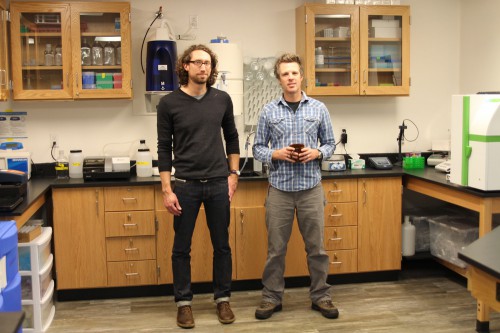
Lab manager Michael Jamros stands with Chris Whitehead, founder of the Southeast Alaska Tribal Ocean Research group. The lab hopes to be regional testing hub for commercial and casual shellfish harvesters alike. (Photo by Emily Kwong/KCAW)

With warming ocean temperatures, the risk of paralytic shellfish poisoning can linger all year-round, and Alaska has only one Food and Drug Administration certified laboratory to test shellfish. There are no labs to protect those digging for their dinner, but that may soon change.

At the end of the month, the Sitka Tribe of Alaska will open an environmental research laboratory and – with all hope – take a bite out of the testing market.

This time last year, the room in the corner of Sitka Tribe of Alaska’s (STA) Resource Protection Department was bare. And now, it’s got a fume hood, test tubes in every color, and a $49,000 machine.

Michael Jamros is the lab’s new manager. And the “robot” in question is a plate reader, one of several machines that can analyze toxins in shellfish. After the shellfish arrive, Jamros shucks all the meat out and puts it in a blender to homogenize it. He then extracts the toxins and removes the solids using a centrifuge.

Using a pipette, Jamros will dispense the solution in 96 tiny wells on one plastic plate. Imagine filling a tray with batter for 96 muffins, but instead of putting it in an oven, he feeds it into a plate reader.

Jamros is running an ELISA assay, measuring the toxicity of each well. The results appear on his laptop. “From here we have our data that we can calculate from and figure out how much toxin is in our samples,” he said.

You hear that? Data. Cold, hard numbers that take the guesswork out of eating butter clams or blue mussels. In Southeast, there’s never been a way for subsistence harvesters to assess the risk of paralytic shellfish poisoning or measure harmful algal blooms, or HABs, which load shellfish with toxins until now.

Chris Whitehead is STA’s environmental program manager and the driving force behind the lab, set to open in May. “Native people have been harvesting clams for thousands of year. A lot of the elders I talk to don’t do it anymore because they just don’t know. So, to be able to bring that back and be able to utilize that resource is huge,” Whitehead said.

When he came to Sitka in 2013, Whitehead wanted to create a warning system for clam diggers, like in Washington state. “The Washington Department of Health has a great website so you can see what beaches are open or closed. And when I got to Alaska there wasn’t anything.”

Whitehead called up Alaska’s Department of Environmental Conservation, which tests all commercial shellfish for the state. He discovered, however, there would be a time lag to ship shellfish to Anchorage and await results. “The turnaround time for the (DEC) data – to actually be usable for us and to prevent human health issues – wasn’t going to work,” he said.

Given this, Whitehead decided to pursue a local solution by creating his own marine biotoxin program right here in Southeast. He locked in $1 million in grant funding for the next three years. He formed Southeast Alaska Tribal Toxins (SEATT), a coalition of 13 other tribes in the region and organized trainings for them with state and federal agencies, like NOAA, to be “eyes in the water,” monitoring local beaches for toxic blooms.

“So those sites will be monitored at the expense of the tribe and the resources that the tribes have every other week. So every tide cycle pretty much,” Whitehead said.

The lab uses new technology, including the ELISA and receptor binding assay (RBA), to test for the presence of toxins in shellfish, without resorting to live mice. (Emily Kwong/KCAW)

Jerry Borchert was in Sitka to lead one of those trainings. Borchert coordinates marine biotoxin management for the state of Washington.

In speaking with KCAW, he said, “My first time here was a year ago in September. It was a smaller group. I think there were six tribes at the time and for a lot of these folks, this was brand-new to them. Looking at plankton, trying to identify what a harmful species looks like, how to record it, how to share this information, and it’s those same tribes in the beginning that are now the teachers and the program is expanding. This is amazing.”

With the new laboratory, subsistence harvesters can hopefully send their shellfish to Sitka and get test results back in one business day. Eventually, the lab hopes to run tests for commercial entities – like shellfish growers and processors.

But some hurdles remain. The lab needs the blessing of an alphabet soup of agencies, like the FDA, to become a full-fledged regulatory lab, on par with the one on Anchorage. Borchert said, “Long term stability is something I’m a little concerned with. The state regulatory folks are finally coming to these workshops and I’m hoping they can recognize what can happen.”

For his part, Whitehead is taking it one step at a time. The lab is running test samples all this month and sending their results to NOAA in Seattle, for verification. If those check out, the lab will begin accepting subsistence shellfish as early as May.

Historical tensions surface at Sitka land use meeting

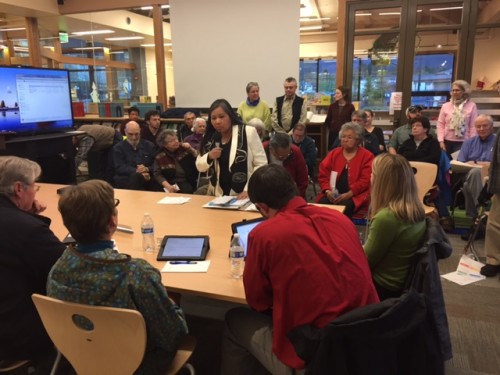
The Planning Commission listens to citizen testimony about land use. Paulette Moreno of the Alaska Native Sisterhood urged the commission to include Tlingit elders in the process. (Photo by Emily Kwong/KCAW)

The Planning Commission is revising the land use section of Sitka’s Comprehensive Plan. And they’re inviting the public to weigh in. By devoting one meeting a month to land use, the commission hopes to get policies up to speed with modern practices. But at recent meeting, it was the past – not the future – that took center stage.

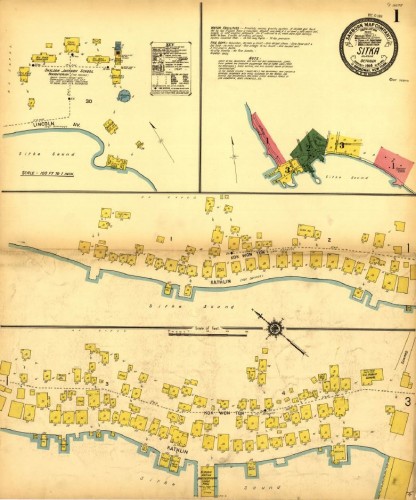
At the top of the meeting, the Planning and Community Development Commission presented a series of maps – drawn up by Russian and American settlers in the 1800s.

In tiny ink boxes, you can see the footprint of Sitka’s earliest homes and business. One set of maps, from the Sanborn Map and Publishing Company, were created for fire insurance purposes.

A 1826 map of Sitka Sound, drawn up by Russian settlers. You can make out Bjorka Island in the bottom right corner. (Map courtesy of the Sitka Planning Commission)
A 1914 fire insurance map of Sitka, published by the Sanborn Map and Publishing Company. The map provides a snapshot of urban development in WWI-era Sitka. (Courtesy of the Sitka Planning Commission)

The presentation was intended to acquaint the 50 or so Sitkans in the audience with the early history of land use. But for some, it also touched a nerve.

Paulette Moreno is the president of the Alaska Native Sisterhood (ANS). Picking up the microphone shortly after the presentation, she said, “Out of respect for the Tlingit people and the land on which you are speaking on – Sheet’ka Kwaan – at every moment, at every time, you are a guest here.”

She then drew attention to one particular chapter of the plan, last updated in 2007. “We’re referred to as ‘Ethnic Diversity and Native Issues.’” Moreno paused. “Words are very important. I don’t consider myself or the people that walk amongst me or even any of our neighbors as ‘issues.’”

Moreno was not alone in challenging the commission to tread with sensitivity as they revise the comprehensive plan. Flanking her on both sides were tribal leaders and citizens. They took up the entire first row. They talked about how Alaskan Natives have been ostracized – both physically and politically – from the development process time and again.

Joy Wood is an officer with ANS. “A lot of the Natives just clam up as soon as soon as they see a white person with a piece of paper. I’m a notary public and there are some Natives that no matter how hard they try, I cannot get them to sign their names on paper. Because they are traumatized.

Scott Saline said some of that trauma is more recent. He criticized a past Planning Commission for the failing to install adequate drainage on Kaagwaantaan Street, thus damaging a clan house.

Saline lives on nearby Katlian Street, where the Tlingit set up a village segregated from the Russian side of town. “The property that I’ve owned in Indian Village – once I’ve studied how I’ve been able to buy that – I’m ashamed that I have that,” Saline told the commission. “I have learned how that paperwork and good faith has been taken advantage of. That is the culture of resistance, where what the grandfather struggles to forget the grandson fights to remember.

Culture. History. Trauma. These aren’t words you’d expect to hear at a land use meeting, but they illustrate how complex and fraught the conversation is around land use in Sitka.

During a break in the public testimony, I asked Maegan Bosak, planning and community development director, whether this surprised her.

KCAW: Did you ever see yourselves as accountable for addressing trauma and providing healing? Those are very different orders than creating a land use plan.

Bosak: Yes, very different from planning but I think in the end it’s a part of our community. And that’s what we’re charged with doing. We feel honored to be able to provide that service.

And in many ways, Bosak says, candid public testimony is exactly what the Planning Commission wants. “These meetings will not just be held at the library. We plan to have one at the senior center. We plan to have one at ANB (Alaska Native Brotherhood) hall. We plan to go around town to really highlight different groups and make sure that their voices are a part of this plan,” Bosak said.

In the zoning code of the 1970s, housing lots were 4,000 square feet. Now, they’re 8,000 square feet, which a handful of participants, like Michelle Putz, criticized as too big and too expensive. Putz said, “I really want to see us working toward smaller lots and more options to develop small housing on existing lots to make housing more affordable, so that all of us can live here.”

With conversation flowing, the meeting was also as staging ground for various groups and individuals to pitch development ideas. That included creating agricultural zones — particularly in land deemed unsafe for housing — building a new lost-cost trailer court or higher density properties, and adapting roads to be safer for walkers and bicyclists.

There’s a lot that’s possible in Sitka, but the challenges posed by precedent – by history – are there too. Nancy Yaw Davis complimented the commission trying to reconcile the two. “Part of what you’re working toward is a fuller awareness and validation of what really matters. Place names can help with that,” Yaw Davis said. “So as you move into neighborhoods, return to the history. Each of those lots. Each section of Sitka.”

The Planning and Zoning Commission hopes to finalize the revised comprehensive plan by the spring of 2017 and is dedicating the first Tuesday meeting of every month to that project.

Japanese delegation visits from Sitka’s Sister City

Mayor Mim McConnell and City Administrator Mark Gorman welcomed Nemuro city council member Toshiharu Honda on Monday (04-01-16) with a Tlingit print. (Photo by Emily Kwong/KCAW)

Sitka has a sister city in Nemuro, Japan. Like Sitka, Nemuro is an ocean-facing fishing port, but bigger – about 30,000 people to Sitka’s 10,000. Nemuro citizens visited Sitka’s city hall Monday to commemorate their decadeslong relationship.

If you were to trace your finger on a map, starting in Sitka and moving downward across the Pacific Ocean, you could draw a direct line to our sister city, Nemuro. And the connection is embodied in one man: Atsuo Tsunoda.

“I’ve been coordinating the relationship between the City of Sitka and Nemuro since I moved to Sitka in 1978,” Tsunoda said.

Tsunoda is a neatly dressed man and the most cheerful translator I’ve ever met, gracefully bridging communication between city staff and the Japanese delegation.

“In the group is Mr. Honda and Mrs. Honda,” said Tsunoda.

The group included Nemuro assembly member Toshiharu Honda, who last visited Sitka in 1999 with the all-Japanese East Point Jazz Orchestra for Alaska Day.

“He dreams to repeat the visit again,” Tsunoda said. “And this is actually dreams come true.”

Mr. Honda was joined by his wife Kimiko and four friends: Kunihiro Kobayashi, Yuuko Kobayashi, Emiko Nakamura and Nanako Karibe. The occasion? Commemorating 40 years as Sitka’s sister city. At a news conference Monday morning city administrator Mark Gorman and Mayor Mim McConnell opened piles of gifts. Guidebooks and Taiko drumming sticks wrapped in pink crepe paper. One of the Nemuro citizens, Kunihiro Kobayashi, presented a calendar of paintings he made himself.

“Wonderful,” McConnell said. “He’s an artist.”

“Artist, yes!” confirmed Tsunoda.

“He’s got an Henri Matisse look,” Gorman said. “Did you see that?”

In return, Gorman presented a print of a raven and an eagle – the two moieties of the Tlingit tribe.

“This is the land of the Tlingit people and so we share this image with our sister city,” declared Gorman.

The two groups then split bottles of Sitka-made root beer and chatted, while their translator Tsunoda took a break. Turns out, the two cities have been partnered in business since the 1970s – when a man named Masao Masuzawa, then Board Director of the Nemuro Fishermen’s Association, visited Sitka.

“Nemuro is very strong in the seafood business and Sitka is also very strong,” Tsunoda said.

The two cities became officially linked in 1975, through the timber industry as well.

Tsunoda is really organized and he produced a neatly printed timeline, detailing the diplomatic relationship between the two cities across the decades. The Baranof Bluegrass Band performed for Nemuro audiences in 1980. High schools students were pen pals in 1993. But after that big Alaska Day visit in 1999, the Nemuro-Sitka relationship waned. Tsunoda said it’s probably because of changes in the global economy.

“Japan’s economy is kind of fried,” said Tsunoda. “The fishing industry tied up our relationship to Sitka. But as you know Sitka Sound Seafood – the other industry – they catch most of the herring to Japan so those businesses still continue.”

Tsunoda makes an effort to come to Sitka every April for herring eggs, a delicacy known as kazunoko in Japan. He was an employee of the Pulp Mill from 1978 until its closure. And he says this visit – initiated by Mr. Honda — is an attempt to revive diplomatic relationships between citizens, all business aside.

“Business has kind of slowed down,” Tsunoda said. “But he wants to tie up more citizen relationship, especially with young people.”

Which is why the group will not be returning to Nemuro without making a stop at Keet Goshi Heen Elementary School to meet with Sitka’s youngest citizens.

Sitka landslide lawsuit raises questions about liability

The August 18, 2015 landslide damaged properties being built by Sound Development LLC, on land they purchased from the city in 2013. (Photo by Robert Woolsey/KCAW)

The Aug. 18 landslide in Sitka was unprecedented, claiming the lives of three men and raising safety concerns about the Benchlands, a strip of land nestled between the mountains and the ocean. The city sold four parcels, totaling 20 acres, to Sound Development LLC in 2013 and construction was in progress when the landslide hit, damaging one home and completely destroying another.

Now, a lawsuit by one of those homeowners is raising legal questions about who is responsible: the city or the developer?

On the morning of Aug. 18, 2015, heavy rains generated a thousand-foot landslide through Sitka’s Kramer Avenue neighborhood, sweeping away the home of Christine McGraw.

On Dec. 4, 2015, McGraw filed a complaint against Sound Development, LLC, from whom she had purchased the lot. The Sitka-based developer is now demanding the City of Sitka come to its defense, compensate Sound for its losses, and ultimately, hold the business harmless for what happened.

None of the attorneys involved in this case would comment or return KCAW’s calls by press time, but we do have a paper trail of their letters.

In a letter dated March 22, 2016, the lawyers representing Sound Development, Kim Stephens and Michael Lessmeier, wrote to David Bruce, hired to represent Sitka in the wake of the landslide.

The letter reads, “Neither the city to our knowledge nor Sound anticipated the landslide, but if Sound has any liability for the landslide, the City is the genesis of that liability.”

The letter also quotes the 2012 Request for Proposals — or RFP — put out by the city, which described the South Benchlands as “prime development land” for residential housing.

Attorneys Stephens and Lessmeier go on to say that, “In order to induce Sound to purchase the RFP land, the City led Sound to believe that the RFP land was suitable for development” and that “the City has an ethical and moral responsibility to protect its residents when calamity strikes.”

In his response letter, Bruce refused to commit the City of Sitka to the defense of Sound Development and challenged their characterization of events. Dated March 29, 2016, Bruce wrote, “The City and Borough of Sitka rejects as baseless your implication that CBS ‘induced’ your client to purchase property under some false pretense, or that the CBS is the ‘geneses’ of any liability your client may have.”

Before the landslide, the city had not performed a geotechnical survey on Sitka lands. In response, the city hired Shannon & Wilson in November to perform a survey on the mountainside between Jacobs Circle and Emmons Street. Their subsequent report revealed that all zones were at risk for landslides to varying degrees.

Site notifications
Update notification options
Subscribe to notifications