KCAW is our partner station in Sitka. KTOO collaborates with partners across the state to cover important news and to share stories with our audiences.
Alexis Biggerstaff can’t camouflage her enthusiasm for the Lady Kings’ win on Friday. (Photo by Robert Woolsey/KCAW)
The Ketchikan Lady Kings have captured the Region V 4A basketball crown. The Juneau Crimson Bears took the boys’ title.
Ketchikan defeated Juneau-Douglas 37-27 Friday in the BJ McGillis Gym at Mount Edgecumbe High School.
Eliah Anderson was the top scorer for the Lady Kings, with 12 points. Every other player on the Ketchikan bench put up points though none reached double-figures.
Cristina Arehart was the top scorer for Juneau with 10.
The Juneau Crimson Bears came out on top in the 4A boys championship.
Juneau-Douglas defeated their valley rivals, Thunder Mountain, 65-48.
Juneau took the lead from the opening tip-off and never looked back. Brief rallies by the Falcons brought the game to within 11 points, but a strong inside game by the Crimson Bears won the day.
The top scorer for Juneau was Kaleb Tompkins with 19 points. Molo Maka and Treyson Ramos put up 14 and 12 points respectively.
The Sitka Pioneer Home was the first such facility. Five others operate in Ketchikan, Juneau, Anchorage, Wasilla and Fairbanks. (Photo by Emily Kwong/KCAW)
The pioneer homes are a purely Alaskan invention. The assisted-living and nursing-care facilities are state-funded and provide long-term boarding for residents over 65.
And judging by the growing waitlist, the service provided by Alaska’s six pioneer homes – three of which are in Southeast – is needed more than ever. As part of CoastAlaska’s series, Aging Southeast, we visit the oldest home in the system.
Betty Decicco is in love with a mountain meadow that she’s never been to. The 86-year-old first came to the Sitka Pioneer Home as a volunteer in 2001, calling bingo.
“When I would look out the window as I was calling, I would see Verstovia and there’s this meadow,” Decicco said. “I call it my meadow.”
The meadow is a flat place that turns green in the summertime. Going there isn’t possible for Decicco, but that doesn’t mean she hasn’t tried.
“Jokingly I said to one of the [members of the Coast Guard], ‘Don, can you do a reverse rescue? Can you put me up there?’ He said, ‘No.’ And of course walking up there is out of the question,” she said. “So I stare at the window now.”
Betty Decicco, left, and Fredi Young became fast friends while volunteering in the gift shop and living at the Sitka Pioneer Home year-round. (Photo by Emily Kwong/KCAW)
If Decicco sounds uncommonly grateful, it’s because she almost lost that view entirely.
In 2014, she moved into an assisted-living facility in Seattle to be near her son and granddaughter. It was privately operated and in her words, “luxurious,” but the schedule of activities bored her. She told the coordinators.
“They looked at me like, ‘What are you talking about? Look at this and this and this on the schedule.’ I said, ‘I don’t want to be entertained, I want to do something,’ and she couldn’t comprehend it,” Decicco explained.
Decicco moved back to Sitka and has been living at the pioneer home for the past three months. She works in the gift shop, goes to Bible Study, and takes ceramics classes. She’s got her meadow back and she wants her ashes scattered there one day. Reflecting on her happiness at the home, Decicco said, “I think as older people we need a purpose in life.”
Vickie Wilson, director of the state Division of Alaska Pioneer Homes, said that giving residents ample reason to get up in the morning is what the pioneer homes are all about. “There are three plagues within assisted living and it’s the loneliness, helplessness and boredom,” she said.
To counter this, all six homes follow the Eden Alternative®, which is a care model that tries to build community among residents. Wilson said that this type of care flips the script of what getting older means.
“You don’t line people up in the hall anymore to take them all to dinner. It is a home. It’s not home-like. The pioneer homes are homes.”
In addition to a packed schedule filled with volunteer opportunities and classes, residents are allowed to keep their pets and plants. The Fairbanks home is filled with art. In the Palmer Veterans & Pioneer Home, there’s a wheelchair-accessible garden. In the Sitka home, residents don’t just listen to someone play the piano. They sing along.
But there’s a serious challenge. The governor’s budget proposes a 2 percent cut to the Pioneer Homes. Last year’s cut saw the loss of 19 personnel. Fewer staff means a home can’t operate as many beds, and fewer beds means longer wait times for the hundreds of Alaskans hoping for immediate placement.
Phil Welsh is the administrator of the Sitka Pioneer Home, which has a small waitlist compared to Anchorage and Fairbanks. (Photo by Emily Kwong/KCAW photo)
Phil Welsh is the administrator of the Sitka Pioneer Home. “Sitka has the shortest waitlist. We’ve have 40-50 folks on ours. Some stretch into the hundreds,” he said. And as Alaska’s senior citizen population grows, particularly in Southeast, the lists are only getting longer.
It works like this: anyone who is 65 or older and has lived in Alaska for one year can apply to be on the inactive waitlist, which has over 4,000 names. And once you’re ready to be move into a home, you are transferred to active lists (for whichever homes you prefer) and wait for that phone call saying, ‘We have a spot for you.’
Fifteen years ago, getting a call from one of the Southeast homes – in Juneau, Ketchikan or Sitka – took four and a half months at most. Last year, the longest wait time was four and a half years. And average wait time is about a year and two months.
Welsh said it’s not only the wait period that’s changing.
“I think our average age in the homes is around 84, 85. The population that comes in is older than it was in the past.”
The population is also frailer. Sixty percent of residents have been diagnosed with Alzheimer’s disease or another form of dementia. And compared to the pioneer homes in Anchorage or Fairbanks, the Southeast homes have a smaller proportion of residents able to manage their own medications, feeding and bathing.
Basically, the pioneer homes have had to adapt, catering to a more fragile clientele as Alaskans enter the homes later in life. And the breaking point usually comes when the caregiver – sons, daughters, spouses- just can’t do any more on their own.
Fredi Young has lived in Alaska for 31 years. Of her life story, she said, “There’s too much to tell, but I was born in Texas, in West Texas, on a ranch.” Fredi’s husband, George Young, was a pastor. Fredi was a teacher.
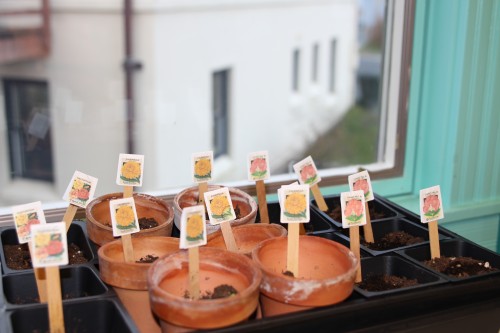
Residents at the Sitka Pioneer Home are growing flowers. “The most important thing we can do as an organization is to maintain the dignity of those we serve. If we do that, I think we’ve done the job we need to do,” said administrator Phil Welsh. (Photo by Emily Kwong/KCAW)
In 2004, George’s Parkinson’s disease reached a severe stage. Doctors in Hoonah urged him to consider entering a pioneer home. “He was tall and had big bones and he was heavy, you know?” Fredi recalled. At the time, she couldn’t lift him up any more. “I think when he realized that,” Fredi said, “he was willing to come.”
Fredi and George took an open spot in Sitka and moved into a shared apartment. For Fredi, the weight of managing his medical needs was lifted off her shoulders. “Everyone else did the work and that lifted such a load. I could just sit and talk with him and visit him and be his companion rather than his caretaker,” she said.
George died in 2013, but she didn’t consider leaving.
“We had not ever had a home. We were gypsies, moving from place to place. I stayed because I’d loved it here. It was my home, you know?”
Looking around, she adds, “And it’s the nicest home I’ve ever had.”
Robert Davis Hoffman’s “Woman Who Married A Bear.” (Photo by Brielle Schaeffer/KCAW)
Strength, loss, healing and transformation: those are themes present in a new permanent art installation that acknowledges the history of the original Sheldon Jackson Training School. The school later became a college and was influential in the lives of many Alaska Natives.
The Sitka Fine Arts Camp opened the exhibit “Create, Memory” Wednesday at Allen Hall.
Jennifer Younger “Fragmented.” (Photo courtesy of Jennifer Younger)
A trio of Robert Davis Hoffman’s graphic paintings of Native stories — Salmon Boy, The Woman Who Married a Bear and Raven Baby — line the stairwell. His artist statement says those stories are all ones of transformation, representing how the campus became what it is today. Above the stairs is a canopy of copper devil’s club leaves, which were crafted by artist and curator of the collection Mary Goddard.
Devil’s club is a symbol of healing and protection in Tlingit culture. Goddard said she wanted her piece to evoke feelings “similar to when you go for a walk in the forest and you’re walking under these giant leaves and you feel protected and you feel secure. I wanted that same feeling when you come into the environment.”
Her piece is the bridge between Jennifer Younger’s copper “Fragmented,” which represents the Presbyterian presence in Tlingit culture, and Dave Galanin’s 4-foot copper “Tináa,” which looks like a shield, a symbol of wealth and status.
“(The church) really did break apart their culture and their Native lifestyle. So, it’s broken apart you can see the pieces — the broken raven, the broken eagle — but it what it represents is that it’s still here and those pieces still can be put back together and carry on that history,” Younger said.
The tináa is an ancient symbol and was also used as currency, which fascinates Galanin. The metal worker says it implies the value of sharing knowledge, culture and art, much like the Sitka Fine Arts Camp does.
Dave Galanin’s ”Tináa” hangs behind Mary Goddard’s “Devils Club Canopy.” (Photo courtesy of Jennifer Younger)
“The thing about artwork, in general, is those are the last things that people find after a culture dies off. When you look at the Mayans, for instance, (their art is still there),” he said. “The people aren’t there but the artwork is. It still stands.”
The CIRI Foundation and Steward family funded the exhibit. Galanin says Goddard recruited the artists first and they worked on their pieces independently.
“The amazing thing is they all tie in together,” he said. “The story evolved on its own.”
To Younger, the artwork’s story is one of perseverance.
“Any hurt, even unintentional, we all can heal and bring it back together full circle,” she said.
Sitka Fine Arts Camp wants the campus to become more of a community gathering space. Kenley Jackson, the camp’s program director, says the artwork gives it that feel.
“We hope people enjoy it for years to come and kids are inspired by it,” she said. “I think when you read the artist statement it tells the story of the impact art can have and the impact this place has had on people for a long time.”
While the work is pregnant with meaning, it’s also all visually stunning.
“You see it right as you walk in and it’s like, bam!” spectator Amanda Roberts said. “It’s beautiful.”
She’s talking about Galanin’s tináa. She says she happy the work will remain on campus forever, a talisman of the history of the Tlingit people and the college.
SEARHC CEO Charles Clement tells assembly he’s in conversation with Sitka Community Hospital CEO Rob Allen about how the two institutions can share resources in the future. (Photo by Emily Kwong/KCAW)
For decades, the question of whether Sitka can afford two hospitals has percolated, with little success at consolidating services. That era may be coming to a close. The assembly entertained a motion Tuesday from Charles Clement, CEO of the Southeast Alaska Regional Health Consortium to renew talks with Sitka Community Hospital about collaborating on medical services. This raised alarm bells for some citizens.
How do you kick-start a difficult conversation that no one really wants to have? If you’re Charles Clement, CEO of SEARHC, you write a letter.
Of the letter, he told the assembly, “I don’t want to belabor and read it back to you again, but it really was an attempt to take a stab at trying to figure out, ‘How do we have this conversation in about hospitals and health care and service delivery in Sitka?’”
Sitka’s tale of two hospitals stretches back to World War II. Mt. Edgecumbe Hospital was built in the 1940s while the city opened Sitka Community Hospital in 1956. And between the two facilities, Sitka has two emergency rooms, two obstetrics facilities and two physical therapy centers, among other duplicate services.
In his letter, Clement said that given the state’s financial crisis – and anticipated cuts to health care reimbursement – sustaining both hospitals may not be practical.
“Change is coming. And I really am a firm believer that we have every opportunity to guide that change where we’d like it to go,” he said.
Clement has been meeting monthly with Sitka Community Hospital CEO Rob Allen. The hospitals have already experimented with sharing laboratory space and a dietician which, Allen previously told KCAW, would save Sitka Community Hospital $50,000.
To that end, Clement’s letter suggested that SEARHC draw up a management proposal for the consolidation of services between the two hospitals and present it to the assembly.
The idea was met with cautious optimism from members of the assembly. Matthew Hunter said, “There’s a lot of nervousness amongst our health care community on both sides of our bridge and it’s been going on for years. I see this as a fresh opportunity to have a collaborative effort.”
Yet staff with Sitka Community Hospital worried that the motion – which clearly said that SEARCH would draw up the management proposal – wasn’t in the spirit of collaboration. Steve Hartford, Director of Operations, said, “[A management proposal] seems a little narrowly focused to us, as opposed to working together to set up a structure for a community discussion.”
Clement responded that it was always SEARHC’s intent to include Sitka Community Hospital in the discussion. But speaking as members of the public, past and present Sitka Community Hospital staff didn’t seem convinced. They spoke about a legacy of mistrust between the two hospitals and worried that the letter hinted a takeover was on the horizon.
CEO Rob Allen was traveling and not present at the meeting. But speaking on his behalf, Harford said Allen supported the proposal as a way to get the thorny tumbleweed that is this particular topic rolling.
The assembly agreed. Steven Eisenbeisz said, “This can either go really, really well or not so well. And I know there’s anxiety in the community about it, so I’m excited to see what both entities come up with and so we reduce our overlapping services in Sitka.”
In the end, the assembly members penciled some new words into the motion, specifying that SEARHC and Sitka Community Hospital would draft a management proposal and the proposal had to be collaborative. The motion then passed unanimously. In the future, should the two hospitals present an ordinance for consolidation to the assembly, it would require two readings to take effect.
Former Alaskan Bonnie-Sue Hitchcock’s new book The Smell of Other People’s Houses was released Feb. 23. (Image courtesy of Bonnie-Sue Hitchcock)
Former Sitkan and public radio reporter Bonnie-Sue Hitchcock has published her first novel.
The Smell of Other People’s Houses is a novel for young adults about growing up in Alaska, and the powerful stories we build around home and family.
Bonnie-Sue Hitchcock’s novel The Smell of Other People’s Houses is available in bookstores and online Tuesday, February 23.
It wasn’t until Bonnie-Sue Hitchcock left Alaska that she began to feel like writing about it.
“I was really homesick. And that’s when I started tapping into those old, old memories. Not just my time in Sitka, which was more recent, but really going back to my childhood and my time spent with my family.”
Hitchcock grew up in Alaska, eventually moving to Sitka where she worked two stints as a reporter at KCAW, the last ending in 2009.
She was also the host of the nationally-syndicated program Independent Native News.
Hitchcock says it took a while for her to shed her journalistic sensibilities, and look at the world through the lens of the novelist.
“It’s really fun to just play with this world and not constantly have to have attributions, and double-check, and make sure that this source was correct. It took me a while, too. I’d Google the 1970s — what was on the street in Fairbanks at that time. And then slowly, slowly I loosened up and I was able to create my own world.”
The Smell of Other People’s Houses began as a writing exercise, as Hitchcock was working towards her Masters of Fine Arts degree in children’s and young adult literature. She and a friend would sit down and prompt each other with ideas, then write for 20 minutes. One of those prompts is now the title of the novel.
The book is told through teenage narrators. Hitchcock says her publisher told her to balance some of the darker issues in the story with hope.
She discovered that fiction was a powerful tool for examining ideas that might have been hard to cover in reporting.
“The cool thing about writing fiction is that the issues are real, but the characters are fiction. But as a journalist, I was constantly thinking about how these people’s lives are being represented in the press and my hand in that. And that was a huge responsibility. And with a fictional character, it’s just a fictional character, and you can dig deeper into the subject matter. That was a pretty great realization: That I could almost be more truthful writing fiction.”
The Smell of Other People’s Houses was originally a series of short stories. Transforming it into a continuous narrative was one of Hitchcock’s biggest challenges after she made the sale.
The first chapter was also a murder mystery. A lot has changed since then.
“In the end, it became a much different story. And they wouldn’t let me kill anybody. Which was sad.”
Melissa Marconi-Wentzel contributed to this report.
Mindy Anderson sells Salty Pantry products at the Petersburg Farmer’s Market. (Photo by Ed Schoenfeld/CoastAlaska News)
A Petersburg flavored-salt startup and a Sitka poultry and livestock farm won this year’s Path to Prosperity contest. Sponsors Haa Aaní Community Development Fund and the Nature Conservancy will provide each with $40,000 to build their businesses.
The winners were announced at this year’s Innovation Summit, Feb. 9 in Juneau.
Bobbi Daniels, who owns The Sawmill Farm, went on stage to accept her plaque from the presenter.
“So I’m standing there in front of everybody, in front of this huge Innovation Summit,” she said. “And I said, ‘Thank you. I’ll try really hard not to get manure on it.’ ”
Daniels is the kind of person to leave you rolling with laughter, and with a fresh jug of goat’s milk on your porch. I’m in her car, which has a pink steering wheel and is packed with chicken feed. Since space is so limited in Sitka, Daniels has built the farm across seven different backyards – offered by kindly friends and neighbors.
All told, there are 75 rabbits, 50 quail, 25 ducks, seven geese, seven turkeys and eight goats. She feeds them with cast-off produce from the grocery store. And the number of mouths to feed is only getting larger.
“We’re going to be getting 400 chicks from a hatchery. Both are laying flock and our first round of broilers …our meat chickens,” Daniels explained.
Bobbi Daniels of the Sawmill Farm, holding up a freshly hatched duck egg. Daniels grew up on a family farm in Indiana. (Photo by Emily Kwong/KCAW)
There are also 12 pigs in Washington, that still need to brought over on the ferry. Along with her business partner, Joshua Meabon, the Sawmill Farm has spent the past two years rearing livestock and fowl in Sitka.
Their goal? Daniels said, “When Sawmill Farm labeled meat is on the grocery store shelves in Sitka, that’s huge for us. That’s a huge goal for us. And we think we’re going to get that done by May.”
Daniels was a finalist for the Path to Prosperity Contest in 2014 and 2015, but said that what likely put her business into the winner’s circle this year is her plan to consolidate the farm on one location – at the Gary Paxton Industrial Park, the site of Sitka’s former pulp mill.
The $40,000 prize cash prize is earmarked for business development only, so Daniels will use it for website development, branding and accounting.
Daniels grew up on a family farm in Indiana and wants to bring her locally-grown food philosophy to Sitka. “You look at your plate and what you eat and how you eat differently when you are involved in making it happen. You can’t help it. And I think it’s a really good change,” Daniels said.
The other winner of the Path to Prosperity contest doesn’t have to worry about getting manure on her award, but hummus may be another matter. Mindy Anderson owns the Salty Pantry, a rustic-foods market and deli in Petersburg.
This is Anderson’s first time entering the Path to Prosperity contest and she said the most useful part was the requirement to rewrite her business plan. “In fact the night it was due, I was still adding photos and putting on the finishing touches. Finally I hit the submit button. It was a great feeling. My heart was pumping. ‘Finally, I’m turning in this project after all of this time.’ I think it was a 56-page document,” Anderson said.
Anderson started the Salty Pantry in 2014, bringing gourmet salt blends to the local farmer’s market. She also offers artisanal bread and pickled vegetables. Fans say her oatmeal is to die for.
She’s largely self-taught.
“There was a phase in my life when I ate chicken without skin. It wasn’t until later I learned to cook with spices,” she said.
And now, Anderson wants to expand her business from a home-based, cottage industry …”to a small family-run market and deli with eat-in dining for approximately 20 customers. I’m going to strive to be a business Petersburg can be proud of and be a leader in food and food education.”
Anderson also wants to open up a commercial kitchen to expand into home-cooked meals and retail products, like pastas, salads, flavored butters and cassoulets. While she can’t use the Path to Prosperity money to buy a new mixer, but she can use it for branding or her personal development, like classes in butchery and bread making.
“As a business owner you tend to not spend money on those things. You think, ‘I have to buy the stove, the hood, or I can’t leave my business at this point,’ ” said Anderson. “But right now is the perfect time for me to take advantage of those things and be more educated and be a successful entrepreneur.”
And that is the whole idea of the Path to Prosperity contest. With this money, both Anderson and Daniels will have the means and the permission to make their booming businesses even better.
Close
Update notification options
Subscribe to notifications
Subscribe
Get notifications about news related to the topics you care about. You can unsubscribe anytime.