KCAW - Sitka

KCAW is our partner station in Sitka. KTOO collaborates with partners across the state to cover important news and to share stories with our audiences.

Sitka teachers agree to no pay raise next year

The Sitka School Board and district teachers have signed off on a new three-year contract.

For the first year of the deal, at least, teachers agreed to take no pay raise.

Tim Pike teaches vocational education and served as a negotiator for the Sitka Education Association.

“In our background we spent a lot of time looking at all of the factors that are around: All of the state factors, local factors, federal factors — what does the funding picture look like for the district. So that if we ask for something, it’s reasonable and doable. That’s critical to us because we’re part of the community.”

In the second and third years of the contract, teachers will get raises of $500 and $750 respectively.

The pay hikes will be applied uniformly across the pay scale: A teacher who’s been on staff for 15 years will be bumped the same $500 as a new hire.

Pike says that there’s a simple rationale behind the strategy.

“We do that on purpose to try and bring as much money as possible into the bottom of the salary schedule, to attract quality applicants when we have teachers retire.”

Pike says the new contract was well-received by union membership, even though agreeing to a year without a pay raise is unusual. In 2016, for example — also a tight budget year — district teachers agreed to annual raises of $500, $750, and $900.

This year’s vote was unanimous — almost.

“All the votes came in and only one teacher voted against it.”

Under the new contract, beginning teachers in 2019 will earn $49,100. Top-end teachers, with 15 years or more experience and a master’s degree, will earn $78,725. You can read the contract yourself on our website, kcaw.org

The Sitka School Board signed the new teacher contract March 22, in the middle of their annual budget process. At a budget hearing Tuesday night, the board moved no closer to closing the $1-million projected deficit for next year.

Significant public opposition to closing the Performing Arts Center expressed at a meeting last week sent the board looking for other ideas. One of those — transferring responsibility for the PAC to the private sector, to an entity like the Sitka Fine Arts Camp, would likely be illegal, according to Sitka’s chief financial officer Jay Sweeney.

The board also remains reluctant to increase class sizes in the elementary grades, while a discussion about closing the Ventures program did get traction.

Ventures is the district’s after-school activity program for elementary grades. Although parents pay fees for children to attend, the district is limited in how much it can charge. Ventures serves about 25 children, one-quarter of who are low income. The cost of providing Ventures in 2014 was over $57,000.


Third, lesser-known democratic presidential candidate campaigns in Sitka

Though De La Fuente has picked up zero delegates, he seems undeterred. His campaign was sparked by the anti-immigrant rhetoric of Donald Trump (Photo by Emily Kwong/KCAW)

While Bernie Sanders and Hillary Clinton marshaled support in Washington this weekend, a lesser-known candidate – Rocky De La Fuente came to Alaska. De La Fuente was the only presidential hopeful in the state for the democratic caucus. And he brought his campaign – with its dark horse ambitions – to Sitka.

Rocky De La Fuente, 61, is the most determined Democratic candidate you’ve never heard of. The Mexican-American businessman filed his candidacy on Oct. 1, months after Hillary Clinton and Bernie Sanders. But it was another candidate who sparked his campaign.

“When Mr. Trump called everyone every name in the book, I was expecting to have a worldwide contra-reaction,” De La Fuente said. “I was expecting the president of the U.S., the president of Argentina, there wasn’t one person who said A, B or C. So the question is I said, somebody has to stand to that man.”

Trump’s affront on the Latin American community inspired De La Fuente. But the two men are similar in a few ways: both are wealthy businessmen with no political experience who want to shake up the establishment and appeal to working-class Americans. But De La Fuente’s base is very different: immigrants, the homeless and non-whites. He was caucusing in Arizona and met a young girl named Renata, who started crying.

“She says, I won’t be able to see my grandfather. Why not? Somebody’s building a wall,” said De La Fuente.

Immigration reform is at the top of his priority list.

“We have 11 million people in this country that do not have their papers,” De La Fuente said. “I consider those 11 million people assets. I don’t consider them liabilities. They’re here. I didn’t bring them here. But if we’re going to grow this country and we’re going to generate 34 million jobs, I need those 11 million here. I need them working. I need them legal. And I need them to pay taxes.”

De La Fuente is pro-gun and supports the Affordable Care Act, but thinks it needs to be changed. He’s OK with same-sex marriage and abortion rights but thinks states should have the right to choose. He’s an unusual blend of stances. And he thinks it’s enough for him to be an alternative to front-runner Hillary Clinton.

“The lady thinks she’s queen,” said De La Fuente. “This is a democracy. This is not a dynasty. Do we have to elect the wife of a president?”

De La Fuente has picked up zero delegates, but as far as fringe candidates go, he’s doing OK. He appeared on more state ballots than former Maryland Governor Martin O’Malley, who withdrew after a poor showing in Iowa.

To his disappointment, though, he did not appear on the ballot in Washington this weekend.

“Even though I qualified for 44 states, in Seattle they put me as other,” De La Fuente said. “So the Democratic Party has said Washington, you cannot vote for this man because he doesn’t exist.”

So, he came to Alaska which he’s visited numerous times on cruise ships – he even owned a 165-foot catcher-processor out of Dutch Harbor at one point – and took part in the District 35 caucus. For a state this large in size, there are few delegates up for grabs – just 20. De La Fuente would have needed at least 15 percent of the room to pick up any. He netted 11 votes, making him not viable. But he seemed undeterred. I asked De La Fuente why he keeps with it, given the odds.

“It’s a 56-kilometer race,” said De La Fuente. “So you cannot judge a race just because somebody is leading the first 10 kilometers or the first 20 kilometers. The question is, “Who is going to cross that finish line?”

De La Fuente’s campaign – which is entirely grassroots – even developed a game called “Rocky Run.” Available on iPhone and Android, De La Fuente is a horse you can pit against horses “Hillary Pigton” and “Don Bulltromp.” With the brush of a finger, you can jump over obstacles.

And his eyes light up when he mentions that the Democratic National Convention will be in Philadelphia. Because as you may have noticed, he shares a name with another underdog, Rocky Balboa.

“All my life, I’ve been an underdog,” De La Fuente said. “All my life, I’m a minority. We have two types of people: we have the hard-working people that work and we have the government that’s trying to do everything they can to stop us. Imagine if we can all be working with the same objective. And let’s make America 10 times greater than what it is today.”

And in his pursuit of greatness, De La Fuente has his eyes on the June 7 primary in California, where he does business in 45 cities. “At least,” he says, “My employees can vote for me.”

Researcher says state ferries benefit more than they cost

MacDowell Group researcher Heather Haugland says that state gets a 133 percent return on its investment in the Alaska Marine Highway System. (Photo by Robert Woolsey.KCAW)

The state gets a 133 percent return on its investment in the Alaska Marine Highway System. That’s the conclusion of a recent economic analysis by the McDowell Group, and independent research firm based in Juneau.

Senior analyst Heather Haugland delivered the report for the first time to the Sitka Chamber of Commerce.

The report was commissioned by the Marine Highway in 2014, but it’s driven entirely by statistics.

And some of the numbers are pretty granular. There’s not a lot Heather Haugland doesn’t know about passengers who, say, boarded a ferry in Sitka in 2014.

“You’ve got 81 Australians. 22 Germans, 16 New Zealanders. You had 2 people from the United Arab Emirates — I love this stuff, I think it’s so fascinating,” Haugland said.

But Haugland, who now lives in Bellingham after spending 12 years working for McDowell in Juneau, dives much deeper into the numbers. She tracks employment in the system, and where that money is being spent. She also tracks visitor traffic, and where passengers are headed when they ride the ferry.

It’s probably not where you were thinking.

“Anchorage and Juneau are the top two destinations. So folks taking the ferry are not just tooling around in Southeast. They’re driving, getting off the ferry in Haines or Skagway, or taking it up to the Southwest system, but they are getting throughout the state. Denali is the #5 community of those visited. Fairbanks is #7. Tok. These are communities that are not on the ferry system, but are benefiting from the service by getting visitors.”

And the ferry is not just for visitors. The other prize Anchorage and Juneau win is for travel by local residents. Juneau tops that list, followed by Anchorage. Ketchikan is a distant third, followed by Palmer and Wasilla.

There are more people from Palmer and Wasilla using the ferry than from Sitka — than from Haines, even. And there are more residents of Fairbanks using the ferry than residents of Wrangell and Petersburg.

In just the last three years, traveling from Sitka on the ferry has become almost as rare as departing Chicago in a Pullman sleeper car.

“Sitka’s traffic, between 2012 and 2015 has gone down by 33-percent. That’s about twice what the statewide traffic went down. I know that scheduling, and what’s going on with the ferries and their maintenance plays a role, but that’s a big number. I was surprised that it had gone down by a full third.”

Haugland is not sure how the information will be used by decision-makers in Juneau. The impression created by Sitka’s legislators — especially Sen. Bert Stedman — is that ferries are considered expensive and inefficient by Railbelt politicians who prefer spending money on pavement.

Her biggest reveal, however, was pure economics. In 2014, the state subsidized ferries to the tune of $117-million. The net economic benefit to the state was $273-million — a return of 133-percent.

Nevertheless, state support for the marine highway continues to decline.

“There was a $123-million subsidy in 2013. And what they’re talking about in the house and senate — juggling around right now — it may be about $84-million going forward, for the fiscal year 2018.”

Haugland lets the numbers speak for themselves, and resists the impulse to interpret them.

When a chamber member asked her for suggestions on how to stop the decline in passenger traffic out of Sitka she replied, “That’s a question for the marine highway.”

Mount Edgecumbe school gets new superintendent

Mount Edgecumbe High School. (KCAW photo)

Janelle Vanasse of Bethel has been named superintendent and director of of Mount Edgecumbe, the state-run boarding school in Sitka. Vanasse will replace Bill Hutton, who retires June 30.

Vanasse is the director of secondary education at the Lower Kuskokwim School District. During her tenure, she oversaw the district’s “Ready Academies,” which are boarding programs of varying lengths. She’s also served as principal of Bethel High School and executive director of Yuut Elitnaurviat, a Bethel nonprofit that provides vocational training to youth and adults. Vanasse will complete her superintendent’s endorsement from the University of Alaska Southeast in May.

Hutton was Mount Edgecumbe’s superintendent from 2008 to 2010, overseeing 400 students and nearly 150 staff. Hutton came out of retirement when his replacement, Troy J. Thayne, who went by “J,” resigned in January 2015 after six months on the job.

Hutton is pleased that Vanasse is stepping into the role. He said he’s impressed with her multifaceted resume. “In her background she has the ability to think creatively and put things together, as she did in the regional training center. She’s got residential background. She’s got the experience with Bethel High School,” he said. “All those things lead to somebody who has a lot of moxie, organizational and communication skills, and the ability to get things done.”

For 70 years, Mount Edgecumbe has been a unique cornerstone of the Alaskan education system. The majority of its students are Alaskan Native and hail from over 100 communities, some from small villages. The boarding school becomes like a second home.

Hutton had one word of advice for Vanasse: “Listen. And learn. Because we’re such a unique boarding situation in a state environment that it just takes a while to learn all the different things which are different from your traditional public school in Alaska.”

The State Board of Education & Early Development approved Vanasse’s appointment at its March 22 meeting in Juneau. They began the search July 1 of last year. The annual salary for the position ranges from about $103,000 to $122,000, depending on experience.

140 minutes to fish thousands of tons of Sitka Sound herring

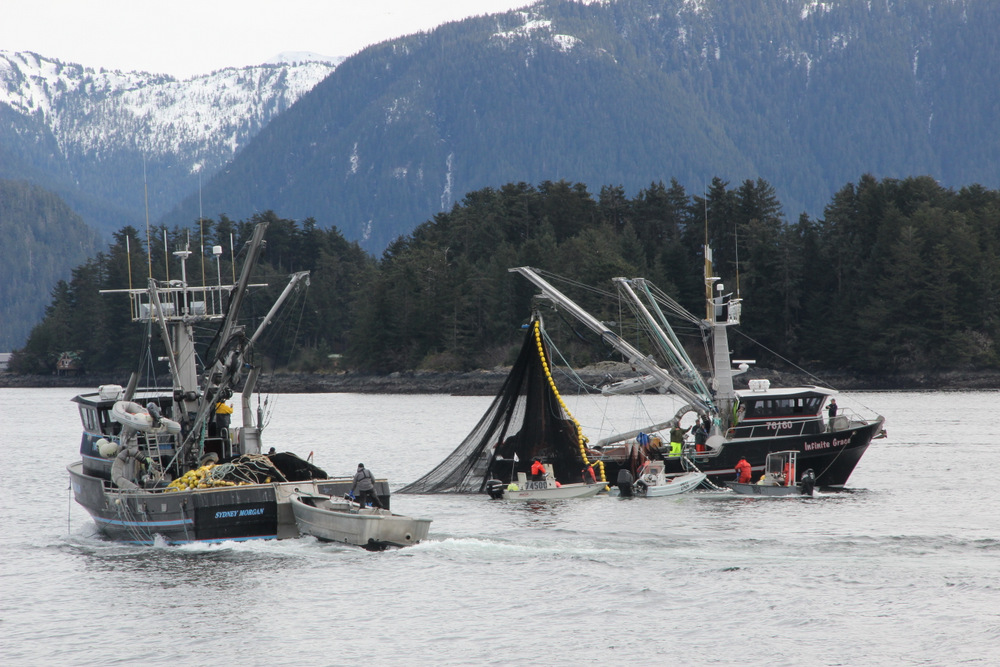
The seiner Infinite Grace pursing up during the third opening in the Sitka Sound sac roe herring fishery, on Wednesday, March 26, 2014 (Photo by Rachel Waldholz/KCAW)
The seiner Infinite Grace pursing up during a Sitka Sound sac roe herring fishery in March 2014. (Photo by Rachel Waldholz/KCAW)

The commercial herring season opened Thursday, more abruptly than in past years. Herring seiners had about two days’ notice to get to Sitka. And then about another four hours’ notice to prep their gear.

Although winter salmon trolling wrapped 10 days ago, this always feels like the opening bell of the commercial fishing season in Alaska.

State biologist Dave Gordon manages the commercial herring fishery. Over the years, he has also become its voice.

“Five, four, three, two, one, open! The Sitka Sound Sac Roe Herring Fishery is now open. This is the Alaska Department of Fish & Game standing by on channel 10,” Gordon announced.

Gordon opened fishing at 2:45 Thursday afternoon along the shoreline of Kruzof Island, about 10 miles northwest of Sitka.

Fishing closed at 5:05 p.m. The openers are typically 2 to 3 hours, as seiners home in on schools of large fish with adequate proportions of females. The value in this fishery comes from the egg sacs inside the females, which are stripped, salted, and sold overseas in Asia.

There are 48 active permit holders in the 2016 fishery. That’s not a lot compared to other fisheries, but owning a herring permit is a little like owning a silver mine. According to the Commercial Fisheries Entry Commission, purse seine permits for Southeast Alaska are now worth $227,500 — a staggering figure that’s actually down from the all-time high permit price of $540,000 in 2011.

This year seiners are targeting 14,741 tons of herring. Processing capacity limits fishermen to no more than 4,500 tons per day. A big harvest day usually means fishermen will take a day off to let processors catch up.

The commercial fishery is over when the guideline harvest level is met, or the herring start to spawn, whichever comes first.

The beginning of spawning is also the beginning of the subsistence harvest of roe on hemlock. Subsistence fishermen cut hemlock branches from the forest and sink them in quiet coves around the inner islands of Sitka Sound. Successful fishermen return to find their branches covered in a thick layer herring eggs, which they can eat on the spot, cook, freeze or deliver to family and friends around the state.

Editor’s note: The headline has been corrected to reflect what the herring catch was limited to for the day, rather than the seasonal limit.

Alaska Native Sisterhood, Brotherhood urge racial equity in Sitka schools

The Sitka School Board at ANB Founders Hall Monday night (3-14-16). ANB/ANS members asked for more frequent reports from the Sitka Native Education Program (SNEP), and suggested that the school board consider holding a second meeting each year in the Native community. (Photo by Robert Woolsey/KCAW)

Alaska Native knowledge is becoming more valued in Sitka’s schools but there’s still much work to be done toward racial equity. That’s the message members of the Alaska Native Brotherhood and Sisterhood delivered to the Sitka School Board at its regular meeting Monday night.

The Sitka School Board assembles once a year in the ANB Founders Hall — both to hold a regular meeting and to listen to a status report from the Sitka Native Education Program.

Compared to meetings in years past, there was a consensus that things had improved.

“I’ve been associated with you coming here to the ANB Hall for board meetings for a very long time. And in that very long time, I tell you I see progress,” said lifetime ANB member Nels Lawson.

Lawson was appreciative of the efforts of the school district to host a paddle-making workshop for a ceremonial canoe trip later this spring, and for participating in a recent discussion with the First Alaskans Institute on working together to better serve all students.

ANS member Patricia Alexander also saw positive change.

“I have to say that I like the tone of the relationship between the school board and the Native community. I think that it hasn’t really been a day at the beach for you all trying to balance the budget. I think we’re aware of it.”

But the good words were balanced by advocacy for continued work on Tlingit language revitalization, and for dialogue on racial awareness.

ANS member Marsha Strand told the board that she considered Tlingit an endangered language. She wanted the school district to take a lead role in its preservation.

“Wouldn’t it be awesome if the school district could brag of being on the cutting edge of the best local teaching of Tlingit in Southeast?”

Strand also wanted the district to continue to build racial awareness into teacher training. Her sentiments were echoed by former ANB president Tom Gamble, who is planning a two-day meeting April 1 and 2 as part of the First Alaskans program Advancing Native Dialogues on Racial Equity.

Gamble told the board, “When people are given the opportunity to discuss their experience about race and racial inequity, it gives everybody the sensitivity to say, Look, whatever my actions, they may or may not impact somebody. It just happens with dialogue.”

Gamble urged board members to support the meeting — possibly by hosting it in a school building — and by attending in person.

Board member Cass Pook — an Alaska Native — agreed that racism was more prevalent than most people believe and more insidious.

District cultural director Nancy Douglas responded that upending negative racial attitudes was a major benefit of the Sitka Native Education Program.

“When you think of racism, it’s thinking of changing people’s views of who we are as Natives. And we’re doing that. When you have little kids running up to me at SeaMart saying, Mom, this is the lady who taught me how to weave today — from the non-Native kids! It brings tears to my eyes, no matter if it’s our Native kids or our non-Native kids. Because that means to me that we are becoming valued in the Sitka School District.”

Douglas recalled learning from elders when she herself was a student in SNEP. The message Douglas was taught: “It is our responsibility to make our kids shine.”

The board listened to ANB/ANS members’ issues but took no official action. They briefly discussed making Elizabeth Peratrovich Day a school holiday but agreed that the more powerful way to celebrate the civil rights leader would be to gather students in school for a “teaching moment,” and then release them early to attend the local parade.

Site notifications
Update notification options
Subscribe to notifications