KCAW - Sitka

KCAW is our partner station in Sitka. KTOO collaborates with partners across the state to cover important news and to share stories with our audiences.

McLean, Barr take home 1st place in subsistence foods contests

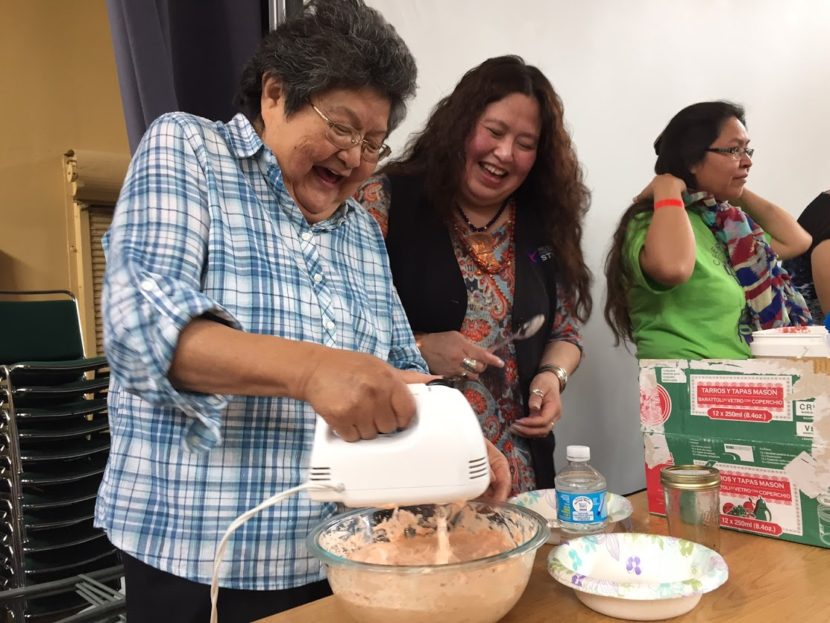
Doris McLean of Whitehorse whips up a jar of soapberries, which took first prize at Sealaska Heritage's contest. Next to her is Leonilei Abbott, daughter of Helen Watkins, who was widely known for teaching about native foods. (Photo by Emily Kwong/KCAW)
Doris McLean of Whitehorse whips up a jar of soapberries, which took first prize at Sealaska Heritage’s contest. Next to her is Leonilei Abbott, daughter of Helen Watkins, who was widely known for teaching about native foods. (Photo by Emily Kwong/KCAW)

Celebration brings together tribal citizens from across Southeast every other year. It’s a sensory experience and two contests in particular were made for the tastebuds.

Doris McLean stands before a bowl of soap berries, ripe and gleaming red.

But pretty soon, with the help of a hand mixer, they turn pink and frothy, the consistency of whipped cream. McLean is something of a soapberry alchemist.

The soapberry contest was dedicated to Helen Watkins, a longtime soapberry contest contestant who "walked into the forest" earlier this year. Competitors this year included Charlene Baker and Fran Neumann. (Photo by Emily Kwong/KCAW)
The soapberry contest was dedicated to Helen Watkins, a longtime soapberry contest contestant who “walked into the forest” earlier this year. Competitors this year included Charlene Baker and Fran Neumann. (Photo courtesy of Sealaska Heritage Institute)

“These soap berries are a healer,” McLean says. “Just tons of vitamin C in it, you know. Our people have to know the healing foods.”

McLean lives in Whitehorse, but picked her berries in Carcross in the Yukon. All she needed was an 8 oz. jar to feed the crowd.

The crown lets out a cheer as she flipps the bowl over — the whipped berries stay inside.

Her secret? Whipping the berries into a stiff, smooth formation, without any sugar granules. In fact, McLean prides herself on not adding much sugar at all.

“My soap berries don’t need any doctoring. Like god made it!” she says.

A man in the crowd yells out, “I wish you were my grandma.”

Like a lot of subsistence foods, methods for preparation and tricks of the trade are passed between the generations. McLean learned from her mom, who used to give her kids a mason jar and say, “Go pick some berries.”

“Get rid of us, hey? So we’d run out and pick enough berries in our mason jar. And she used to give a stick so we’d have to … whip it up and use the sugar and made our own dessert.”

Shifting over to the salty side of things, Celebration’s also included a black seaweed contest. Much like the soap berries, the friendly competition brings out differences in preparation.
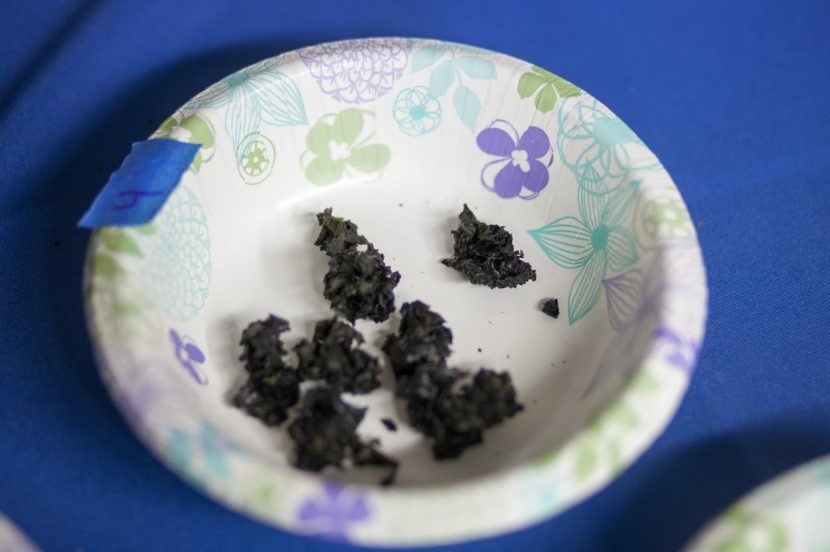
At the black seaweed contest, some entries were dried outdoors while others were dried in the oven. "It all depends on where you grew up," says judge Paul Johnson, who was raised in Angoon. (Photo by Rashah McChesney/KTOO)
At the black seaweed contest, some entries were dried outdoors while others were dried in the oven. “It all depends on where you grew up,” says judge Paul Johnson, who was raised in Angoon. (Photo by Rashah McChesney/KTOO)

Paul Johnson prefers seaweed when it’s not too salty and not too dry, aired naturally in the sun instead of in the oven. When I ask what he means, he hands me a dark, green kernel.
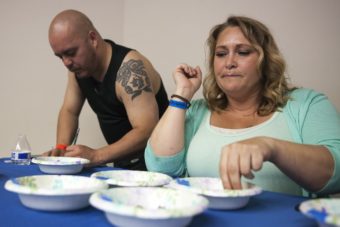
Paul Johnson and Ashley Colon were two of three judges for the black seaweed contest, hosted by the Sealaska Heritage Institute at Celebration 2016. (Photo by Rashah McChesney/KTOO)

KCAW: (Crunches) Oh. I see what you mean now.
Johnson: This one’s got a lot of salt water. Depends on how you grew up. Where you grew up. Depends on the kind of seaweed you get.
Howard: We had to hand grind it! (Laughs) The grinders were only that big around.

Johnson’s daughter Catherine passes by. Johnson says, “You know, when I was pregnant with her. I was anemic.”

“I was allergic to the iron pills and my father was still alive and he went out and shot a seal. My dad was cooking seal meat, seal liver and it brought up my blood count. Our own natural food is good for us.”

Hosted by the Sealaska Heritage Institute, these contests are not only popular, but shine a spotlight on the health benefits of subsistence foods. The soapberry contest was dedicated to Tlingit elder Helen Watkins, who spent decades passing on her knowledge of traditional food and medicines. Watkins “walked into the forest” this year in February.

Doris McLean was the winner of the soapberry whipping contest, while the winner of the black seaweed contest was Dora Barr. They were each awarded a cash prize of $500.

10-year-old completes 3-day canoe journey to Celebration

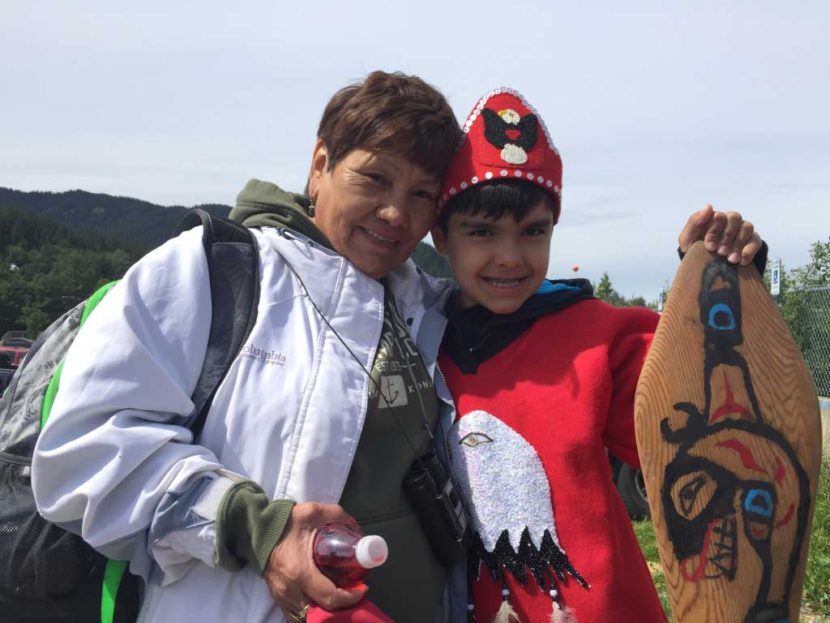
Marie Johnson greets her 10-year-old grandson, Roary Earl Bennett, who just completed a 3-day paddle from Coghlan Island to Douglas for Celebration 2016. Johnson made Bennett's tunic out of felt and abalone shells. (Photo by Emily Kwong/KCAW)
Marie Johnson greets her 10-year-old grandson, Roary Earl Bennett, who just completed a three-day paddle from Coghlan Island to Douglas for Celebration. Johnson made Bennett’s tunic out of felt and abalone shells. (Photo by Emily Kwong/KCAW)

At Celebration, waiting has a sound — of drums, of voices raised in songs of welcome. The crowd is scanning the horizon. And one grandmother, Marie Johnson, is looking extra closely for the tip of a red canoe carrying her grandson. His name is Roary Earl Bennett. He’s 10 years old from Craig, and he’s making the journey with his grandfather.

The arrival of the One People Canoe Society Wednesday unofficially kicks off Celebration. A crowd of more than 300 people clustered at Douglas Harbor awaiting the flotilla’s arrival.

Roary was invited by his grandfather Bill Bennett to join the Coghlan Island-to-Douglas portion of the journey. That’s a three-day trip. Johnson said she was washing dishes when her grandson broke the news.

“He talked about it but I never knew if he was serious, you know? … He finally came to me and told me, ‘Grandma, you better start making my tunic.’ I said, ‘Oh you’re going to dance.’ He said, ‘I’m going to ride the canoe.’”

Roary even made his own paddle at a workshop with Doug Chilton, a Tlingit master carver. The paddle has his grandfather’s killer whale crest on it.

Johnson made Roary’s tunic in two weeks, using felt and abalone shells. She put a beaded eagle on the front and a killer whale on the back, both family crests.

“We didn’t even measure it,” Johnson said. “It fit him perfect. It was just like his year.”

The journey, organized by the One People Canoe Society, has only grown bigger over the past decade. Waiting to greet them was Paul Marks, council member with the Douglas Indian Association. This land used to be the Douglas Indian Village, so his permission is key if the canoe parties want to come ashore.

“The importance is making sure you do the right things and say the right things,” Marks said. “If you don’t, it could cause misfortune, and some of the things the young people do (is) because of enthusiasm. They want to be culturally oriented, but a lot time they really don’t know what to do or say.”

So elders like Marks are more than leaders. They are teachers, demonstrating at the shore’s edge how to arrive and how to receive.

As the first canoe is spotted rounding the breakwater, the crowd cries out. There are 10 canoes; they came from Ketchikan, Sitka, Kake, Angoon, Hoonah and Yakutat, and two other canoes are designated for war veterans. Each one has a safety boat.

Rowers chant “Hoo haa!” as they approach the shore. There are more than 100 people aboard the canoes in regalia, their paddles pointed towards the sky. They raft up and at the edge of the water, Marks joins Fran Houston representing the Aakʼw Ḵwáan.

“Welcome, to Auk country,” Houston said. “We are so happy that you made it here safely.”

The exchange is one of respect, welcome and thanks.

The shores were pretty squishy with mud. I made my way over to Marie Johnson, who was taking pictures of her grandson from afar with her cell phone.

“Oh, I’m so proud of him. Ooo!”

Joined by family from Kake, we wandered over to the harbor ramp.

“Oh there he is!” Johnson said.

We spot Roary. He’s totally adorable, with green braces on his top teeth.

“Um … I’m feeling kind of tired, because I’ve been paddling a lot,” he said. “And since I’m a kid I get to take long breaks on the canoe. And it’s kind of an honor because not a lot of people get to go on there.

Roary told me he was in a boat accident once, but now feels safe traveling by canoe. His top snacks on the trip? Chex Mix, jerky and candy. The journey in three words? Sleepy, hard working and fun.

I ask him how the experience has changed him.

“I feel that my ancestors felt tired a lot … and I bet they got used to it though because they had to paddle every day to catch fish and salmon,” he said.

For someone who stepped into the shoes of his ancestors in a way that most 10-year-olds don’t, Roary is matter of fact. I ask him, “How did they push through? How did you push through?”

With the shrug, he said, “Just keep going. Take little breaks. And keep going.”

Correction: An earlier version of this story misidentified who helped Roary Earl Bennett carve his paddle. The carver who helped him was Doug Chilton, not Wayne Price. Also, Bennett is from Craig, not Kake. 

Meeting federal regs, Sitka treats water with UV light

Project engineer Stephen Weatherman explains how all of Sitka’s water is run through the 24-inch pipes in the plant. (Photo by Robert Woolsey/KCAW)

Some of the best drinking water anywhere may be just a little bit better now.

Sitka officials on the 19th of May cut the ribbon on a new, $8 million dollar ultraviolet disinfection plant for the town’s water supply.

The great thing about Sitka’s water is how easy it is to trace. It literally falls from the sky into Blue Lake and the surrounding watershed, and maybe just a few days’ later flows out our taps.

A subalpine lake, Blue Lake water has never been filtered — only chlorinated.
A subalpine lake, Blue Lake water has never been filtered — only chlorinated. (Photo courtesy KCAW)

But for the US Environmental Protection Agency that is not enough. Thanks to the Enhanced Surface Water Treatment Rule, Sitka’s water now takes a detour through an innocuous gray building with a blue metal roof at the Sawmill Cove Industrial Park.

On the ground floor of the UV Disinfection Facility are offices and storage rooms for chlorine and fluoride. Not much to write home about.

But down in the basement it’s a plumber’s paradise.

City engineer Stephen Weatherman leads a small group of residents into a room of massive blue pipes — each 24 inches in diameter — and steers us toward three silver-colored ultraviolet reactors.

“This is where all the action takes place,” Weatherman said. “There are tubes in here, nine of them, just like a fluorescent light except they put out ultraviolet — which is really dangerous. It’s why it’s all enclosed. We have special masks upstairs people have to wear if they come in here and they’re on. But it’s no different than the ultraviolet you get from the sun. It’s just more intense.”

“This is where the action takes place…”. Weatherman points out the three UV reactors in the plant.
“This is where the action takes place…”. Weatherman points out the three UV reactors in the plant. (Photo by Robert Woolsey/KCAW)

The ultraviolet light targets cryptosporidium, a microscopic parasite that is the leading cause of waterborne illness in the United States. Cryptosporidium have an outer shell that allows them to live outside of humans and animals — and also makes them resistant to chlorine disinfection.

Right now about 2,500 gallons of water per minute are flowing through just one of three UV reactors in this plant. That’s less than a second of exposure for any cryptosporidium.

So how well is it working?

Deputy environmental superintendent Shiloh Williams can’t really say — yet.

“We generally don’t do a lot of UV testing that isn’t required,” Williams said. “We have this UV facility here as a barrier for cryptosporidium. The cryptosporidium test is quite expensive. So we haven’t actually tested it post-UV. We haven’t had any reason to at this point.”

Back outside the plant, in the warm sunshine, Sitka’s environmental superintendent Mark Buggins believes it’s better to be safe than sorry. Blue Lake was already a very clean source of surface water — even before the new EPA rules.

“Certainly you don’t know,” Buggins said. “If cryptosporidium is there and someone gets sick from it, you probably just don’t know. You get an upset stomach and diarrhea and attribute it to something else. Twice we’ve tested for cryptosporidium in Blue Lake’s water and found very small amounts — like one, out of a thousand gallons. So the dosage is really low. You need to drink more than one or two cryptosporidium spores to get sick. But the people who get affected — who you’re really protecting — are the immunocompromised, people who are on chemotherapy, people who are sick already, and dehydrated. It can really hurt you.”

Both chlorine and fluoride are added to the water after UV treatment.
Both chlorine and fluoride are added to the water after UV treatment. (Photo by Robert Woolsey/KCAW)

Even at $8 million, ultraviolet disinfection was the lesser of three options for Sitka to comply with the Enhanced Surface Water Treatment Rule. Installing granular filtration — like a huge swimming pool filter — would have run to $24 million. Membrane filtration would have cost $46 million.

State grants paid for over $6 million of this project, the rest was covered by loans, and about $20,000 from Sitka’s water fund. Operating costs for the UV plant — including electricity bought from the city — will run about $360,000 a year.

Buggins said electrical engineers are integrating the computer controls of the UV plant and the existing water system. Soon, water employees will be able to control everything from a laptop — even at home.

For Buggins, who’s been running Sitka’s water for 26 years and has plans to retire, this is an intriguing possibility. He even joked he may be asked to keep his password if he does retire.

And will UV treatment make Sitka’s water taste any different? Once the state has signed off on the new UV plant, Buggins said it likely will be easier to meet disinfection standards with lower amounts of chlorine — just enough chlorine to be detectable at the extremities of Sitka’s water system.


Sitka upgrades to silver level for bicycle friendly streets

Doug Osborne and Charles Bingham Sitka with Bike Award 05 17 2016
Doug Osborne, left, and Charles Bingham of the Sitka Bicycle Friendly Community Coalition hold Sitka’s new Bicycle Friendly Community sign and certificate letter. The League of American Bicyclists announced on May 18, 2016, that Sitka is now a Silver level Bicycle Friendly Community after winning the Bronze level award in 2008 and 2012. (Photo by Ken Sprague/Courtesy City of Sitka)

Last week, the League of American Bicyclists designated Sitka a silver level bicycle friendly community. Only 73 other communities in the United States have earned this honor, including Anchorage.

Sitka was the first city in Alaska to earn a bronze level designation in 2008 and again in 2012. In the past eight years, a lot has changed. The percentage of bike commuters in Sitka has doubled to 5.42 percent, which is well over national and state averages.

Bingham, a spokesman for the Sitka Bicycle Friendly Community Coalition, said this makes Sitka’s ridership pretty unique.

“Our culture is somewhat different in that we’re not really dominated by the racing community. Our people riding bikes are people riding bikes to work, riding bikes to school, riding bikes to do errands – everyday life kind of biking. You don’t see a lot of spandex-clad people here in town,” Bingham said.

To improve safety for those in town, the coalition has implemented a host of programs, from youth camps to safety campaigns. The wintertime “Be Bright at Night” program distributed reflective tape and yellow vests to riders.

Bingham said there are material improvements too. The city has repaved main roads with wider bike lanes to accommodate the wave of cyclists, including Halibut Point Road, Granite Creek and No Name Creek Bridges. And just last week, the city added directional arrows on Halibut Point Road to remind cyclists to ride on the right side of traffic.

Bingham attributed the popularity of bicycling to low traffic speeds and improved driver awareness, but reminds cyclists to be just as savvy as drivers when sharing the road.

“We still have some ways to go,” Bingham said. “Some of it the cyclists need to do. We need to ride on the right. We need to make sure that if we’re riding at night we have headlights and taillights and we also need to be visible, but I appreciate the fact that the cyclists are getting a lot more help from drivers in terms of trying to make this a safe community.”

Looking to the future, Bingham wants there to be even more accountability for personal safety.

“I’d love to see the police stopping wrong way riders and telling them, ‘Hey, you’re supposed to riding with traffic. You’re not supposed to be riding on a sidewalk in the downtown area.’ Unless you’re a little kid, get off your bike and walk it. If you’re under 18, you’re supposed to have a bike helmet. Sometimes our enforcement has been pretty lax.”

Anchorage is also at the silver level as a bicycle friendly community and Juneau at the bronze level.

Bear attack survivor: ‘Grace was extended to me’

brown bear at Crescent Lake in brush
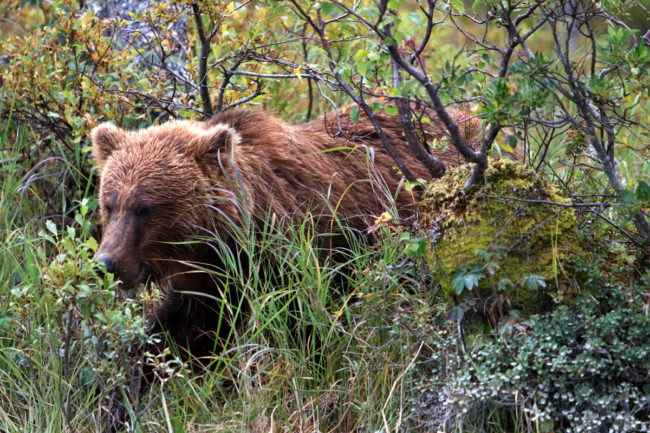
A brown bear spotted near Crescent Lake in August 2014. (Creative Commons photo by Nathanael Coyne)

Ken Steck said he “did not anticipate a bear threat” in his party’s camping area in Disenchantment Bay. “I could have done more to warn this bear,” he said.

Some of the early official reports of Steck’s encounter with the bear indicated he had a gun when the bear charged, but did not have time to use it.

That’s not quite right.

“For a lot of reasons — and I’m not exactly sure why — I really didn’t even think twice about bringing a weapon or bringing the bear mace,” Steck said.

Steck had camped overnight on a gravel bar with seven other people. Given the noise and disturbance that a party of this size makes, he didn’t think it necessary to bring one of the two hunting rifles on his 200-yard walk to fetch water.

But a gun may not have made any difference. The bear stood up in the brush around 30 yards away and went on the move.

“When I heard the bear I turned around and it was already running at me three-quarters, if not full speed. I keep replaying the scenario in my head,” Steck said. “Even if I had a rifle slung around my back I don’t know if I would have had enough time to get it off my back, put a round in the chamber, and place a well-aimed shot.”

In some ways, Steck said it was a by-the-book brown bear attack. At least it seems that way in hindsight.

“I feel like the bear saw me as a threat and it took me down. And once it realized that I wasn’t as tough as it thought I was, it took off and didn’t want anything to do with me,” he said.

Steck estimated the bear was on him for about 20 seconds, though he has no way of knowing for sure.

Steck is a military veteran. He spent four years in active duty in the Marine Corps as a firefighter and EMT. After leaving the Marines, he served in the same capacity as a civilian in Iraq, for 14 months in Kirkuk, about 100 miles north of Baghdad. He said he was scared sometimes doing that work, but nothing comes close to his experience with the bear.

Steck said that during the encounter itself, his fear was almost irrational.

“I do remember that when the bear had my head in his mouth my brain was in shock — my body, obviously, was in shock. And I just remember thinking, ‘This bear is going to swallow me whole. He’s going to eat me and walk away and no one’s ever going to find me,’” Steck said. “I was kind of thinking crazy thoughts. Obviously the bear wouldn’t be able to do that. But I did — I thought the bear was going to take me and no one would ever find me, and I was going to die within the next few seconds.”

Steck said the bear left on its own. The other members of his party heard him shouting at the animal but arrived too late. Four of them were nurses: Steck’s wife Hannah, with eight years’ experience in emergency rooms and intensive care units, and his brother-in-law Isaiah Carlson and his wife, Heidi, who’ve worked for the last three years at the Alaska Native Medical Center in Anchorage; and Ellen Ivers, who just graduated from nursing school.

Steck joked that he “married into a good family.” They provided first aid and transported him the quarter-mile along the gravel bar to their boat, and then on the 90-minute return to Yakutat.

He’s serious about harboring no ill-will toward this bear.

“I understand that the bear was just reacting,” Steck said. “I don’t have any intentions of going to hunt that bear, and wanting to kill the bear.”

Steck admitted that he might have been a little too complacent going to fetch water that day, and that this encounter will affect the way he hunts and camps and enjoys the outdoors in the future.

He’s feeling grateful to be alive, and a little humbled.

“Grace was totally extended to me, and I did nothing to deserve it,” Steck said.

Steck was in transition between jobs in Juneau and Glenallen when the attack occurred. He said his new employers at the Bureau of Land Management are willing to give him time to heal. Steck expects a full recovery in four to six months.

Mount Edgecumbe students to present original research on beluga and narwhal bioacoustics

SeaTech students on a Skype call with Josh Jones of Scripps Institution of Oceanography. (Photo by Brielle Schaeffer/KCAW)

Despite graduation, school is not over for some science students at Mount Edgecumbe High School in Sitka. The class, known as SeaTech, is headed to the Scripps Institution of Oceanography in San Diego to present their original research on beluga and narwhal bioacoustics.

You’ve probably never heard a beluga whistle or a narwhal click. Not many people have. But Michael Mahoney’s students are experts on the bioacoustics of these mammals, after spending hours logging recordings of their sounds from the Chukchi Sea and Northwest Passage.

“We’re trying to figure out if they’re happy if they’re sad, like, if there’s more fish around, to see if their clicks and their buzzes represent what’s going on in the ocean around them,” said Natalia Smith, a 17-year-old junior from Elfin Cove.

The SeaTech class is not your regular science lab. The students are actually contributing to the research at Scripps Institution of Oceanography at the University of California, San Diego.

“You’ll have people who come to your classroom who say, ‘If you go to school for a really long time you can be a scientist like me, too,’” Mahoney said. “Scripps and the Whale Acoustics Lab says, ‘Why don’t you guys be scientists with us right now.’”

Using Skype, SeaTech students connect with the oceanographer John Hildebrand and Josh Jones, a graduate student in biological oceanography at Scripps, to talk about how researchers analyze the acoustic data to study the marine mammals.

Jones says the diversity of students at Mount Edgecumbe, many who are from the villages near his study area, benefits the project. The students from subsistence communities have cultural ties to whales, having grown up around them or depending on them for food.

“That perspective, that sort of cultural and personal perspective on the animals really lends a lot to their insights on what might be going on in these otherwise numerical analytical processes,” he said.

And, Jones says, working with the SeaTech class is good for productivity.

“In a certain respect we work harder down here in our lab because we are trying to keep up with the students who are up there making steady progress on this research,” he said.

The Whale Acoustics Lab collects the sounds underwater with a high-frequency acoustic recording package, which is basically a computer and hydrophone anchored to the sea floor. The system can record underwater sound continuously for a year at a time.

Mahoney says the students go through the tape with a computer program to identify any patterns in sounds made by the whales at different times of year. The work looks to see effects of climate change and human activity on these animals.

“We can know when ice formation happens, we hear ice sounds,” he said. “Or lots of other environmental sounds. We can hear anthropogenic sounds, sounds that humans make so we can hear ships that pass over or any of those types of things.”

Jones says the Scripps/Mount Edgecumbe partnership has been going on for about 10 years. He started the program as an undergrad interested in science outreach and with roots in Sitka, having worked at the Baranof Wilderness Lodge.

As the program grew, several of Mahoney’s former SeaTech students have presented at other symposiums and even had their work published in scientific journals. A couple even chose to attend UCSD and got jobs at the Whale Acoustics Lab when they started.

In San Diego, SeaTech students will present their findings from the research they’ve been conducting during class, which is kind of a big deal.

Natalia is looking forward to the trip.

“It’s really cool,” she said. “I never thought it would be this big. I thought it was just we go into his class and we learn how to use these programs. I never thought we would get to go down to San Diego and talk to all these important people in science and learn more about these animals.”

The students will also spend time on some Scripps Institution research vessels and when the hard science is over, they’ll study the habitat of mice, talking dogs, and flying elephants during a visit to Disneyland.

Site notifications
Update notification options
Subscribe to notifications