KDLL - Kenai

KDLL is our partner station in Kenai. KTOO collaborates with partners across the state to cover important news and to share stories with our audiences.
Fishing council ties bycatch limits on Bering Sea trawlers to halibut abundance

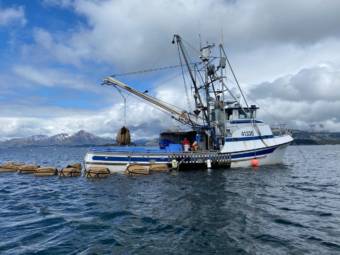
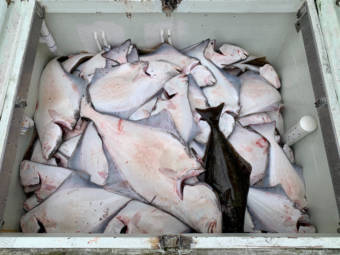
Bering Sea trawlers tend to scoop up juvenile halibut in their nets. Commercial and subsistence fishermen in Western Alaska say that doesn’t leave enough halibut for them to catch in years when abundance is low. (Angela Denning/KFSK)

The council that manages fishing in federal waters voted this week to link groundfish trawl fishing in the Bering Sea and Aleutian Islands to halibut abundance. The action caps — at least for now — a six-year debate about curbing halibut bycatch in Alaska.

For many who have been following that debate, the decision comes as a surprise because it’s expected to deal what trawlers say is a crushing blow to their fishery.

But members of the North Pacific Fishery Management Council said it was also important for them to consider how high levels of bycatch hurt small-boat halibut fishermen in Western Alaska — even if they didn’t go quite as far as advocates from those communities had hoped.

The action that ultimately passed Monday came from Rachel Baker, the deputy Fish and Game commissioner who represents Gov. Mike Dunleavy’s administration on the council. She said it will incentivize the trawl industry to reduce the halibut they incidentally catch in their nets.

When halibut stocks are low, the cap on prohibited species catch, or PSC, will also drop.

“Mr. Chair, this council clearly would rather not impose additional costs that could result in reduced groundfish harvest and revenues, if we had other management options,” Baker said. “But again, halibut is fully used in the Bering Sea and Aleutian Islands, and at the low and very low index state, mortality from PSC should decline in response to reduced amounts of halibut available for all users.”

The new limits apply to a group of fishermen and processers called the Amendment 80 fleet, which catch and process groundfish in the Bering Sea.

Halibut is a prohibited species for the fleet and must be discarded. That trawl sector catches the largest amount of halibut bycatch in the region — an estimated 2.8 million pounds each year. Other Bering Sea fishermen say that reduces their opportunities to catch halibut, particularly as spawning halibut stocks decline there.

As it is now, the bycatch cap in place for the fleet is fixed and is not adjusted to halibut abundance. So when halibut abundance is low, bycatch is a larger slice of the overall pie. The last time the cap was changed was five years ago.

The council voted to make that cap dependent on the abundance of halibut in the area. Under the new guidelines, when halibut abundance is high, the fleet could catch the same amount of bycatch it is limited to now. But when halibut abundance is very low, that cap would drop by 35%.

Chris Woodley is executive director of the Groundfish Forum, the fishery association that represents those trawlers. He said the fleet has been working to lower its halibut bycatch already and called Monday’s decision “devastating.”

“Because we’re being told to do better without more tools,” he said. “And that’s going to harm crew members, it’s going to reduce our revenues …. and harm our crewmembers’ families.”

He said without new tools to curb halibut bycatch, the fleet will have to stop fishing earlier in the season to meet those lower caps. Woodley said the 2,200 crew members the fleet employs — many from out of state — will bear much of the impact as the fleet’s fishing opportunities change. Analysis suggests the action will result in tens of millions in losses for the fishery.

Anne Vanderhoeven, a member of the council who works with Arctic Storm Management Group in Seattle, found that concerning.

“I find cuts at the levels in the motion to be punitive — cuts to the Amendment 80 fleet — to reallocate halibut from one user group to another with no real conservation benefit,” Vanderhoeven said. “And cuts at these levels could put some Amendment 80 companies out of business and I don’t think that’s the right thing to be doing here.”

But council members said they’re also taking into account the social and cultural impacts of bycatch.

The halibut fishery in St. Paul, a small island community in the Bering Sea, originated in the 1980s as the commercial seal harvest there was phased out. Today, it’s the primary source of income for the 355 residents there, according to a packet submitted to the council by the Central Bering Sea Fishermen’s Association ahead of the decision.

Lauren Divine, with the Aleut Community of St. Paul Island, said that value is immeasurable — and not purely economic.

“What is the value of the health of the halibut population?” she said. “The Bering Sea ecosystem? The connected, large marine ecosystems of Alaska that are vital to our people, family, communities, business cultures and the nation?”

Divine and other tribal leaders had been pushing for another option this week, Alternative 4, which would have taken an even bigger swing at reducing bycatch. They said that would have also opened up more fishing opportunities for small-boat fishermen like those in St. Paul.

That alternative was also backed by a bipartisan coalition of Alaska legislators and fishermen’s associations across the state, who provided hours of testimony to the council last week.

Marissa Wilson is a member of the council’s advisory panel and a fisherman based in Homer. She said the council’s impact analysis did not take into account the impacts of bycatch on communities around Alaska.

“There are values involved in this decision that are not adequately captured,” she said. ” And there are grave, intergenerational consequences of choosing any alternative besides four.”

The council said it can’t guarantee reducing bycatch will help out halibut fishermen.

It’s actually a different council that manages halibut stocks — the International Pacific Halibut Commission. Commission scientist Allan Hicks told council members changing the cap will have little impact on halibut spawning biomass in the region.

But it will likely change the amount of halibut commercial and subsistence fishermen are able to catch. Council Member Andy Mezirow, a charter operator in Seward, said it’s important to share the burden of halibut conservation between sectors.

“The Amendment 80 fleet may in fact have to face doing more with less,” he said. “But we are moving this action one step closer to having all fishermen share in this burden.”

Mezirow voted “yes” on Monday’s motion, as did the other representatives to the council from Alaska. The motion passed the council 8-3.

Jeff Kauffman is celebrating that decision. He’s the vice president of the Central Bering Sea Fishermen’s Association and a commercial halibut fisherman.

He said while the measure doesn’t go as far as he would’ve liked, it’s an exciting step in the right direction.

“This is a big day for St. Paul and the Indigenous small-boat fishermen that live there,” he said. “Because the halibut fishery is so important for St. Paul, we spent six years and tremendous resources and efforts to get to this better place.”

This week’s decision marks the first time the federal council has linked halibut bycatch to abundance, Mezirow said. The council will likely take up more bycatch issues next year.

NOAA Fisheries will have to review the final action before it goes into effect.

A Soldotna man has created a new fantasy dice game

A man sitting at a table full of dice, holding up the box for Battle Dice
Aaron Gordon created Battle Dice, which is on shelves now. (Sabine Poux/KDLL)

Aaron Gordon spent the last five years designing and fine-tuning his very own dice game. Unbeknownst to his friends and family, they were part of that experiment.
“Every once in a while, or at family gatherings or whatever, I would just kind of nonchalantly set this on the table with the other games, and people would pick it up and read those rules on the back and they’d go through it,” he said. “And I’d just kind of sit in the corner taking notes. And they’d read it and not understand a rule, and I’d be like, ‘That needs more clarification.”

Gordon, who lives in Soldotna, created the fantasy dice game Battle Dice. It’s now available online and on shelves around town.

Gordon works at Kalifornsky Beach Elementary School and is a producer with Final Spark, a Kenai Peninsula film production company.

He also really likes games. Several years ago, he was finishing up a math lesson with a student when they had a couple minutes to kill.

They picked up a pair of dice. Whoever rolled a higher number won the round.

“So we did that for a couple minutes and I was getting pretty bored of it,” Gordon said. “So, this kid liked fantasy-type stuff. And so I went with, ‘Oh, let’s pretend: Instead of rolling a six, a six is a fireball.'”

That got the gears turning in Gordon’s head. He found a wooden cube and drew pictures on the sides to correspond with different fantasy symbols and characters. And he came up with a prototype.

“So after I had this for a little while I decided to kind of look up what it would take to do it for real,” he said.

He finalized his design and ordered 37,000 dice from a manufacturing company in China. They come in compact boxes, with a beautiful illustration on the front. It’s a rendering of the world the game’s characters inhabit.

Battle Dice involves a lot of rolling the dice. But it’s not just about luck. Gordon said it’s been fun to watch his friends figure out strategies as they play.

And it doesn’t take long to learn.

“It’s a game that we play while we’re waiting for everyone to show up for a real game,” he said. “If we’re going to play like a big board game that takes a setup and everything and we have half a dozen people coming, the first person that gets here will do a little duel and will battle each other. And if somebody else shows up we can add ’em in and play again. It goes pretty quick.”

In a nod to the game’s origins, Gordon gave a copy to one of the classes at his school. He said they’re play-testing it now.

Battle Dice has been on the market for two weeks. Gordon said Beemun’s Variety has sold out twice already.

You can also find Battle Dice — and a video on how to play— at finalspark.org

Rebounding oil prices mean two idled Cook Inlet fields are operating again

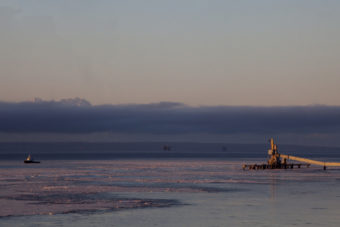
Cook Inlet oil platforms are visible from shore near Kenai, Alaska. (Rashah McChesney/Alaska’s Energy Desk)

Oil prices plummeted last spring as the country ground to a halt and demand for oil tanked.

Larger oil and gas companies can typically keep business afloat during hiccups like those. But for smaller companies, COVID-related burdens and high fixed costs were harder to bear. That’s why Glacier Oil and Gas officials said the company suspended operations in Cook Inlet in the spring of 2020.

Now that prices have largely bounced back, the independent producer is bringing its wells online again. Chief Operating Officer David Pascal said the company was waiting for oil prices to rebound, even though it meant they weren’t making money from the inlet.

Glacier, a subsidiary of Cook Inlet Energy, owns two fields on the west side of the inlet.

Larry Persily, who has worked in and reported on Alaska’s oil and gas industry, said it makes sense that smaller producers would suspend operations when they can’t make as much money. At the worst point in the collapse last year, North Slope producers cut back their output by 20%

“There’s no point producing a finite resource that you’ve paid a lot of money to lease if you’re not going to make any money or make pennies,” he said. “So if you can afford it, you just wait until prices come back up.”

This fall, when Glacier brought its facilities back online, Alaska oil prices were climbing amid global supply shortages.

Prices tumbled again this month, likely due to the emergence of the omicron variant of the coronavirus. Pascal said the company is watching the situation.

Persily said current prices are still profitable when compared to how low they were last year.

“As I’m looking yesterday, Alaska North Slope Crude was at $76 a barrel,” Persily said. “That is still very good.”

He said prices in Cook Inlet typically track with the North Slope. When Glacier Oil and Gas suspended operations last spring, North Slope crude was averaging less than $30 a barrel.

Glacier employs about 40 full-time contractors and employees in Cook Inlet. It also owns assets on the North Slope.

Pascal said the company produced close to 1,300 barrels of oil from both Cook Inlet fields last month. He said they’ve bumped up production in December.

Fired commissioner Hollis French gets hearing on 2017 Cook Inlet pipeline leak

Former State Sen. Hollis French addresses the Alaska Senate on April 7, 2014 during debate on House Bill 266, the state’s operating budget that would begin on July 1. (Skip Gray/Gavel Alaska)

It’s been nearly five years since a Hilcorp pipeline off the coast of Nikiski began leaking fuel gas into Cook Inlet, a problem that lasted for months.

State regulators will now revisit the circumstances of that leak at a hearing next week. The Alaska Oil and Gas Conservation Commission will hear a complaint from a former commissioner after he successfully sued the agency for not taking action several years ago.

The former commissioner is Hollis French, who’s also served as a Democratic state senator from Anchorage. At the time of the leak, he served on the conservation commission, which is charged with preventing waste in the oil industry and protecting the environment.

French said he doesn’t think commissioners will change their minds or that fine Hilcorp as a result of the hearing. But he does think setting precedent is important.

“The agency’s position on this has been extremely shortsighted,” he said. “And I’m hoping, through this presentation, to at least let the public know why I feel so strongly about this. And maybe the agency will learn something in this process.”

The pipeline in question is eight inches wide and carries gas from Nikiski to a platform in the inlet that uses it as fuel.

An aerial photo of gas bubbling up in icy water
Cook Inletkeeper filmed the gas leak from a helicopter in February 2017. At the time, Inletkeeper threatened to sue the oil and gas company. (Courtesy of Cook Inletkeeper)

The line sprung a leak late in December, 2016. The leak continued for three months until Hilcorp, which had cited danger from ice, repaired it.

Commissioners said it was up to federal regulators, not state ones, to look into the leak. Since the gas had already left the place it was produced, they said, it belonged to Hilcorp and was no longer up to them to regulate.

But French disagreed, saying that the state commission had a responsibility to investigate. After Gov. Mike Dunleavy fired French from the agency in 2019, he petitioned the commission to take a deeper look.

When the commission said no, he sued. The Supreme Court of Alaska sided with him earlier this year.

French said the commission should hold a hearing on the leak because it constitutes waste — which is the commission’s job to prevent.

“Any leak means that the gas that’s leaked is never going to be used to make electricity or heat our houses,” he said. “When gas is shooting up in the air, any person walking down the street would look at that gas and go, ‘That gas is being wasted!’”

In its decision, the Alaska Supreme Court said the commission needs to show evidence that the leak didn’t constitute waste if it’s arguing it has no jurisdiction.

Grace Salazar with the Alaska Oil and Gas Conservation Commission said it has not yet heard from Hilcorp on whether it plans to attend the hearing next week. A Hilcorp spokesperson did not respond to requests for comment.

The hearing is virtual and open to the public. It starts at 10 a.m. next Wednesday.

Salazar said the commission cannot comment on whether it still stands by its original decision.

The ruptured Hilcorp line released an estimated 210,000 to 310,000 cubic feet of gas daily, enough to power more than 1,000 homes.

The line was first installed in 1965 and carried fuel gas made up mostly of methane. Investigators say that a rock on the ocean floor caused the 2017 leak.

But the line has a history of leaks dating back to 2014. Its most recent reported leak was last spring. Following that leak, the feds ordered Hilcorp to replace the line.

Second hunter found dead days after boat capsized near Whittier

The port of Whittier. (Sabine Poux/KDLL)

Update — Sunday, Dec. 5:

Alaska State Troopers said they located the body of Luki Akelkok, ending a multi-day search for the 28-year-old Dillingham man that was hindered by bad weather.

Aklelkok’s family and the boat’s owner were in Whittier Saturday to retrieve the vessel that capsized Wednesday, leaving 28-year-old Anchorage man Stefan Weingarth dead and Akelkok missing. The two men had been returning to Whittier from a hunt on Esther Island.

Around noon, they found the boat about nine miles northeast of Whittier, an updated trooper statement said. Thirty minutes later and about 200 yards from the vessel, they found Akelkok’s remains in two feet of water.

Akelkok was not wearing a personal flotation device when he was found, according to the statement. Troopers said his body had drifted about five miles before coming to rest.

His body was transported to the State Medical Examiner Office in Anchorage.

Original story — Saturday, Dec. 4:

A Dillingham man is still missing after his boat sank off the coast of Whittier on Wednesday, leaving his passenger dead.

Twenty-eight-year-old Luki Akelkok, of Dillingham, has been listed as a missing person, according to Tim DeSpain with the state’s Department of Public Safety. He said the U.S. Coast Guard suspended their search and rescue efforts Thursday at 10 p.m. amid difficult weather conditions, but they’ll continue their search when weather improves.

Akelkok has been missing since Wednesday. Troopers said he and 28-year old Stefan Weingarth, of Anchorage, were on their way back to Whittier after a deer hunt on Esther Island when they came across bad weather.

Troopers said the men were part of a group of four hunters returning on two boats Wednesday afternoon. One of the boats arrived in Whittier around 3:30 Wednesday.

Almost two-and-a-half hours later, Weingarth — the passenger in the 20-foot aluminum Lund skiff — called the other boat to report that their bow was underwater and he and Akelkok were sinking. The boat had four deer and two seals on board, according to troopers.

The trooper statement said witnesses reported “seas of 6 feet with whitecaps on top of the waves, winds blowing 40 knots, and dark skies.”

Coast Guard from Juneau and Anchorage were contacted and coordinated response with vessels from Valdez.

But their response was delayed due to bad weather. Around 10 that night, the Coast Guard found Weingarth dead in a life jacket about five miles northeast of Whittier. The Coast Guard also found the missing vessel.

DeSpain said the search for Akelkok have been hindered by windy conditions and heavy freezing spray. But he said searching will continue as weather improves.

DeSpain did not have an update on the search Saturday morning.

Olympian Lydia Jacoby partners with swimwear company following NCAA rule change

Lydia Jacoby of Seward, who won gold at the Tokyo Olympics, is swimming at the University of Texas at Austin next year. Her deal with swimwear company Arena wouldn’t have been possible a few months ago because of a previous NCAA rule that prohibited college athletes from making money off of their image. (Valerie Kern/Alaska Public Media)

Seward swimmer Lydia Jacoby just signed with swimwear company Arena — the high school senior’s first deal with a brand since winning gold at the Tokyo Olympics this summer.

But it wouldn’t have been possible even a few months ago. The partnership takes advantage of a new set of rules from the National Collegiate Athletic Association, the body that governs student athletics.

Before June, student-athletes had to choose: play college sports or go pro and sign with companies. It’s a choice Olympic champions like Missy Franklin and Katie Ledecky had to make when they were entering college, due to a “name, image and likeness rule” that prohibited college athletes from profiting off their popularity.

That was until this summer when the NCAA lifted that rule.

“The rules are still very cloudy,” said Steve Ozmai, director of marketing for Aena. “And what complicates things a little bit is the fact that the rules for the individual athlete are different state to state and university to university.”

Jacoby is swimming at the University of Texas at Austin next year. Before signing with her, Arena worked with the university to talk through the terms of the contract.

This fall, representatives from Arena came to Seward to meet the Jacobys. Jacoby’s mom Leslie said the brand felt like a good fit.

“Lydia’s always been surrounded by people that support her and she has a really great team of supporters between her coach and her family and her friends and community,” Leslie Jacoby said. “And I get a really good feeling from the Arena group.”

The feeling is mutual. Jacoby is the first student-athlete Arena signed.


View this post on Instagram

A post shared by Lydia Jacoby (@lydiaalicee_)

“We were just so inspired by what we saw from her in the pool in Tokyo,” Ozmai said. “It still gives you goosebumps if you watch the watch party in Seward and all of her fans. And when we were up there and came to visit, we saw the banners on the side of the buildings saying, ‘Go Lydia’ and the stickers on the backs of the cars.”

Jacoby is not the only Olympian who’s heading to college under the new rules. And athletes with large social media followings, like football players from Big Ten schools, might have the most to gain.

Travis Thornberry with the University of Alaska Anchorage athletic department said there’s at least one athlete taking advantage of the new rules at UAA — cross-country skier JC Schoonmaker.

Generally, Thornberry said most deals will probably be reserved for Division 1 athletes. He said UAA will handle deals with companies on an individual basis.

Ozmai said the new rules are a game-changer for both companies and athletes. Under the old guard, even if Jacoby was wearing a swimsuit from Arena, the brand couldn’t promote it. Now, it can.

“Any promotional advertisement materials, whether it’s social media, TV commercials, full-page advertisements, things like that were off-limits in the past,” Ozmai said. “And now, this has opened up the opportunity to do that.”

Leslie Jacoby said life has been a whirlwind since the Olympics when Jacoby swam her way into the hearts of spectators all over the world. When the Jacobys returned to Seward in August, they hired an agent. In September, Jacoby joined the U.S. National Team. Just a few months later, she joined her peers in the pool for the state meet in Anchorage.

“We have been learning step by step since Lydia’s success at the Olympics,” Leslie Jacoby said. “We just haven’t anticipated each step. We just didn’t see any of this coming. It’s been a really positive but really busy and wild ride since.”

The Seward Tsunami Swim Club, Jacoby’s home team, is also feeling the hype.

Leslie Jacoby said the club has 82 swimmers signed up this year. She said it’s the most they’ve ever had.

Site notifications
Update notification options
Subscribe to notifications