KDLL is our partner station in Kenai. KTOO collaborates with partners across the state to cover important news and to share stories with our audiences.
Indy Walton was appointed to the Board of Fish last fall. (Courtesy of Indy Walton)
Indy Walton of Soldotna has resigned from his seat on the state Board of Fisheries, the seven-member board that makes decisions about fish allocation and management in Alaska’s waters.
Walton said he’s dealing with a confluence of health issues that have been exacerbated by stress and a bout of COVID-19. While he thought he could balance those issues when he accepted Gov. Mike Dunleavy’s nomination in September, he said he has since had to reconsider.
“I hoped when I accepted the position that things would be different and change as far as my schedule, and I didn’t realize some of the health issues that I was being faced with until doing some tests,” he said. “And I know now I’ve got to alleviate some of the stress and lighten my load a little bit.”
He said his workload is another factor. Walton is a financial adviser with the Soldotna branch of Edward Jones.
Walton’s resignation caps a four-month tenure on the board, the Cordova Times first reported. Dunleavy appointed Walton to the seventh open seat on the board last fall, after his previous nominee was rejected by the Alaska Legislature.
Walton lives in Soldotna and has roots in both the commercial and sport fishing sectors. He owns a sport fishing lodge in Igiugig and commercial fishes in Bristol Bay. He’s also an outspoken critic of the controversial Pebble Mine project.
In his time on the board, Walton attended one work session in Anchorage.

He said he’s frustrated he has to take a step back from the board now. And he might consider pursuing the position again if his situation changes down the road.
In the meantime, he hopes whoever takes his place can bring experience from multiple sectors.
“I would love to see somebody who has an open mind that can try to bring both sides of the commercial and sport sides of fishing together to work out some of the impasses that are currently at bay,” he said.
Board of Fisheries Executive Director Glenn Haight said Dunleavy has 30 days to make a new appointment to the board. His office is now accepting applications for the three-year position.
Separately, the board’s next meeting, scheduled for January in Ketchikan, has been postponed due to high COVID-19 case counts in Southeast Alaska.
An empty hallway at a Kenai Peninsula Borough School (Sabine Poux/KDLL)
Student enrollment is still down in public school districts across the country. An NPR investigation found schools in New York and Chicago were among the many that saw enrollment drop off last year and then again this fall.
That’s not the case for the Kenai Peninsula Borough School District. While the district did see a large drop in enrollment in 2020 that still hasn’t entirely rebounded, many students have since come back.
This time last year, there were almost 1,700 fewer kids in the district’s brick and mortar schools, as parents opted for private school or the district’s own homeschool option, Connections Homeschool. Connections saw an increase of nearly 1,000 students between October 2019 and 2020.
Fast forward to 2021. Enrollment in brick and mortar schools is up over 1,000 students from last year while enrollment at Connections is down by approximately 570, according to a count taken this fall. Overall, the district has gained nearly 550 students this fiscal year, bringing the total student count to approximately 8,300.
It’s more students than the district was expecting — particularly in brick and mortar schools, which get the district 10% more funding than those in Connections. The district had to amend its budget plan for the 2022 fiscal year to take that bump into account.
Another impact of higher enrollment — staffing. The number of teachers the district has at any given school depends on how many students are enrolled there.
But the growth doesn’t interrupt a larger trend of enrollment decline that the district has been seeing for several years. District spokesperson Pegge Erkeneff says the decline has partly to do with shifting demographics and that it’s been happening since well before the pandemic. Between the 2011 and 2020 fiscal years, enrollment dropped by about 5%.
That local trend again is in contrast with a national one. Public school enrollment has been growing slowly across the U.S. for a decade, according to NPR.
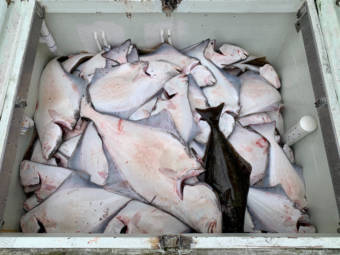
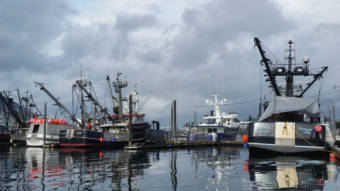
Bering Sea trawlers tend to scoop up juvenile halibut in their nets. Commercial and subsistence fishermen in Western Alaska say that doesn’t leave enough halibut for them to catch in years when abundance is low. (Angela Denning/KFSK)
The council that manages fishing in federal waters voted last week to link groundfish trawl fishing in the Bering Sea and Aleutian Islands to halibut abundance. The action caps — at least for now — a six-year debate about curbing halibut bycatch in Alaska.
For many who have been following that debate, the decision comes as a surprise because it’s expected to deal what trawlers say is a crushing blow to their fishery.
But members of the North Pacific Fishery Management Council said it was also important for them to consider how high levels of bycatch hurt small-boat halibut fishermen in Western Alaska — even if they didn’t go quite as far as advocates from those communities had hoped.
The action that ultimately passed Monday came from Rachel Baker, the deputy Fish and Game commissioner who represents Gov. Mike Dunleavy’s administration on the council. She said it will incentivize the trawl industry to reduce the halibut they incidentally catch in their nets.
When halibut stocks are low, the cap on prohibited species catch, or PSC, will also drop.
“Mr. Chair, this council clearly would rather not impose additional costs that could result in reduced groundfish harvest and revenues, if we had other management options,” Baker said. “But again, halibut is fully used in the Bering Sea and Aleutian Islands, and at the low and very low index state, mortality from PSC should decline in response to reduced amounts of halibut available for all users.”
The new limits apply to a group of fishermen and processers called the Amendment 80 fleet, which catch and process groundfish in the Bering Sea.
Halibut is a prohibited species for the fleet and must be discarded. That trawl sector catches the largest amount of halibut bycatch in the region — an estimated 2.8 million pounds each year. Other Bering Sea fishermen say that reduces their opportunities to catch halibut, particularly as spawning halibut stocks decline there.
As it is now, the bycatch cap in place for the fleet is fixed and is not adjusted to halibut abundance. So when halibut abundance is low, bycatch is a larger slice of the overall pie. The last time the cap was changed was five years ago.
The council voted to make that cap dependent on the abundance of halibut in the area. Under the new guidelines, when halibut abundance is high, the fleet could catch the same amount of bycatch it is limited to now. But when halibut abundance is very low, that cap would drop by 35%.
Chris Woodley is executive director of the Groundfish Forum, the fishery association that represents those trawlers, said the fleet has been working to lower its halibut bycatch already and called Monday’s decision “devastating.”
“Because we’re being told to do better without more tools,” he said. “And that’s going to harm crew members, it’s going to reduce our revenues …. and harm our crewmembers’ families.”
He said without new tools to curb halibut bycatch, the fleet will have to stop fishing earlier in the season to meet those lower caps. Woodley said the 2,200 crew members the fleet employs — many from out of state — will bear much of the impact as the fleet’s fishing opportunities change. Analysis suggests the action will result in tens of millions in losses for the fishery.
Anne Vanderhoeven, a member of the council who works with Arctic Storm Management Group in Seattle, found that concerning.
“I find cuts at the levels in the motion to be punitive — cuts to the Amendment 80 fleet — to reallocate halibut from one user group to another with no real conservation benefit,” Vanderhoeven said. “And cuts at these levels could put some Amendment 80 companies out of business and I don’t think that’s the right thing to be doing here.”
But council members said they’re also taking into account the social and cultural impacts of bycatch.
The halibut fishery in St. Paul, a small island community in the Bering Sea, originated in the 1980s as the commercial seal harvest there was phased out. Today, it’s the primary source of income for the 355 residents there, according to a packet submitted to the council by the Central Bering Sea Fishermen’s Association ahead of the decision.
Lauren Divine, with the Aleut Community of St. Paul Island, said that value is immeasurable — and not purely economic.
“What is the value of the health of the halibut population?” she said. “The Bering Sea ecosystem? The connected, large marine ecosystems of Alaska that are vital to our people, family, communities, business cultures and the nation?”
Divine and other tribal leaders had been pushing for another option this week, Alternative 4, which would have taken an even bigger swing at reducing bycatch. They said that would have also opened up more fishing opportunities for small-boat fishermen like those in St. Paul.
That alternative was also backed by a bipartisan coalition of Alaska legislators and fishermen’s associations across the state, who provided hours of testimony to the council last week.
Marissa Wilson is a member of the council’s advisory panel and a fisherman based in Homer. She said the council’s impact analysis did not take into account the impacts of bycatch on communities around Alaska.
“There are values involved in this decision that are not adequately captured,” she said. ” And there are grave, intergenerational consequences of choosing any alternative besides four.”
The council said it can’t guarantee reducing bycatch will help out halibut fishermen.
It’s actually a different council that manages halibut stocks — the International Pacific Halibut Commission. Commission scientist Allan Hicks told council members changing the cap will have little impact on halibut spawning biomass in the region.
But it will likely change the amount of halibut commercial and subsistence fishermen are able to catch. Council Member Andy Mezirow, a charter operator in Seward, said it’s important to share the burden of halibut conservation between sectors.
“The Amendment 80 fleet may in fact have to face doing more with less,” he said. “But we are moving this action one step closer to having all fishermen share in this burden.”
Mezirow voted yes on Monday’s motion, as did the other representatives to the council from Alaska. The motion passed the council 8-3.
Jeff Kauffman is celebrating that decision. He’s the vice president of the Central Bering Sea Fishermen’s Association and a commercial halibut fisherman.
He said while the measure doesn’t go as far as he would’ve liked, it’s an exciting step in the right direction.
“This is a big day for St. Paul and the Indigenous small-boat fishermen that live there,” he said. “Because the halibut fishery is so important for St. Paul, we spent six years and tremendous resources and efforts to get to this better place.”
This week’s decision marks the first time the federal council has linked halibut bycatch to abundance, Mezirow said. The council will likely take up more bycatch issues next year.
NOAA Fisheries will have to review the final action before it goes into effect.
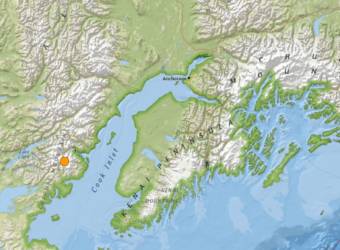
A map showing the location of an earthquake in Southcentral Alaska on Dec. 21, 2021. (Screenshot from USGS)
A 5.9-magnitude earthquake centered in Lake Clark National Park shook the Kenai Peninsula and Southcentral Alaska Tuesday at about 1:40 p.m.
The epicenter of the quake was about 7 miles northwest of Mount Iliamna, across Cook Inlet from Ninilchik. That’s according to the U.S. Geological Survey.
Alex Farrell, a scientific developer with the Alaska Earthquake Center in Fairbanks, said this quake is “moderate” by the center’s standards.
“This is not the largest earthquake of the year but it is definitely significant,” said Farrell.
Farrell said there are no reports of damage so far. She said that’s likely because the earthquake was 95 miles deep and far from a population center. In contrast, the 2018 Anchorage earthquake was less than 30 miles deep.
Many of the messages sent to the USGS “Did You Feel It?” map come from the western Kenai Peninsula and Anchorage and report “light” shaking.” Farrell says the strongest reports came up from the Homer area. As of Tuesday afternoon, there were reports as far north as Fairbanks and as far south as Kodiak.
Ashlyn O’Hara was working at her office in Kenai when the earthquake hit.
“I was sitting at my desk and could feel the rumbling in my chair,” she said. “And we have string lights hanging up in our office so I looked around my computer and those were swinging back and forth.”
O’Hara’s from Southern California and has done her fair share of earthquake drills. She dropped and covered under her desk.
“I’ve felt earthquakes before, but in terms of one that stick out in terms of being really strong, I think this is probably the second one where I could feel it and notice it,” she said.
She said the quake lasted long enough for her to take out her phone and start recording while she was under her desk.
Farrell said a tsunami is not expected. But there is a possibility for aftershocks.
“Usually an earthquake of this size is going to have some aftershocks,” she said. “You’ll tend to have more aftershocks closer in time, and then as you get further away in time from when the earthquake occurred, you’ll get fewer and fewer aftershocks.”
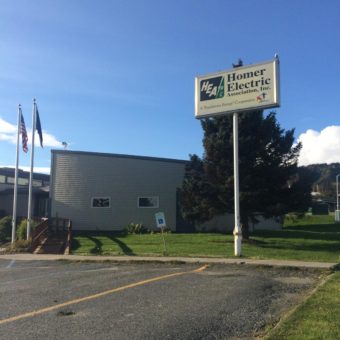
Homer Electric Association’s office in Homer, Alaska. (Daysha Eaton/KBBI)
Homer Electric Association is suing a Sterling man for stealing what it said is more than $325,500 in power over seven years — the co-op’s biggest reported instance of electricity theft to date.
The lawsuit, filed last week in Homer District Court, alleges Sterling resident Max Finch used a wiretap for years to avoid paying for energy for his business, Alaska Canoe and Campground. Finch said he didn’t know about the wiretap or the stolen electricity and that it was the doings of a previous property manager.
It’s the second time HEA says it’s discovered the Sterling Highway campground and RV park stealing power.
“We’re generally not comfortable with anyone diverting energy because what they’re really doing — they’re not just taking from HEA, they’re taking from all of our members,” said Keriann Baker, HEA’s director of member relations. “Because those costs are being passed onto all of us as a collective, as a cooperative.”
Baker said linemen discovered the tap this fall when they went to investigate why a meter display had failed — something that in itself is routine.
But while they were at the property, they found evidence of tampering and later discovered what looked like a man-made hole in the ground by an electric transformer pole. Underground, they found two wires that were clamped onto a service line, according to the complaint.
When the linemen asked him about the wires, Finch told them an electrician he hired had put them there.
Linemen tried to investigate further a week later. But they couldn’t, the suit said, because Finch’s truck was right over the spot where they found the tampering. Finch, for his part, said it wasn’t his truck and he was out of the country at the time.
When the linemen returned, the truck had been moved. When they investigated, they found a service line had been tapped to divert electric current from the meter to another location on the property. They immediately removed the tampered wires and de-energized the meter, according to the lawsuit.
Homer Electric said Finch started diverting electricity in November 2014, bringing the total power taken from the co-op without payment to at least $325,543. The co-op estimates an additional $9,992 in damages to property.
Finch said the rewiring was put in by a previous manager of the property, who lived in Sterling and died in 2014. Finch said he managed the property and paid the bills while Finch was working away from home. He said the other manager probably tampered with the wires to save money.
“Any of the costs that were incurred from the business he had to pay for,” Finch said. “And of course, the electrical was the biggest bill.”
But said he didn’t know about the diversion. And he said he genuinely did not know he was not paying what he was supposed to be paying to HEA, since there were so many bills for the property and variability in visitors staying there.
He said he wasn’t capable of doing that digging. And he said proof of that is he needed HEA’s help to fix an electrical issue.
“It was something that was bigger than me. I wasn’t capable of doing that kind of project,” he said. “I just left it to HEA to figure out, or I would’ve tried to cover my tracks somehow. But I didn’t do that.”
The suit said the truck parked over the site and the prior instance of tampering show that Finch is guilty.
In 2013, Homer Electric caught Alaska Canoe and Campground tampering with two meters, which led to three exploded transformers and resulted in damages of almost $38,751. Finch owed an additional $6,025 in lost energy payments.
He repaid both those costs and was reconnected later that year. He said the other manager was responsible for that tampering, too, but that he paid up because he was the property’s owner.
Baker said it’s disappointing that Finch would tamper with the wires a second time after the co-op let him off on good standing in 2013. While the first instance was above ground, the second was harder to detect below ground.
“Our position is, you don’t just get wired tampered with six feet underground out of sight of anyone by accident,” Baker said.
She said linemen are also concerned because someone could have gotten hurt from the tampered lines.
Homer Electric said it’s entitled to both the value of the damages and three times the value of the electricity that was stolen — close to $1 million, total.
Finch also has a Homer Electric meter at his house. But Baker said there’s no evidence at this time that he’s tampering with that one, as well.
A tendering vessel brings kelp back to Kodiak for processing. Kelp farming is taking off in Kodiak and making waves on the Kenai Peninsula, too, where there are several permitted kelp farmers on Kachemak Bay. (Photo courtesy of Chris Sannito)
Alaska’s economic development districts are in the running to win $50 million in federal money to grow the state’s seaweed and shellfish farming industry, known collectively as mariculture.
The U.S. Economic Development Administration announced this week that the proposed mariculture project is among 60 finalists for a Build Back Better Regional Challenge grant. Advocates say the money could help with the state’s goal of building a $100 million industry by 2040.
More kelp and oyster farms have been popping up along Alaska’s shorelines in recent years. The National Oceanic and Atmospheric Administration valued Alaska’s mariculture industry at $1.4 million in 2019.
But the industry still has a long way to go.
“Where we stand right now is, for the most part, we’re more of a cottage industry than a full-blown industry,” said Tim Dillon, who directs the Kenai Peninsula Economic Development District.
He said a lot of the mariculture action in Alaska is playing out in Southeast.
In Southcentral, it’s mostly concentrated on the far side of Kachemak Bay. Dillon said he sees potential for producers hailing from other parts of the Kenai Peninsula — and Alaska — as well.
“It depends on who wants to play,” he said. “And we want to make sure we’re there to help. And one of the big issues and things we’re working on is to find out, how much money do you think you need to go from A to C? And whether that investment is worth it or not.”
Every finalist for the Build Back Better grant — including the Alaska mariculture cluster — gets $500,000. Dillon said they’ll use that money to further flesh out their goals for the project.
The final grant proposal is due in March. The 20 to 30 finalists who pass through that second phase can get up to $100 million to support industries in their regions.
The grant money comes from the federal American Rescue Plan Act – the COVID-19 relief stimulus package passed by the feds earlier this year. The Alaska project clocks in at around $50 million.
The Kenai Peninsula district’s counterpart in Southeast Alaska, Southeast Conference, is the project’s lead.
Executive director Robert Venables said a big hurdle facing producers now is the small size of the industry, particularly when it comes to marketing and selling a final product.
“It’s kind of an awkward stage of things right now where there’s a lot of small businesses scattered around coastal Alaska and they don’t have economies of scale to really take that big leap forward,” he said. “And so this will help them with supply and infrastructure in order to step up, throw in the workforce component and develop the markets and, all of a sudden, you add an element to our economy that simply does not exist today.”
One area for growth outlined in the project proposal is workforce development. Dillon says mariculture jobs could help balance the decline of other industries in Alaska’s coastal communities, like commercial fishing.
Bringing more of the industry into the public eye is also a priority. Dillon said he’s still learning himself, from experts at the Alutiiq Pride Marine Institute in Seward and other scientists around the state.
“I didn’t know what a FLUPSY was a year ago,” he said. “That’s the equipment they use for oysters for going from seed to spat to eventually oysters.”
The mariculture program was one of nearly 530 applicants to the Build Back Better program.
Another Alaska project is a finalist for the grant, too. That project, proposed by nonprofit Spruce Root, would support more sustainable forest development in Southeast as an alternative to the region’s logging economy.
Close
Update notification options
Subscribe to notifications
Subscribe
Get notifications about news related to the topics you care about. You can unsubscribe anytime.