KDLL is our partner station in Kenai. KTOO collaborates with partners across the state to cover important news and to share stories with our audiences.
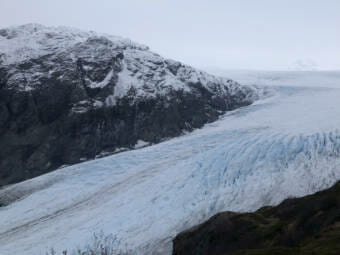
Exit Glacier has retreated so much that the management plan made in 2004 no longer makes sense for that part of the park. (Photo by Sabine Poux/KDLL)
Exit Glacier has receded more than 2,300 feet since 2004.
That year was the last time Kenai Fjords National Park created a management plan for that part of the park. In it, park officials said a big draw of the glacier was that visitors could walk right up and touch it.
That’s not possible anymore. Exit Glacier has been receding so quickly that parts of the park that were once prime glacier viewing aren’t anymore.
To account for those changes, Kenai Fjords National Park is updating its management plan for the area. And it’s asking for input from the public on what it would like to see from a new park plan.
Exit Glacier, just west of Seward, is the most accessible part of the 1,000-square-mile Kenai Fjords National Park. But the glacier has been receding so quickly that the National Park Service now says it’s no longer feasible to add new trails to account for the shift, as it’s done in the past.
The park says it’s considering new visitor facilities and modified rules for where visitors can walk, which would move as the glacier recedes. It says a new management plan would be in place for the next 10 to 20 years.
Kenai Fjords is not the only national park that’s had to adjust its management style to account for climate change. Last year, the park service published a guide for parks to consider those forces and manage accordingly.
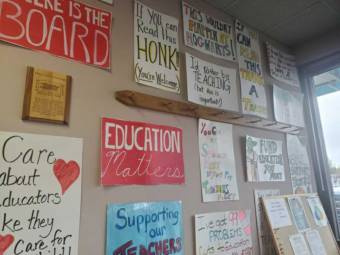
Strike signs hang in the Kenai Peninsula Education Association teachers union office as a reminder of the 2019 negotiation process. (Photo courtesy Nathan Erfurth)
Alaska’s schools have long struggled to attract and retain teachers and support staff. That was the case even before COVID-19 hit and upended education worldwide.
The pandemic has only made things more challenging, say education officials, as the strains from burnout and absenteeism pile stress on a system that was already buckling under the pressure.
The Kenai Peninsula Borough School District is among the many districts in Alaska having trouble filling open jobs and keeping current staff.
For the head of the local teachers union, teacher retention is the number one priority.
“As far as this particular issue is concerned, this has always been an elephant in the room,” said Nathan Erfurth, president of the Kenai Peninsula Education Association. “But the lights were off. We were not looking around in the corners of the room. COVID flipped on the fluorescents and we can see everything right now.”
Burnout is one factor contributing to a nationwide teacher exodus. Erfurth said about 18 teachers are planning on leaving the Kenai school district this year, and he’s expecting a big spike in the spring when contracts come out. In general, he said, he’s heard a lot more discussion this year from teachers who are thinking about resigning as they contend with the ongoing stress of the pandemic and national battles about school curriculum.
At the same time, it’s becoming harder for teachers to support themselves. The pandemic has put more strain on already sparse daycare services and affordable housing. Erfurth said there’s at least one new administrator in Seward who hasn’t been able to find housing for his family since he moved to the district in the fall.
“At the beginning of the year, I was talking to one of our local landlords and he was telling me that he had zero available units,” said Erfurth. “And we were trying to hire, at that time, 25 different teaching positions across the school district.”
At a recent school board meeting, Kenai Superintendent Clayton Holland said he’s working with administrators in Seward to find more housing for teachers and their families.
The problem is hardly unique to the Kenai Peninsula.
Gov. Mike Dunleavy convened a task force in 2020 to find out why schools were having trouble recruiting and retaining employees.
The state is part of the problem, said Tom Klaameyer, president of Alaska’s branch of the National Education Association teachers union. He said low funding from the state has impacted teachers everywhere, who now have to do more with less.
“We used to be sort of the model in the country for teacher recruitment and retention and compensation,” he said. “And we’ve lost a lot of ground there with flat funding, for the last decade, approximately.”
Retirement benefits for teachers in Alaska have also gotten worse, he said. Over 15 years ago, the state gutted its pension system. Without good retirement, there’s an “educational tourists” problem, he said. Teachers stay in their districts for four to five years and then leave. Research shows that higher turnover is associated with lower outcomes for students and higher costs for districts.
There is a bill working its way through the Alaska Legislature now that would improve retirement benefits for public sector employees, including teachers.
The problems hit even harder in more remote areas. Klaameyer said the rate of turnover for Alaska’s rural districts is above the statewide average
“And in Alaska, just like in all other career fields, it’s a special person that wants to come to Alaska and live here, especially the further you get from the road system,” he said. “That’s always been a challenge, and it’s an even greater one now.”
School districts are also struggling to hire support staff — the critical behind-the-scenes positions that keep schools running.
There are almost 25 open support staff positions in the Kenai district. The district has had to up its recruitment game in the last year, raising pay for nurses and changing hiring requirements for substitute teachers to make employment more attractive.
Susanna Litwiniak, who represents support staff with the Kenai Peninsula Educational Support Association, said the unfilled jobs become unbearable when COVID-19 exposures are also keeping staff out of school.
“What it looks like is the custodian greeting the kids in the morning and making sure that they’re keeping a 6-foot distance because there aren’t enough teachers to do that. And then the custodian helping in the lunch room because the lunch room is short staffed,” she said.
Retaining school staff is just part of the equation. National studies say the pandemic is turning many teachers-to-be away from the profession in the first place.
Erfurth said he understands why.
“Because they’re seeing what we’re going through. and it’s not attractive,” he said.
Despite the challenges, he said people stick around because they love what they do. It’s just important to them that their schools love them back.
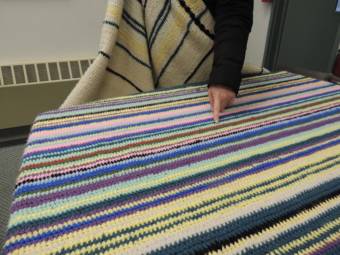
Rebecca Bezdecny points to a line of red yarn in her blanket, symbolizing a day of 90-100 new COVID-19 cases on the central Kenai Peninsula. (Photo by Sabine Poux/KDLL)
When the pandemic grounded people at home, many new crafters picked up painting, sewing or bread-baking for the first time. For those already making crafts, the extra days at home were chances to get even craftier.
For Rebecca Bezdecny, the pandemic wasn’t just an excuse to craft, it was also a muse. The Kenai resident crocheted what she’s calling her COVID blanket — a striking visual picture of one pandemic year on the central Kenai Peninsula.
“It gave me a way to kind of bring order to an unorganized thing that was going on outside of my control,” she said. “It’s almost literally like a safety blanket.”
Bezdecny’s blanket is modeled after what’s called a temperature blanket in the fiber arts world. Each row on a temperature blanket represents one day, using a different color of yarn to show how hot or cold it was on a given day.
Each row on Bezdecny‘s blanket represents a day of COVID-19. And each color is a different range in case numbers.
A row of white means the central peninsula had between zero and five new cases that day. There’s a lot of white on the blanket at the beginning, representing July 2020.
“It starts off really mild,” Bezdecny said.
But as summer 2020 faded into fall, Alaska saw its first COVID spike. That’s where the blanket becomes really colorful. Pink stripes are days with 51 to 60 reported cases and light blue stripes are days with 61 to 70 reported cases. Noticeably missing is any white.
There is one ominous strip of red, representing 91 to 100 cases.
“It’s stuck in my mind,” she said. “Ninety-two cases that day. Now I look back and go, ‘Yeah, that wouldn’t be a bad day today.’ But back then, about a year ago, that was a really bad day.”
Bezdecny stopped before the omicron era. Her last row represents June 30, 2021.
The finished blanket is nearly 11.5 feet long by 5 feet wide and weighs 10 pounds. It represents more than a year of crocheting in front of the TV, watching cases spike and fall like a roller coaster.

That deeper meaning, hidden behind cheerful pastels and a black scalloped border, is eerie. But Bezdecny wonders what the blanket would look like to someone who doesn’t know the story. At first glance, there seems to be little rhyme or reason why there’s one row of dark blue here and two rows of pink and yellow there.
“I try to imagine, if I hand this down to my grandkids, are they going to understand what this means? Are they going to know that Grandma did this in the middle of the pandemic?” she said.
There’s also an ode to Bezdecny’s own COVID-19 experience. A red pin near the piece’s chronological end represents the point in the process when COVID-19 came into her home for the first time.
The pandemic, of course, is not over. And if Bezdecny was still crocheting, she might have to create a whole new color category to account for the high case numbers reported some days on the central peninsula.
But she has hung up her crochet hook for now. That also means relief from meticulously monitoring the state’s case counts.
“There were some days where you add ’em up, you had to add up the four towns I was keeping track of, your stomach just sinks,” she said. “You’re like, ‘Oh, gosh.’ Even now, it’s a hard habit to break. You get those texts from the state with the every-other-day case counts, it’s like, ‘Oh, OK. I don’t need to keep track of this anymore.’”
Finally, she can enjoy the blanket for what it is, using it to keep warm during her third pandemic winter.
Kenai Rep. Gillham at a town hall in Soldotna last April. (Photo by Sabine Poux/KDLL)
Rep. Ron Gillham, R-Kenai, is back in Juneau after he was hospitalized for a heart attack last week. The Soldotna Republican said today he was released from Providence Alaska Medical Center Saturday and is ready to get back to work.
As first reported by KSRM, the heart attack kept him Gillham from the Alaska State Capitol for several days as he was treated in Juneau and Anchorage.
Gillham said his symptoms began after he and his wife got dinner with friends in Juneau. When he got in bed around 10 p.m. Wednesday, he felt a pain in his chest. He first thought it was indigestion.
But it continued late into the night. Then he started sweating profusely.
“And all of a sudden, it is like somebody dumped a bucket of water on me,” he said.
His wife suggested they go to the hospital around 1 a.m. and he checked into the emergency room at Bartlett Regional Hospital. He said a doctor found a vessel was clogged at the bottom of his heart.
“They scheduled a medevac to Providence,” Gillham said. “And due to the weather, they couldn’t get me out. So I was in the Bartlett ER for about four hours.”
In the meantime, he was given medication to unclog the vessel, which he said worked as it was supposed to. When Gillham finally did get to Anchorage Thursday morning, doctors put a stent in his heart to help keep the vessel open.
Gillham said he was released with no restrictions Saturday and flew back to Juneau this week. He said he’s grateful for the doctors at Bartlett and Providence for taking good care of him. And he said he’s ready to move forward.
“I’ve never taken medication any stronger than an Ibuprofen,” Gillham said. “I just don’t like it. But from now on, for the rest of my life, I’ll have to take a couple different medications.”
He said his doctor told him genetic factors were at play in his case. He said anyone with a history of heart issues in their family should get checked out by their doctor.
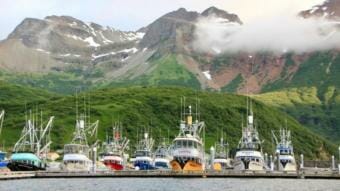
Fishing boats wait for an opener in Chignik’s city harbor in 2019. The 2020 Chignik salmon fishery was one of 14 Alaska fisheries disasters recently declared by the federal government. (Photo by Alex Hager/KDLG)
The designation is supposed to unlock funds to help the communities impacted by those fisheries failures, including communities around Cook Inlet. But it can take years for the money to reach fishermen’s pockets.
U.S. Sen. Lisa Murkowski said the timing is one of the problems with the process.
“If you’ve had a disaster that happened in 2018, we’re sitting here in 2022 and you’re saying, ‘Really? You think that that’s going to help me?’ In the meantime. I’ve got a boat mortgage that I’ve got to be paying. I’ve got a crew that I’ve got to be paying. This doesn’t help me at all,” she said.
The state knows the process can be lengthy and tries to expedite it where possible, said Rachel Baker, Alaska’s deputy Fish and Game commissioner.
It starts with requests from the impacted communities. The Kenai Peninsula Borough Assembly made its request for a declaration for the 2020 season just over a year ago.
The state fields the requests first, then checks to make sure the fisheries meet certain federal criteria — like negative impacts to a significant share of the fleet, or that the disaster could not have been prevented by fishery managers.
“We do that initial evaluation,” Baker said. “So that’s why sometimes it can take just a little bit of time between the time we receive the request from affected fishery participants and the time the request formally goes from the governor to the Secretary of Commerce.”
The state makes a list of the fisheries requesting relief and sends that letter to the federal government. Then the U.S. the Secretary of Commerce makes a decision. Secretary Gina Raimondo released her list of 14 Alaska fisheries earlier this month.
This year’s list is unusually long, Baker said.
Two fishery disasters were declared in Alaska in 2018, for sockeye and Pacific cod, and one in 2016 for pink salmon. Before that, the most recent one was in 2012, for king salmon in the Cook Inlet and the Yukon regions.
“It seems to be increasing in frequency that we’re having disaster conditions in fisheries,” Baker said.
She said COVID-19 did impact fisheries in 2020. But for the most part, revenue losses didn’t stem from reduced effort from Alaska’s fleets.
“It was definitely issues related to fish returns,” Baker said.
The 2020 Pacific cod fishery is one of the failed fisheries on the list. A heat wave that hit the Gulf of Alaska decimated cod stocks there, prompting federal managers to close the fishery completely in 2020.
Several salmon fisheries in the Yukon-Kuskokwim area are also listed. Advocates there told KYUK they hope some of the federal funding they receive can be used to determine why salmon are declining so severely in the region.
The 2018 Cook Inlet east side setnet fishery is a recipient, too, as are the 2020 Upper Cook Inlet salmon fisheries. The harvest in Cook Inlet in 2020 was the lowest since 1971, with low salmon prices adding insult to injury.
But Cook Inlet fishermen and their communities won’t see the money right after a request is approved.
“And this is where we really do try to manage expectations related to these disaster programs,” Baker said. “It’s challenging, because obviously the participants in these fisheries were quite negatively impacted by these conditions.”
The disaster determination announcements only make fisheries eligible for disaster funding if Congress decides to set aside money. Baker said she’s not aware of any Congressional funds appropriated at this time.
Once Congress does appropriate funds, the state works with fisheries participants to develop a distribution plan. Then the plan goes back to the federal government.
“Which unfortunately, in some cases, can take quite some time,” Baker said. “And then after that process, the application process can begin for eligible participants and the funds can be distributed.”
In 2012, when the federal government declared a king salmon fishery disaster, Alaska was eligible for $21 million, some of which made its way to Cook Inlet stakeholders. It’s unclear now how much money Cook Inlet communities might receive this time around.
Baker said the state is gaining experience with handling these disaster declarations as it racks up more and more. She said it will try to quickly move the process along when possible.
Murkowski said she’s working on federal legislation to make the fishery disaster declaration process more transparent going forward.
U.S. Sen. Lisa Murkowski speaks with U.S. Energy Secretary Jennifer Granholm in August, 2021. (Photo by Matthew Faubion/Alaska Public Media)
U.S. Sen. Lisa Murkowski is known for sometimes breaking with her party on major issues. She was the only Senate Republican to vote to advance the John Lewis Voting Rights Advancement Act before it was consolidated and quashed this month. Last year, she was one of just a few Republicans to confirm Judge Ketanji Brown Jackson to the U.S. Court of Appeals. Jackson’s name is now coming up in discussions about the impending vacancy on the U.S. Supreme Court.
Murkowski is up for reelection this November. KDLL’s Sabine Poux spoke with her over Zoom during a visit to her home state about that voting legislation, the Supreme Court vacancy and the status of COVID-19 relief.
This interview has been lightly edited for clarity.
Sabine Poux: President Biden said today that he’d like to have someone nominated for the Supreme Court vacancy next month, and people are throwing around Ketanji Brown Jackson’s name. You are one of the three Republican senators to vote yes for her appointment to the appeals court. Do you have thoughts on a potential Supreme Court appointment for this vacancy?
Lisa Murkowski: You know, we all just saw the news just yesterday that Justice [Stephen] Breyer was going to be announcing this morning. He’s obviously confirmed that. So we will begin that process.
I have not had any conversations with anybody, either back in Washington or in phone calls here, about who the potential nominee may be. It’s not breaking news to remind people that President Biden had made a statement, or perhaps several statements, that he would like to be the first president to nominate an African American woman to the Supreme Court. And I think this is where you’re seeing the focus on not only Ketanji Jackson but several of the others.
You have indicated that I did support her for that district court nomination. But keep in mind there is a pretty tangible difference between being on a district court, a circuit court and then this Supreme Court. These are lifetime appointments. My role in the advice and consent is one that I take very, very seriously.
So I will look at any nominee who comes forward with very critical review and analysis. I think it’s well known that I take my time. I deliberate. This is probably one of the more significant roles that I have as a sitting senator, is to provide my vote or abstain or withhold my vote for Supreme Court nominee. So I’m going to be looking to see who the president puts forward. I hope that we give this the due time and consideration without kind of rushing through quickly.
I think that Justice Breyer has said that he will stay on the bench until the end of the summer term. So it’s not as if we’ve got to fill a vacancy immediately. This is important, we need to do it.
Sabine Poux: Speaking of the Supreme Court, we just passed the anniversary of Roe v. Wade. And in terms of the recent appointments — you did not vote to confirm [Brett] Kavanaugh to the court. But you did vote “yes” on [Amy Coney] Barrett. Are you worried about the court overturning Roe at this point?
Lisa Murkowski: Well, I don’t know if — we don’t know where the court may go, whether it’s actual overturning of Roe or whether it would be an erosion of Roe v. Wade, or whether or not it’s the status quo. And so there’s a lot of speculation. I think there’s been a lot of reading of the tea leaves from the arguments that were made earlier this year.
I am one who has said that the provisions within Roe v. Wade that allow for a woman to to make a very difficult decision as to whether or not to proceed with an abortion — that the limitations that the court has put in place are ones that have been in place now for some 40-plus years. And ensuring that the precedents that have been created with Roe v. Wade, that those protections for women and their reproductive rights, are continued.
So I’m looking at this with a great deal of interest, but I don’t have any more insight as to where the court may take this than anyone else out there.
Sabine Poux: Turning to voting rights, something that’s been dominating the conversation recently. You said you support reform to voting rights laws. But you didn’t approve of the way the voting rights bills were sent through Congress recently and, rather, you’d like to figure out a compromise. What do you think that compromise would look like? Where do we go from here?
Lisa Murkowski: Well, it’s a good question. And it’s one that we are already on course with taking the next steps.
You’ve indicated that I wanted to try to find an approach and a process that was actually going to gain support of the Congress. And in order to do that, you can’t approach this from just, “What is the position on the Democrat side of the aisle?” You’ve got to have bipartisan support.
I was the only Republican that stepped forward and said I think there are good strong considerations, valid considerations within the John Lewis Voting Rights Act. I worked with colleagues to try to move that in a better direction. We weren’t all the way there, but I think we were moving in the right place.
But what happened was, rather than trying to find a level of consensus, either with the John Lewis Voting Rights Act or with what they were doing with some of the other election reforms, the Democrat majority just decided, “We’re gonna do it on our own. And we’re going to do it on our own in a way that was actually going to require eliminating or pulling back on a process rule or procedural rule, that of the filibuster, in the Senate.”
Voting rights are significant and important on a host of different levels. They’re critical to our democracy. And the thought that we would just try to move through with a bare minimum majority — you know, you’ve got a Senate that’s divided 50/50, you’re relying on your vice president to break it. That’s not how voting rights that protect the rights and the privileges of Americans around the country, that’s not how it should advance.
So you asked the question, “What comes next?” I’m already meeting with a group — I think it’s a significant number, we’ve got about 16. It’s bipartisan, Republicans and Democrats. And we’re looking to what we can actually pass into law that would address some of the issues and the real conundrum that we saw during the counting of the electoral votes where there just wasn’t clarity. There wasn’t certainty as to what is the vice president’s role here.
So we’re looking specifically at the Electoral Count Act, we’re looking at what more can be done to provide for the security of poll workers. We are looking to, in what way can we ensure that from a cyber perspective, our elections are more secure. We’re looking to those areas where we can provide state support to put in place protocols that, again, will ensure that we’re removing barriers to voting. We are making sure that our elections are free and fair and transparent.
So there’s a good working group that’s already formed. We had the vote [on the voting rights bill] last week and then the Senate broke for a week recess so we could be back in our home states. And we’ve already been working over Zoom calls and the telephone and we’re going to have our first in-person meeting on Monday.
So those who think that the message was sent and the Republicans didn’t move and the Democrats didn’t move and so nothing’s going to happen here, I think they need to know that there is a very concerted effort to try to address the real issues and concerns that we saw, we saw reflected on Jan. 6 and leading up to that. We’ve got a responsibility to address it. We’re going to work together to do it.
Sabine Poux: Do you think that’s something that’s going to come to fruition within this year?
Lisa Murkowski: That’s this year. Our goal is not to develop a messaging bill. We’ve already done that. The Freedom to Vote Act was a messaging bill. And what I mean by that is if the Democrats really wanted to try to pass that, what they would have done is they would have tried to build the support to get 60 votes for it. And there was no effort to do that. Because I think for them it was more effective to just be able to say, “We want to make sure that elections are sound and fair and we protect voting rights and Republicans don’t. See? There’s not a single person that has joined in this effort.”
So it was a message for them. Well, we don’t need to have a message. What we need to do is we need to clear up some of the ambiguities that are in a law that’s, like, 150 years old.
Let’s not send a message. Let’s actually develop legislation that not only gets a bare minimum to pass, but gets a vast majority of the Senate and the House and can be signed into law.
So, I think we’ve got a really strong working group reflective of folks on both sides of the aisle, all the way to the far right and all the way to — maybe not all the way to the far left and maybe not all the way to the far right. Maybe to the right and to the left and in the middle there. I’ve got to be honest.
Sabine Poux: Pivoting to talking a little bit more Alaska-specific — talking about energy and our state’s energy economy, there has been a lot of conversation at the local level about renewables and how this area of the state, in particular, the Cook Inlet area, might diversify its energy economy. And there’s been a lot of talk of solar and tidal energy. What can be done at the federal level to help with that progress? Are there any bills or things that you’re thinking about on a federal level that would have to do with advancing the renewable economy in Alaska?
Lisa Murkowski: Yes. There’s not only things that we’re thinking forward on but there’s also some things that we’ve done just within this past year that help, whether it’s the Kenai Peninsula here with renewables or really anywhere in the state.
I was able to build and get enacted into law a measure that we call the Energy Act of 2020 that really authorized and laid the groundwork for demonstration projects in so many different areas of renewables, whether it is on the hydro-kinetic side, geothermal. Obviously there’s a lot that’s already going on within wind and solar, but in the other renewable areas, as well.
You know, here on the peninsula, I think we have extraordinary opportunities when it comes to tidal. Here in the Cook Inlet, we have some of the strongest and highest tides in the world. And so those who are looking at how we can harness that renewable energy source.
Just across the bay here, you have geothermal opportunities that I think are extraordinary. And we’ve looked at them over the years and for lots of different reasons projects haven’t advanced.
But I think folks on the peninsula should be encouraged to know that not only did we put in place the authorizing language for renewable energy opportunities, but then with passage of this bipartisan infrastructure bill that I worked so hard on all of last year, that what we effectively did there was to fund the authorized initiatives that we had put in place through the energy act.
So it’s two specific measures that I led on, that we now have in place into law.
So when we think about diversification of our energy portfolio here in Alaska, I think we need to be looking at this really broadly, because we have more renewable opportunities then I think any other state out there. You think about our hydropower and all that that provides us, particularly in areas like the Southeast. But, you know, you just need to look down past Homer, you’ve got Bradley Lake there.
But what more can be coming on again with tidal, with geothermal. Our wind. Clearly our wind today. Solar is not going to work very well today, I’m afraid to tell you.
But the biomass – we really do have more of everything here in this state. I think we’re just limited by our imagination and the opportunities that will present themselves with financing. That’s always the hard issue for us. But I think we’ve got some opportunities with this infrastructure bill.
Sabine Poux: Commercial fishing relief is also something that you’ve worked on. And I just want to quickly ask – I think COVID relief funds can be a bit of a black box for folks and they come out in different phases and stages. Can you kind of situate us here? What else are we expecting to see on the COVID relief fund front here in Alaska?
Lisa Murkowski:Well, as it relates to fisheries funding, you’re right. There was funding that came through the COVID relief package. In fact, it was the latest round of assistance to fishermen, whether it was commercial, whether it was charter operators, subsistence. The latest round came just before Christmas. I think that that was very welcome news for so many of our fishermen and fishing families.
The Department of Commerce just notified us — what was it, last week — that the fisheries disaster declarations that had been sent forward from the state, some from as far back as 2018, that those declarations have been declared or accepted at the federal level now.
What we have to do is move forward through the appropriations process, and get that fisheries assistance out to the fishermen. It’s an imperfect process, and I think this is a good example of what I’m working on with many others in the Senate to address what you’ve called kind of a “black box” here.
There’s no timeline right now. There’s no requirement that on the federal end, this declaration of disaster needs to be wrapped up by. And so, again, if you’ve had a disaster that happened in 2018, we’re sitting here in 2022 and you’re saying, “Really? You think that that’s going to help me? In the meantime. I’ve got a boat mortgage that I’ve got to be paying. I’ve got a crew that I’ve got to be paying. This doesn’t help me at all.”
So what we are working on is legislation that really puts the fire under the Department of Commerce and the agencies to work this more quickly and in a more transparent way.
It still doesn’t resolve the issue of moving it more more rapidly through appropriations. But at least those who have been impacted have some sense as to what they may expect.
On the COVID side, there was COVID money, there was the [American Rescue Plan Act] funding that came out last year. But right now, there’s not an effort in the Senate to be working on yet an additional package of COVID relief that that our fishermen would count on. It’s basically these fisheries disasters that we’re talking about now.
Sabine Poux: I have to ask about Jan. 6. And I’m kind of curious, two parts to this – one, about the way you think it’s being handled by this [Jan. 6 select] committee. And two, the Anchorage Daily News reported this week that the Alaska State House is considering taking some sort of action against Rep. David Eastman (R-Wasilla) because he was part of a group that was linked to the insurrection. And I’m curious if you have thoughts on that, those two things there.
Lisa Murkowski: Really, let me comment on the commission, because I don’t think it’s appropriate for me to weigh in with what the Legislature may or may not do with another member. That is clearly within their wheelhouse there.
But, you know, I was one who said I think that we need an independent commission, not unlike what we did after 9/11. And that was rejected in the Senate, which I think was unfortunate. Because what you’re seeing now is the inquiry is going forward, the investigation is going forward, but everything that is being seen is then being criticized by those on the right and saying, “Well, it’s because it’s wholly partisan.”
Well, that’s true. But we could have had a say in this. We could have said, “No, we need to have an independent — to the extent that it’s possible — unbiased review of this.”
And so now, you’ve got a situation where anything that is going to come out of this investigation, this commission, is going to be viewed as just a partisan witch hunt, if you will. That’s not helpful for us.
I was there. I was one of the 100 in the Senate chamber, that was locked in that chamber, that was told to run through the basement to a secured location. Basically, don’t look back, just keep running, keep running.
You know, you can’t change the facts of what happened on that day. But what we do need to understand is, really, what led up to it? And let’s learn from that so that we never, ever, ever repeat that.
And so I’m looking with great interest at what this House investigation is bringing forward. But my fear is that whatever it may be, anything is going to be criticized as, “Well, it’s wholly partisan.” And I think that we could have avoided this. And I think that the country would have been better off in a place where they could look at a report and say, ‘Hmm. There’s some credibility to that and maybe we’ve learned something here.’
Sabine Poux: The last thing I wanted to ask is there’s been a conversation about salvaging parts of Build Back Better [Act]. Is there anything that was part of Build Back Better that you liked that you would like to see go through to the next level?
Lisa Murkowski: Yeah, there actually is. There’s some things on the energy side that I think would be helpful for us.
I mentioned hydropower earlier. And I’ve been working on a bill with Sen. [Maria] Cantwell (D-Wash.) that would allow for tax credits for new construction for hydro. That would be really, really, really helpful for us in this state. And that was one of those provisions within Build Back Better. And I look at that and say, ‘That’s something to work on.’
I’m actually talking with my colleague, chairman of the energy committee, Sen. [Joe] Manchin (D-W.Va.), about whether or not there are some energy and some climate-related provisions that we can put in in kind of a smaller package.
In fairness, I think Build Back Better as the whole meal deal is probably dead. And in my view, that’s good because it was everything but the kitchen sink that was going into it.
Almost all of it was matters that had really never had any process, never seen any committee work. And it’s a price tag of, you know, round numbers, between $3.5 and $4.5 trillion, on top of everything else that has been spent.
We don’t need additional inflationary pressures. Anybody who’s shopping at any store is going to tell you we don’t need that.
But are there some pieces of it that we can look at and say, “Alright. Could we put this through a regular process?” Could we run a bill that takes some of these elements — some of the energy provisions, quite honestly, were just a poke in the eye toward Alaska, they were offensive — get rid of the offensive stuff, but do a smaller, more discrete package focused in a way that allows you to have some process and some input? Build legislation the way that we should, instead of in the back room of the majority leader’s office and just putting it on the floor and saying, “Take it or leave it.” That’s not how you legislate.
Close
Update notification options
Subscribe to notifications
Subscribe
Get notifications about news related to the topics you care about. You can unsubscribe anytime.