KDLL - Kenai

KDLL is our partner station in Kenai. KTOO collaborates with partners across the state to cover important news and to share stories with our audiences.
Seward plans to welcome its first cruise ships since 2019

""
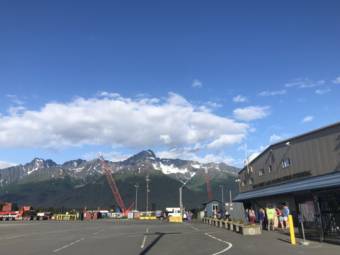
Seward is expecting a full schedule of cruise ships this summer. (Photo by Sabine Poux/KDLL)

Seward plans to welcome back its first cruise ships this summer since 2019.

But there’s a lot that could happen between now and May 9, when the first ship is slated to dock in town.

“I’m going to try to remember how that works,” said Kat Sorensen, executive director at the Seward Chamber of Commerce.

She said she’s cautiously optimistic about the return of cruises. Seward was burned in 2021 due to COVID-19-related restrictions from Canada.

“Last year, we had a first cruise ship that was supposed to arrive in Seward,” Sorensen said. “And the day kept getting pushed back or canceled until, all of a sudden, the season was over. And it’s like, ‘OK, we’re not getting any cruise ships this year.’”

Seward’s economy relies heavily on tourism from cruises. And the effects of two canceled seasons in a row extend throughout the region — cruises support an estimated 20,000 jobs in Southcentral every season.

Last year, Norwegian Cruise Line sent Seward and several other communities $1 million each in an attempt to fill in some of the gaps left behind by the no-show.

But the season wasn’t a total loss in Seward. Independent travelers still filled Seward’s streets last year, said Amy Haddow, a Seward-based vessel manager with Cruise Lines Agencies of Alaska. Her job is to connect the ships with services on land like customs and groceries.

She said Seward bustled with visitors from Alaska last year, but also from the Lower 48 and overseas. That’s reflected in Seward’s 2021 sales tax revenue, which rebounded and surpassed 2019 numbers.

Haddow also said Seward is different from communities in Southeast in that it’s typically the first or final destination on passengers’ trips. Many go straight between the bus or train and the ship.

“The vast majority of passengers leave Seward,” she said.

So even if some of the businesses down at the dock are impacted by quiet seasons, many local stores and restaurants may not be as hurt when cruise ships don’t come into town.

Cruises or not, Seward relies on an influx of seasonal workers each summer.

Finding housing for those workers is always an issue, but Sorensen says it might be especially tough this year.

“And usually we start seeing posts on our Seward housing Facebook page around February or March,” she said. “But this year we’ve been seeing them since November, of people desperate for a place to live for the summer.”

Still, Sorensen and Haddow hope ships are a go for this summer. The schedule is chock full of voyages, from May through October. Sorensen says the chamber is operating with the assumption, for now, that things will be normal.

But she won’t say anything with complete certainty, at least not until the first ship of the season pulls up to the dock.

For some Alaskans, a foreign war hits close to home

A family of four poses for a photo in the mountains
Violetta Strait and her family in the Carpathian Mountains in Ukraine in 2014. (Photo courtesy of Violetta Strait)

There were no Ukrainian schools in Violetta Strait’s town growing up. Strait spoke Russian at a Russian school in the Donetsk region of Ukraine.

But when she was old enough to start teaching, she helped open Donetsk’s first Ukrainian school. Not long after that, she worked toward Ukrainian independence from the Soviet Union.

Now, she’s in Alaska, watching from Kenai as Russia invades her country. And she said she’s worried.

“My biggest fear is that Russia’s always wanted to see Ukraine as a younger brother,” she said.

Strait is from what’s now being called the Donetsk People’s Republic — a separatist region within Ukraine. It’s part of the area Russia declared independent from Ukraine earlier this week before launching an invasion into the country.

Strait moved to Alaska with her husband in 1999 and settled in Kenai, where she’s a classroom aide. Her relatives are still overseas.

“All my family is still in Ukraine,” she said. “Some are on occupied territories and some are on freshly occupied territories. Some are on those that are not occupied yet. And hopefully they will not be occupied.”

She’s been following news on Facebook and a Ukrainian channel and getting updates from her mom every day — sometimes just a sentence, to let her know she’s OK.

Many Ukrainians are evacuating. But others are worried if they leave, there will be nothing to come back to. She said her mom and some of the members of her congregation decided to stay.

“And she said that most of the people are older people,” she said. “They cannot be on a bus, waiting on a bus for two or three days trying to figure out where they go. So they all decided to stay and they just hope for better, for peace.”

Gregory Weissenberg is a retired world history and Russian teacher from Moldova, living in Soldotna. He was in Ukraine last year, visiting a group of former students for his 70th birthday. They spent time in the capital, Kyiv.

“You could sense the freedom. It was nothing like a former Soviet Republic,” he said. “If it wasn’t for this invasion, I planned this year another trip to Kyiv.”

One of the students he was with on that trip called him Thursday.

“She called me on WhatsApp and she was crying and just wanted to share with me her frustration. So it’s personal for me now,” Weissenberg said.

Weissenberg said he’s been watching the news nonstop.

He also knows what it’s like to live under Soviet control. The first year he left Moldova to teach on the Kenai Peninsula was 1991, the year the USSR collapsed.

And, as a history teacher, he said it’s really important for people tuning into this week’s news to rewind the tape.

“I think the news that I’ve been watching, I like the coverage,” he said. “The only thing … I would suggest that Americans try to put more history behind the news.”

He said that’s critical both for understanding what’s happening in eastern Europe today and to fight misinformation.

But he said it’s also necessary to zoom in and understand the human toll.

He likes to say history is personal. His home country, Moldova, borders Ukraine.

“I mean, the current government in Moldova is very nervous,” he said. “But that invasion, of course, sends some chills down the spine.”

It’s certainly personal for the Ukrainians in Kenai.

A group photo of people holding protest signs with slogans like "God Bless Ukraine" and "Support freedom."
Strait and friends supporting protests in Kyiv from Kenai in 2014. (Courtesy of Violetta Strait)

Strait said the Ukrainian women she knows in the area are all coping differently with the news.

“There are different opinions but most of them are really shocked,” she said. “Most of them are seeing it as an invasion. Some are more proactive and try to send money and try to spread the news and try to talk to others. And some people are just kind of watching and inside being numb.”

She said she can’t look away from what’s happening now. She was in Ukraine when the country was fighting for its independence — spreading information to people there before the referendum vote in 1991 and beginning her teaching career as the Soviet Union dissolved.

“And I think that’s why I feel like I’m involved a lot,” she said.

She kept up the work since coming to the U.S., doing some translation for a Ukrainian journalist. She and her husband have returned to the country to do missionary work and visit family, though she worries if Russia takes control she won’t be able to go back.

She said she’d like people to think globally, especially in a small, seemingly far-away community like Kenai. Apathy, she said, is dangerous.

“Turn on your brain,” she said. “Think and don’t be indifferent.”

When it comes down to it, she said, the world isn’t all that big.

Former Dunleavy Chief of Staff Tuckerman Babcock files bid for state Senate seat

A man wearing a blue vest that says "Tuckerman" on it
Babcock lives in Soldotna. He’s running to represent Soldotna and much of the central Kenai Peninsula in the state Senate. (Photo by Sabine Poux/KDLL)

Former Dunleavy Chief of Staff and longtime Soldotna Republican Tuckerman Babcock filed to run for state Senate yesterday.

Babcock has worn many hats in Alaska politics. He was chair of the Alaska Republican party and an aide for several state legislators and Gov. Wally Hickel.

But this would be his first time serving in elected office himself. He’s running for the seat currently held by Sen. Peter Micciche. Seat D — formerly Seat O, before the new legislative maps were set in November —  covers Kenai and Soldotna, north to Hope and east to Bear Creek.

Babcock said he sees his existing relationships in Juneau as an asset.

“The governor and I have a very good relationship,” he said. “And if it happens to be Mayor Pierce as the new governor, he and I also have a good relationship. So the opportunity to work with a governor to work with the Legislature to actually accomplish things, that’s something I’ve been looking to bring to the table.”

He said he’s also motivated by the infighting he’s seen over matters like the PFD. He said he finds the repeated special sessions and lack of compromise frustrating.

“We need to resolve that with certainty,” Babcock said. “And the statutory formula worked for 30 years, so that’s the starting point.”

Micciche has been in the seat since 2012 and is also registered to run again. Babcock, who is Micciche’s only challenger so far, said he doesn’t want to compare his political leanings to Micciche’s yet, but he identifies as a conservative Republican.

Babcock has tried for state office before. He ran, unsuccessfully, for a Mat-Su seat in the late 1980s.

In 2018, Babcock ran Dunleavy’s transition team. Dunleavy and Babcock ended up in court after demanding resignations from hundreds of state employees. A federal judge ruled last year those demands were unconstitutional. Last month, a federal judge said Dunleavy and Babcock violated the First Amendment when they fired one Juneau lawyer.

Babcock said those court decisions could give future governors and transition teams some direction.

“That’s great to have that clarity for the next transition team, the next governor,” he said. “A much more clear idea of what they’re allowed to do and not allowed to do, according to the judge’s interpretation. And that’s as it should be. But I would just say put it in context with everything going on.”

He said he hopes people put those court losses in context with other decisions the administration made – like appointing commissioners who continue to serve the state today.

Babcock has a big family — six of his eight children live in Alaska. His wife, Kristie Babcock, was appointed by Dunleavy to the Alaska Judicial Council, the state body that nominates candidates for judicial vacancies. She also runs a State Farm insurance agency in Kenai.

State senators serve four-year terms. But the Senate seat Babcock is aiming for is open this year due to redistricting, and will be for a two-year term.

Lawmakers focus bills on school curriculum

A man speaks to an audience from a stage
Kenai Rep. Gillham at a town hall in Soldotna last April. Gillham said he’s making education the focus of his legislative session. (Photo by Sabine Poux/KDLL)

State legislators released a spate of bills aimed at public education curricula last week, including several from Soldotna Republican Rep. Ron Gillham.

Gillham said he’s making education the focus of his legislative session.

“When I came down [to Juneau] last year, it was a lot of focus on the dividend and the budget and a few other things,” he said. “And over the winter, I did a lot of investigating on our education system. And we needed some things changed.”

Gillham said, overall, parents should have more involvement in their kids’ education.

A so-called “parents’ rights” movement has become popular in education during the pandemic, as parents demand more input over what their students are learning in schools and how COVID-19 mitigation is being handled.

One of Gillham’s bills would require schools to publish lists of textbooks and course syllabi on their sites. It’s not unlike bills being proposed in Ohio and Michigan.

Some teachers in those districts said they’re worried that will lead to censorship. Gillham said he sees the bill as a way to ensure transparency.

“And if they’re trying to keep you from seeing what it is, that tells me you are trying to hide something,” he said. “They may not be, but that is kind of in the back of my mind.”

The Kenai Peninsula Borough School District already publishes some of its curriculum materials online.

Another bill would provide public funding for students who are homeschooled or in private school. Students would be eligible for $5,930 per year in scholarships if they have disabilities, attend a “low-performing school” or have a parent in the armed forces, among other criteria.

Gillham said he got the idea for that bill from a summit he attended last November in Florida, held by ExcelInEd, an organization started by former Florida Gov. Jeb Bush.

Gillham said he also attended a summit for conservative state legislators last year in Texas sponsored by an organization called WallBuilders. The WallBuilders website said the group is dedicated to preserving the “moral, religious, and constitutional foundation on which America was built — a foundation which, in recent years, has been seriously attacked and undermined.”

Another bill from Gillham would bar teachers from making students feel guilty or inherently “racist, sexist, or oppressive” by virtue of their own identities. It’s similar to a bill proposed in Florida.
Gillham said he is thinking about critical race theory, or CRT – an academic framework that’s become a rallying cry in conservative circles for fighting back against a perceived progressive ideology in schools.

The Kenai district and many others have said they aren’t teaching critical race theory in their classrooms.

District Spokesperson Pegge Erkeneff said the district looks at new education bills when they’re introduced to see if they align with the district’s legislative priorities. She said the district will be looking into the bills proposed this week in the next few days,

Tom Klaaymeyer heads the Alaska branch of the National Education Association. He said in an email he did not find Gillham’s bills productive.

“The education reform package proposed by Rep. Gillham does not address the urgent needs I’m hearing from Alaska educators or the students they serve,” he said. “NEA-Alaska is eager to work with any and all parties to improve educational achievement and student learning. Unfortunately, this package of bills does not appear to be productive, practical, or a strategic investment in our public education system.”

Gillham said he’ll also file a bill to introduce a “character development program” that would emphasize values like patriotism, responsibility and racial and religious tolerance. He said the program would teach high schoolers employment and civic skills, among others.

“So that one will be read across on Tuesday,” he said. “Right now there’s no bill number, so it’s not available online.”

Gillham is not the only Alaska legislator who filed bills focused on public education this week.

Wasilla Republican Rep. David Eastman wants the state’s education department to create a social studies program about “victims of communism,” including instruction on former communist leaders like Joseph Stalin and Fidel Castro.

And both the House and Senate are considering bills that would — among other things — establish a Read by 9 program for students. Another piece of legislation, would increase the amount of money schools get for each student, a metric which has not been changed in the last several years.

Roland Maw reaches plea deal on PFD fraud

Roland Maw waits to be called for an interview before a joint meeting of the Boards of Fisheries and Game on Jan. 14, 2015. (Photo by Matt Miller/KTOO)

One of the most prominent figures in Cook Inlet fishing reached a plea deal with the state Friday, capping a six-year legal battle over a case of Alaska Permanent Fund dividend fraud.

Kasilof drift fisherman Roland Maw pleaded guilty in superior court for collecting six years of PFDs while he was claiming residency in another state.

Maw, a former director and current volunteer with the United Cook Inlet Drift Association, was charged on one misdemeanor in the place of the original 12 charges brought against him. He’ll pay a $500 fine, nearly $9,582 in restitution to the state and will have a criminal conviction on his record. He will no longer be allowed to collect PFDs.

Maw’s defense attorney said during Friday’s plea hearing that it’s a good deal. Maw said he’s relieved the matter is settled.

“It would be nice to have this behind me and have this over so I can move on with my life and the state can move on with whatever it chooses to do,” he said at the hearing.

The case has taken years to work its way through the courts.

Attorneys in Montana were first to charge Maw for buying resident hunting and fishing licenses there while he was also claiming residency in Alaska. In 2015, a Montana court barred Maw from hunting and fishing in the state for a year and a half and ordered him to pay a fine.

The charges in Alaska came later.

In 2016, the state accused Maw of illegally collecting PFDs between 2009 and 2014, alleging he had not been honest on his applications about his time Outside. The state indicted Maw on seven felonies and five misdemeanors.

On two occasions, those charges were dismissed and refiled. The third indictment, in early 2019, stuck.

But attorneys for Maw and the state reached a plea deal, made official Friday, to replace all those charges with one count of unsworn falsification in the second degree.

Maw said the plea deal was presented to him as a way to resolve the case.

Lisa Kelley, an attorney from the state, said the restitution represents the entirety of PFDs that were erroneously paid and the difference in prices between resident and nonresident Fish and Game licenses.

Class A misdemeanors like this can be punishable by thousands of dollars in fines and up to a year of jail time. Maw has not served jail time, nor will he have to.

Juneau Judge Amy Mead said she found the state’s penalties fit for the crime, given Maw’s lack of priors. And she said the fact that Maw will walk away with a criminal conviction deserves a lot of weight.

“Because it is a crime of dishonesty,” she said. “And I use that in the legal sense. I think the fact that you’re walking away with a conviction is very significant.”

Maw said the state knew about his travels at the time because of his role on an international anadromous fish commission. And he said the issue should have been resolved in an administrative hearing.

Maw was appointed by Gov. Bill Walker to the Board of Fish in January 2015. He withdrew his name around the time officials in Montana first announced the criminal investigation, the Anchorage Daily News reported.

In an interview after Friday’s hearing, Maw said he’s no longer a paid employee of United Cook Inlet Drift Association. But he’s still a volunteer, answering phones at the drift association’s Soldotna office as recently as Friday. He said he’s unsure if he’ll continue to be a volunteer with the association going forward.

Maw also holds a drift gillnet permit for Cook Inlet and still fishes there. He’s had a home in Kasilof since 1988.

Fisher poet publishes memoir about his years in Cook Inlet

An old color film snapshot of a bearded man in a baseball cap
Patrick Dixon on his first boat, the Skookum Too, in the 1980s. (Courtesy of Patrick Dixon)

It has been nearly 24 years since Patrick Dixon sold his Cook Inlet drift boat and moved from Kenai to Olympia, Wash. But for the former fisherman, writing has always been a way to remember.

He wrote his first fishing poem when he was stranded on land, after the Exxon-Valdez oil spill of 1989.

“I ended up writing a poem called ‘Middle Rip, Cook Inlet,'” he said. “And it was about what it’s like to be on the water. And I was writing, really, about what I was going to miss. What I was being forced to miss.”

That poem was the first in a large portfolio of work inspired by fishing and Cook Inlet. This month, Dixon’s publishing a collection of those poems, stories and photos, called “Waiting to Deliver” – a memoir about his summers on the water.

The first of those summers came by accident. Dixon was a new transplant to Kenai from Indiana in the 1970s. He had moved to be a teacher and had no concept of commercial fishing as a livelihood.

But he had some neighbors who were in the business.

“When I first moved to Alaska in ’75, my first house was out the North Road, in North Kenai, right across the lake from Jim and Nedra Evenson,” he said.

The Evensons had been gill-netting in the inlet since the ‘50s and were steeped in the culture of Cook Inlet fishing. So was their son, Thor. Dixon became his friend and, later, his deckhand. Eventually, he captained his own boats — first the Skookum Too, then the Veronika K. All the while, he was teaching, special education and, then, photography in Kenai.

A book cover: Waiting to Deliver, bu Patrick Dixon
(Courtesy of Patrick Dixon)

That lasted about 20 years. In 1997, he took a photography teaching job at Evergreen State College in Olympia.

“And for the next year and a half, I was pretty depressed because I missed Alaska, I missed fishing. I didn’t have an identity anymore,” Dixon said. “And another fisherman, good friend of Thor’s and mine, Frank Mullen, ended up telling me about the FisherPoets gathering.”

Fishermen from all over the country meet in Astoria, Oregon each year for FisherPoets, to share stories and songs. And it immediately became a way for Dixon to connect back with a part of himself that he had left on the boat.

“Part of the book describes that first trip, that first year, where all of a sudden, I found a community that I had been part of up in Alaska and didn’t have anymore and was missing terribly,” he said.

He’s been there almost every year since, in 2014 compiling and publishing an anthology of poetry from the FisherPoets called “Anchored in Deep Water.”

And he made sure his new book would be ready for the 2022 gathering, happening later this month. The book compiles stories he started writing years ago and put together as a pandemic project in early 2020. The 225 copies he ordered should arrive in less than two weeks – right in time for the start of FisherPoets.

Even though Dixon’s fishing years are long behind him, he said writing helps him recall even the most specific details — how it felt when the boat rocked in stormy weather or the joy of learning to pick salmon from a friend.

“I think by immersing myself in it and feeling like I’m there doing it again, I can see the details that I need to see to make the story effective,” Dixon said.

Some of his writing is a callback to the earliest lessons he learned, when he was still a new arrival from a landlocked state in the midwest.

Like “Boat Puller,” a poem he wrote for Jim Evenson, who brought him into the world of fishing all those years ago:

Dixon will read from his book and hold a question and answer session at this year’s FisherPoets gathering.

For the second year in a row, it’s going to be virtual and broadcast by KUMN — the community radio station in Astoria. Their site is coastradio.org. The gathering is Feb. 24-26.

Site notifications
Update notification options
Subscribe to notifications