KDLL - Kenai

KDLL is our partner station in Kenai. KTOO collaborates with partners across the state to cover important news and to share stories with our audiences.
Fish and Game surveys Cook Inlet beaches in hopes of reopening to clammers

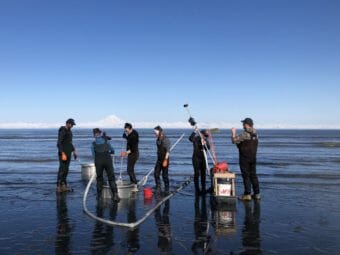
Six people working with various pieces of equipment to collect clams on a beach
The Department of Fish and Game is hopeful it will be able to open at least some beaches on the east side of Cook Inlet to clamming this year. (Photo by Sabine Poux/KDLL)

The Alaska Department of Fish and Game might reopen the razor clam fisheries in Ninilchik and Clam Gulch for the first time since 2014.

But before that can happen, biologists are hitting the beaches to count clams.

Technicians surveying the Ninilchik beach Wednesday used some unlikely tools to stir up the clams hiding underneath the sand.

Some held lacrosse sticks. Assistant Area Manager Holly Dickson used a high-pressure water pump connected to a fire hose to liquify the sand within a small circle of beach.

“Once the sand is liquified inside the plot, razor clams will just sort of float to the surface,” she said. “Then people come in with these scoops and just filter through the water and sand.”

When they were certain there were no clams in a given plot, they picked up and ran to the next spot, chasing the tide as it quickly pushed out.

Dickson said the circular plot they probed is just one of hundreds they’ll survey this week.

“So we’ll start to get more into the best clam habitat once we get more like 300 to 500 feet out,” she said. “The middle of the beach has the most clams, is what we typically see.”

Fish and Game will use the clam counts to decide if there are enough to reopen sport and personal-use clamming in Ninilchik and Clam Gulch.

Two women surveying clams on a Kenai beach
Holly Dickson (right), assistant area management biologist for Lower Cook Inlet sportfishing, used a high-pressure water pump to emulsify sand in small pockets on the beach. (Photo by Sabine Poux/KDLL)

The closures have been a response to low razor clam counts on the east side of Cook Inlet. The clam population crashed about a decade ago and has been slow to bounce back. In the meantime, clammers and sportfish charters have been taking their shovels over to the west side of the inlet, where the population is healthier.

Fish and Game Area Manager Mike Booz said his department has been watching the clams closely.

“Really at the closure of the fishery — ‘16, ‘17, ‘18 — we saw really high numbers of juvenile clams,” he said. “And so that’s really the first step for numbers to rebuild. You get new clams showing up on the beach. So that was kind of the bright spot. The downside was during those years we had really poor growth rates.”

Today, he believes there might finally be enough clams to justify reopening some beaches. The Alaska Board of Fisheries just approved a management plan that sets a threshold for restarting a limited fishery with a bag limit of 30 clams per day.

“This fishery is loved by so many Alaskans, so we definitely like to hear from people and want everyone to understand, really, what’s going on with these Cook Inlet razor clams,” he said.

Before the closure, the beaches on the east side were a mecca for clammers.

Brent Johnson started clamming with his family when they homesteaded on the Kenai Peninsula in the 1950s.

They’d dig near their set-net site on the beach in Clam Gulch — named for its abundance of clams.

“I would describe it as great clamming,” Johnson said. “I mean, a person who went out in that area, we would get a bucket of clams, the limit was 60. We could get that on any minus-one or two tides, something like that.”

For several years in the 1980s and 1990s, the sport fish harvest of clams was over 1 million.

Clamming was popular long before it became a regulated fishery. Johnson, who’s also a historian, knows the first, Alaska Native settlers of the land clammed, too. He’s found shells buried on his parents’ homestead.

And he’s seen surveys from the early 1900s that list “Clam Gulch” as a town name.

“And so ‘Clam Gulch’ must stretch back at least to 1920,” Johnson said. “So it was known for clamming at least back as far as 1920, I would say.”

Johnson and his family clammed up until the closure, in 2015.

He’d cook the clams the same way his mom did when he was a kid.

“We either fry ‘em, or we have clam chowder,” he said.

He’s not sure he’ll go clamming himself this summer if the fishery does reopen. He’s vegan now.

But Booz knows there are lots of people waiting, shovel ready, to dig into the east side beaches again.

Hands holding up a ruler to measure a clam
Aging a clam by the stripes on its shell is a bit like aging a tree by its rings. (Photo by Sabine Poux/KDLL)

Technicians in Ninilchik were several plots into their survey Wednesday when, at last, a small yellow clam bubbled to the surface.

Booz took out a ruler and pointed to the distinctly colored stripes on its shell, like the rings of an aging oak.

“So this is a three year old clam that didn’t quite grow enough to make it to the adult size this year,” he said.

On the whole, Booz said it’s not looking too good for Ninilchik. But he’s more optimistic for the beaches Clam Gulch, where he thinks there will be enough mature clams to have a fishery.

He said his department will make a decision by the middle of next month. The fishery, if open at either beach, would run May through October.

Millions of Alaska-bound honeybees die at Atlanta airport

A large white container full of sliver crates on an airport tarmac
The bees were bound for Anchorage, where they were to be shipped to beekeepers across the state. (Photo by Matthew Pearson/WABE)

Hundreds of pounds of honeybees were set to ship from the Lower 48 to beekeepers across Alaska last weekend, but died in transit when the crates carrying them were left for hours on a hot tarmac in Atlanta.

Soldotna beekeeper Sarah McElrea said the loss is devastating. She runs Sarah’s Alaska Honey and also teaches classes and coordinates shipments of bees to beekeepers around Alaska.

On Sunday, she was waiting at the Anchorage airport for a shipment of 800 pounds of bees from a distributor in Sacramento, California. It was the first of two shipments that she had ordered on behalf of more than 300 Alaskan beekeepers.

“We had a load that was going to Fairbanks, and then we had somebody else that was going to distribute from Wasilla to Talkeetna,” she said. “And then we were going to do Anchorage and the Valley. And then our second one would’ve come in the following day, and we would’ve taken that one back down to the Peninsula to fulfill the rest of our orders.”

But the plan hit a snag when the bees were pushed from the original Delta flight. Instead, the airline rerouted them to Atlanta, where they were supposed to catch a direct flight to Anchorage.

When they didn’t make that flight, McElrea really started to worry. Honeybees don’t do well in extreme heat. McElrea asked that the bees be put in a cooler.

But the next day, the airline told her some bees had escaped from their crates and so Delta put them outside.

“I really panicked when they found they had moved them outside because the pheromones that those honeybees emit are attractive to other honeybees that are native to the area,” she said.

Sure enough, outside bees gathered around the crate, so it looked like more bees were escaping.

McElrea said Delta refused to put the shipment on the plane. So she turned to the internet for help.

“I got on Facebook and made a quick post to a page that is based in Georgia,” she said.

That’s how she connected with Atlanta beekeeper Edward Morgan. He went to the airport to take a look and found most of the bees in the shipment were already dead from the heat. McElrea said it was 80 degrees in Atlanta that day.

The only thing left to do was to rescue the survivors. Morgan called in reinforcements to open the crates and save whatever individual bees were left.

A woman inspects a beehive inside a shipping container
Beekeepers flocked to Atlanta’s Hartsfield-Jackson airport Sunday to check on the bees and take the survivors home. (Matthew Pearson/WABE)

Gina Galucci with the Georgia Beekeepers Association was one of the dozen-plus volunteers that beelined for the airport. She told WABE’s Emily Wu Pearson Sunday that they understood the urgency of the situation.

“This is a disaster,” Galucci said. “So while we did mobilize very, very quickly, we did that because we know they’re going to die. And so the person who bought these bees is out a whole lot of money. So we’re going to try to help support with some donations toward that.”

McElrea said these last few days have been a nightmare. She’s scrambling to patch up the mess and hasn’t slept much.

She said the beekeeping business has never been about money for her. Still, she said it’s an incalculable loss.

She said her supplier in California is going to replace the shipment, which included $48,000 worth of bees. She’s also hoping for some sort of relief from the airline, though she understands that for many airlines, people ship live animals at their own risk.

But she’s grateful for the support from the Georgia beekeepers. Some took the few survivors back to their own apiaries.

“I will forever be grateful for anything that they were able to salvage,” she said. “They just assembled quickly and efficiency and really are the heroes in this scenario.”

And while this is the first time she’s experienced such a tragedy, she said it’s not the first time she’s heard of bees dying in transit.

Distributors know how much food to put in crates so the bees can travel safely within a reasonable timeframe. But that becomes complicated when there are delays or cancellations, particularly in extreme climates.

McElrea is coordinating with beekeepers in Seattle so that if there’s a problem with the next shipment, volunteers will be ready to intervene.

Catherine Salm with Delta Air Lines’ corporate communications said in an email Tuesday the airline is aware of the incident and is working to make sure something similar does not happen again.

“We have been in contact with the customer directly to apologize for the unfortunate situation,” she said.

McElrea wants people to know they can protect these important pollinators in their own backyards. She said gardeners should plant pollinator-friendly plants and avoid spraying toxic chemicals, like RoundUp. Importantly, they shouldn’t be afraid of honeybees, which only sting when they’re in danger.

“Being educated about honeybees is the first big step I think everyone should take on that can help them to just have a better understanding of how important they are as far as pollinators,” McElrea said. “And just such a fragile part of our ecosystem that we as humans are completely dependent on for our survival.”

Now, McElrea and other beekeepers from the Kenai Peninsula are waiting on the second shipment and the replacement, set to come in later this week.

WABE journalists Matt Pearson and Emily Wu Pearson contributed photographs and interviews from Atlanta.

For Alaska public defenders, Ketanji Brown Jackson’s confirmation was doubly historic

Ketanji Brown Jackson 2020
Judge Ketanji Brown Jackson speaks as an honoree at the Third Annual Judge James B. Parsons Legacy Dinner on Feb. 24, 2020, at the University of Chicago Law School. (Creative Commons photo by Lloyd DeGrane)

When she’s sworn in this summer, Judge Ketanji Brown Jackson will be the first Black woman to serve on the U.S. Supreme Court.

She’ll also be the first Supreme Court justice who has worked as a public defender. And that means a lot to public defenders like Lacey Jane Brewster. The Kenai attorney, who works for the Alaska Public Defender Agency, said the Supreme Court has been missing that perspective on the bench.

“Criminal law takes up such a big part of the docket in the federal courts and the state courts,” Brewster said. “And it’s important to have people on the bench who understand the perspective of a criminal defendant and what it’s like to go through a trial.”

Ketanji Brown Jackson is President Joe Biden’s pick to fill the Supreme Court vacancy left when Justice Stephen Breyer retires.

Today, Jackson serves on the U.S. Court of Appeals. In the early 2000s, she was a federal public defender — a court-appointed attorney assigned to defendants who can’t afford their own lawyers.

The U.S. Senate confirmed Jackson to the bench last week. Alaska Sen. Lisa Murkowski was one of three Republicans to vote “yes,” while Sen. Dan Sullivan joined most of his Republican colleagues in voting “no.”

Brewster said some of the questioning from senators at those hearings showed the misconception public defenders often face — that they’re standing on the wrong side of justice or are in the work for the wrong reasons.

“But most of us are here because we’re zealous about defending people’s rights, which is a constitutionally mandated thing,” Brewster said. “We’re literally in the Bill of Rights.”

Brewster, for her part, decided she wanted to be a public defender when she was in law school. She said she had a professor who steered her toward the field.

Today, she works alongside eight other public defenders in Kenai representing defendants from across the peninsula. She said there are about 100 public defenders working at offices around the state.

Brewster said Jackson wasn’t on her radar before Biden’s appointment. But the judge was slated to speak to the Alaska Bar Association in Anchorage this upcoming October.

That was decided before Biden nominated Jackson, and it’s unclear whether she’ll still make the trip. Danielle Bailey, executive director of the Alaska Bar, said the group sent an email congratulating Jackson and is following up with another email this week to see if there are updates.

Bailey said she had hoped Jackson would focus her talk on her background with the criminal sentencing commission, which works to ensure fair sentencing in the court system, as well as her journey to the Court of Appeals. Now, she imagines the Supreme Court appointment would be a dominant theme.

Kenai attorney Kristine Schmidt hopes Jackson can make it to Alaska. Schmidt, a Kenai Peninsula Bar Association member, goes to the conference every year.

“It’s a huge inspiration for any woman who’s practicing law, or thinking about practicing law, to see how women can really excel in the profession and advance,” Schmidt said.

She remembers one Alaska Bar conference talk from Sandra Day O’Connor, the first female judge on the Supreme Court. In 2008, Ruth Bader Ginsburg delivered a memorable speech about the role of dissent in the judicial process.

“I think it’s fantastic that there’s such a diversity of women justices now,” Schmidt said. “Each of the women on the court now come from different backgrounds and different experiences. I think it’s really important.”

Schmidt said it’s amazing that a former public defender is joining the highest court in the land. Like Brewster, she said it’s a job that’s often misunderstood.

“It’s very difficult to be appointed a judge when you’re a public defender,” Schmidt said. “In Alaska, it’s not uncommon. But it is certainly at the U.S. Supreme Court level.”

Brewster, who’s also a member of the Kenai Peninsula Bar Association, said she plans to go to the conference, too. She jokes that all the public defenders in her office will be up in Anchorage that day.

She said they’re excited to see a second side represented on the court. And she hopes Jackson’s appointment inspires current law students to give public defense a try.

“Because it is a profession that is valuable,” Brewster said. “And now that we have some recognition of the fact that, even on our highest court, someone with the experience of a public defender belongs there, hopefully it will inspire younger attorneys to think about going into public defense as a career.”

Jackson was confirmed to the court April 7 and will join the eight other justices on the bench this summer.

Homer fisherman appointed to Board of Fish

""
Michael Heimbuch in Homer in 2005. (Courtesy of Michael Armstrong/The Homer News)

A second-generation commercial fisherman from Homer is Gov. Mike Dunleavy’s latest pick for the state’s Board of Fisheries.

The governor appointed Michael Heimbuch to fill the vacancy left earlier this year by Soldotna’s Indy Walton, who resigned from the board after four months, citing health issues.

Heimbuch, who has set- and drift-netted across the state, will finish out the remainder of Walton’s term — just over one year. He said he applied at the suggestion of his predecessor, who’s a friend from their Bristol Bay days.

“So on a lark I just did it,” he said. “And then it had a life of its own after that, and that was about a month ago.”

The seven-member Board of Fisheries makes decisions about fish allocation and management in Alaska’s waters. Board nominees are appointed by the governor and approved by the Alaska Legislature.

Heimbuch has thrown his hat in the fisheries policy ring before.

He’s been nominated twice for the federal North Pacific Fishery Management Council as an alternate and has a long history of commercial fishing around Alaska, first with his parents on the west side of Cook Inlet in 1963, followed by stints set- and drift-netting in False Pass, Prince William Sound and Bristol Bay. He’s also fished in Adak and by Kodiak.

“And so I’ve just been making the circuit as kind of a short timer in all of those places,” Heimbuch said. “I was always far more interested in doing new and different things than I was in staying in one place for a long time.”

Heimbuch moved to Homer in 1975. There aren’t currently any permits registered in his name. He had a Cook Inlet drift net permit as recently as 2021, although he said he hasn’t fished the inlet since 2018. The latest boat registered in his name is a 38-foot gillnetter called Last Lite.

“Whether or not I ever go back and fish again, I’m not sure,” Heimbuch said. “But I am scheduled to go to help my daughter fish this summer in Kodiak.”

Hannah, his daughter, lives in Kodiak and has two permits in her name — one Cook Inlet drift net permit and another Kodiak set net permit. She’s also been an active voice in fisheries policy, including in the Alaska Young Fishermen’s Network. Heimbuch’s son, Ivan, has a Cook Inlet drift net permit registered in his name and is a leatherworker based in Homer.

Heimbuch said that because both kids fish the inlet, he won’t discuss or vote on anything related to Cook Inlet salmon fishing altogether — known as “conflicting out.”

He said he’s acutely aware from his experience how rural communities rely on the commercial fishing industry. And he’s concerned that a large portion of Alaska seafood is harvested by nonresidents. He said he’s interested in making sure residents of coastal communities have the resources to participate in local commercial fishing.

Participation of the next generation in the fishery is another matter that hits close to home. Heimbuch said he wants to make sure young people have reason and rationale to get involved in the business.

“For coastal Alaska, until we get better at making people understand that industry is at least as important as leisure, we’re always going to be behind the eight ball,” Heimbuch said. “And I can only hope that the representatives on the Board of Fish are successful in telling urban Alaska why rural Alaska has such a high dependence on the stability of commercial fishing.”

Heimbuch was previously a member of the Homer City Council and has held roles on local boards. He’s also worked with the Prince William Sound Aquaculture Corporation, which works on hatchery issues.

Court records show three fishing regulation violations in his name from the 1980s and 1990s. Heimbuch said two were related to fishing just over the line in Prince William Sound and Cook Inlet, while another was because he was late to drop off a registration card in Naknek.

Outside of fishing, Heimbuch is a longtime columnist for the Homer News and is a jazz pianist. He studied music as an undergrad at the University of Alaska Fairbanks.

Heimbuch begins his time on the board April 15. Board terms are usually three years. But since Heimbuch is filling out Walton’s term, his will end June 2023.

Glenn Haight, executive director for the board, said it’s unclear whether the Legislature will have time to fit in a hearing this session or if it will have to wait until next year. The governor appointed Heimbuch to the seat nearly two months later than the legal 30-day deadline for filling the seat.

His announcement Monday came with two other Board of Fish appointments.

Dunleavy appointed Three Bears Alaska CEO David Weitz, of Tok, and Thomas Carpenter, a commercial fisherman in Cordova, to the seats that will come open this summer when two current members — Gerard Godfrey and Israel Payton — term out.

The Board of Fish — with its vacant seat — is meeting in Anchorage this week. It’s scheduled to consider a proposal to loosen paired restrictions on Cook Inlet set-netters for the 2022 fishing season.

Veteran Alaska journalist Jay Barrett dies at 60

A black-and-white photo of two men and and a woman
Jay Barrett with Sally Cassano and Shaylon Cochran. Jay was the reporter and Morning Edition host on KDLL between 2017 and 2020. (Courtesy of Sally Cassano)

Veteran Alaska journalist and KBBI news director Laurence Jay Barrett died Thursday, March 17, at his home in Homer. He was 60.

If you’ve ever turned on a radio in Alaska, there’s a good chance you’ve heard Jay Barrett’s unflinchingly upbeat voice.

That voice has played on local airwaves across Alaska, from Kodiak to Bethel to Kenai and, most recently, Homer.

His first ever broadcasts were in his hometown of Dillingham, where he announced high school basketball games as a kid.

He was later pulled out of state by art of a visual kind, earning a degree in photography from the Art Institute in Seattle in 1988. He started pursuing a career in commercial photography.

But — as so many do — he found his way back. His brother, Jean Barrett, of Dillingham, said Jay always had a deep love for Alaska’s rural communities.

“You can take the kid out of the village, you can’t take the village out of the kid,” Jean said. “I think he liked small-town Alaska.”

Jay — known affectionately to friends as JayBob — found home all across rural Alaska, as a public radio and newspaper reporter for a myriad of outlets and as the decade-long voice of the statewide Alaska Fisheries Report.

But journalist Rhonda McBride said, despite that breadth, he was laser-focused on every community he worked in. And it showed in his storytelling.

“To me, there is a trademark Jay Barrett story,” McBride said.

McBride worked with Jay at KYUK in the 1990s. She said he had a knack for covering the stories reporters usually shied away from — the kind of nuts and bolts reporting on what makes a community tick.

“Jay always had a magic of taking stories like that and drawing us in,” she said. “And not just telling the story but building a sense of community with it. I mean, he was the quintessential small-town reporter — loved it. He never wanted to work somewhere other than rural Alaska.”

At KYUK, she said Jay was known as the “red-haired Native.” His mom was half Yup’ik, from the Kuskokwim area.

A man sitting in a newsroom holding a large plastic mug
Jay Barrett in the KYUK-Bethel newsroom in 1996. (Courtesy of Martha Scott)

In all his news gigs, Jay was a dogged follower of AP style. He never shied away from emailing a reporter — including this one — when there was an error or typo in their copy.

But radio listeners statewide were perhaps most taken with Jay’s cheery radio voice, with a bellowing laugh that brightened every airwave. He could read out the phonebook, McBride said, and it would be entertaining.

With his statewide reporting came a statewide network of friends and colleagues.

Cheryl Nugent, one of Jay’s best friends and a DJ at KMXT-Kodiak, said they would celebrate their birthdays together every July, watching movies over the phone when their friendship turned long distance.

“We kept in touch by texting and sending silly stories and videos back and forth,” she said. “I just got one from him the day before yesterday, a really cute video with animals. And also we would watch movies together. He actually signed me up on one of his streaming channels so we could watch some of our favorite actors together, where we’d be on the phone and say, ‘OK, press play.’ and then ‘OK, press pause.'”

Beyond becoming a part of Nugent’s family, Jay was also a mentor as she found her voice at KMXT.

Casey Kelly said that was true for him, as well. He remembers coming up to Kodiak in 2006 to work on the fish report with very little radio experience under his belt. He said Jay took a chance on him.

“He was the first person I worked with in journalism who embodied the old saying — ‘Comfort the afflicted and afflict the comfortable,’” he said. “I still think about that saying because he would say it all the time.”

And while Jay’s work largely remained in the realm of audio and print, he was a talented and award-winning photographer. Kasilof artist Zirrus VanDevere said his art was featured in state and local exhibits often.

“Many of his pieces told of life in Alaska, both succinctly and tenderly, and his poignant images, his frequent fundraiser donations and his in-depth artist interviews describe a man passionately supportive of the arts,” VanDevere said.

Jay was a superfan of many stripes. He loved sports — namely, his Chicago Cubs. In Kodiak, he was part of a show called Jock of the Rock that ran for 10 years.

And he was a Trekkie and a sort-of tech wizard, serving as de-facto support for more than a few journalists around the state. Jean, his brother, also said he was an accomplished motorcycle rider in his youth.

“He had a great sense of balance. And he was able to do a lot of things on the motorbike that surprised me,” he said. “And later on in life, he was talking about getting a motorbike and I told him, ‘Listen, dude. Your center of gravity has changed. Don’t expect that you can do the things you used to do.’”

Jay leaves behind a far-reaching network of friends and listeners in every corner of Alaska. He is preceded in death by his parents — Evelyn Johnson Barrett and Lawrence Frances Barrett — and survived by his brother, Jean Barrett, of Dillingham, and several cousins and extended family.

KDLL’s Jenny Neyman contributed reporting.

Cheryl Nugent said she’ll be dedicating next week’s edition of her KMXT show, The Oldies Show, to Jay. She’ll be taking song requests between 79 p.m. on Friday, March 25 on KMXT.

Volunteers help monitor Cook Inlet’s endangered belugas

A woman on a snowy shore looks out on the water with binoculars
Kelly Hild says she’s hooked on beluga observing. Her go-to spots are Bridge Access Road and the bluff near Vintage Pointe in Kenai. (Photo by Sabine Poux/KDLL)

To the untrained eye, any flash of movement or ripple of water at the mouth of the Kenai River could be a beluga.

Not to Kelly Hild of Kasilof. She’s a trained beluga monitor, and she knows what to look for when she’s watching for belugas and reporting those sightings back to researchers.

“We do a lot of scanning,” she said, pointing toward the inlet. “From this spot you can see south. So if the whales were coming up from the south, you could see them there.”

Each spring, trained volunteers with the Alaska Beluga Monitoring Partnership perch on the Kenai and Kasilof bluffs and along Turnagain Arm. They’re trying to spot the critically endangered whales and record observations for researchers with NOAA Fisheries, so they can learn more about what the population is doing and why it isn’t rebounding.

Tuesday was the official first day of beluga monitoring on the Kenai. And Tuesday afternoon, visibility was great, minus a streak of sun glare on the river.

Hild, peering through a pair of binoculars, didn’t spot any belugas or seals from the park next to the Kenai Senior Center.

But she’s seen them many times before. This is her third season tracking belugas.

“It’s kind of addicting once you get out here and you start to kind of see the patterns and the times that they’re showing up,” Hild said. “And you think you have it, and I’m like, ‘OK, I know who’s gonna show up today.’ And then they trick you, and they don’t show up, or they show up and it’s a completely different group, or it’s half of the group. It’s very mysterious.”

Researchers know belugas are in the rivers in the spring and that they feed on fish there, including hooligan.

But beyond that, there’s a lot they don’t know about why the population goes upriver, says Deborah Boege-Tobin, a biology professor with Kenai Peninsula College who’s working on a beluga research project on the Kenai River.

“That’s part of the reason we’re monitoring,” Boege-Tobin said. “We think they’re going in the river to look for prey, but we don’t really know exactly.”

This year, volunteers are making observations even earlier than they usually do, said Teresa Becher, a coordinator for the Alaska Beluga Monitoring Partnership. Although the official start of the two-hour daily monitoring sessions was Tuesday, there have already been several sightings this month, including on a few occasions on the Kenai.

“The Kenai River broke up much earlier than it did last year than it did last year and the year before that,” Becher said. “And so the river is open now. The belugas have access and so they can come in and start looking to see what’s in the river, what’s coming down the river and what food is available right now.”

The first observation this year was March 10 — a mom and a calf on the river. Last year, the first sighting was March 25.

Becher tries to look for belugas most days on the Kenai River.

This week, she was traveling back into town just in time to start spring monitoring.

“I’m very very excited and assessing to see how they fared over the winter,” Becher said. “They’re a critically endangered group and so we want to make sure that they survived and that they thrive this season.”

The official observation season for Turnagain Arm starts a little later than the river season — April 1. Suzanne Steinert, who runs the nonprofit Beluga Whale Alliance, said that’s because the whales show up a bit earlier in the middle part of the inlet.

“So it’s not really known exactly why they hit that area first,” she said. “But in Turnagain Arm anyway, the hooligan run starts in April, and that’s when we really see them come into the upper inlet.”

But this year, monitors have already spotted whales on the arm, including an observation Saturday. On Tuesday, Steinert was heading out to the arm to take a look.

Hild, the beluga observer in Kenai, studied animal science in school. She finds watching the animals in their natural habitat fascinating.

And she’s hardly the only one. The Beluga Monitoring Partnership had nearly 30 volunteers last year, between March and May. While Hild was out on the Kenai bluff by herself on Tuesday, she’ll be joined later this week by other volunteers.

“Everybody comes from really cool backgrounds, and it’s not a group of people that I would’ve met any other way,” Hild said. “And it’s just kind of a little beluga family that comes together. And if you want to come out and volunteer, definitely reach out and meet us. The more eyes the better out here. It’s a really special experience that you cant really get anywhere else.”

Site notifications
Update notification options
Subscribe to notifications