KDLL - Kenai

KDLL is our partner station in Kenai. KTOO collaborates with partners across the state to cover important news and to share stories with our audiences.
Worsening wildfires spark changes to state forestry division

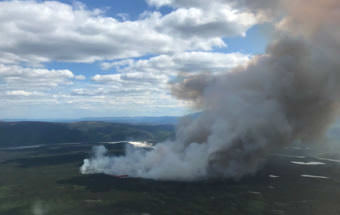
The North Robertson Fire burning about 2 miles west of the Alaska Highway near milepost 1350 is now estimated at 800 acres. (Photo by Tim Whitesell/Alaska Division of Forestry)
The North Robertson Fire near Tok in 2017. (Photo by Tim Whitesell/Alaska Division of Forestry)

At its start, the Alaska Division of Forestry focused in large part on managing forests for the state’s timber industry. Firefighting was a secondary focus.

But now, over 90% of the division’s budget goes toward fighting fires. And with the frequency and severity of wildland fires only expected to increase, officials say the division needs to further build up its capacity to ready for conditions ahead.

Gov. Mike Dunleavy introduced an executive order this week to change the name of the department from the Alaska Division of Forestry to the Alaska Division of Forestry and Fire Protection. He also requested money in his budget for an additional 30 positions.

Division spokesperson Tim Mowry said it’s time for the division to catch up with the ever-increasing need for fire management..

“Even this past year, where we burned 250,000 acres — which is a very small fire season in Alaska — we had to bring up more than 300 people in the Lower 48 to fill positions that we just don’t have up here,” Mowry said. “So we’re trying to become more self-sufficient. And we need more people to do that.”

The impending shift accompanies a rise in wildland fires in Alaska and the Lower 48.

That rise has happened before Randi Jandt’s eyes. She’s a fire ecologist with the Fairbanks’s Alaska Fire Science Consortium.

“It is an interesting job to be an ecologist when things are changing so rapidly that you can actually see change in the course of one person’s career,” Jandt said. “That’s pretty astounding.”

Alaska’s wildfire risk is rising with that of the Lower 48. And while the ecology of a place like Boulder, Colorado is different from that of Alaska, Jandt said they’re all experiencing more extreme weather events.

“I can tell you with quite a bit of confidence that the phenomena that we’re seeing are definitely climate-related,” she said.

Jandt said an increase in wildfires in Alaska is related to more lightning and drier conditions that make fuel out of vegetation like moss.

What’s more, so-called “zombie fires” — named for their tendency to arise from the dead after winter — are increasing in northern climates.

Fire seasons are also becoming longer, complicating existing agreements between crews in Alaska and the Lower 48. Now that those seasons overlap, it’s harder for states to send crews elsewhere during their off-seasons.

“I’ve been a firefighter in California,” Jandt said. “And our season was, back in the 80s, four or five months. But it certainly isn’t now. And in Alaska, our fire season has increased by roughly a month in the last 30, 40 years.”

The 2019 fire season in Southcentral Alaska was the hottest and driest June-through-August season the region had experienced in 40 years, according to a recent study Jandt coauthored with other researchers from UAF. Interior Alaska and Alaska’s tundra are seeing the largest changes to climate and fire conditions in the state.

Jandt said the cumulative changes require new ways of thinking about fire management, from agencies like the Division of Forestry and individual property owners.

“And I think just the intensity that we can get with a fire season like 2004, 2005, 2015, 2019 … I mean, you start to get the picture,” she said. “You need more capacity, more wildfire fighting capacity to try and protect all the communities that might be threatened at once by a season like that.”

Mowry, with the division, said the name change in particular might seem minor.

But he said more people than ever before are living in parts of Alaska that can be impacted by wildland fires. Consequentially, it’s important for Alaskans to understand what the department does so they know where to go when they’re facing fires.

The name change takes effect this summer, unless it garners opposition from the Alaska legislature.

Kenai Peninsula Borough mayor files bid for Alaska governor

Kenai Peninsula Borough Mayor Charlie Pierce in 2018. (Aaron Bolton/KBBI)

Kenai Peninsula Borough Mayor Charlie Pierce is joining a crowded field of candidates for Alaska governor.

Pierce, a conservative, filed a letter of intent Thursday, according to an email from his chief of staff Aaron Rhoades to some borough employees.

Pierce is serving his second term as Kenai Peninsula Borough Mayor. He terms out in 2023.

Pierce did not immediately respond to requests for comment. He told conservative blog Must Read Alaska that he wants to run the state like a business to jumpstart the economy.
He’s been an advocate for keeping the borough budget lean and has said he follows the idiom, “if it ain’t broke don’t fix it.” 

His most recent term in office has been dominated by management of the COVID-19 pandemic. Pierce was an outspoken advocate of opening the peninsula up to business as usual early in the pandemic and keeping mask-wearing a personal choice. More recently, he slammed the borough-owned hospital at public meetings and on talk radio for not offering COVID-19 patients drugs like ivermectin, which has not been approved for treatment against COVID-19 and is popular in anti-vaccine circles.

Before he was borough mayor, Pierce was on the Kenai Peninsula Borough Assembly and was a manager at Enstar.

Also on the ballot for governor is incumbent Gov. Mike Dunleavy, Republican Wasilla Rep. Christopher Kurka, Republican Bruce Walden and Democrat Les Gara. William Toien is running as a libertarian and former Gov. Bill Walker is running as an independent.

Alaska seafood showing ‘partial recovery,’ says state seafood marketing arm

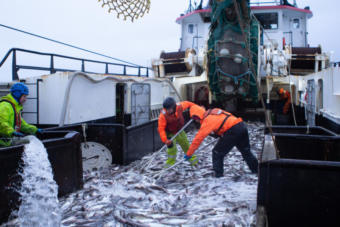
Crew members shovel pollock off the deck of a Bering Sea fishing boat earlier this year.
Crew members shovel pollock off the deck of a Bering Sea fishing boat in 2019. (Photo by Nathaniel Herz / Alaska’s Energy Desk)

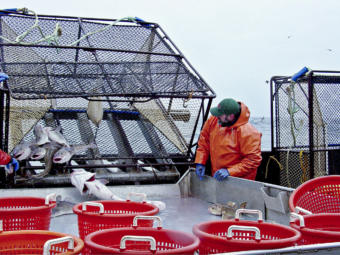
Things were looking up for Alaska’s seafood industry in many ways in 2021. More people around the world took to buying and cooking seafood at home and seafood prices went up statewide.

But the industry is still struggling with problems brought on and exacerbated by COVID-19, like supply chain issues and mitigation costs. That’s according to a new report from the Alaska Seafood Marketing Institute, the state’s seafood marketing arm.
“Our industry is still facing a lot of the challenges it faced both at the start of the pandemic in 2020 and even before that,” said Ashley Heimbigner, communications director for the institute.

She said this year’s report scrutinized numbers from 2019, since 2020 was such an anomaly.

The report found seafood created the third most jobs of any industry in the state that year, behind oil and gas and tourism, and generated the second highest labor income. Most workers were concentrated in the Bering Sea/Aleutian Islands and Bristol Bay regions.

Fishermen in Alaska’s fisheries earned a gross $636 million in earnings in 2019. And Alaska contributed 11% of the global supply of salmon.

Still, the report says farmed salmon outnumbers wild salmon 2.8 to 1.

The institute also analyzed preliminary industry data from 2021.

“In terms of differences between 2020 and 2021, we are seeing the price of Alaska seafood increase for the value of all of our stakeholders,” Heimbigner said.

That was true for the Cook Inlet fleet last year, where fishermen reeled more in salmon and higher earnings than they did in 2020, despite a continuing downward trend for the salmon fishery.

Past heat waves and low sea ice continued to impact Alaska’s waters in 2021

A man in an orange raincoat watches Pacific cod slide out of a black cage onto the boat.
NOAA Fisheries scientists collect Pacific cod samples in the Aleutian Islands. The North Pacific Fishery Management Council, closed the Pacific Cod fishery in 2020 after the blob decimated cod stocks in the Gulf of Alaska. (Public domain photo by
NOAA Fisheries)

The so-called blob that brought warm surface water temperatures to the Gulf of Alaska between 2014 and 2016 has passed.

But the effects of that blob, and a subsequent heat wave in 2019, are not all in the rearview mirror. And researchers are bracing for more as climate change brings with it more ocean warming.

“For an area like the Gulf of Alaska, definitely this is a topic we need to understand better,” said Bridget Ferriss, a research fish biologist with NOAA Fisheries. She edited this year’s Ecosystems Status Report for the Gulf of Alaska, used by federal managers to inform fisheries policy in Alaska.

Last year, researchers continued to track the impacts of recent heat waves on Alaska’s marine species.

Ferriss said a heat wave happens when the sea surface temperature on a given day is warmer than 90% of the temperatures on record for that same day, for five days in a row.

The gulf wasn’t dominated by heat waves in 2020 and 2021 like it was in the years before. But some populations are still responding — for better or worse.

Forage fish, some seabirds and humpback whales in Prince William Sound all seemed to see declines in the gulf related to warm temperatures, with mixed rates of recovery.

Herring, on the other hand, have done great since the heat wave. They thrive in warmer water.

Salmon were likely impacted by the blob as well. Ferriss said decreases in salmon runs in 2020 track with low juvenile salmon survival in the years immediately following.

“I think definite signs are that they were affected by the heat wave,” Ferriss said. “We don’t have a nice concise story yet to really what caused each one.”

NOAA Fisheries Research Biologist Elizabeth Siddon was the editor of the Bering Sea ecosystem report. She’s also taking the long view at how conditions over the years have impacted salmon runs.

“Many of the stories or the things we saw in 2021 were a result of conditions that these organisms — fish or crabs, salmon — have experienced since 2014 when this new warm phase started,” she said.

Siddon has been thinking about three coincident crashes in the Bering Sea — snow crab, salmon and sea-birds.

She said having the historical perspective is important. Understanding the salmon crashes in the Arctic-Yukon-Kuskokwim region, for example, requires following the run through the last several years.

“What we’re seeing this year could be the results of what happened this year,” she said. “Could be the results of what happened two years ago or three years ago.”

Scientists who are monitoring the Bering Sea are looking at another important factor: sea ice.

“When the ice melts, we get this cold, dense water that sinks to the bottom of the Bering Sea,” Siddon said. “And that cold water then changes the distribution of the fish in the Bering Sea.”

She said when sea ice was low and there were no cold pools in the years after the wave, so species were freer to move into the northern Bering Sea. Now, she said NOAA is seeing different combinations of species living there than it has seen in the past.

Reports like NOAA’s are used to inform policy decisions by the council that manages fishing in Alaska’s federal waters. That group, the North Pacific Fishery Management Council, closed the Pacific Cod fishery in 2020 after the blob decimated cod stocks in the gulf.

Ferriss said it’s too early to tell if that species is recovering, years after the fact.

“It’s still at a low level since the marine heat wave period,” she said. “And we’re monitoring it and trying to make sure we’re managing that fishery correctly so it can recover.”

She said it’s important for researchers and fisheries managers to stay up to speed on how changes like these impact species in the gulf because the area is changing so rapidly.

That’s true now, just a few years after the blob subsided. But as heat waves continue to increase in the North Pacific, as they are predicted to do, it could be more critical than ever.

Alaska SeaLife Center scientists learn from two baby belugas with diverging paths

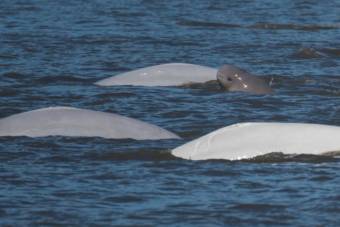
Endangered Cook Inlet belugas in the wild. (NOAA photo)

Tyonek became the first beluga calf to be successfully nursed back to health when the Alaska SeaLife Center rescued him in 2017. The baby beluga was just 6 months old when he was found stranded on a mudflat in Trading Bay, on the other side of Cook Inlet.

The scientific success story came just a few years after the SeaLife Center took in another stranded beluga calf from the beluga population in Bristol Bay. But that calf, named Naknek, died from infections.

Those two cases give biologists invaluable insight into the species, said Carrie Goertz, director of animal health at the SeaLife Center. She and her team published a paper on the two whale tales, and their findings, late last year.

“As we’re caring for animals, we wind up getting a lot of information about them, specifically, but also about the populations they come from and even the species,” Goertz said.

Opportunities to study beluga whale calves up close aren’t so common.

That’s what made Naknek and Tyonek so interesting for the team. Goertz said researchers gathered important data on the beluga populations while they were in the SeaLife Center’s care, from hearing tests to disease screenings.

Naknek, the Bristol Bay beluga, was found stranded after a storm in 2012. He was born prematurely. Goertz said he had a weak immune system as a result, which is partly why he died.

“In retrospect, there are things we could’ve tried with Naknek,” Goertz said. “We could’ve been more aggressive with various therapies.”

But she said the experience was informative. Cut to Tyonek, several years later.

“We were able to learn not only how to provide care, but potentially giving us the comfort to go ahead and pursue more aggressive treatment,” she said. “And I think that really helped in the end.”

Unlike Naknek, Tyonek had experience with his mother, as well, which Goertz said was important to how he adapted.

After a month at the center, Goertz and her team weaned Tyonek off his medications and moved him to a pool outdoors. But they determined he couldn’t live on his own in the wild.

In 2018, Tyonek was moved to SeaWorld in San Antonio, Texas.

Goertz said it was a bit of an adjustment from all the time around human caretakers. But eventually,  it clicked.

“And when he started exhibiting play behaviors with other belugas, it was just a really magical moment, to be honest,” she said.

Tyonek still lives in San Antonio today.

Goertz said rehabilitating cetaceans, in general, is difficult. Even though Naknek didn’t survive, his story and Tyonek’s show promise that, while caring for beluga calves in captivity does require an extreme amount of care and dedication, it can be done.

American history professor reflects on Jan. 6 insurrection: ‘We must not be enemies’

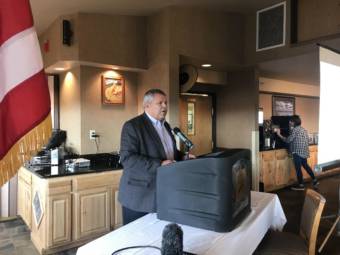
Professor Jeffrey Meyers spoke at a vigil in Homer Thursday morning on the one-year anniversary of the Jan. 6 riot at the U.S. Capitol. (Photo courtesy of Jeffrey Meyers)

One year ago, a mob of pro-Trump insurrectionists violently stormed the U.S. Capitol while lawmakers gathered to certify Joe Biden’s Electoral College victory.

On the other side of the country, Jeffrey Meyers was gearing up for the first day of the semester at Kenai Peninsula College. Meyers is an assistant professor of history and political science at KPC’s Homer campus.

When we talked to him on Jan. 6, 2021, Meyers said he was just starting to think about how to make sense of that day and contextualize it in his American history courses. Thursday, on the anniversary of the riot, he said it’s something he has thought a lot about in the year since.

Jeffrey Meyers: I watched quite a bit this morning, and I’ve been watching for the last year and reading and listening to people who were there — senators, congressmen, congresswomen. Why it happened, and we’re going to know more and more as things go on.

But mostly it just kind of it makes me sad. But hopefully we can move forward, find out what happened, hold people responsible for what happened and then move forward and get back on track.

Sabine Poux: When we spoke last year, we were talking about how an educator goes about teaching current events like what happened last Jan. 6 as they’re happening when the political climate is so volatile.

It’s been a year. How have you incorporated Jan. 6 into your curriculum?

Jeffrey Meyers: It was good timing for me in the sense that KPC taught a Civil War class starting in January. So students from around Alaska were able to take an American Civil War class through me.

And one of the first things that we did in class is we showed a picture of the gentleman who was running through the Capitol on Jan. 6 holding the Confederate flag.

And I’m sure a lot of people are familiar with that photo. And so we basically started the American Civil War class asking students from Alaska, you know, “What does this photo mean to you?” Or, “What do you see here?”

And there was about 15 or 16 students, and we were all on Zoom because of COVID. And I got everything from, “He’s breaking the law,” and that the Confederate flag is a sign of states that seceded from the Union illegally to “Well, actually, that’s just a symbol of states’ rights and it’s cultural, and there’s nothing too wrong with the flag itself.”

It was interesting that through these 15 or 16 students, you could see that even when you’re looking at the same photo at the same time discussing it, images and ideas and events mean different things to different people. So it has been fairly difficult in this time period to teach things like Jan. 6.

Sabine Poux: Where do you go from there as a professor? Like as an educator, how do you carry on that conversation?

Jeffrey Meyers: Well, that day it went on — “OK, that’s great. Now, let’s learn about what the flag is.”

And then so for the next four months, we discussed the reasons for the Civil War, what it meant to the country, why it occurred, could it have been stopped — things like that.

And so we went through some of the reasons why a human, a person, an American would be flying the Confederate flag through the Capitol. And so from that day forward, we tried to explain that photo a little better with historical outlooks.

Sabine Poux: You went to a Jan. 6 remembrance today. Can you talk about that?

Jeffrey Meyers: Sure. It was put on by the Homer Unitarian Universalists and it was a vigil. And it was a discussion of and a remembrance of what happened to year ago. And just kind of how we got here and what we can do to help heal and kind of move our democracy forward so that we don’t lose it.

And so my role in this was they asked me to give a speech. And I gave a short six, seven-minute — because it was like eight degrees outside — discussion on the historical comparisons between the time that Abraham Lincoln was first elected to his inauguration, which was from November to March, and kind of the similarities between when Joe Biden was elected to his inauguration.

And I kind of went through some of the similarities, in the sense that we have been through this before and we got out of it. And one of the things that Abraham Lincoln said at his inauguration was essentially that we’re friends, we’re not enemies. You know, we must not be enemies. And even though passions have strained us we have to come together.

Site notifications
Update notification options
Subscribe to notifications