KFSK - Petersburg

KFSK is our partner station in Petersburg. KTOO collaborates with partners across the state to cover important news and to share stories with our audiences.
Arizona-based scientist developing geologic map of Southeast Alaska

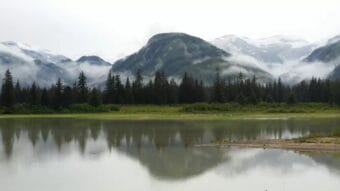
A view of the Stikine River near Wrangell and Petersburg. (Courtesy Cindi Lagoudakis)

A geologist who has studied Southeast Alaska’s rocks and minerals for decades is creating a new geologic map of the region. That map could have a wide range of applications — from educating tourists, to helping prospectors find gold, to helping communities prepare for landslides.

Arizona-based geologist George Gehrels has studied Southeast Alaska’s rocks and minerals for over 40 years. He stopped through Petersburg this summer to do field research and tell the public a little bit about the geologic history of the earth beneath their feet. He wrapped up his summer research trip to rainy Southeast still tanned from the Tucson sun, where he’s a geology professor at the University of Arizona.

He’s been doing field research around the Coast Mountains since 1981 — going out on boats, carving up rock samples, and inspecting them with a tiny magnifying glass. But Gehrels said every summer he spends here is a little different.

“Sometimes we have big groups of students with us, sometimes I’m out with just a colleague and another professor or two,” he said. “Sometimes, I’ve been by myself with my dog — and then she’s the geo-assistant for me!”

So, what makes the region’s rocks so special? He said it starts with a process called “metamorphosis” — that’s when huge amounts of heat and pressure change the formation of a rock. Gehrels describes central Southeast stones in terms that almost sound tasty: crusty bits, flaky bits and what he calls the “Crunch Zone.”

“Petersburg is kind of in the big ‘Crunch Zone’ of Southeast Alaska,” Gehrels said. “The plates are moving — North America, we know, has been moving westward for about 200 million years. As North America moves westward, it’s kind of like a bulldozer — or kind of like a snowplow — moving over the Pacific Ocean off to the west.”

Gehrels said Petersburg was right smack in the path of that snowplow or bulldozer about 100 million years ago, getting crammed up against another piece of the continent at a speed of about five centimeters per year — or, about as fast as your fingernails and hair can grow. That means Petersburg is part of the critical boundary where land was deposited onto the west coast of North America. Gehrels said all that movement and metamorphosis produced some pretty cool rocks.

“Many Petersburg people know about Garnet Ledge down by Wrangell,” Gehrels said. “Those garnets there are a result of this collision. When the rocks get metamorphosed, minerals grow like garnet. So, those are world-class.”

Gehrels said the same metamorphic event formed the blood red crystals that can be picked out of the hillsides in neighboring Petersburg. But those garnets didn’t get hot enough in the formation process to be as good as Wrangell’s — they have more impurities.

Gehrels said the continental “Crunch Zone” produced some of the other rocks that characterize central Southeast — there’s lots of sparkly schist and stripey gneiss and coarse quartzite.

But there’s more to his research than just cataloging cool rocks. Gehrels is gearing up to produce a geologic map of the area with some scientists with the Alaska State Survey. He said that map could be useful for people who might want to extract certain minerals — like gold — from the area. Or, it could help tour guides explain the geological significance of the landscape to visitors.

“Tourism is a huge part of the economy in Southeast Alaska right now,” Gehrels said. “The people on the tour ships, maybe they don’t realize it, but one of the main reasons they come here is because of geology. It’s fabulous, it’s what controls our landscape. Tracy Arm, you know, one of the most beautiful places on the planet — it owes its beauty in large part to the geology.”

But, even more importantly, the information they’re gathering for the map could also help people evaluate the stability of the slopes around them, to protect their communities from disaster — like when Wrangell experienced a deadly landslide last fall.

“That’s a key topic here in the Wrangell-Petersburg area right now, after the big landslide,” Gehrels said. “And all of that kind of depends on knowing a little bit about the bedrock geology in Southeast Alaska. So that’s what we’re trying to do.”

He said his team is developing an interactive digital map where users can zoom in and out, so they can see the level of detail they want — kind of like Google Maps. But he said he’ll still print out a few old-fashioned paper versions — just because he likes them.

He expects it’ll probably take his team a year to finish the map, after which, it will be available to the public.

9th Circuit Court judges hear oral appeals for king salmon troll fishery lawsuit

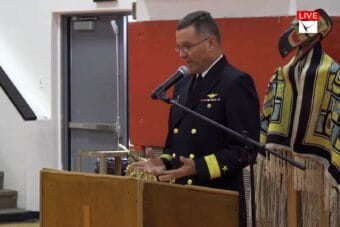
Attorney Laura Wolff (bottom left) speaks on behalf of the State of Alaska in front of judges Mark Bennett, Milan Smith Jr., and Anthony Johnstone on July 18, 2024, from the 9th U.S. Circuit Court of Appeals in San Francisco. (Screenshot from video livestream)

On Thursday, the 9th District Court of Appeals heard cases for and against a lower court ruling that threatened to halt Southeast Alaska’s troll fishery for king or chinook salmon. Although there’s no decision yet, a panel of judges expressed sympathy for the coastal communities that could be hurt by the order.

With an opener the first week of July, Southeast Alaska trollers already got to fish for kings this summer. But the future of their fall season is in the balance at a courtroom over a thousand miles south in San Francisco, California.

The Alaska Trollers Association, the State of Alaska, the National Oceanic and Atmospheric Administration and other entities appealed a lower court ruling that found NOAA broke the law by letting Southeast trollers catch too many kings — to the detriment of a population of endangered killer whales.

The Washington District Court order would have effectively stopped Southeast trollers from fishing for kings. But the case is now on hold in the appeals process and in the hands of judges Mark Bennett, Anthony Johnstone, and Milan Smith Jr.

Attorney Laura Wolff, who represents the State of Alaska, argued that keeping Southeast king trollers off the water wouldn’t only injure the region’s economy. She said it could demolish an entire way of life

“There’s also huge social and cultural harms,” said Wolff. “There are multiple declarations that say, ‘if we can’t fish and earn, if half of our income is last we’ll probably not fish at all.’ So it forces people into poverty or choosing to leave these very small rural communities, and that [has] huge cascading effects. It’s not just harm to some fishermen — it’s remote, isolated communities.”

The Ninth Circuit Court of Appeals last year issued a stay on a lower court order allowing the fishery to stay open — for now. But the Washington-based Wild Fish Conservancy seeks to lift that stay, and keep Southeast king trollers tied up at the docks.

Their case rests on the idea that the trollers intercept salmon that would otherwise feed a population of endangered Puget Sound killer whales, called Southern Residents. Attorney Brian Knutsen, who represents the Wild Fish Conservancy, said trollers should think about fishing for something else to keep their economy going.

“If (the opposing counsel’s) position is that: if (trollers) are unable to harvest chinook, maybe nobody will fish anything,” said Knutsen. “But half — and even sometimes over half — the economic value of the troll fishery is from coho.”

Knutsen also presented research suggesting Southern Resident killer whales, who prefer to eat king salmon, will not recover without immediate and serious intervention.

“The condition is really bad,” said Knutsen. “These whales are continuing to die, and it’s gotten worse during the stay. There’s been no live births since 2023 … Sorry — there was one, but the whale died within a month. There’s been multiple late-stage pregnancies that do not produce calves. These whales need prey now.

But Judge Mark Bennett was skeptical.

“There is a lot of uncertainty around everything here in terms of, is it going to help the whales,” said Bennett. “All we know for sure is that closing some of the fisheries is absolutely going to cause harm to inhabitants of Alaska, and their various subsistence and cultural practices.”

Thekla Hansen-Young is the attorney for NOAA Fisheries. She said that as the appeal moves through the courts, the federal government is rewriting the fisheries rules that were the basis of the Wild Fish Conservancy’s lawsuit. She said NOAA is on track to complete the new version of the rules by November.

And she told the judges she would accept it if they issued more limited instructions — like halting trolling for kings — if NOAA doesn’t finish their rules in time.

With that, the three-judge panel wrapped up the proceedings, with Judge Milan Smith Jr. declaring that he had finally resolved some of his confusion about dolphins and whales.

“I just want to add for the record that (a member of) the audience has informed me that killer whales aredolphins. So there you go,” Smith Jr. said, before tapping the gavel.

The judges may release their opinion on the appeal at any time.

Correction: This story has been updated to correct the spelling of Laura Wolff’s name and the phrasing of one of her quotes. 

Tongass National Forest exits years-long insect outbreak with a ‘bad haircut’

A western black-headed budworm hangs from a silk thread. (Photo by Elizabeth Graham)

Insect infestations began tearing through Southeast Alaska years ago, leaving behind scores of balding trees and annoyed hikers.

Those outbreaks are part of a natural cycle, and the latest appear to be slowing down. But a Forest Service entomologist says the Tongass National Forest might be out of the woods … for now.

If you’ve hiked around the Tongass in the last several years, you might remember walking face-first into a web, or feeling squirmy little bugs drop down your shirt collar. You may have passed swaths of evergreen trees with dead, yellow or rusty-red needles — or none at all — and wondered what’s wrong with them.

If any of those things describe your experience in the rainforest, you’ve witnessed the latest outbreak of hemlock sawfly larvae and western black-headed budworms — which actually aren’t worms at all, but larval moths. U.S. Forest Service Entomologist Elizabeth Graham, who has studied the critters for years, says the latest outbreak started in 2018, with an explosion of hemlock sawflies. Then in 2021, the western black-headed budworm outbreak blew up.

“That was really felt here in Petersburg and the central part of the Tongass, where we had just a lot of trees turning red, causing a lot of concern,” said Graham. “But now, we’re kind of on the other end of it. What happens with these insect populations — we call it ‘boom and bust.’”

Graham says it’s a natural cycle, and there’s little cause for concern to see the bugs come and go so dramatically. The insects are usually kept in check by disease, starvation, parasites and predators — like the several species of parasitic wasps that live in the Tongass.

“They’re essentially what the movie ‘Alien’ was based off of!” said Graham. “They lay their eggs inside their host, the eggs hatch, they feed internally, and then they eventually burst their way out and go find a new host to lay eggs in.”

A type of fungus also keeps the insects in line. But Graham says extreme drought conditions in Southeast did a number on the rain-loving fungus in 2010, triggering the sawfly larvae outbreak. Over the next couple years, the insects munched about 385,000 acres of Tongass trees, until normal precipitation levels returned, bringing the fungus back with it.

But that didn’t mean trees — or hikers — in the region could catch a break from the caterpillar flare-up so soon. The budworm boom came next, and with a vengeance. They defoliated almost 700,000 acres of the Tongass from 2021 to 2023. But according to Graham, things are going back to normal.

“They have the perfect conditions that causes their populations to rise up,” said Graham. “That’s what we were experiencing the last few years where [there are] caterpillars everywhere, and trees turning red … But then, all of the natural control mechanisms that keep that population in check, they get a chance to catch up.”

Some may not miss having fewer bugs dangling in front of their faces while out on the trail. Graham, however, looks at the outbreaks with a different lens.

She calls the insects “Little Foresters.” When she does public lectures about the outbreaks, one of her slides includes a photoshopped image of a little budworm dressed in a hardhat and a fluorescent orange forestry vest — and wielding a tiny chainsaw. Even in the thick of the outbreaks, Graham said they’re just out there doing their little jobs.

“They’re out there, trimming the trees!” said Graham. “And while it’s really ugly, and unsightly when it’s happening — and I know people don’t appreciate having caterpillars hanging from the sky and falling on them and … pooping on them. What they are doing is playing a role in the forest, and they’re thinning some of the trees out.”

By and large, Graham says the bugs aren’t actually killing most of the trees they infest, even though it might look like it. They’re just giving them what she calls “a bad haircut.”

“It may not look pretty … but we’ve all been there, and the only solution is time,” said Graham. “It’s allowing more light to reach the forest floor, all of that feeding and dropping of needles and then going to the bathroom — all of this fertilizer is now going into the forest. It opens up an opportunity for new trees to grow. It’s really pretty impressive if you think about these small, little insects that are actually changing the forest dynamics. I think it’s pretty awesome.”

Graham says budworm outbreaks on this scale usually only happen every 30 years or so. That means Tongass trees have some time to regrow their needles, and hikers are in for a long break from dangling insects.

9th Circuit to hear oral arguments on Southeast king salmon troll fishery lawsuit

""
King salmon landed in the commercial troll fishery in the summer of 2019. (Photo courtesy of Matt Lichtenstein)

A panel of federal judges will hear oral arguments on Thursday, July 18, in an appeal of a lower court ruling that threatened to halt the Southeast troll fishery for king salmon.

The Alaska Trollers Association, the State of Alaska, and other entities are appealing a Washington District Court ruling that found NOAA Fisheries violated endangered species and environmental laws. The ruling says the agency did so by allowing the Southeast trollers to harvest king salmon at rates that harmed a small population of endangered killer whales in Puget Sound, as well as well as several king salmon populations from the lower Columbia River.

That ruling would have effectively stopped Southeast trollers from fishing for kings — at least, until the National Marine Fisheries Service corrects its environmental analysis. But the Ninth Circuit Court of Appeals issued a stay on the lower court order in June of 2023, allowing the fishery to stay open for now.

The Washington-based conservation group Wild Fish Conservancy filed the initial suit four years ago. The organization’s case rests on the idea that the trollers are intercepting salmon that would otherwise feed the Puget Sound killer whales. The Wild Fish Conservancy has since petitioned the federal government to give Endangered Species Act protections to king salmon across the entire Gulf of Alaska.

Wild Fish Conservancy Director Emma Helverson told KFSK via email: “Wild Fish Conservancy is committed to taking all actions necessary, including through the ongoing appeal process, to prevent the further decline of the Southern Resident killer whales and wild chinook populations. Sustainable management of natural resources is essential for the well-being of coastal communities and ecosystems from Oregon to Alaska.”

Representatives from the Alaska Trollers Association and NOAA declined to comment on any litigation matters before the hearing.

In the San Francisco appeals courtroom on Thursday morning the State of Alaska, Alaska Trollers Association, and other entities will have an opportunity to argue against the lower court’s judgment against them. Then, the Wild Fish Conservancy will make its case for upholding it.

Judges Mark Bennett, Anthony Johnstone, and Milan Smith Jr. will hear the case in the Ninth Circuit Court of Appeals at around 9 a.m. Pacific time, or 8 a.m. Alaska time. You can view the court’s live video stream of the oral arguments here.

Petersburg develops tiny home designs in hopes of easing housing market

A rendering of the 600-square-foot Spruce Unit, with the optional gable roof. (Photo: Borough of Petersburg)

Petersburg has a tight housing market – last year, a survey found the town would need an additional 300 homes in the next decade. But a new local program aims to make it easier for people to add small homes, also known as Accessory Dwelling Units, or ADUs, to their property. The Borough of Petersburg has developed detailed, pre-permitted blueprints that are available to residents free of charge.

Community Development Director Liz Cabrera said she hopes it provides people with affordable, doable housing opportunities.

“When you’re trying to address housing situations, it’s multifaceted, so there’s no single solution, she said. “And in this case, we’re trying to make something that takes a lot of the upfront work out of the picture and be able to get someone a little bit further along in getting the project done.”

Cabrera said when you put a tiny home on a lot next to a larger house, you can use the already-installed infrastructure, like roads, sewer and water, of the larger home. That saves a lot of money.

“What it does really well, I think, is that it addresses the issue of the cost of infrastructure development and it gives you an option for increasing the number of housing units without having to build out your infrastructure,” she said.

Cabrera worked with two local architecture firms to develop the plans for four different tiny homes, which range in size from about 350 to 650 square feet. The houses are designed for Petersburg’s climate, and built to the town’s code. Cabrera said she hopes the houses will be used in a variety of ways.

“Just providing a different option for housing, and that can be multi generational, it could be a rental income, it could be having older parents aging in place – there’s lots of options there,” she said. “So really, it’s up to the property owner, and it just gives them a leg up in that process.”

Anyone who lives in Petersburg’s Service Area 1 can apply for the plans. Cabrera said homes built outside the service area would open the borough up to liability, since the borough can’t enforce code outside Service Area 1. Applicants will pay a building permit fee once the borough confirms that zoning codes are met. Cabrera said the borough used money from the American Rescue Plan Act, or ARPA, to fund the development of the plans. She said now that the plans are completed, the program will essentially be free to maintain.

Cabrera said that while she can’t be sure, she thinks this plan is the first of its kind in the state.

Crew swims ashore after crab boat sinks in Duncan Canal

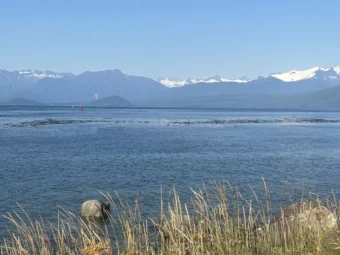
Duncan Canal and the South Kupreanof Roadless area as seen from Portage Mountain west of Petersburg. (KFSK photo)

A Petersburg-based commercial crab boat capsized in Duncan Canal on the morning of Sunday, June 16. A spokesperson for the U.S. Coast Guard reported that the two people aboard the 22-foot Mangy Otter survived the sinking unharmed.

The mariners told the Coast Guard that the vessel was pulling crab pots, which they believe shifted the weight of the Mangy Otter and caused it to sink. Then, they swam an unknown distance to shore. Their neighbors picked them up later that day and escorted them home.

A camper at High Castle Island reported the sinking on VHF channel 16 at around 6 a.m. on June 16. The Coast Guard didn’t send any personnel out to rescue the mariners, as they had already made it to safety. The Coast Guard also did not attempt to recover the sunken vessel.

Site notifications
Update notification options
Subscribe to notifications