KFSK - Petersburg

KFSK is our partner station in Petersburg. KTOO collaborates with partners across the state to cover important news and to share stories with our audiences.
Reality TV crews bring economic boost to Petersburg, but many wonder if it’s worth it

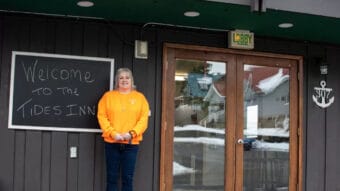
Hotel Manager Holly Childs pictured in front of the Tides Inn in Petersburg. (Shelby Herbert/KFSK)

The Tides Inn is one of just two hotels in Petersburg, and it has hosted almost every visiting film crew to pass through the town since the COVID-19 pandemic. The inn, more than 50 years old, is built into a steep hill just off the main drag and has a clear view of the ocean.

When you walk in, it’s tidy and warm inside. But with the departure of the cast and crew of “Outlast” and “Port Protection,” the lobby is pretty quiet.

Hotel Manager Holly Childs fondly remembers the crews that came and went this winter.

“You know, I’ve had regular hotel guests do more outrageous things than they do!” said Childs.

More than anything else, Childs appreciates the crews for the lift they’ve given to the local economy. Especially in the off season, when the fishing boats have turned in and the tourists have trickled out. In the fall, when Childs would only expect to book the occasional traveling government employee or grade school sports team, Tides Inn was almost completely sold out.

“It means a lot to me, like it does everybody else around here,” said Childs. “To get that little extra boost — to me, that’s very much a positive. Can’t imagine it being a bad thing, to have business come to town, especially that time of the year. It’s been really good (for) us.”

For now, many of the inn’s rooms sit empty. Childs hopes more film crews will return this year.

In 2023, three reality TV shows and one feature-length documentary were shot in Petersburg. The sudden influx of crew members was a small windfall for many local retailers, charter companies, hotels and restaurants.

Business owners around town say the TV and film crews gave them a surprisingly profitable winter season. The U.S. Forest Service, which approved the necessary permits to film on federal land, estimates the crews flooded Petersburg with at least a million dollars.

But it’s a controversial issue in the community. The Forest Service allowed a film crew to take over a popular hunting spot — during peak moose hunting season.

Local subsistence hunter Lee Gilpin said “Outlast” set up camp in a spot that gets a lot of traffic from youth hunters, due to its easy accessibility and safe terrain.

“If you’re growing up in Petersburg, you have one season of deer hunting that you can’t get to during high school,” Gilpin said. “And that’s a quarter of your easy access hunting area — gone. A quarter of the time you can hunt has been put away so somebody could make a few dollars.”

He’s not the only one who feels that way. When the Forest Service opened a comment period for Outlast’s special use permit, they were inundated with letters of concern about the project from people who use that land to hunt.

This isn’t the first time Petersburg residents have tangled with reality TV show crews who popped up in their backyards. In recent years, some locals opposed the Discovery series “Alaskan Bush People,” which they say casts the region in a negative light.

But opinions vary — even among Petersburg hunters. Some have personally chartered and guided for film crews that came to town this year.

Clay Newcomb is a content creator for “MeatEater,” a television and web series about hunting, fishing, and foraging across the United States. Newcomb and his crew came to Petersburg to shoot an episode about trapping wolves. He wasn’t in town for long — most of his crew’s visit was spent deep in the wilderness. But he hired and featured a local hunting guide, and he stopped though town to resupply.

“I loved Petersburg,” said Newcomb. “It was a beautiful little coastal town. We had breakfast there, went to the grocery store, went to the hardware store, ate lunch down at the harbor. We were kind of buzzing around, you know.”

Newcomb may have only been in Petersburg for a short time, but local businesses appreciate the extra patronage — and the exposure.

Along with all the letters of concern, several people representing different businesses in town wrote in favor of letting more film crews set up shop.

Scott Newman, a Petersburg hunting guide and pilot who also sits on the Borough Assembly, was one of them. He thinks the film crews are a good thing for Petersburg. Newman turned his own profit from film-crew business this year. He piloted seaplane flights for “Outlast” in the fall, as well as for a NatGeo documentary filmed in late summer.

But, he said, a lot of other businesses in town benefitted too. With falling fish prices and the sale of one of its two major seafood processing plants, he said the future is uncertain for the town’s economy.

“Petersburg is the town that was built by fish,” said Newman. “And we all see the winds of change on the horizon. And I think Petersburg is going to have to decide how they’re going to navigate for the maximum benefit to the community.”

Now, he said, it’s up to the town to decide its own future — whether that means trying to weather the storm of low dock prices, or opening themselves up to a new type of customer. Either way, once all the media shot in Petersburg gets produced later this year, he’s sure all the exposure will beckon new crews to town.

Improvements could help Five Finger Island’s lighthousekeepers stay for a longer season

Five Finger Island Lighthouse, at the intersection of Stephens Passage and the Frederick Sound. (Shelby Herbert/KFSK)

Five Finger Island Lighthouse has helped mariners navigate Frederick Sound for over a century. But now, it also serves an educational purpose. Every summer, the remote lighthouse draws in scores of visitors who want to learn more about the unique history and ecology of Five Finger Island.

Five Finger Lighthouse Society director Jeff Erickson was skiffing a group of volunteers to Five Finger Island. He piloted his boat away from Petersburg’s South Harbor and into the thick mist hanging over the Frederick Sound.

It’s a long way out to the island — which is located about halfway to Juneau. The trip takes a couple hours on calm seas. Jeff’s boat rumbled on and on over the glassy surface of the water. There wasn’t much to look at — the mountains were blanketed in fog. But that gray monotony didn’t last forever.

That’s because, almost out of nowhere, Erickson had to cut the engine — even though the island was nowhere in sight.

A humpback whale near the Five Finger Island. (Shelby Herbert/KFSK)

He was braking for a pod of whales. The passengers poked their heads outside the cabin to marvel at them.

Not long after, the lighthouse came into focus. Erickson anchored next to a sheer cliff and his passengers start unloading gear for the people staying at the lighthouse – the keepers — crates of food, amenities, and pieces of what is to become their new heating system.

Lighthouse keepers Briana and Don Drury came out to meet us. They’re married — both, from Oklahoma. They were both still working remotely, using Starlink to connect with the outside world. They’re also here working on the lighthouse, itself.

“There is a lot of work that needs to be done around here,” said Briana. “Tons of projects — we’ve been working on the solar array, and the batteries, water pumps, and tracing down electrical issues… And just general cleaning.”

Today, the lighthouse’s  beacon is automated by the U.S. Coast Guard. So, Briana and Don don’t actually have to be around to keep it lit. But the keepers — and a group of volunteers from Petersburg — are working hard to keep the structure intact and ready for visitors.

Briana and Don said that this gig offers a nice escape from the frustrations of day-to-day life. But there’s still plenty to do out here — and plenty of chores.

Interim lighthouse keepers Briana and Don Drury in the Five Finger Lighthouse cupola.
(Shelby Herbert/KFSK)

Among Don and Briana’s least favorites: managing all their waste. It all has to go out on a boat from the Five Finger Lighthouse Society, which only stops by every couple weeks. However, Briana said, for the experience they’re getting, it’s all worth it — down to the last ounce of trash.

“I mean, I think it’s the most beautiful place on the planet,” said Briana. “So, when the board said they needed lighthouse keepers for three weeks at the end of the season, we said, ‘Absolutely!’”

Another one of their duties was to greet visitors who occasionally come in off the cruise ships and show them around.

“We’re new to the job,” said Briana. “So we actually haven’t had visitors come ashore yet, except you! But yeah, showing visitors around… Giving them the history, asking them to help support because it’s a nonprofit. So, if we don’t have the money to fix something, it doesn’t get fixed.

Briana said it takes a unique type of person to step up for the job.

“If you enjoy solitude, and if you enjoy whale watching and MacGyvering, this is the job for you,” said Briana.

The Drurys can tolerate cobbling together complicated mechanical equipment, but the real draw for them is the environment. The waters around the lighthouse are teeming with marine life —and whales are the star of the show here.

The best place to whale-watch is from the island’s helipad. Don was up there chatting up a pod of humpbacks in the distance.

“Remember Moby Dick!” Don called out to them.

Briana said the helipad isn’t just the best place to see the whales — it’s also the best place to hear them.

“You can just kind of close your eyes and hear these just massive animals making these just kind of primal, primordial sounds,” said Briana. “In the evening, they start bellowing and making these really deep rumbling sounds that you feel almost more than you hear.”

Despite all the natural beauty around her, Briana admitted that, after a while, the spot feels a little eerie. Author Sue Henry wrote a murder mystery novel about it: Murder at Five Finger Light. Unlike the characters in Henry’s novel, visitors probably won’t stumble upon a hidden corpse on the premises. But they might find some hidden treasure. There’s a geocache tucked into a hollowed out tree next to a steep cliff.

“It’s one of the more difficult ones to get to if people are trying to follow the coordinates,” said Briana. “We’ve heard stories of people trying to land here and scramble up this cliff. They’re just following the GPS coordinates and not actually looking around the island for where to anchor!”

The Five Finger Island geocache. (Shelby Herbert/KFSK)

Briana led the way back to the lighthouse, picking handfuls of thimbleberries as she passed them by. It was a sweet end to the day, especially for the volunteers who, after a lot of sweat — and maybe even a few tears of frustration — successfully installed a new boiler.

The fruit of their labor, funded by community donations and a Rasmussen grant, means that the structure has a more reliable heat source that will protect it from humidity and mold. Jeff Erickson said the upgrade means a lot for the future of the Five Finger Lighthouse.

“What was accomplished today — we finally got our heating system,” said Erickson. “The boilers are hooked up, and we got heat in the lighthouse, which was a big accomplishment. It’s never been hooked up. So, it’s a really exciting day for us.”

For most of the winter, the lighthouse sits empty. But that could change soon. Erickson said the new heating system could allow them to keep their keepers longer into the fall and start the season earlier in the spring. And that means more opportunities for them to share its haunting beauty and hidden treasures with the outside world.

Petersburg Christmas Bird Count records highest number of birds in recent memory

Brad Hunter looks at waterfowl through his spotting scope at Hungry Point. (Shelby Herbert/KFSK)

Petersburg birdwatchers cataloged scores of birds for the Audubon Society’s Christmas Bird Count, an annual citizen science inventory of birds across North America. The island community counted the most birds in recent memory.

Splinters of sunlight pierced the morning mist at Hungry Point, a recreation spot on Petersburg’s northern coast. A flock of scoters bobbed in the surf. They’re large dark sea ducks with white markings around their faces. Brad Hunter had his spotting scope trained on them.

“So, there’s three species of scooters: surf, white wing, and black,” said Hunter. “The first two are the most predominant ones we have here — but the black ones are the ones that talk the most. So you know they’re out there because you hear them.”

Hunter didn’t need his sophisticated lens — or even his eyes — to know what types of birds are around him. He can identify many species in the region by sound alone.

“Actually being able to hear the birds is a huge part of identifying what species are out there,” said Hunter. “Visually seeing them is a big part, of course, but when you hear their call, hear their song — it’s very important.”

…Even when that song gets interrupted by other wildlife. Sea lions intermittently barked over the scoter calls.

Hunter has compiled Mitkof Island’s Christmas Bird Count data for the Audubon Society since the mid-90s. He said the group of about a dozen Petersburg birders had a remarkable inventory this year. Hunter is still finalizing the numbers, but by his latest figure, the group tallied a little over 9,000 birds around the island — and that was all in one day.

“I think it’s interesting,” said Hunter. “It’s notable!”

It’s not just the quantity that has Hunter so excited. The group also spotted an exceptional number of species at this year’s count: 61, over their previous high of 57. Hunter said the air was thick with uncommon seabirds this year.

“There’s also some seabirds that are still here,” said Hunter. “We typically do not get Bonaparte gulls on the Christmas Bird Count. But this year, we had quite a few of them.”

He doesn’t know why there were so many birds out and about this winter. But his best guess is that recent warm weather might play a part.

“We suspect that some of the birds that would have headed on South if ice had formed, and lakes and ponds were frozen over,” said Hunter. “[But] they have stayed around longer than normal.”

The climate pattern known as El Niño is cycling warmer water through Southeast Alaska. The resulting unseasonably calm weather is also making it easier for Petersburg’s birdwatchers to stay out longer. Hunter said his group has braved much worse conditions for the count in previous years.

“We’ve had so many terrible weather days for Christmas Bird Count,” said Hunter. “It’s hard to pick one of them out as the worst… But we’ve had some pretty bad ones where it’s blowing 30, 40, and snowing mixed in with rain. Or the roads are all icy, and deep snow — it can be challenging some years.”

Fair weather or not, Hunter said the count is important to him. And that’s because the data birdwatchers collect will help scientists better understand how bird populations are changing — and, eventually, how to better protect them. He said the process of learning about regional birds is also meaningful to him.

“I just find it interesting, just to keep growing and challenging myself and learning more about them — and especially learning about them around here,” said Hunter. “Some people travel all over the world to see how many species they can find. My challenge to myself is to see how many I can find around home.”

That’s what keeps him coming back, year after year.

Scientists and townspeople rescued 2 orcas trapped in a Southeast Alaska lake

A killer whale surfaces in Barnes Lake during the live stranding rescue effort. (Photo courtesy of Jared Towers, collected under National Marine Fisheries Service Permit Number 24359)

Late this summer, two killer whales swam into an ocean-fed lake on Prince of Wales Island and got trapped. The effort to free the whales took a collaboration between scientists and residents of the remote island town of Coffman Cove — with some extra help from the whales’ friends.

It’s possible to get into Barnes Lake from the ocean, but only at high tide, in a small boat.

Doug Rhodes lives around the corner in Coffman Cove, an ex-logging town with a winter population of around 100 people. He says those entrances are the only way to get to the lake, and they’re only passable by small boats at high tide.

“The north entrance is like a class four rapids at maybe two hours after the tide, and the south entrance is a waterfall,” Rhodes said.

So it was a bit of a surprise when two killer whales found their way into the lake in mid-August. Rhodes says at first, people were more curious than concerned.

“It was kind of a novelty thing, you know, ‘There’s whales in Barnes Lake!’ Everybody just figured they’d get out on their own,” he said.

But the window around high tide is short, and the entrances to the lake are small. The whales didn’t get out on their own. After a couple of weeks, folks in Coffman Cove called the experts.

Mandy Keough from the National Oceanic and Atmospheric Administration whale stranding hotline gathered a group of researchers and scientists with experience in orca live strandings. They were concerned about the whale’s body condition. The lake is freshwater fed, so it’s less salty than the ocean, and orcas need salt water to survive.

Jared Towers is a killer whale specialist with Fisheries and Oceans Canada. He says he knew it was possible the whales could get out on their own, but there was another possibility.

“They end up dying in there,” he said. “And dying a slow death because they’re basically starving to death.”

That’s because these were Bigg’s, or transient, killer whales. They eat mammals, not fish. Barnes Lake is full of salmon, but not many seals and sea lions.

The response team decided that their best chance of getting the whales out was during the big tides in late September, a few weeks away.

They would need boats on the lake — more than a dozen. And the researchers said they needed at least three people in each boat. That meant nearly half the town would be out on the lake. Rhodes says that wasn’t a problem.

“As it went on the energy level in town kept building, and more and more people wanted to get involved,” he said.

They would use nets in the water, which the whales experience as a barrier. And they would herd the whales using sound — by submerging metal pipes in the lake and banging on the exposed end. Each required special equipment, which the volunteers made with what the had around town.

The townspeople kept the scientists updated on the whale’s health with photos. From the photos, Towers was able to identify the whales as T051, a 42-year-old male, and T049A2, a 16-year-old male. Towers even knew which orcas they’d traveled with in the past. Not only that, he had actual recordings of those travel partners. The recordings could be played under water to lure the stranded whales toward the sound, a technique called “playback.”

Chloe Kotik studies Bigg’s killer whales for her doctorate degree at the University of Alaska Fairbanks. She says the barrier nets and sounds of metal pipes are stressful to whales. She says playbacks can be really effective, but they’re also stressful.

“When you play a recording of a killer whale that isn’t really there, for them, it’s like seeing a ghost,” Kotik said.

Kotik and Towers arrived with two other scientists a few days before the high tides. More than six weeks after the whales were spotted, 14 small boats filed into Barnes Lake.

Towers and Kotik started the playbacks, luring the whales toward the north channel. Volunteers in the boats banged the submerged pipes to urge them on.

At first, it seemed to be working. The whales responded to the playbacks by breaching and slapping the water with their tales. They followed the sound and entered the north channel. The boats lowered nets to keep the whales from turning back. But a thick kelp bed was blocking the entrance to the channel.

Time was short — the tide was going out. Towers says they knew it was their only shot that day.

“If that whale and the other one didn’t make it through the kelp, our window was over,” he said.

Then the bigger whale turned and swam back into the lake, ignoring the nets and sounds of the pipes. The younger whale was close behind. Towers says even the boats were in danger of getting stranded in the lake. Rapids were forming in the channel.

“We just radioed the others and said, you know, our time’s up,” he said.

Kotik says based on the weather forecast, they likely only had one more day to get the whales out. But more than that, she was worried that they’d already asked too much of the volunteers.

“These people in Coffman Cove have already given us so much of their time and their energy and their help,” she said. “And we didn’t get them out today, how much can we really ask them, and are they going to be willing to help us out with this?”

But when they got to the dock at Coffman Cove, the volunteers were waiting, ready to make plans for the next day.

“It was such a weight off of my shoulders to realize like oh my god, they’re still in it with us,” she said. “They haven’t lost faith in us. They haven’t lost hope.”

The next day they started at the south entrance, which was free of kelp. This time, when the whales heard the playbacks, they were all business. Rhodes and Fecko were in a boat with nets.

“And so they got out in the middle and played this playback, and we looked up and we see the whales coming towards us, and they were picking up speed as he was playing the whale sounds,” Rhodes said.

“There was a bow wake in front of these whales, they were just bookin’ it!” laughed Fecko.

As they charged toward the playback of their friends, the whales called out. The scientists’ underwater microphone picked up the sounds.

“We were just standing there hearing whale sounds across the water as they came by and, oh geez, there were people whooping and hollering and cheering, there were people crying out there.”

As they neared the southern entrance, one the whales dove deep.

They had to wait to deploy the nets until they were both past and in the channel.

They got the net out behind the whales. But Rhodes said it hardly seemed necessary.

“At that point, those guys were probably going ten knots. They didn’t think twice, they just busted right on out of there,” said Rhodes.

The playback boat led the whales through the channel. The southern entrance is long and winding and rocky. Towers said it took 10 to 15 minutes to pass through.

“I was holding my breath for a long time,” he said. “I told myself, ‘Okay when they’re past the maple tree we’re good,’ because there’s this beautiful big Canadian maple on the shoreline at the beginning of the south channel.”

They passed the maple. They kept swimming, out into Lake Bay, and then beyond. The boat followed them for a couple hours.

Kotik says they weren’t sure how the pair would adjust to their freedom.

“Then we saw a kind of shift into this much more quiet, purposeful swim,” she said. “And I think it was because they were starting to hunt. And that moment of seeing that shift was such a relief of like, ‘I really do think they’re going to be okay.’”

Towers and Kotik skiffed back to Coffman Cove. They found a celebration in full swing. Doug Rhodes and Cheryl Fecko said the local bar got plenty of business that night.

“You couldn’t you couldn’t hear in that bar. Everybody was just chattering away,” said Fecko.

“The bar was hopping, everybody was in there. I don’t know if the scientists bought a drink that night at all,” laughed Rhodes.

Scientists don’t know where the pair is now, but they will be spotted eventually. Researchers keep tabs on killer whales through photos sent in by scientists and civilians.

‘Landless’ legislation passes committee for the first time in history

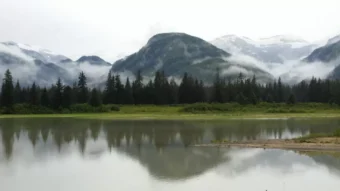
Thomas Bay and Frederick Sound near Petersburg, one of the five “Landless” communities. (Courtesy of Cindi Lagoudakis)

“Landless” legislation passed a new milestone on Dec. 14  after winning approval of the Senate Energy and Natural Resources committee.

The bill still has a long way to go to become law. But if it does, it would return land to the original occupants of five Alaska Native communities in Southeast Alaska. Those communities were left out of the Alaska Native Claims Settlement Act of 1971.

Senator Lisa Murkowski, who sponsored the bill, said in a statement that the omission was “hampering their ability to support development and opportunity while protecting their traditional ways of life. Alaskans have been trying to right this wrong for 51 years.”

ANCSA put millions of acres of land in the control of more than 200 newly formed local and regional Alaska Native corporations.

Cecilia Tavoliero is the Landless delegate for Petersburg and Chair of the Southeast Alaska Landless Corporation board. She was in the room when the bill passed through committee.

“Everybody was elated. We were so happy,” she said. “But we understand there’s a lot more work to do.”

There has never been a clear explanation as to why Petersburg, Ketchikan, Wrangell, Haines, and Tenakee Springs were not included in ANCSA.

Senator Dan Sullivan cosponsored the bill. Representative Mary Peltola has introduced similar legislation in the house. Alaska’s congressional delegation has been bringing similar bills to the legislature for roughly two decades.

Opponents have voiced concerns that the new corporations would log their land, clearcutting swaths of what had been the Tongass National Forest.

But supporters say the timber industry has changed in recent years. Nicole Hallingstad sits on the SeaAlaska board and is a Petersburg representative of the Landless. She said Native Corporations are moving toward more sustainable business ventures.

“The industry in the Tongass is no longer focused on huge harvest of timber.” she said. “And we’ve had such long, engaging conversations with the conservation community, that many of the largest conservation societies in the nation are moving either to neutral or to support our legislation.”

The Wilderness Society recently reversed years of opposition to voice their support for the legislation.

Some are also concerned about public access. But Hallingstad says that public input has helped the Landless delegation refine the bill.

“We’ve got such strong language, ensuring public access, in perpetuity, for recreation activities, your favorite hunting spot where you like to pick berries, that will still be available,” she said.

Public access was not guaranteed by ANCSA.

If the house bill passes committee, the two versions would be combined in a process called “mark-up,” and then would proceed to the house floor for a vote.

Alaska ferry system awarded $132M in federal grants

The 60-year-old Tustumena stops in Kodiak. (Photo by Brian Venua/KMXT)

The Federal Transit Administration announced on Nov. 30 that rural ferries in Alaska will receive about $132 million. The federal money comes from the 2023 Ferry Grant Program, which is funded by the Bipartisan Infrastructure Law.

The Alaska Marine Highway’s fleet has started showing its age, and the state is struggling to keep the ships staffed. Over the past year alone, there have been significant cuts to service.

In a Nov. 30 address announcing the new windfall, U.S. Senator Lisa Murkowski said the funds represent “a big, fat deal” for Alaskans who rely on the service.

“I grew up using the ferry system to get around Southeast, and I know how important the Alaska marine highway system is to so many Alaskan families,” said Murkowski. “By supporting operations across the state and replacing the Tustumena serving Southwest Alaska, we’re helping connect coastal communities across our state.”

$92 million of the grant will contribute to a project to replace the Tustumena, a passenger ferry connecting communities in Southwest and Southcentral Alaska. The deteriorating vessel, affectionately known as the “Rusty Tusty,” is almost 60 years old. Its replacement will be the state’s first diesel-electric hybrid ferry. The state is required to match at least $23 million for this portion of the grant.

However, the remaining $38 million in funding does not require a match — that amount is earmarked for improving the Marine Highway’s workforce and vessels.

Murkowski said the federal funding will help sustain ferry service to rural communities, and that this is a critical opportunity to transform the crumbling system.

“I encourage the state to smartly take advantage of these investments,” she said. “The future of the Alaska Marine Highway System depends on their efforts and contribution.”

To date, the 2021 Bipartisan Infrastructure Law has brought a total of $716 million to support projects to revitalize the Alaska Marine Highway System.

Site notifications
Update notification options
Subscribe to notifications