KFSK - Petersburg

KFSK is our partner station in Petersburg. KTOO collaborates with partners across the state to cover important news and to share stories with our audiences.
Filming of reality show near Petersburg could interfere with subsistence hunting

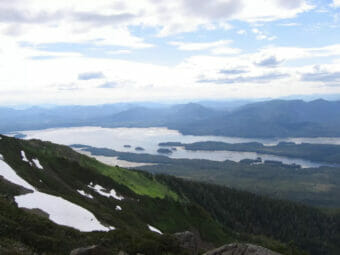
Little Duncan Bay and Duncan Canal as seen from Portage Mountain west of Petersburg. (Photo by KFSK)

“Outlast” is a survival show where contestants are dropped into the Alaskan wilderness to compete for a cash prize — it’s kind of a Hunger Games for adults. It’s only had one season so far, filmed on Chichagof Island, and the competition was cutthroat. Acts of sabotage were commonplace between contestants — including, infamously, setting rival campsites on fire.

The U.S. Forest Service authorized Netflix and the BBC to shoot the second season of Outlast in Little Duncan Bay, a popular fishing, hunting, and recreation area about 20 miles southeast of Petersburg.

Ray Born is Petersburg’s District Ranger. He said a few charter pilots, boat captains, caterers, and Borough officials told him that this would be an economic boon for Petersburg.

“They’re bringing in about a million dollars into the community for this project,” said Born. “So, there’s economic value that way, as we look at it. And part of our mission is to help take care of the community.”

But not everybody in the community is happy — least of all, subsistence users.

“[It] seems misguided,” said Lee Gilpin, a Petersburg subsistence hunter. “There’s going to be some grumpiness.”

Gilpin was speaking from the exact location Outlast is set to take place. He was out hunting moose in late September and saw the film crew staking out the coast. He said he’s not thrilled about them setting up shop right in the middle of the Sitka blacktail season. He said it’s a high traffic hunting spot — especially for local kids.

“My daughter grew up hunting in this area,” said Gilpin. “Every deer she’s ever killed has been inside the area that’s being discussed here. She’s not the only one. There’s a lot of kids in Petersburg that this is where they get to go deer hunting for the first time because the access is very, very easy.”

The federal government usually prioritizes the interests of subsistence users over commercial in rural areas — but not in this case.

In its decision memo, the Forest Service said the filming will affect access to subsistence resources within the proposed area. But the scale of the impact on subsistence is not significant within the overall traditional use area.

Bob Lynn sits on the Petersburg Borough Assembly, and his house overlooks Little Duncan. For weeks, he’s watched the film crew’s charter boats and planes come and go from the area. At an assembly meeting in late September, he said he was concerned for local hunters — and for the safety of the contestants.

“I can see a conflict really quick here, where somebody gets shot — not intentionally, but it could happen,” said Lynn. “I think you might want to take a look at a different time of the year. I think we’re asking for some problems we don’t need.”

Bret Uppencamp oversees special use permits for the Petersburg Ranger District. He said the Outlast crew has to follow a long list of rules to use the area.

“Essentially, like, if they can cut trees down, or if they can have fires, how they’re going to dispose of human waste,” said Uppencamp. “And for wildlife interactions, like — they need to ensure they’re not overly harassing wildlife.”

Uppencamp said those federal stipulations amount to basic “leave no trace” principles, but there’s not much on the list that specifically pertains to safety.

The Forest Service opened up a week-long comment period to gather feedback on the permit. They notified about 450 interested parties on an email chain, and addressed Petersburg’s Borough Assembly and the local tribe, Petersburg Indian Association. About 50 people responded, and feedback was fairly mixed.

Subsistence users weren’t the only ones taking issue with the project. One commenter noted that the area is sacred to Indigenous people. Uppencamp said the district is looking into this claim, but he and Ranger Born believe the filming activities won’t compromise the physical integrity of the site.

Altogether, Born said it was a tough call to make — but the land doesn’t just belong to Petersburg locals.

“This is a relatively high-use area,” said Born. “A lot of people do go through there, but it’s not a closed area. Forest Service land belongs to all the American people. So, everybody has the right to be in there.”

Gilpin said it all feels a little exploitative — and that even if the Outlast crew “leaves no trace” on the land, they’ll leave behind a lost season.

“If you’re growing up […] in Petersburg, you have one season of deer hunting that you can’t get to during high school,” said Gilpin. “That’s a quarter of your easy access hunting area, gone. A quarter of the time you can hunt has been put away so somebody could make a few dollars.”

And it’s not the first go around Petersburg residents have had with reality TV shows in their backyard. In recent years, some have opposed the Discovery series, Alaskan Bush People, which they say casts the region in a negative light.

The Outlast cast and crew will film around Little Duncan until mid-November. By that time, one determined contestant will have won their million dollar prize — but some locals will have missed their chance to get a prize buck.

Alaska Seaplanes to close Petersburg and Wrangell locations

Alaska Seaplanes C-208 Grand Caravan is a nine passenger plane that was used on routes between Petersburg and Juneau. (Photo courtesy of Alaska Seaplanes)

Alaska Seaplanes announced on Wednesday that it will close its Petersburg and Wrangell locations at the end of the month. Alaska Seaplanes is the only commuter airline service in competition with Alaska Airlines in Southeast Alaska.

General Manager Carl Ramseth says the decision did not come lightly.

“It was the difficult decision that came, it came after much deliberation — months and months of deliberation,” he said. “[I] think this is probably the hardest decision I’ve been involved in personally in my 30 plus years of aviation and Southeast. It just was not our plan to leave.”

The closure will take effect for passengers on Oct. 31 and for cargo on Oct. 28.

The airline offers twice-daily flights between Petersburg and Juneau, which allow residents to take day trips to the capital. Those will end, along with the triangular flights that connect Sitka, Wrangell and Petersburg three times a week.

Alaska Seaplanes began serving Petersburg in April of 2021 and Wrangell in May of 2022. Ramseth says that when Seaplanes starts serving a community, they have a three-year plan to allow time to build up a presence in the town. This is only the second time Seaplanes has pulled out of a community before that three-year period is up.

“With Wrangell and Petersburg, it’s just bottom line, the traffic and the ridership didn’t grow as we’d hoped,” said Ramseth.

But low ridership isn’t the only factor. Alaska Seaplanes also rely on carrying cargo. That brings in more business in smaller communities like Tenakee Springs and Klawock because they are not serviced by Alaska Airlines. Ramseth says that isn’t true for Wrangell and Petersburg.

“One challenge that Wrangell and Petersburg have compared to most of our other communities is that we don’t carry any mail or UPS, and we don’t have so much cargo into those communities,” he said. “So that affects the bottom line too.” 

Seaplanes has two part-time employees in Wrangell. Petersburg has one full-time and two part-time workers. All were informed of the closure last week. Ramseth says that while there are jobs with the company for them in other communities, all employees want to stay where they are.

The closure is indefinite, although Ramseth says he would love to be able to serve Wrangell and Petersburg again in the future if factors change.

Alaska Seaplanes isn’t the first commuter airline service to call it quits after a short stint in central Southeast. Island Air ended its Petersburg to Juneau flights after just nine months in 2018. Scott Van Valin, co-owner and director of operations, told KFSK at the time that there was not enough passenger demand on those flights.

Mariners and pilots report dangerous landslide debris in LeConte Bay

Boaters and pilots noticed the aftermath of a large landslide in LeConte Bay. (Photo by Julie Hursey/KFSK)

If a tree falls in the forest and nobody’s around to hear it, does it make a sound?

Maybe that’s best left to the philosophers. But if hundreds of trees tumble off a mountainside and into the ocean — who would find out about it first?

In remote Southeast Alaska, that would be mariners and pilots. They were the first to notice the aftermath of a huge landslide near LeConte Bay in the last week of September. Personnel at the nearest ranger district, in Petersburg, were unaware that it had happened at all.

The Tongass National Forest spans 16.7 million acres — the largest National Forest in the United States. It’s a lot to keep track of.

Doug Riemer is the owner of Nordic Air, a Petersburg-based charter flight business. He was piloting a tour around LeConte Bay when he noticed the telltale signs of a slide.

“Mostly just timber, everywhere,” said Riemer. “This slide was pretty dramatic because it didn’t just land in one spot. It just brought a whole bunch of trees down and it just ripped all the branches off of them and pulled the bark off of them and everything like that — littered trees all over.”

Doug Riemer saw evidence of the landslide from the sky while piloting a tour. (Photo courtesy of Doug Riemer)

That debris can be a dangerous problem. Floating wood can damage or even sink small vessels and marine infrastructure. Glorianne Wollen is Petersburg’s harbormaster. She says she and her team have been getting reports about the slide from northbound vessels all week. And now, they’re trying to fish out as much flotsam as they can before it can clog up the Wrangell Narrows in front of town.

“It was mostly big, big root wads,” said Wollen. “We knew something that let loose because there was rocks and sand and dirt and stuff that was still attached. But we ended up seeing it and reacting as it occurs.”

Landslides are alarming when they happen, even in the most remote areas. Climate change and the resulting wetter weather are making them more common in Southeast Alaska.

Brian Bezenek is a meteorologist with the National Weather Service in Juneau. He says Southcentral-Southeast has seen record-breaking rains in the last few weeks, and it’s probably no coincidence that the slide happened when it did.

“There was an atmospheric river that was pushing through the central-southcentral Panhandle during that time frame,” said Bezenek. “It just turned out that it was a very rainy end of the week, across the area. Petersburg reported 4.47 inches on the 21st — which, looking at the records, would be the rainiest day on record for that day. Over those two days, we’ve received 7.02 inches.”

To put that number in perspective, the normal monthly precipitation in the Petersburg area is 14.35 inches of rain. It got half of that in a single weekend.

Bezenek says those heavy rains will probably bear down for weeks to come. But there’s no telling how long it’ll take for all the debris to get flushed away.

A large increase in trash shipping costs in Southeast Alaska has leaders exploring solutions

Kelly Davis has been driving trash trucks in Petersburg for almost a year. The borough hopes to recycle and compost more to bring down costs. (Hannah Flor/KFSK)

Kelly Davis has been a trash truck driver in Petersburg for less than a year but she already has lots of stories about the things she sees in garbage cans. On a recent trip down bumpy Noseeum Street, she described one surprise.

“I opened it up, it was a dead chicken,” she said. “I shut the lid. I was with Mikey and I was like ‘Oh my God, it’s a dead chicken!’ And he’s like, ‘Yeah it happens,’ and I’m like, ‘God, gross!’”

That chicken is just a tiny portion of the millions of pounds of garbage that Petersburg residents get rid of each year. The borough just signed a trash disposal contract that’s 34% more expensive than the last, one and now they’re hoping to find ways to lower costs for customers in the remote town with already sky-high living expenses.

But trash disposal in Southeast Alaska is expensive. And complicated. Because it’s an archipelago, towns can’t just truck their garbage down the highway to a shared landfill. A lot of municipalities compress their trash into giant blocks called “bales” and barge it down to the Lower 48. Chris Cotta, Director of Public Works in Petersburg, said shipping prices are the biggest sanitation challenge across the region.

The increased cost of Petersburg’s new waste disposal contract won’t be passed on to residents this year. But higher costs will eventually mean higher prices for customers and one of the easiest solutions is simply throwing away less.

Cotta estimated that nearly half of baled trash could be composted or recycled.

“It’s safe to say a really significant portion of what goes into the garbage can could be diverted in some fashion,” he said. “Either converted to compost, or put into a recycling stream and reused as something else.”

The local tribe, the Petersburg Indian Association, already has a small composting program. Cotta is working with the tribe to look into the possibility of expanding the program for the whole community.

But Cotta and others are also exploring region-wide solutions. Over a decade ago, eight municipalities in Southeast banded together to look at possibilities. Cotta is acting chair of the group, called the Southeast Alaska Solid Waste Authority, or SEASWA. He said while Juneau, Sitka and Ketchikan are not yet members of SEASWA, he hopes they’ll join eventually.

“If we could get some of the larger communities to join up and be part of SEASWA, I do think we’d have a lot more bargaining power,” he said.

Cotta said that if most communities in Southeast joined the group, together they may be able to bring down the price of future contracts with shipping companies.

They’re interested in exploring other ideas as well. When the group looked at solutions about a decade ago, they found baling and shipping garbage south to be the most effective solution. That’s why many communities moved to that model but Cotta said increased shipping costs have changed that calculation.

He’s also curious whether new technologies could be part of a solution.

In Petersburg, the coming price increase for most customers will only be the equivalent of a few cups of coffee each month. That might not seem like a lot. But Cotta is concerned. He said if garbage prices go up too much, some customers just won’t pay.

“We end up with a situation where garbage is being tossed in the woods or collecting on properties, because people can’t afford to get rid of it,” Cotta said.

And for organizations that produce a lot more trash than the average household in Petersburg, the cost really adds up. The increase to garbage costs at the Petersburg School District would be a lot more than a few coffees. Shannon Baird is the Director of Finance at the District. She  calculated the potential increase over a school year.

“We were estimating maybe $15,000,” Baird said. “That’s $15,000 that we don’t have to put into other things like student activities, and school supplies.” 

The group plans to apply for funding to conduct study this fall. They hope it will help determine the best path forward for Southeast Alaska.

Alex Honnold and Tommy Caldwell summit Devil’s Thumb, with help from a local climbing legend

Dieter Klose stands outside his cabin on Sandy Beach Road. (Shelby Herbert/KFSK)

Celebrated climbers Alex Honnold and Tommy Caldwell summited Devil’s Thumb in late August. But they couldn’t pull it off without the counsel of a local climber who’s had a decades-long love affair with the mountain.

Standing outside his little cabin on the edge of the rainforest, Dieter Klose gazes out at the ocean. He built this place in the shadow of this giant rock. On this day, a wall of fog blocks his view. But Klose knows exactly what’s behind those clouds.

“It looks just like a German beer stein that’s a little wider at the bottom, so it doesn’t tip over when you’re drunk,” said Klose. “There’s only room for one person at the top, and you can just barely stand — if you have the courage.”

Klose stood there himself, twice. He can’t even count how many unsuccessful climbs it took  — his best guess is a dozen. He’s the only person to make it halfway up the unclimbed Northwest face — and come back alive. Klose has been climbing since he was a kid. He moved to Petersburg in 1982. At first, he lived behind a cemetery in a borrowed tent.

“It got torn up by a bear,” said Klose. “A friend of mine told me, ‘Hey, there’s a boat for sale for 200 bucks.’ And I thought, ‘Great! Then I can look at Devil’s Thumb.’”

Klose said it wasn’t love at first sight — or first summit. His enchantment with the mountain grew over the course of his life.

“It had everything I wanted, everything that satisfied me by climbing,” said Klose. “It’s difficult by any side, and it’s not super high altitude, which is great. We’re totally alone. And it’s a wild looking thing.”

A view of Devils Thumb from Petersburg. (Photo courtesy of Carey Case)

Klose is a home builder by trade. He hurt his back at work a few years ago. The injury all but ended his climbing career — but he’s still known to climbers in the region as the godfather of the Stikine Ice Caps.

“I mean, Dieter is key to anybody who comes here to climb,” said world-class climber Tommy Caldwell.

Caldwell came up north recently to climb Devil’s Thumb and shoot a documentary about it. Dieter advised him and his climbing partner, Alex Honnold.

“There’s just nobody else that knows nearly as much about Devil’s Thumb,” said Honnold. “He’s like, the local custodian — just, like, managing the mountain.”

Klose also helped draft their route. It tags every peak up and down the whole massif; over the twin summits of the Witch’s Towers, the slender Cat’s Ears Spires — and then the looming cathedral of Devil’s Thumb itself. Caldwell said those features were as wicked as the sound of their names.

“All of the summits are like incredibly pointy,” said Caldwell. “You climb up it and you’re sitting on the summit, and there’s like thousands and thousands of feet drop on either side of you. It’s one of the more exposed-feeling summits I’ve ever seen in my life.”

Alex Honnold and Tommy Caldwell spoke with KFSK the day before they left Alaska. (Shelby Herbert/KFSK)

Hours before they left Alaska, both climbers came by to write in a book that Dieter Klose keeps about the mountain. It contains the names of everybody to ever summit in living history. Alex and Tommy sketched out a map of their route that took up two whole pages.

Back in front of his house, Klose gazed across the sound. He said the view is actually better from down here.

“You’re not necessarily enjoying yourself on difficult climbs — you’re getting tired and thirsty, hungry, all of that,” said Klose. “It’s not until you get back into the valley and look up at that mountain, and then you get some real joy out of it.”

Climbing Devil’s Thumb today would be difficult for him. But Dieter Klose still dreams about one last summit.

First climber born and raised in Petersburg summits Devils Thumb

A view of Devils Thumb from Petersburg. (Photo courtesy of Carey Case)

Devils Thumb sits just across the water from Petersburg, a monolith of ice and granite. Until recently the mountain had never been climbed by someone born and raised in Petersburg. Kyle Knight reached the summit after a lifetime of watching the mountain, dreaming of the climb.

Devils Thumb rises to nine thousand feet above sea level, part of the  Boundary Mountains of the Stikine Icefield. Mountaineer Dieter Klose has spent more time exploring the Thumb than anyone else. He came to Petersburg to climb it in 1980, and eventually made Petersburg his home.

“Like my son said, Petersburg wouldn’t be the same without Devils Thumb” said Klose. “I think for everybody, we kind of relate, we see this beautiful thing. It’s inspiring. It’s daunting, it’s aberrant. And it just instills this wonder in climbers and non.”

In cloudy, misty Southeast Alaska, the peak isn’t visible most of the time. So it’s a shorthand – when people say “you can see the Thumb” that means good weather, blue skies.

The mountain’s remote location and extreme conditions make it notorious among rock and ice climbers. It’s been summited fewer than 50 times since Fred Beckey first climbed it in 1946. The “classic” Eastern Ridge is sometimes referred to as the “easy route.” But that’s only in comparison to the icy Northwest Face, which remains unclimbed. Three people have died in the attempt.

To locals, the Thumb is as much a part of Petersburg as the rain and the smell of fish in summertime. That’s part of the reason 35-year-old Kyle Knight wanted to climb the mountain.

“It’s been part of the landscape since before I can remember,” he said. “And I think that’s what makes it so special or significant to me is that that’s a peak that’s been dominating the skyline from a very young age. And you know, it’s totally striking. I know that everybody has some sort of relationship with that skyline.”

His interest started in middle school when he found an old climbing magazine from the ‘70s in his parent’s library. It had an account of Bob Plumb and Dave Stutzman’s first ascent of the Northeast rib of the North Face of Devils Thumb in 1977. “I was just totally enamored with that story of their adventure in the landscape,” said Knight.

But when Knight was young, and even after he started climbing in his teens, summiting Devils Thumb seemed more like a dream than a realistic goal. “I felt like that was sort of the realm of the world class alpinist, and a different challenge at a risk level that I wasn’t going to be able to develop the skills to be comfortable with,” he said.

But the skills came. Knight became friends with people who had climbed Devils Thumb. After high school he moved to the Lower 48 and climbed constantly. The dream became a stated goal.

It would take another 15 years to achieve the goal. That’s partly because the best time to climb the mountain is May through August, when there’s less chance of avalanches and rockfall. Knight is a fisherman and spends summers in Bristol Bay. But this year a close friend with lots of experience on the mountain was visiting Petersburg. They decided they would attempt the climb in August after Knight returned from fishing.

Kyle Knight on the summit of Devils Thumb. (Photo courtesy of Kyle Knight)

Even in summer, storms can make an ascent of Devils Thumb impossible. The pair lucked out, with a tight window of good weather within days of Knight’s return. They took a helicopter to base camp where they spent the night. At about 7:00 a.m. they roped up and began their climb of the Direct East Ridge.

Knight said he often tried to block out the view on the way up. “It’s scary,” he laughed. “So by focusing more just on the moves themselves, you can avoid being negatively affected by that fear.”

They reached the top around dinnertime. “I totally felt satisfaction,” Knight said. “But also I know that getting to the top is only halfway, because you gotta get back down and you never want to feel so satisfied that you lose that sense of focus.”

Knight said the summit is a boulder about the size of a van. “The actual top of it is just big enough for one person to sit astride with 6000 feet of exposure down on either side below your feet,” he said.

They spent about two minutes taking in the view and snapping photos. “And then my partner went up and slapped it and said ‘okay, let’s get the heck down.’” It was two in the morning before they were back at base camp.

Knight said their slow speed could have been due to his training, or lack thereof. He had a very specific training regime in the months leading up to the climb. He explained, “Bristol Bay – sockeye salmon fishing. Lots and lots of crawling in and out of the engine room.” 

But it took longer than expected for another reason. There’s a lot of newly exposed rock at the very beginning of the climb where in the past there had been snowfields. That rock hasn’t had time to settle, which means it’s loose, and dangerous. Knight said the descent in the dark was a risk that he was comfortable taking once. “Yeah, I did it once. I don’t really want to do it again,” he said. “Which like for a fisherman, you might think about, you know, that big storm that you ran through, that you didn’t really want to, but you got stuck in. It happens, but you don’t try to make a habit of it.”

Knight said that he’s always thinking about the conditions of the route when he’s climbing. He’s constantly calculating risk. But that risk doesn’t take away from his enjoyment. “In a way that’s part of the appeal,” he said.

But trying the Thumb again? Knight said he gives it “a solid maybe.”

That’s because “a big part of wanting to do it is looking at it for all these years, now I can look up there and know that I have been up there.”

Veteran climber Dieter Klose is thrilled that Knight summited the mountain.

“He’s the first person that grew up in Petersburg and climbed Devils Thumb. Born and raised,” he said. “And I lived here so many years, I was the only climber. I had to go climbing alone, unless I brought somebody up. And so for Kyle to do it…in my mind, that’s the beginning of a legend in Petersburg.”

One thing is for sure. It’s not the last mountain Knight will climb. He plans to keep fishing every summer, and climbing the rest of the year.

Site notifications
Update notification options
Subscribe to notifications