KFSK - Petersburg

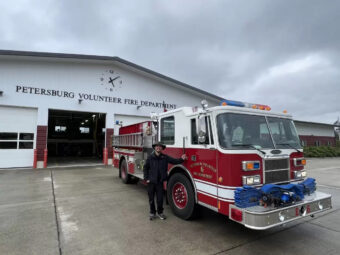
KFSK is our partner station in Petersburg. KTOO collaborates with partners across the state to cover important news and to share stories with our audiences.

Smoke from Canada wildfires reaches Southeast Alaska

Wildfire smoke was visible in the sunset on the coastline of Frederick Sound on Saturday, June 8th. (Photo by Shelby Herbert/KFSK)

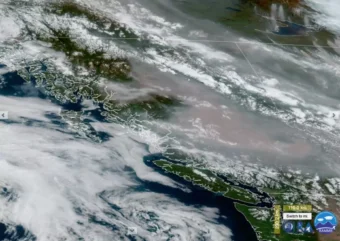
Large swaths of western Canada are ablaze in a record-shattering wildfire season for the country. Now, people in Southeast Alaska are starting to see the smoke — and there’s more to come.

Petersburg resident Brad Hunter woke up to murky skies on Friday morning. By sheer coincidence, that was the day after what Petersburg firefighters are calling the worst structure fire the community has seen in decades. At first, Hunter thought the pale fog came from the blaze at the local Catholic Church.

“I noticed the smoky haze down towards the east, kinda down towards the Stikine River,” said Hunter. “And at first, you’d think, ‘Well, we had that smoke in town on Thursday.’ But then it was apparent that it was a different type and a different source for the smoke.”

On that day alone, more than 22 million acres of British Columbia and the Yukon Territory went up in flames, breaking a record that was set over 30 years ago. A few of the fires are right behind the Coastal Mountain Range — just due east of the Alaska panhandle.

The intense fires blew smoke thousands of feet in the air over the Boundary Range. That’s why, back in Petersburg, Hunter couldn’t see the usual landmarks on the Canadian border.

“Devil’s Thumb disappeared,” said Hunter. “Then, eventually, even the Front Range towards Horn Cliffs started disappearing through the haze.”

The coastline of Sandy Beach on a sunny day. Only a few mountains are visible in the distance. They're half-obscured by a thick fog.
The view of the mountains across Frederick Sound was obscured by smoke on Saturday, June 8th. (Photo by Angela Denning/CoastAlaska)

Andy Park is a meteorologist with the National Weather Service in Juneau. He’s been tracking the smoke across the border, and says there’s no cause for concern quite yet. The air quality levels are still fair: hovering around 17, on a scale that goes up to 300. At least — that’s compared to cities on the eastern seaboard of the U.S., which were choked with smoke from Canadian fires in early June. However, Park says things could get worse around here.

“If we see really increased fire activity in that area, it’ll push more smoke into Juneau, Petersburg, Ketchikan, [and] Skagway,” said Park. “Right now with the models that we have in terms of smoke forecast looks to stay more north of Petersburg. But we would really have to pay attention as to how fires blow up today. You have to watch and see what happens.”

Alaska is in for some more smoke. But so far, there’s been very little fire. Mark Smith is a meteorologist with Alaska’s Division of Air Quality. He says Alaska’s fire season had a late start — but Canada’s is coming in hot.

“This year, Alaska is not burning,” said Smith. “We’ve only had 1,400 acres to date burn. Typically, even during a low fire year, we’ll have 200,000 acres [burned] by this time. But the high pressure has been dominating in Canada — there are hundreds of fires through the Yukon Territory, British Columbia, and Alberta.”

So, when will it stop? Smith’s weather models predict it could take a while for the smoky days to pass — possibly, until the end of the summer.

“Typically, we’re in fire season until the rainy season starts,” said Smith. “But we’re still looking at the Canadian fires being dampened — not ‘till August. So we still have another month of smoke potential.”

Central Southeast, near Petersburg and Wrangell, could get the most of that smoke, on account of the flow of air over the Stikine River.

“Petersburg tends to be impacted from the smoke quicker than a lot of the other areas due to the drainage,” Smith explained. “As the smoke kind of moves into the mountains from the east, that drainage flow would help steer and channel the smoke into Petersburg.”

More detailed data for the area is limited. There aren’t any air quality sensors in Central Southeast. The closest are actually in Ketchikan. But sensors to the north and south are clocking in good air quality levels. Sensitive groups — like children, older adults, and people with lung diseases — can still safely enjoy the outdoors.

So — for now — folks can breathe easy and enjoy stunning sunsets and sunrises stained scarlet by wildfire smoke.

For real-time smoke updates, you can check out the Alaska Division of Air Quality’s website.

Petersburg Catholic church burns in 10-hour fire

The roof and steeple of St. Catherine of Siena Catholic Church was consumed by flames. (Photo by Shelby Herbert/KFSK)

Petersburg’s Catholic church, St. Catherine of Sienna, caught fire yesterday afternoon in a blaze that continued for nearly ten hours.

Don Koenigs has attended St. Catherine of Siena Catholic Church for over 40 years. He was one of just two parishioners at midday Mass on Thursday.

“We were just ready to receive Holy Communion,” Koenigs said. “I looked up and I saw smoke billowing up above, so I ran out of the church immediately and could see that the church was on fire. I ran in and told Father, and I said, ‘You have to take Jesus out of the tabernacle.’”

At 12:29, emergency dispatch received multiple calls as neighbors and passersby caught sight of the flames. Responders were on the scene within minutes. As the firefighters tackled the blaze, smoke billowed from St. Catherine’s down into Petersburg. Sergeant Drew Ayriss said police officers quickly cordoned off several streets.

“The smoke was heading in a southwesterly direction,” said Ayriss. “So we evacuated everybody in the nearby houses. We also evacuated the Children’s Center because it was there [were] actually children in the school.”

At Petersburg Medical Center, CEO Phil Hofstetter saw the smoke as it blew down the hill to  the clinic.

“It was almost like it was porous,” said Hofstetter. “It went right through the building.”

And that meant scores of appointments were quickly canceled.

“We closed all non essential services and we sent staff home,” said Hofstetter. “We put some air scrubbers into the different units for long term care.”

Three fire engines and dozens of emergency personnel responded to the fire. (Photo by Shelby Herbert/KFSK)

Back at St. Catherine’s, crowds gathered as the church roof began to cave in and its spire buckled under the heat of the flames.

“[It’s] bringing tears to my eyes,” said Jim Litsheim. “I’m just shocked.”

“I’ve never seen anything like this,” said Becky Knight. “I’ve lived here for 48 years, and I don’t know — there’s been fires in town, but this is pretty terrible.”

“I’m sad for the community,” said Ed Tagaban. “It’s gonna be tough on all the parishioners there and stuff so they’re gonna go through they’re gonna need a lot of community support a lot of help.”

Among the onlookers stood Father Jose. This is his first year at St. Catherine’s.

“It’s so heartbreaking,” said Jose. “So heartbreaking. But we will survive. That’s our hope. And I want to thank all the fire department works they are working hard to control this fire.”

As the first hour rolled on, more volunteers arrived on the scene. Some, like Taylor Norheim, even raced in from the water to fight the fire.

“I got here late, even,” said Norheim. “I was out on the boat, [but] I had to go. I cancelled work for the day, because, I don’t know — somebody’s got to do it. But I mean, the building’s a loss that really sucks. My parents got married in there a long time ago. “

The Petersburg Fire Department has to rely on volunteers — many, like Norheim, with full-time jobs. Fire Department spokesperson Dave Berg said that means when a massive fire like this happens — the worst he’s seen in a quarter century — they can find themselves with just a skeleton crew.

“One engine came in with only a driver. So there was no one no, no staff. I mean, it’s capable of carrying six us a crew of six,” Berg said. “Our volunteer staff has been declining over the years is just, you know — people don’t seem to be as interested in in either fire service or volunteering as a whole. Which has really put a damper on what we can do as far as interior attack on some structures. And so, at some point, you have to become defensive and go into a defensive mode — kind of like we’re in right now.”

The church steeple buckled from the heat of the flames. (Photo by Shelby Herbert/KFSK)

Aaron Hankins, the director of fire and EMS, said in a race against time, fewer volunteers can hurt.

“We might have been able to get up on the roof before the whole entire thing was compromised,” Berg said. “But by the time we got access and had enough volunteers to do it. You know, it was kind of not really safe to go on there.”

As the afternoon turned to evening, the flames died down but refused to die out. Four-inch-thick wooden beams, tightly layered on the roof of the sanctuary, blocked the hoses from extinguishing the flames smoldering underneath. And the attic of the fellowship was just as hard to access. So the chainsaws came out to carve up chunks of timber to allow for  a way for the water to get in.

Across a parking lot in the Parks and Recreation gymnasium, the congregation of St. Catherine’s gathered for communion, prayer and to plan for the days ahead. Father Jose was living at the back of the church before it burned down. But in a brief moment of levity, he told the parishioners he had just brought home some groceries.

“I was about to cook today — I’d just bought some pork,” said Jose. “It’s maybe roasted now with the fire.”

The congregation hopes to assemble for Mass this weekend in the grotto next to the burnt-out church, but they don’t yet know what can be salvaged from inside. As the parishioners left the gymnasium, they stopped to watch the firefighters still battling the stubborn flames burning in the church roof. Berg says the outlook for the building isn’t good.

“Well, the sanctuary was spared,” said Berg. “There’s heavy smoke damage in their very little fire. But as far as the rectory is concerned — and especially the the Fellowship Hall and the kitchen area — it’s pretty much destroyed. I really think that all in all, we’re probably going to have a total loss with the building.”

It was past 10 p.m. when the final hose was turned off. There was just one injury amongst the multi-agency army of Petersburg volunteers, a broken finger in the fire crew.

The fire’s cause will be investigated in the days and weeks to come by local and state fire marshalls. But for now, St Catherine’s of Siena is reduced to a shell.

With prices low, many fishermen are skipping Southeast’s Dungeness crab season

Crab pots loaded onto the crabbing boat Hi Nikki at Petersburg’s South Harbor. (Hannah Flor/KFSK)

The Southeast Alaska Dungeness crab fishery opened on June 15. But roughly a quarter of the fleet in Petersburg is skipping the season. That’s partly because many of them are expecting low prices.

Two days before crabbing started, Petersburg fisherman Paul Menish was in the cabin of his boat, the Hi Nikki, speculating on crab prices.

“Sounds like prices aren’t going to be as low as we were quoted three weeks ago,” said Menish. “Now, it’s just rumors, but that the prices will be for Dungeness, will be in north at two dollars. Which isn’t a good price but better than three weeks ago.”

It turns out Menish was right.

When he sold his first load to OBI Seafoods in Petersburg, he said he got $2.10 a pound. That’s fifty cents lower than the starting price last summer.

Kevin Timm is the fleet manager at OBI Seafoods in Petersburg. He said the problem is that there’s still a lot of Dungeness crab left over from last year. He said it’s expensive and customers just aren’t buying it.

“There’s not a huge demand for it. It’s all about demand. And with the economy and recession, people aren’t buying crab,” said Timm.

Greg Smith is the communication director of the Alaska Seafood Marketing Institute. He said that while the institute doesn’t track prices, he’s noticed the same thing.

“We believe the impacts of inflation are moving people away from that species, from that category — and as a result, is hurting demand,” said Smith.

The organization doesn’t have any specific information on last year’s leftover dungy inventory. But they do know that snow crab inventory is higher than usual.

“The fisheries, they will kind of trend together,” said Smith. “So we can kind of make some assumptions that with snow crab having higher inventories, that Dungeness also probably has higher inventories as well.”

One way that crabbers make up for low prices is by catching a whole lot of crab. But last year, state managers closed Southeast’s Dungeness summer fishery two weeks early by emergency order because of low harvest numbers.

Joe Stratman is a regional shellfish biologist for the Alaska Department of Fish and Game. He said that unlike many fisheries, last year’s Dungeness numbers are not any indication of potential stocks for the summer fishery. No one will know those numbers until the fishery is under way.

“We don’t survey Dungeness like we do in Southeast for red and blue king crab and tanner crab,” said Stratman. “So we don’t have any stock assessment independent of the fishery. So all of our information is fishery dependent.”

Fish and Game collects data on Dungeness stocks when processors buy crab. That means the department knows what to expect in terms of numbers at roughly the same time the fishermen do.

Menish — the Petersburg fisherman — feels good about this year’s potential harvest. He said the low crab price didn’t factor into his decision to participate this year. He’s heard that there were a lot of soft shells during last fall’s dungy opener. Soft shells mean the crabs aren’t mature enough to be caught and sold, but they’re a promising sign for future harvests.

“[I’m] hoping we can make up for it in volume this year,” said Menish. “But yeah, it has definitely taken the wind out of your sails, you know, when you hear those prices and your enthusiasm drops, but I was gonna do it anyways.”

Still, others just aren’t willing to set gear out. This summer, the Southeast Dungeness fishery opened with only 146 permit holders registered, which is about 50 less than last year.  That means roughly one quarter of the crabbing fleet decided to focus on other fisheries, or stay home and work other jobs.

Mike Weigand is one of them. He owns the Deli, a skiff with a winch for hauling crab pots. Weigand does have another job, which means he can be pretty relaxed about his fishing decisions.

“Even if it’s not the best year, I still have my other job I can kind of fall back on,” said Weigand. “So if it’s bad, then we’ll try and have as much fun as possible, I guess. We’ll just let the gear soak and play.”

One thing is for sure: fishermen are tight-lipped. Now that the crabbing has started, they won’t be sharing their dungy numbers.

Fish and Game will announce the length of the season by June 29. Their report will also have stock data from the first week of crabbing.

Petersburg sees wave of COVID cases after large gatherings

home COVID-19 tests kits
(Photo courtesy of City and Borough of Juneau)

The small island community of Petersburg is dealing with a new wave of COVID-19 cases in the wake of several large public gatherings. Jennifer Bryner is the chief nursing officer at Petersburg’s medical center. She said it’s impossible to know the exact number of cases in town because of the widespread use of home test kits — but from what she’s witnessed in the past few weeks, she knows it’s a lot.

“We’ve definitely seen a lot of new COVID activity,” said Bryner. “I would say it’s probably quite widespread in the community. We’re definitely seeing more people calling and letting us know that they have COVID-19, or asking for Paxlovid treatment.”

Many people who catch the virus choose to test and recover at home. But a lot are getting diagnosed in the emergency room with more severe symptoms — fever, cough, sore throat, fatigue and loss of smell. Bryner said the influx of COVID-19 patients coincides with large numbers of people traveling in and out of town in early summer.

Petersburg hosted the Little Norway Festival in May, which drew huge crowds. Then hundreds more came out for two weddings that took place on the first weekend of June. Bryner said COVID-19 patients are arriving in Petersburg from visiting cruise ships as well.

“We’ve definitely had cruise ship passengers and crew,” said Bryner. “I’m not saying that that’s how it’s getting here — but there are definitely a lot of people who we see from the cruise ships.”

Bryner said Petersburg Medical Center is prepared to handle the wave of patients. They’re well-staffed and well-stocked with Paxlovid, and there have been no COVID-19 hospitalizations so far this month. But she encourages locals to stay vigilant.

The Alaska Department of Health recommends one of the updated booster shots for everybody 6 months and older. Those who are immunocompromised or over the age of 65 may be eligible for a second dose.

Bryner said those who have been exposed to the virus or are developing symptoms should take a test, although some home tests may not turn positive immediately.

“It takes sometimes a while for you to get enough of the virus in your nasal area to turn the test positive,” said Bryner. “The main story is that if you have symptoms, you should stay clear from people — versus just saying, ‘Oh, I had a negative test, and I’m free.’ You might turn positive tonight or the next day.”

Free take-home test kits are available at Petersburg’s Public Library and at the front desk of the Medical Center.

Petersburg police get their first ‘text for help,’ from a sinking boat

Petersburg dispatchers responded to a 911 text from the south end of Kuiu Island. (KFSK photo)

Petersburg police received a request for help last month after a 26-foot aluminum boat tipped onto its side near the south end of Kuiu Island. Two people were aboard, and both of them survived the sinking.

But they never actually called dispatch — the area where the vessel sank was far too remote for that. Instead, they were able to send a text — the first text the department received on an almost two-year-old system that allows users to text emergency dispatchers when they have limited cell reception.

Petersburg Police Chief Jim Kerr says dispatchers got the text at approximately 3 p.m. on April 30. The department was able to gather important details — like the user’s location, the health of the people aboard and even the state of their phone battery — in order to get them help.

“Our dispatch was able to get in contact with the [Alaska State] Troopers,” Kerr said. “[They] ultimately got in contact with the Coast Guard to get resources over there to help them out.”

Kerr said it was a celebratory moment for the dispatch team. In 2021, the Petersburg Police Department was approached by Third Signal, a 911 consulting company, about accepting texts for help. The department paid a one-time fee of $8,000 to implement the service.

“Living in this environment, the biggest benefit is where you end up in spots where you only have one bar,” said Kerr. “You can’t make a phone call, but you can send a text. So we thought that it would enhance the overall safety of this area for the people out there enjoying this country. This was the first legitimate use of it.”

Kerr wants to remind locals that they can still get help when they’re off the grid. The texting service is available if they end up in remote areas with limited service. Some of the latest iPhones can still make contact with a satellite when you can’t get a Wi-Fi signal or a lock on a cell tower. In neighboring Wrangell, emergency dispatch is also capable of receiving text messages to 911 — though the department hasn’t received one yet.

Plans move forward for new hospital that could be ‘the biggest project in the history of Petersburg’

The Petersburg Medical Center inclused long-term care for older residents, among others (Photo by KFSK)
Petersburg Medical Center. (KFSK file photo)

Petersburg is moving forward with plans for a new hospital. The community’s Borough Assembly authorized plans for the new facility on April 17. Now, the Petersburg Medical Center’s board can start drawing up plans for the facility.

However, some community members have concerns about what assembly members are calling “the biggest project in the history of Petersburg.”

The project would replace the existing Petersburg Medical Center with a new facility, which would include updated infrastructure and seven additional beds. The building is roughly 60 years old. And Petersburg Medical Center CEO Phil Hofstetter said the cracks are starting to show.

“There’s a clock ticking on the major components of our facility, and they are failing,” said Hofstetter. “Almost ten years ago, PMC hired architect JYL out of Juneau to complete a comprehensive facility condition assessment. The results show that almost all major infrastructure and architectural standards were at the end-of-life or exceeded their life.”

Petersburg Borough Assembly member Scott Newman said it’s time for a new facility.

“Look around this room,” Newman told his fellow Assembly Members. “Look at how old we are. We’re all aging. And the facility that we have is — well, I’m 58 years old, and I was born in it. My wife works there. I’ve heard stories for 30 years about things breaking down.”

The borough owns Petersburg Medical Center, but it’s operated by a semi-autonomous board, which is planning to source the $85 million necessary to build and outfit the new hospital from state and federal grants. But some community members still have reservations — Don Koenigs is one of them. He told the assembly he’s worried about what happens after construction is complete. He said maintenance and upkeep costs could burden the community.

“You need to figure out how you’re going to own and operate that facility,” said Koenigs. “I believe that should be presented to the public before you start moving forward with your site selection and getting a contractor. Asking dumb questions is much easier than correcting dumb mistakes.”

Koenigs asked the assembly to seek approval from the public before they sign off on the project.

“My suggestion,” said Koenigs, “Is to make sure that you have the confidence and the vote of the public on what you’re endeavoring to try to do before you authorize construction and selection of a site.”

Assembly member Donna Marsh expressed similar concerns over operational and maintenance costs. And she said she thought the $85 million estimate for construction was optimistic.

“It sounds like a great facility, but I don’t think it’s going to fit in Petersburg because we cannot afford it,” said Marsh. “The concept is based on a lot of: ‘If we get this funding, we can do this.’ I think that’s shaky ground. I’ve spoken to quite a few people who wish that it had gone to a vote of the public.”

She was the seven-member assembly’s lone vote against a resolution outlining the borough’s plans for the new hospital. Mayor Mark Jensen said he was initially worried about leaving Petersburg on the hook if state and federal funding falls through. But, he said, he’s talked this through with the borough’s attorney, the architect for the project, the contract manager, and the CEO of Petersburg’s Medical Center. Jensen said he’s confident that the borough won’t be left holding the bag.

“If the money is not there, they can’t proceed,” said Jensen. “So we have to have a guarantee that they have the funding before they take each step in the process. I still have reservations about this. But with this resolution, the way it’s worded, I think the residents of this town are protected.”

Newman said he understood others’ hesitation. But he said he knew how badly Petersburg needs a new hospital.

“Like other people have said, it’s the biggest project in the history of Petersburg,” said Newman. “It’s a mountain to climb. And how do you climb that mountain? You take the first step. None of us have built anything this big.”

In other business, the Assembly unanimously accepted a $17,000 grant from the Alaska Department of Health and Social Services for new lab equipment for the existing Petersburg Medical Center. The grant will fund a microscope with a camera attachment.

Site notifications
Update notification options
Subscribe to notifications