KFSK - Petersburg

KFSK is our partner station in Petersburg. KTOO collaborates with partners across the state to cover important news and to share stories with our audiences.

Petersburg looks for answers to housing shortage

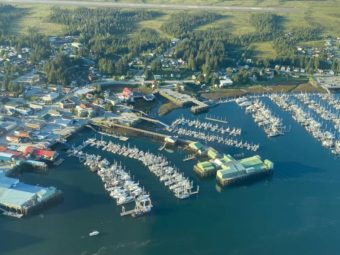
Petersburg’s harbors and downtown from the air on Monday, June 27, 2022 (Photo by Joe Viechnicki/KFSK)

Chase Kirby recently began a job as a police officer in  Petersburg. He says the chief made it clear during the interview that housing is hard to come by here. But he wasn’t expecting it to be this hard.

Kirby has a wife, three children, six dogs and one cat. They’re all waiting back in Utah while he tries to find at least a three-bedroom house. He’s working with a realtor, and the borough is reaching out on his behalf, but nothing has opened up so far. Meanwhile, Kirby is staying in the firehouse.

“It’s not horrible,” he said, “but it’s not home.”

He says that he and his family miss each other. He’s heard that some homes may become available several months from now, but nothing is definite.

Just in the past few years, housing has become a big issue in this small fishing community. Much of the nation is experiencing a lack of affordable housing, and many people have had to move to cheaper areas with longer commutes. But like many Southeast towns, Petersburg is on an island, so commuting from out of town isn’t an option.

“The rental market is very tight,” said local real estate agent Sarah Holmgrain, “as well as the home sales market. It’s difficult to find rentals right now that can accommodate really anybody more than a person or more than a couple.”

A quick online search shows two homes for sale in Petersburg and zero rentals. But 15 Airbnbs are available.

Holmgrain says that’s one area of Petersburg’s housing market that has grown.

“That’s where I think a lot of our rentals have either disappeared into,” she said, “that, or as people have developed rentals, they become Airbnbs.”

That lack of rentals limits the options for people who are trying to make a transition in their lives — whether they’re hoping to move into a situation, like Kirby with his new job, or out of one.

“If today, you had to pick up and leave, where would you go?” said Annette Bennett. They’re the director of WAVE, a nonprofit organization that offers assistance to people in Petersburg who are impacted by violence. “There just isn’t an option. And so that puts people choosing to stay in an unhealthy or unsafe space, because they’d rather do that than be homeless. And there’s also some people that choose to live in their cars, because they can’t live at home anymore.”

Another group that’s affected by the shortage is local employers. Some are having a hard time attracting essential workers. Borough Manager Steve Giesbrecht says the borough has been trying for six months to fill its Fire/EMS Director position, and several finalists have backed out citing housing as a reason.

“We can bring more workers to town,” Giesbrecht said, “but if they can’t find a place to live, then they can’t move here. So it’s gonna be very difficult to fix the lack of workforce without fixing the housing side of it.”

The borough is looking into creating additional lots that people could build houses on. However, it’s very expensive to extend roads and utilities to new areas.

“Generally what we see is by the time the infrastructure is put in place, the value of the lots is so high that people can’t afford them,” Giesbrecht said.

The borough is also interested in creative solutions. It hopes to lease units from the U.S. Coast Guard and make them available for Petersburg first responders. The Borough Assembly on August 29th held a work session on housing, and discussed possibilities like regulating airbnbs, creating tax incentives for rentals, and designating a legal camping area in town.

At the next public meeting on Sept. 6, councilmember Thomas Fine-Walsh plans to  propose an ordinance to allow for tiny homes, accessory dwellings, and multiple buildings on a single lot.

Petersburg man tries to swim across Frederick Sound for ‘no good reason’

A man in a wetsuit swimming past a chunk of ice
Andrew Simmonds attempting to swim across Frederick Sound. (Photo by Josef Quitslund)

Andrew Simmonds walked out onto Petersburg’s Sandy Beach at 8:00 a.m. on July 30. He wore a hooded wetsuit, gloves, booties, goggles and a fluorescent green swim cap. He had a diving knife and a waterproof radio strapped to him.

He was about to try to swim across Frederick Sound — almost six miles from Sandy Beach to the mainland.

“There’s no good reason for me to do this. This is a bunch of nonsense,” Andrew Simmonds said. “But this is what one does when one has nothing else going on in their life. It’s pretty simple. They do things like this.”

He didn’t know how far his body temperature would drop over several hours in 51-degree water — or which way the currents were going. The farthest he’d ever swum before was two miles in a pool.

A smiling man in a wetsuit sitting in the stern of a boat
Andrew Simmonds after his seven and a half hour swim. (Photo by Josef Quitslund)

And he’s 60 years old.

“If I was married, do you think I’d be out here doing this?” he asked.

He waded out into a thick fog and started up a slow, steady stroke.

Simmonds is a physical therapist at the Petersburg Medical Center. He’s originally from New York and says he spent the first 55 years of his life within a 100 mile radius.

When his son went to college, Simmonds joined the Peace Corps and began to travel — South Sudan, Haiti, then Sitka and Hawaii.

He swam in the big waves in Hawaii and liked it, so when he came to Petersburg in November 2021 he started training in the pool to improve his freestyle stroke.  A few months later, he got the idea to swim across Frederick Sound.

Josef Quitslund agreed to spot him in a boat. “I thought he was crazy,” Quitslund says, “but I knew that he could do it.”

When they started crossing the Sound, everything went smoothly. It was flat and calm. They could hear each other well. Around halfway across, Simmonds started thinking that maybe this would be a piece of cake.

But by about six hours in Simmonds, who weighs about 155 lbs, was getting seriously cold.

“Once we got into the iceberg area,” Simmonds says, “I bumped into a piece of ice, which freaked me out a little bit because I thought it was a marine mammal coming to eat me.”

They had reached just northeast of the McDonald Islands, and chunks of the LeConte Glacier were floating by. Simmonds swam harder to warm himself up. He could tell he was losing function and mental clarity.

A map showing a boat's course most of the way across Frederick Sound
The boat’s GPS shows Simmonds’s path. (Photo by Josef Quitslund)

A strong offshore surface current was pushing against him. On the boat, the GPS showed they were in fact moving backwards. But the shore was less than three quarters of a mile away. Simmonds didn’t want to stop.

“I was pulling harder at that point than the whole time over,” he says. “I was kicking harder, pulling harder and going — nowhere.”

Finally, after seven and a half hours in the ocean, he decided to climb up the ladder onto the boat while he still could.

“He was at the point where he really needed to come out, but he was still coherent,” Quitslund said. “And you know, he was under his own power.”

Simmonds drank some hot cocoa, and when he got home he celebrated by listening to some hard rock. He says he feels like a million bucks.

“The target wasn’t hit, but it was a success,” he said. “I faced the demon, I faced the dragon.”

Simmonds is already planning his next attempt, deconstructing the factors to determine what to adjust. He has no interest in trying a shorter or easier route.

Stream restoration near Petersburg aims to improve fish habitat

An excavator working in a forest
Rock-N-Road excavators move logs into place on the east fork of Ohmer Creek Thursday, July 21, 2022. (Photo by Joe Viechnicki/KFSK)

Several streams south of Petersburg are getting some major restoration work this summer. The goal is to mimic natural processes to bring back topsoil and improve fish habitat.

Two excavators were digging out part of the east fork of Ohmer Creek, a salmon stream that runs under Mitkof Highway about 21 miles south of Petersburg. They were moving huge logs, many with rootwads still attached, and placing them in the streambed.

Six decades ago, the trees along this stream were logged and many stumps removed.

“When you lose the wood out of the stream, you lose the fish habitat out of the stream,” said Heath Whitacre, a hydrologist with the U.S. Forest Service. “And the hard part to overcome is, you have a long time to wait until the trees that were logged in the flood plain come back to a size that will create more habitat in the future.”

This project aims to rebuild some of that fish habitat on an area of about 20 acres around east Ohmer Creek, along with the north and south fork of a tributary to that called Lumpy Creek.

The Forest Service has contracted with Petersburg company Rock-N-Road Construction to cut trees and truck them in from a different part of the island. In mid-July, they started using those logs to create deep pools for salmon and trout.

“We’re just basically creating a structure that will create that pool,” Whitacre said. “All that power that comes down in the water is going to basically flush out a nice deep pool.”

The repairs also stretch out into the forest, where the water flows when the streams top their banks. When it was logged, the area was also a source of gravel for crews extending the nearby Mitkof Highway. When they removed that gravel, they also took topsoil that would normally help new trees grow.

The Forest Service is partnering with the Southeast Alaska Watershed Coalition on this project. Kelsey Dean is a watershed scientist with the coalition.

“There’s a lot of areas where this happened in the 60s, and normally you would see trees be two times the size they are now, but they’re really stunted in growth because they lack that topsoil, that nutrients,” she said. “We’re also looking to restore the flood plains and recruit that soil back in by placing large wood there so that trees can grow bigger and not be this stunted.”

The watershed coalition purchased additional wood from a local company that will be dropped into the flood plain. The project also means re-engineering part of one of the creeks to divert flow into an area that’s been cut off.

The cost of the work is just over $400,000 dollars. The Forest Service is paying around $91,000 of that. The watershed coalition pays around $120,000 dollars from a compensatory mitigation fund it has. Another $155,000 comes from federal funding for projects on National Forest land, while the Alaska Sustainable Salmon Fund pays $40,000 of the project cost.

A man in a hardhat points at trees
Whitacre shows a corduroy road created to bring in logs to a portion of Lumpy Creek, along with the stunted spruce and hemlock growing in this part of the flood plain. (Photo by Joe Viechnicki/KFSK)

Sig Burrell owns the Petersburg contracting company Rock-N-Road. He said it’s not the first stream restoration they’ve done for the Forest Service, and they like doing the work.

“I think it will last,” Burrell said. “We did that one out on Kuiu (Island) and one on Prince of Wales (Island). Heath and these guys know what they’re doing, tell us where to dig them in and how to build these structures.”

The Forest Service did some prior restoration work at Ohmer Creek a couple decades ago, adding some rearing ponds for smaller fish. Those are showing signs of working.

The crews will be building around 15 structures in the creeks and the work should be done by early August. The Forest Service will monitor the progress one year, three years and five years after. Although the benefit for tree growth may not show up for much longer.

Ferry board recommends adding crew quarters to Tazlina, does not vote on Cascade Point terminal plan

The M/V Tazlina rounds Point Retreat on its way to Juneau on Saturday, Jan. 29, 2020. (Photo courtesy of Jay Beedle)

The state is already paying around $15 million to add crew quarters on the Hubbard. Now the oversight board for Alaska’s ferry system is recommending the state add crew quarters to the Tazlina.

The state designed both Alaska class ferries as dayboats — without overnight space and operated by a smaller crew — as a cost saving measure. They were meant for use in Lynn Canal, and the lack of cabins limits the routes they can sail. The Tazlina did some service in 2019 and 2020. But the Hubbard has not been used.

The Alaska Marine Highway Operations Board advises the state on the direction of the ferry system. It was created last year and has been meeting every two weeks since February.

The board approved the resolution that recommended adding crew quarters along with other upgrades to the Tazlina, in early July. The resolution calls for that project to be included the state’s regularly updated plan of work for roads, ferries and airports.

Board vice chair Wanetta Ayers of Anchorage said she’s been a skeptic of the addition but now thinks it makes sense for flexibility.

“From a long range stand point I feel that we have to pursue standardization of the Alaska Class Vessels in order to maximize versatility, community service, inter-operability of the vessels,” Ayers said.

The Hubbard upgrades are expected to be done by Nov. 8. On the Tazlina, the recommended upgrades would cost an estimated $18 million if done.

The board also heard this month that the state is still pursuing a new terminal in Lynn Canal to shorten the ferry run between Juneau, Haines and Skagway.

During the summer, the marine highway wants to run the Tazlina in Lynn Canal through a new ferry terminal at Cascade Point. That’s 27 miles north of the ferry terminal at Auke Bay near Juneau . The state is in discussions with Goldbelt, Juneau’s urban Native corporation, about developing a terminal on their land there.

Department of Transportation commissioner Ryan Anderson told the board that the project has been on pause since April of 2021, but DOT wants to keep working on it.

“There’s some public benefits to Cascade Point, one of them being cost savings,” Anderson said. “There would be a reduction in fares for the public to do this —  about 25% is a very round number but what people could expect. There’d also be a time savings. Granted you have to drive further. But even with the drive, I think we came up with, it’s about an hour and a half one-way of time savings for the public.”

Ferry managers say the new terminal would cut 30 miles off Lynn Canal sailings and allow the ship to operate within a 12-hour timeframe. Goldbelt would operate a bus for walk-on passengers getting on or off the ferry at Cascade Point.

The operations board heard pushback on the proposal, which would require driving between ferry terminals.

Ferry Columbia captain Gabriel Baylous said it’s wrong direction for the system.

“I walk on, and sometimes I’ll have a double-bob stroller for my kids, Costco groceries, a dog in a kennel and it’s hard enough getting to Auke Bay. And to get on a Goldbelt bus? I think we’re really moving away from where we want to go as a system,” he said. “I think we should be simplifying things, not making them more complicated.”

The board heard a presentation from Goldbelt president and CEO McHugh Pierre about the corporation’s interest in the project but did not vote on a recommendation on a Cascade Point terminal.

Fishing lodge guests rescued from remote bay

Two Coast Guard ships at a dock
U.S. Coast Guard cutters Elderberry and Pike at Coast Guard moorings in Petersburg in June 2022 (Photo by Joe Viechnicki/KFSK)

The U.S. Coast Guard rescued two guests of a Petersburg area fishing lodge Sunday from the shore of a remote bay after their skiff sank the day before.

The Coast Guard says it found the two in Totem Bay on the southern shore of Kupreanof Island, nearly 30 miles southwest of Petersburg, just after 11:00 a.m. on Sunday.

The two boaters were reported to have left Island Point Lodge the morning before in an 18-foot aluminum skiff. They were expected back by Saturday evening.

When they had not returned Sunday morning, fellow guests at the lodge contacted the Coast Guard.

The Coast Guard sent a 29-foot response boat with a Seattle-based crew that’s deployed in Petersburg this year along with the cutter Elderberry and a Jayhawk helicopter from Air Station Sitka.

The crew of the response boat located the two on shore at 11:13 a.m. and transported them to Petersburg. Both men were reported to be in stable condition. One had a minor hand injury.

Petersburg Volunteer Fire Department spokesman David Berg said local volunteers responded to meet the Coast Guard Sunday.

“These two had been out in this lodge’s boat and were fishing,” Berg said. “The boat capsized. They spent a couple hours in the water. Fortunately they were well dressed for weather with rain gear and not a lot other emergency equipment available with them. A lot of that went down with the boat. But they were able to get a small buoy and swim to shore and spent the evening, all night on the beach.”

Berg said the two used that buoy to get the attention of rescuers. They were not transported to the local medical center but returned to the lodge.

KFSK reached out to Island Point Lodge to try to contact the boaters, but the lodge declined to comment. Island Point is one of the sport fishing lodges on the Wrangell Narrows south of Petersburg, and guests use the lodge’s skiffs for halibut and salmon fishing in the area.

Bar service returns to 2 Alaska ferries

Passengers watch the scenery go by on the ferry Matanuska's forward deck during a May 3, 2017, sailing from Juneau to Haines. (Photo by Aaron Bolton/KSTK)
Passengers watch the scenery go by on the ferry Matanuska’s forward deck during a May 3, 2017, sailing from Juneau to Haines. (Photo by Aaron Bolton/KSTK)

The Alaska Marine Highway System has reopened bars on two state ferries. The ferry system eliminated bar service in 2015 as a cost saving measure.

The state ferry system started serving beer and wine again on two ships, the Matanuska and Kennicott, in late May and early June.

Alaska Department of Transportation spokesman Sam Dapcevich said existing personnel were able to open the bars on those two ships for limited hours.

“We’re serving like Alaskan Brewing Company beer in bottles and cans,” Dapcevich said. “We have some wines, seltzers. We’re also serving like popcorn, chips and pretzels, and we’re working towards offering pre-packaged mixed drinks. And so far the response has been very positive.”

Dapcevich said this year ferry managers were looking for ways to improve the travel experience.

“I think the consensus from our AMHS team was, yeah, if we can do it, let’s do it,” he said. “As you know, we’re already dealing with staffing shortages, so we wanted to see how we could do it without having to hire specific bar tenders.”

The Matanuska offers service between Bellingham, Washington, Prince Rupert, British Columbia and Southeast Alaska this summer. The Kennicott has sailings from Bellingham to Kodiak. The service could expand to other ships operating this year.

Site notifications
Update notification options
Subscribe to notifications