KFSK - Petersburg

KFSK is our partner station in Petersburg. KTOO collaborates with partners across the state to cover important news and to share stories with our audiences.
Forest Service seeks Alaska workers amid national labor shortage

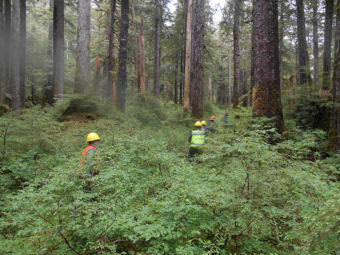
A U.S. Forest Service timber crew on Kosciusko Island (Photo courtesy U.S. Forest Service)

The U. S. Forest Service is seeking new recruits nationwide, with extra focus on filling positions in Alaska. But recruiters say economic conditions are making it hard for them to recruit and retain employees who come from out of state. Now, the agency is turning its attention to the local workforce.

America is in the grip of a widespread labor shortage. According to the latest data from the U.S. Chamber of Commerce, there are over 10 million job openings in the U.S. — but only 5.7 million unemployed workers. The U.S. Forest Service has not been spared from the shortage. And recruiters say it’s especially hard to bring people to Alaska.

Toby Bakos is a wildlife biologist for the Petersburg Forest Service District. He helped set up for a local hiring event on March 2. He said it’s part of the biggest hiring frenzy he’s seen in his decades-long career with the Forest Service.

“This is super rare,” said Bakos. “I don’t remember a single other time when we’ve hired so many permanent positions at one moment in time.”

The Petersburg District is advertising twenty temporary positions as well as six permanent positions. Fifteen of those will open within the next two weeks.

Petersburg District Ranger Ray Born said he hopes the new hiring initiative will help his team make up for years of attrition. His district saw a wave of retirements during the pandemic. Born said the Petersburg Forest Service District is also flush with funding for new projects in the Tongass National Forest. However, those projects require more staff.

“A bunch of different laws got passed and over the last couple of years, and we got increased funding for projects,” said Born. “So we need more people.”

Tiffany Christiansen is an administrative support assistant for the Forest Service. She said the agency isn’t just looking for anybody — they’re specifically seeking out workers with strong ties to the area. Christiansen said hands-on experience living and working in the Tongass National Forest is valuable to the agency — even more valuable than certain academic credentials.

“Someone who has local knowledge has a leg up on someone who’s never been to Alaska,” said Christiansen. “In other words — maybe they haven’t gone and studied these particular sciences in a college down south, but they’ve lived in and grown up in it or lived in it.”

Jason Steele is a Forest Service recruitment specialist. He’s not originally from Alaska, but he recognizes the importance of hiring people who know the area best.

“I could not have gone into Alaska and hit the ground running in these positions, because I don’t know about these things,” said Steele. “In the local community, people do know all about bear habitat and how you would safely work in bear-populated areas in Southeast Alaska.”

But there are also practical reasons for why the Forest Service is trying to source people locally. Born said locals are also better equipped to stay — especially in the current climate of economic hardship.

“We bring people in and they’re like, ‘You mean I can’t drive to my next town?’” said Born. “Some people that’s just not ready for that Alaska adventure.”

Born said Alaska’s remoteness deters potential hires from taking the leap. Especially in the Southeast, where people have to take planes and boats to access the outside world.

However, Born said one of the worst obstacles to hiring people from Outside is Petersburg’s housing market.  Petersburg has struggled with a housing shortage for decades. That lack of housing is already making it difficult for local government offices like the Petersburg School District to bring in workers from out of town.

Born said the Petersburg Ranger District expects up to 40 new workers this year — but they only have 36 beds in their bunkhouse. Compounding that, there’s no space in the bunkhouse for the families they might bring with them. He’s working with local realtors to try and ease the pressure — but that’s why, he said, it makes sense to hire people who are already settled in the area.

Legislature passes resolution to protect Southeast Alaska troll fishery

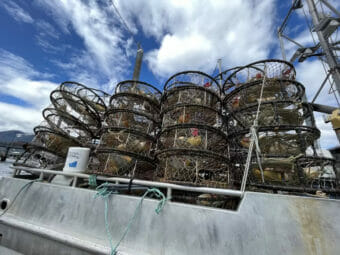
Trollers wait in Ketchikan’s Thomas Basin on Oct. 8, 2022. (Eric Stone/KRBD)

A resolution to protect the Southeast Alaska troll fishery passed in the state Legislature on March 20 by a unanimous vote in the Senate. House Joint Resolution 5 calls on state and federal governments to defend Alaska fisheries from a lawsuit filed by the Washington State-based environmental group, the Wild Fish Conservancy.

The suit seeks to stop the Southeast troll fishery over what the group sees as a threat to the Southern Resident killer whales in the Puget Sound. The organization’s position is that terminating Southeast’s king salmon troll fishery might allow chinook salmon to migrate back down the coast through key hunting grounds of the Southern Resident killer whales.

The Southern Residents exclusively eat fish. They are also genetically, behaviorally, and even culturally distinct from other groups of killer whales. But according to NOAA Fisheries, the population has been in decline for decades, now numbering in the 70s.

The resolution to support the troll fishery was introduced by freshman Rep. Rebecca Himschoot of Sitka, who sits on the House Special Committee on Fisheries. It received support across party lines in the Alaska Senate. Himschoot lauded the resolution’s overwhelming bipartisan support in the latest vote. “I hope the Wild Fish Conservancy reconsiders pursuing this misguided lawsuit and instead starts addressing the factors impacting the Southern Resident Killer Whales in their own backyard,” she said.

The Senate also heard from stakeholders from the troll fishery. Tim O’Connor is the Mayor of Craig and a commercial troller. He said the closure of the fishery would “devastate the troll fleet and have a significant economic impact on the region.”

Many local governments in Southeast Alaska have passed resolutions opposing the lawsuit, including Petersburg, Wrangell, Ketchikan, Sitka and Juneau.

Alaska House passes resolution to protect Southeast Alaska’s troll fisheries from lawsuit

Trollers wait in Ketchikan’s Thomas Basin on Oct. 8, 2022. (Eric Stone/KRBD)

The Alaska House of Representatives passed a resolution to protect Southeast Alaska’s troll fishery on Wednesday. House Joint Resolution 5 calls for state and federal agencies to defend Alaska’s troll fisheries from a lawsuit that seeks to hold them accountable for the decline in killer whales in the Puget Sound area. The legislation passed on a 35-to-1 vote.

Rep. David Eastman, serving District 27 in Wasilla, was the only “no” vote.

The complainant is the Wild Fish Conservancy, a conservation organization based in Washington. Their official position is that terminating Southeast’s king salmon troll fishery might allow Chinook salmon to migrate back down the coast through key hunting grounds of the Southern Resident killer whales.

The resolution to protect Alaska’s troll fishery was introduced by freshman Rep. Rebecca Himschoot of Sitka, who sits on the House Special Committee on Fisheries.

Many of the region’s local governments have passed similar resolutions opposing the lawsuit, including Juneau, Petersburg, Wrangell, Ketchikan and Sitka.

Wrangell woman recounts how she survived sinking that claimed her boyfriend and parrot

A young woman in rain gear with a parrot on her shoulder.
Kelsey Leak survived a boat wreck last month, but lost her boyfriend, Arne Dahl and her parrot, Petrie. (Photo courtesy of Kelsey Leak)

Last month, Kelsey Leak lost a lot. First she lost her pet parrot, Petrie, of seven years. Then she lost her boyfriend, Arne Dahl, when his fishing boat sank and they tried to swim to safety. She also spent a harrowing 24 hours wet and cold, waiting for rescue.

“I was sitting on that rock thinking, ‘I don’t know who’s gonna believe this,’” Leak said.

Dahl was a fisherman — a power troller. His boat, the 39-foot Randi Jo, was like a second home to the couple. Dahl and Leak had been dating for about a year, but their love had bloomed quickly.

“He came for dinner, and he didn’t leave for six months,” Leak said. “It was just a whirlwind.”

It was a clear, sunny day near Point Baker on Nov. 27. Leak says there was calm wind and the waters were foam. She and Dahl took the Randi Jo to gather firewood. On the way back to town, Leak curled up in the wheelhouse to take a nap with Petrie, her parrot, tucked into her shirt. Her golden retriever Mili was also with them.

What happened next was sudden.

“I woke up to being face-first slammed into the side door in the wheelhouse,” Leak said. “The door busted open, and I landed outside on the walkway. The boat just came to a dead halt.”

Dahl told Leak they’d hit a rock. They had a skiff along as well and used that to check out the situation. When they got around to the front of the boat, they saw a huge hole in the port side. They knew it would sink.

Dahl climbed back onto the Randi Jo to get his important papers while Leak stayed in the skiff. She had just learned how to drive it.

“I remember him running to the bow and he’s like, come on, come on, come get me,” said Leak. “My brain is trying to work, and I got up to the midship line again, and a wave pushed the skiff up under the lip of the sinking ship.”

The skiff sank, and the Randi Jo was sinking. The pair had to swim. To their left, they saw a tiny rock island called West Rock.

“My coat started to fill with water,” Leak said. “I was trying to get it off, and I went underwater. And I remember opening my eyes under the water and looking for my zipper.”

When she got back to the surface, she saw that her parrot was struggling.

“I got in my shirt and I took Petrie out, and she was just gasping. And I tried to salt-shaker the water out of her, and I was trying to swim with her, and he said, ‘You have to let her go, I need you to swim with me.’ And I just let her drift off, and I couldn’t even fit that in my brain,” Leak said. “I took a deep breath and just put my face to the water and just started swimming as hard as I could.”

A map of the area where the fishing boat sank.
Map of Point Baker area, with West Rock marked.

Dahl, Leak, and her dog Mili made it to West Rock. It’s about 500 feet offshore, and Leak says it was about the size of a small living room. But it was high enough to stay above the tide. It had a concrete slab marker on top with reflectors and a light.

After resting for a moment, the situation started to hit Dahl.

“He’s like, ‘Oh my god, there goes my boat, we lost our skiff,” Leak said. “And then he paused and he’s like, ‘I just killed Petrie.’ Like, ‘Oh my God.’ And he looked at me. And then I can see his gaze lock on Joe Mace Island. And he was like, ‘We can do that. We can get over there. If we can get over there, we can go get help.'”

But to Leak, the distance looked at least twice as long as what they’d just swam. She’d had a bit of survival training. And her gut told her not to leave that rock. She tried to convince Dahl they should stay, but he insisted.

“You stay. Promise me you’ll stay right there. I’ll come for you,” Dahl said.

She watched him swim out, his head disappearing in the distance. And then it was just her and her dog Mili.

Leak knew that in a survival situation, she could not let emotion take over. So she told herself that Dahl must have arrived safely on the next island.

“Ok, he got out, he found Petrie,” Leak said, “They found some random bottle of Jameson and they’re just making fire on the beach getting warm. They’re having a party, they’re gonna come for me first thing in the morning.”

Leak and Milli faced a long, cold night. Leak’s clothes were still wet. They were synthetics, so they kept her somewhat warm. But it got down to around 26 degrees that night.

“It was a cold, hard night,” Leak said. “I couldn’t feel my feet. My whole body hurt the next day from shivering.”

Sea lions kept approaching, and Mili chased them away. Leak talked to them, naming the biggest one Brutus. She did toe scrunches to keep her feet working. She told Mili they had to stay positive. She tallied all the people waiting for her on the other side of the water. She sang songs in her head.

“Nickelback came on in my head, like ‘If today was your last day,'” Leak said.

Leak and Mili stayed awake all night. They cuddled on the hard rock till the sun broke. Leak could see a house across the water. She stood on top of the concrete block.

“I was waving my hands from 7:30 until 2 pm and trying to get somebody’s attention,” Leak said. “I had some moments on the rock that I was — I mean, it was daylight. I’m starting to process my grief.”

In the afternoon, she realized she might be out there another night, so she climbed down and started wringing out her clothing.

“That’s when I heard like putt-putt-putt of the boat,” Leak said. “I was like, ‘Oh my god, somebody’s here’ and I looked over and see this big white boat with two skiffs towing behind it. I ran down all those rocks barefoot and I was jumping up and down, waving like a crazy person.”

The boat was the Dell II, coming back from a hunting trip. As soon as people found Leak, the search for Dahl started.

“Suddenly there were like skiffs everywhere,” Leak said. “We looked until way past dark, way longer than we should. The weather was starting to get crappy. I mean, it’s, it’s so hard to like give up.”

The U.S. Coast Guard and Wrangell Search and Rescue searched the area for hours, but no one found Dahl. Leak stayed in the area with friends of Dahl’s and they mourned together.

“I’m so happy I had the time with him that I did,” said Leak. “I had a year with Arne, and it’s a huge loss. But there are people out there that have known him his whole life, and they’re hurting too.”

Leak lost two of her loved ones to the ocean that day. But the positivity she cultivated on that rock island that kept her going till morning — it stuck. And it’s helping her get through the loss and focus on what she does have.

Leak is now back in Wrangell, where her family lives.

Correction: An earlier version of this story misstated Leak’s hometown.

‘Surreal’ and then ‘very frightening’: Petersburg residents recount Halloween landslide

Emergency vehicles parked along a road by a steep hillside
Emergency responders at the Halloween landslide scene in Petersburg, October 31, 2022. (Photo by Rachel Cassandra, KFSK)

There were no injuries from a landslide near Petersburg on Halloween night, but it was a close call for some nearby residents. Landslide researchers in Southeast Alaska are keeping tabs on this one and others in order to better predict slides in the future.

“I was standing at my kitchen window, and I looked up, and I saw a green mass just coming towards us,” Sylvia Larson said. She lives on Mitkof Highway, right next to the slide. “I didn’t quite understand what it was. It was pretty surreal, and then became very frightening.”

She was watching the slide through her window.

“I finally figured out it was a landslide,” she said. “I didn’t know when it was going to stop and where it was gonna go and yelled for my husband. And it was like slow motion happening.”

Larson called 911 because she was worried about her neighbors up the mountain side. They all turned out to be safe.

Some of those neighbors are the Walkers. The family wasn’t home at the time of the slide but heard about it from others. The slide had stripped a section of their property. It sent whole trees and earth across the highway below.

The Walkers stayed with family that night. Julie Walker says the next day, when she went to the slide, it all seemed like a movie scene.

“It’s super surreal,” she said. “The closer you get to realize that that’s your property, your house. You kind of just have a knot in your stomach as you get closer to it.”

They were able to walk up to the house to get some clothes and supplies. Walker says the exposed part of their road is too unstable to drive on, and they’re talking with contractors about fixing it.

“Unfortunately,” she said “the landslides are not covered by insurance. So we will have some expensive driveway repairs ahead of us.”

But even with the high costs of repair, Walker feels very lucky.

“I’m just really thankful,” she said, crying. “I’m just really grateful nobody got hurt.”

Walker isn’t the only one feeling gratitude after the slide. Many Petersburg residents have been thinking of those communities nearby who have been hit more severely. Sitka saw a deadly landslide in 2015. And Haines lost two residents to one in 2020.

Thankfully, most landslides in the region are not deadly. But they will keep happening, according to experts. Jacquie Foss works as the Soil Ecology and Botany Program Manager for the Tongass National Forest. She says landslides are a part of the ecosystem’s natural disturbance and renewal process.

Here in Southeast Alaska,” Foss said, “we don’t have fire, but we have things like windthrow, and we have landslides. And so, it’s kind of how soils refresh themselves.”

She says typically they’re associated with intense and hard rainfall. According to the National Weather Service, Petersburg saw close to seven inches of rain the five days before the slide.

It’s not all natural, though. Foss says that how we develop and alter the landscape can make landslides more likely.

Scientists are trying to understand all of these factors and how they impact the likelihood of a slide. Since the big landslide in Sitka, the Sitka Sound Science Center has been gathering data to develop a landslide warning system — a website.

Ron Heintz is research director at the center.

“It tells people in the community what the risk of a landslide is currently,” he said, “and what the risks of a landslide will be over the next 72 hours.”

The online tool was released in August. Heintz says it can’t tell people where a landslide may occur, just that conditions are ripe. He says that the next step in their research is broadening data collection to other communities in Alaska. They got funding from the National Science Foundation for this purpose. He said those areas may include Hoonah, Klukwan, Skagway, Yakutat, Kassaan, and Craig.

Jacyn Schmidt is also involved with the project. She is the regional geoscience specialist at Central Council of Tlingit and Haida Indian Tribes of Alaska. She says the research will be looking at a wider array of influences.

“We see lots of different types of landslides happen around Southeast,” she said. “some of which are associated with extreme rainfall. Others are triggered by other mechanisms, like rockfall is a type of landslide.”

The Sitka Science Center hopes that studying landslides in a bigger variety of places will give them deeper data that can help the region. And for those communities like Petersburg that won’t be in this next stage of research, there are still ways to help.

Foss says if people come across a fresh landslide, even a small one, they can send her a photo with the exact location. She includes all of those reports in a regional landslide inventory.

“It just really helps build the data,” she said, “that informs these early warning products that the science center is working on.”

Landslides may be here to stay. But, with more data, scientists can better understand and predict their impact.

If you see a fresh landslide, you can send a photo and information about the location to jacqueline.foss@usda.gov. And for more resources — like stories, science and how to prepare — you can check out sitkalandslide.org.

Halloween landslide in Petersburg takes out power, phones and internet

View of Oct. 31, 2022, Petersburg landslide from above. (Photo courtesy of Jared Popp)

A landslide about five miles south of Petersburg caused a power outage Monday. Phone lines and internet were also down in parts of town. The slide happened at about 4:30 p.m. and sent a stack of trees and debris across Mitkof Highway. That’s the main road on the island, connecting downtown Petersburg to many residents that live out of town.

As of Monday night, there were no known injuries and no houses were known to be damaged.

A team of responders with Petersburg Fire and EMS searched the debris.

“We’re still searching the pile,” Fire Chief Jim Stolpe said. “I’ve got guys on the other side, and I’ve got two people searching the pile… on that side of the road. Because if there was a car there, when it came through, then that’s what we need to find out. So, there is a little bit of super serious tension right now.”

Stolpe said that one shed was destroyed that was likely a school bus shelter.

Fire Department Spokesman Dave Berg said the damage to infrastructure was extensive.

“It’s taken out power lines and also telephone and two… fiber optic cables from the local providers in the area,” he said. “And fortunately, our internet comes from another direction also, so we will not be isolated in that respect.”

He said that the Alaska Department of Transportation, or DOT, is responsible for removing debris. The road is an Alaska state highway.

Petersburg resident Jeff Hupp lives about four miles south of the slide. He was driving on the road at the time it happened.

“I was on the road. I just picked up the family,” he said. “We were taking the girls in to do trick or treating. …And by the time I drove from their house, to… the store, the power was out.”

The Petersburg Borough said one power pole is destroyed and another one is damaged along the line that brings hydroelectric power to Petersburg. The landslide also damaged the connection to the Blind Slough hydroelectric power system. Borough officials said that customers south of the landslide likely wouldn’t have power until the line is repaired.

It may take the Alaska Department of Transportation a few days to clear the debris from the road. For now, residents can take a detour that includes Cabin Creek Road. It’s a much longer way on dirt roads that aren’t maintained by the borough. The Petersburg school district has excused students who live on the far side of the slide.

Site notifications
Update notification options
Subscribe to notifications