KFSK - Petersburg

KFSK is our partner station in Petersburg. KTOO collaborates with partners across the state to cover important news and to share stories with our audiences.

Veto cuts school project debt reimbursement in half

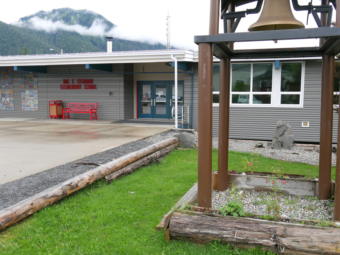
Rae C. Stedman Elementary School in Petersburg. (Photo by Angela Denning/KFSK)

Gov. Mike Dunleavy has vetoed half of the state’s contribution towards debt service for school projects. Local governments will likely dip into reserves, or raise taxes, to make up for the nearly $49 million shortfall.

The state has been covering majority of costs for school projects approved by local voters as recently as five years ago. There’s a moratorium in place for new projects but the state has been continuing payments for older ones.

Dunleavy’s original budget proposed eliminating the state assistance entirely. On Friday, he went with half — and justified it as necessary to pay out a full permanent dividend fund check to Alaskans.

“There’s no easy way out of this,” Dunleavy said, “whether the PFD is taken and the impacts that will have on 680,000 individuals and families statewide, whether it’s taxes, whether it’s reductions. I think everyone realizes that there’s no easy way out of this or we would have found the easy way. But I believe that the communities are going to have to make the decision on how they’re going to deal with that.”

The largest impacts will be in Anchorage, with a $20 million reduction and the Matanuska-Susitna Borough with a $9 million cut.

School administrators say individual Alaskans will end up making up the difference.

“Well a tax is a tax, I don’t care who’s paying it and this is a transference of taxable responsibilities to municipalities and to boroughs across the state,” said Norm Wooten, executive director of the Association of Alaska School Boards in Juneau. He said local governments across the state were counting on these reimbursements when they set their budgets.

“Now the only recourse that they have of course is to either raise taxes or cut services within their municipalities,” Wooten said.

In Petersburg, elected officials have delayed filling public safety jobs in police and fire until the state finalized its budget. Property tax bills were due to go out in the mail around July 1, with a tax rate similar to last year because the borough hoped this funding would continue.

Petersburg Borough Manager Steve Giesbrecht expected to revisit the borough budget after the final word on this reimbursement.

“Kind of the concept has been if we have to get to that point, maybe we wait ‘til the fall when all of the assembly’s back from fishing and in the office, and we sit down and go kind of through a whole brand new budget process, in a sense, on how do we address major changes in funding,” Giesbrecht said earlier this week.

Before Friday’s announcement, the assembly had considered a property tax hike as high as 15% to cover the potential loss of Petersburg’s full annual payment of around $460,000. That repays debt on a community swimming pool and maintenance on school buildings. A smaller tax hike may be one solution, or dipping into reserves or making cuts. It’s a choice municipalities across Alaska will be facing following the governor’s vetoes.

Petersburg museum installs ‘Decolonizing’ bench in municipal building

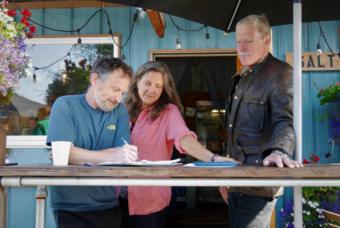
Ray Troll, Delores Churchill and Donald Varnell describe their work on “Ectoplasmic Salmon Settee #1” at the Petersburg Municipal Building Friday, May 17, 2019. (Photo by Joe Viechnicki/KFSK)

The Clausen Museum in Petersburg installed a major new piece of public art outside the borough assembly chambers in the municipal building this month, during Petersburg’s Little Norway Festival. The massive painted and carved red cedar bench is the work of four well-known artists from Ketchikan and was part of the Decolonizing Alaska exhibit that toured the country in the past few years.

“Good afternoon everyone, welcome to the museum’s unveiling of Ectoplasmic Salmon Settee #1,” Clausen Memorial Museum board secretary Jessica Ieremia kicked off the installation on Friday, May 17. She explained the bench came to Petersburg with the Decolonizing Alaska exhibit last fall.

“While this bench was on display in the library, this actual piece of art in particular, really got the curiosity and love of the community and so many people in town had the feeling that this bench needed to stay here,” Ieremia said. “And so Roxy Lee got kind of a movement going. And along with Karen Hofstad they raised enough money to purchase this bench and gift it to the museum.”

Three of the four artists — Ray Troll, Delores Churchill and her grandson Donald Varnell — attended the installation. Nathan Jackson also worked on the piece. A “Do Not Sit” sign has been on the bench following its installation. That’s not permanent. Its only there while a final coat of varnish cures.

“It’s sticky,” laughed Churchill as she and the other artists sat on the bench to discuss their work.

“Ectoplasmic Salmon Settee #1” (Photo by Joe Viechnicki/KFSK)

The work is nine feet long and seven feet high, built from old growth red cedar. It’s adorned with twisted cedar bark rope, acrylic paint, fishing line and diamond plate aluminum. The project took shape when Troll sketched out ideas for the bench but handed over the lead on the project to Varnell, who said it was a challenge collaborating with titans of the art world.

“How do you tell Nathan Jackson what to do? You know how do you tell Ray Troll what to do? As a teenager I grew up with these guys, these guys were my heroes,” Varnell explained. “And I was given the opportunity to be the boss but that didn’t work out very well.”

His grandmother, Churchill told a story of Varnell’s frustration.

“I was at home and Donny comes in,” Churchill said. “He said, I hate that piece. I’m going to burn it. I was so mad at him. We never yell at each other. He and I were just yelling and screaming at one another over this piece. He left and the next day he came and of course we forgave one another right away over this piece.”

The work centers around the theme of salmon. Troll painted a king and coho salmon across the back, underneath a full moon. Varnell’s carved bear heads bite into those fish above his colorful cascading river. Varnell said he enlisted his grandmother in the project without her knowing about it. Churchill added a fringe of deer toes underneath the bench.

“I was here teaching quite a few years ago and I was being interviewed on the radio and the announcer asked me if there was anything else he could do for me,” Churchill said. “I said, oh yes, I need deer toes. So, he said well now you’ll get them because you’re on the radio. So I went off, I went home. And then I went on a trip for two weeks. I came back to the post office and the post office said to me Delores, you have to get that stinky box out of here. Apparently the deer toes started to smell and because it was a government post office they couldn’t throw it away. So anyway, it ended up that my deer toes from Petersburg got put on here.”

Troll explained the deer toes are meant to make noise and he joked about the bench’s new home outside the borough assembly chambers.

“Donny had this idea to add the deer toes and I remember when he talked about it, he thought it’d be a fun thing, people could just sit on the bench and just kind of clack, or rub.” Troll said. “So if you’re nervous about what you got to say in there, you sit out here and get all…”

Troll hoped that people would use the spot to sit.

“Well I think it’s a perfect spot like I said for this bench,” he said. “I think it is meant to be used and sat upon and enjoyed, and I hope that the city, the fine citizens here like sitting on it, and we might just do a little, I don’t know, we might support, in case there’s like 15 people on this bench. But really it is meant to be used, utilitarian but it’s an engaging piece of art. Thank you sincerely from the bottom of my heart.”

Nathan Jackson created Tlingit salmon designs on the bench sides, which reflect in the aluminum above. This work, completed in 2014, is the second collaboration for Varnell and Troll.

The 2014 work cost $35,000, was paid for entirely with private donations and was gifted to the Clausen Museum. (Photo by Joe Viechnicki/KFSK)

Petersburg students learn about the cost of plastic through hands-on lessons

Fifth graders Natalee Bertagnoli, Sebastian Contreras, and Jacobe Birch work on creating plastic fish from local trash. The sculptures are part of art lessons by visiting artist, Elizabeth Roberts. (Photo by Angela Denning/KFSK)

In Petersburg, a visiting artist is turning plastic pollution into art at the grade school. These exercises are designed to educate kids on the true costs of plastics on our planet.

A group of Petersburg second graders are sitting in a circle and inside the circle is a round metal tub. It’s filled with water and thousands of tiny colorful specks.

“This is all plastic that I picked up off the beach when I was in Hawaii,” Oregon-based artist Elizabeth Roberts said.

“What?!” exclaimed a student.

You almost have to see it to believe it.

Before her plastics haul in the tropics, Roberts spent five weeks as a volunteer cleaning up marine debris on Tugidak, a small island near Kodiak. Her group collected 80,000 pounds of trash.

Some of that is in a box, which Roberts dumps out onto the floor.

“Everything in this box came off a beach,” she said.

The kids immediately start sifting through the pile of trash and recognize several items.

“And what was, I thought, going to be this really fun summer adventure pretty much turned into this life changing experience because I was picking up things that I recognized and that I used in my daily life,” Roberts said.

A section of Elizabeth Roberts’ plastic mural for Rae C. Stedman Elementary in Petersburg depicts a halibut made out of found trash from the beach. The entire mural will be unveiled at the Petersburg Public Library May 6. (Photo by Angela Denning/KFSK)

That was six years ago. Since then, Roberts has done other cleanup projects and has been making art out of the trash.

It’s a global problem — and a human-made one.

Since the 1950s plastics have been a part of daily life. They’re cheap to produce and easy to sculpt. Industry was quick to embrace this wonder material. American consumers were sold on its utility. Industry groups continue to promote plastics with the initiative Plastics Make It Possible.

But there’s another side.

More than eight million metric tons of plastic enters the ocean every year. At least five enormous plastic islands have formed. In the Pacific, one bigger than Texas is floating between Hawaii and California.

“As an artist, using that medium is a really powerful way to reach people because it really doesn’t matter what language you speak, we can all look at art and really understand the meaning of it,” Roberts said.

These grade schoolers get it. The students are making their own art out of plastic. They’re at tables, cutting and assembling pieces into large fish.

Fifth graders Eden Davis and Ethan Bertagnoli work on creating plastic fish from local trash. The sculptures are part of art lessons by visiting artist, Elizabeth Roberts. (Photo by Angela Denning/KFSK)

Heidi Brantuas is making a blue and white flying fish.

“I think it is very good because we are reusing plastic that would’ve just been thrown away,” she said.

Plastics are cheap upfront but have an ecological cost that’s harder to calculate. Eleven-year-old Sebastian Contreras understands this.

“It’s endangering species of animals in the water because they eat the plastic and after they eat the plastic we fish for the fish and we eat the fish and then it goes into our bellies,” Contreras said.

Another 5th grader, Sophie Tetrault, digs through a box of bottle tops to find eyes for her fish. She says she understands why plastics are popular.

Heidi Brantuas holds a scissors used to cut up plastic for her fish sculpture while Rae C. Stedman Elementary principal, Teri Toland, drills holes for students in the background. (Photo by Angela Denning/KFSK)

“It helps our everyday lives be easier but it’s not good for the environment,” Tetrault said.

Natalie Bertagnoli agrees.

“It can make cool stuff but it’s really bad when it gets into the ocean,” Bertagnoli said. “And there’s a lot of it that fish can eat and they can die and all sorts of things like birds can die.”

Roberts is working with every class at the grade school for a few weeks.

One person’s trash is another person’s treasure. That may be cliche, but it’s Roberts’ approach to changing people’s perceptions.

Electricity conservation still urged to refill Southeast hydro lakes

Recent photo of the Tyee reservoir (Courtesy Southeast Alaska Power Agency)

Petersburg’s utility director doesn’t foresee the need for more diesel power generation this spring but says the community’s conservation measures will continue to help hydroelectric reservoirs refill this spring.

The community this month is on hydro power from the borough’s plant at Crystal Lake on Mitkof Island as well Tyee Lake near Wrangell, owned by the Southeast Alaska Power Agency, or SEAPA.

“The term that SEAPA uses is we’re almost close to making the turn, which is a seasonal change to warmer temperatures, not only more rainfall instead of snow, but snow melt in the watersheds,” said Karl Hagerman, Petersburg’s utility director. “And we are very close,” he added.

Both Wrangell and Petersburg ran diesel generators this winter to make up for dwindling hydro reservoirs in the midst of an ongoing drought. This past week has seen several weather systems with significant rainfall.

“It did help on the south end a little bit better,” Hagerman said. “Swan Lake is responding to a better degree than Tyee is from the recent rainfall. Tyee is not drafting down continuously like it was before those rain events so it did take a jump up by a half, three-quarters of a foot for both of those rain events. But then as temperatures come down at night and the loads go up, we see less water coming in during periods of colder temperatures and also the increased loads in the morning peak of the system in Wrangell and Petersburg really draw the lake down quite dramatically.”

Swan Lake is one of Ketchikan’s hydro power sources and it’s not currently providing any power to Wrangell and Petersburg. Likewise, Tyee Lake is only powering Wrangell and Petersburg. That lake this month is up more than three feet from its low point in March but continues to fluctuate daily.  The level of the Petersburg borough’s Crystal Lake meanwhile is climbing slowly.

Hagerman said historically lakes start to refill rapidly at the end of this month and the beginning of May but that has not started yet. His message: conserving electricity is still a good idea.

“It’s always a good idea I think to push conservation until we’re absolutely positive that the lakes were on the rise and the turn has actually come upon us,” Hagerman said. “So I would just encourage folks to if you’ve created new habits in conservation to continue those for the short-term anyway.”

Hagerman does not anticipate having to run the backup diesel generators again in the short-term in place of hydro generators. He said SEAPA is drafting a plan to keep Wrangell and Petersburg off diesel except for maintenance work. However, diesel power could still be needed again if this summer is dry like last year’s.

Legislature considers plastic bag ban

Plastic shopping bags
(Photo by Joe Viechnicki/KFSK)

The state legislature is considering a ban on plastic shopping bags.

The ban in HB81 is proposed by Anchorage Democratic representative Andy Josephson as a measure to reduce waste and pollution. Josephson argues that plastics are harmful to the environment and can be ingested by fish and wildlife.

The House Community and Regional Affairs committee took public testimony on the bill this month.

Michelle Putz of Sitka is part of a group called Bags for Change. She highlighted the impact of the long lasting bags in the Southeast community of more than eight thousand people.

“Two million bags are given away each year at just our two grocery stores alone, costing stores and consumers over a hundred thousand dollars a year,” she said. Putz said she’s part of an effort to put a measure on Sitka’s ballot to vote on a local bag ban.

John Havrilek of Petersburg approached the borough assembly in his community about a bag ban and also supported a statewide prohibition.

“To me that’s the most important thing, to keep our oceans clean, our beaches clean,” Havrilek told the Community and Regional Affairs committee. “I live on the water in Wrangell Narrows and daily end up picking plastic bags out of the water and off the beaches. So I would love to see them disappear permanently.”

Petersburg’s borough assembly last year had a brief discussion on the topic last year but did not take any action. Meanwhile some local businesses have started providing reusable bags, alternatives to plastic or are offering to recycle the plastic bags.

Some Alaskan communities have already passed their own local bans. Others testified that bags are no longer found littering those areas.

The industry group American Progressive Bag Alliance opposes the bill and cites studies that plastic bags have less of an impact on the environment.

“Listen we know these policies are well intentioned but the fact is they really do miss the mark on sustainability,” said Matt Seaholm, executive director.

Seaholm also pointed to a recent story by NPR’s Planet Money about the unintended consequences of bag bans around the country.

The act would exempt plastic bag used for produce and other loose food, hardware items, flowers, prescription drugs, wine, newspapers or for use as garbage bags. The proposed bill would create a fine of 250 dollars for a first violation, 500 dollars for a second and 750 dollars for the third. If passed it would take effect in at the start of 2021.

It was moved out of one House committee this month and will go next to another committee.

Guardian Flight prepares to end search for missing plane crew

Air ambulance company Guardian Flight says it has not been able to find the three crew members who went missing after a crash of the company’s plane in Southeast Alaska in January.

A statement on the company’s website on March 27 says the search for the pilot, flight nurse and paramedic lost in the Jan. 29 crash is winding down. Guardian Flight does plan a helicopter search of the shoreline for any remaining pieces of the aircraft that may have washed ashore.

“This is a very sad time for us and our team, the families of our friends who died in this tragedy, and for everyone associated with flying patients in need of a higher level of care,” Guardian Flight’s Randy Lyman writes in the statement.

The plane was flying from Anchorage to Kake to pick up a patient when it went down in the waters of Frederick Sound. Searchers were able to recover the cockpit voice recorder and other parts of the plane. The National Transportation Safety Board is investigating the crash.

Lyman says Guardian Flight is planning a memorial in Juneau sometime within the next few months.

Site notifications
Update notification options
Subscribe to notifications