KFSK - Petersburg

KFSK is our partner station in Petersburg. KTOO collaborates with partners across the state to cover important news and to share stories with our audiences.

Petersburg assembly votes down timber resolution

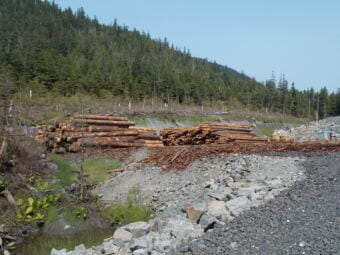
Logs await transport at a sort yard on Kupreanof Island near Petersburg in July of 2013. (Photo by Joe Viechnicki/KFSK)

On Monday, Petersburg’s borough assembly voted down a resolution calling for a forensic audit of two Tongass National Forest timber sales. Back in May, the assembly also voted against sending a letter on lost revenue from the sales and the impact to Petersburg.

The issue has been prompted by a 2016 review by staff in the U.S. Forest Service’s Washington office that noted timber companies were focusing on the more valuable trees. According to that review, the practice resulted in millions of dollars of lost value from the contracts for the Tonka sale on Kupreanof Island near Petersburg and Big Thorne on Prince of Wales Island. The sales are what are called Integrated Resource Contracts, meaning that money would have been kept in the Tongass to pay for stream restoration, culvert repair and other stewardship work.

Becky Knight has been among the local residents asking the assembly to pass such a resolution seeking answers.

“I respectfully ask that you unanimously support the resolution,” Knight told the assembly. “To vote otherwise would send a clear message that not only is the timber industry a sacred cow but there are no budgetary issues facing our community and we are willing to allow millions of dollars to evaporate while suffering the economic and ecological cost with no apparent concern.”

The assembly discussed a draft resolution in April but didn’t vote on it. In May, a short-handed assembly voted down sending a letter to Forest Service officials seeking some of the same answers.

The timber sale problems were highlighted by the group Public Employees for Environmental Responsibility, or PEER, a nationwide watchdog group based in Silver Spring, Maryland. PEER published the 2016 Forest Service review of the sales and sued the agency for documents relating to Tongass timber sale administration and appraisal. PEER says it’s received thousands of pages of Forest Service documents and communications but says it hasn’t seen evidence of change in sale oversight. The Forest Service has said it is implementing a plan to address the Washington office review findings.

Assembly member and retired Forest Service employee Bob Lynn was against the resolution and said he understood the agency was already following up on the problems.

“We need to look at going forward,” Lynn said. “Yeah there’s corrective items here and yeah it needs to be fixed and I don’t disagree with that. But to go back and to ask for another audit that’s already ongoing and one that’s supposed to come to conclusion I don’t think is correct, because all that does is just jam things up really. From a borough standpoint I think we need to look at it from a positive way. And the positive way would be to write a letter asking first of all if we wanted to, maybe the chief of the Forest Service or the Secretary of Agriculture to give us an update on what is going on and when we can expect some results.”

It’s was Lynn’s first meeting back on the assembly. He was off for a year and not a part of the vote in May against sending such a letter.

Assembly member Jeff Meucci asked for the resolution to be back on the agenda at this time.

“This resolution has been before us for quite a while, for like probably a year,” Meucci said. “We had an assembly member here who worked for the Forest Service and this resolution was going to cause him some uncomfort at work. And I didn’t want that to happen. I respected him too much to kind of jam it down his throat and make him vote on it. Now we have an opportunity to kind of move this thing forward. If somebody would like to submit a letter to the Forest Service we can certainly do that but this has been out there for a while. It can’t hurt to ask.”

Current Forest Service employee Eric Castro didn’t run for re-election this year and is no longer on the assembly. Still the votes weren’t there to pass the resolution, only Meucci and Jeigh Stanton Gregor supported it and it failed 2-4.

Redefining sports: Petersburg High School supports starting a video gaming team

Petersburg High School junior Jack Byrer takes questions from the school board about esports at a meeting on Oct. 9, 2018.
Petersburg High School junior Jack Byrer takes questions from the school board about esports at a meeting on Oct. 9, 2018. (Photo by Angela Denning/KFSK)

Petersburg School District is looking at starting a new sport at the high school — esports. It’s video gaming and it’s one of the fastest growing team-based competitions for youth in the state.

Over 40 million people watched this video game playing out on their screens last year. It was the World Championships of League of Legends.

Jack Byrer is a junior at Petersburg High School. He gave a presentation to the school board on what esports are and why his club wants to start a team by next spring. He said they’ll eventually be able to compete against other schools.

“It’s just a sport, it’s a team-based competition,” Byrer said, “much like basketball or football but it just includes video games instead.”

Byrer acts as the club’s coach right now. He said in competition, teams use the skill sets of individual players to overcome the opposing team.

“It’s kind of like a game of chess,” Byrer said. “You outsmart your opponent so you can take all of their pieces until they fall. Except with esports the decisions that can win games are not made in minutes but in seconds and milliseconds.”

Over 30 schools in the state have esports teams starting up this fall. Alaska has followed Connecticut as the second state to join a national gaming program, Electronic Gaming Federation. The program supports three video games in a controlled setting: League of Legends, which is a battle arena video game, Rocket League, a soccer video game that also involves racing vehicles, and Overwatch, a shooter game.

There is shooting, fighting, and destroying other characters in the games but they are rated age appropriate by the Entertainment Software Rating Board.

The high school competitions would be online, so little travel is needed. But Petersburg Principal Rick Dormer said the players will still be held to the same academic requirements and drug policies as other sports.

“They’re a team and they really will be Petersburg Vikings competing, which means something here. You’re part of the community you are representing,” Dormer said. “And just because you’re not jumping and slamming a basketball, you are competing against other schools and that’s self-pride and a lot of scientific studies show that that is a higher connectedness in school and kids always do better in school when they’re more connected.”

Most of the games require at least five players. In Petersburg, the students meet every weekday from 3 to 5 p.m. in the school’s technology room.

“They thought first I lost my mind because we’ve been saying no gaming on the school issued laptops,” said the district’s Technology Director Jon Kludt-Painter.

He supports esports even though he also encourages limiting screen time. Last year he helped bring the film Screenagers to town, which highlights the negative impacts of too much screen time on youth. Kludt-Painter said he understands the mixed message but esports gives gamers who otherwise might be playing alone an opportunity to come together.

“These kids are gaming already. They’re doing this at home and in their free time,” Kludt-Painter said. “And giving them an environment to do it that’s organized and safe I think is really one of the strong points to this.”

Petersburg’s Activities Director Jaime Cabral said although it hasn’t happened yet, the Alaska School Activities Association will be accepting esports as a sanctioned sport soon.

Central Southeast moose hunt lags behind 2017

Petersburg mayor Mark Jensen displays his moose outside the Alaska Department of Fish and Game building. (Photo courtesy of ADF&G)

There’s about a week left in the month-long moose hunting season around Petersburg, Wrangell and Kake and the central Southeast harvest is on the rise. At 68 bulls shot this season, it’s still well below last year’s total, when the count was 117 moose killed. Last year was a new record harvest since restrictions for antler requirements were expanded in 2009. The past four years the harvest has topped 100 moose.

Kupreanof Island around Kake and Petersburg continues to be the biggest producer. So far 19 bulls have been taken around Kake. Another 13, including two that did not meet the state’s antler requirements, were recorded by hunters on the rest of Kupreanof. That’s 32 total, or nearly half the total harvest.

Hunters have also killed eight legal bulls and five illegal bulls on the Stikine River. Nine, including one illegal moose, have been killed on Mitkof Island. Kuiu Island has produced seven and Thomas Bay on the mainland near Petersburg has yielded three.

One legal and one illegal have come from Farragut Bay north of Petersburg. There’s also been one shot on Wrangell Island and one on the rest of the mainland in central Southeast. The season is open through October 15th.

Board of Game tackles Southeast hunting changes at January meeting in Petersburg

Deer climb an alpine meadow near Sheridan Peak on Kupreanof Island north of Petersburg. (Photo by Joe Viechnicki/KFSK)

The state’s Board of Game meets in Petersburg in January to tackle proposed changes to hunting and trapping regulations around Southeast. The board is made up of seven members who set open and closed seasons and areas for hunting and trapping, bag limits and methods for harvesting animals. The board of Fisheries has held meetings in Petersburg before, but it’s a first for the Board of Game.

The board considers Southeast proposals every three years. Kristy Tibbles, the board’s executive director, said five days are scheduled for the Southeast meeting.

“The meeting will begin on January 11th and they’ll hear a number of reports from the department of Fish and Game but following that they’ll take public testimony and after the conclusion of public testimony they’ll start addressing each proposal individually,” Tibbles explained.

The board will also hold a work session on January 10th for administrative business and some reports from state agencies but review of regulation changes won’t start until January 11th.

State managers, Southeast residents, hunters, companies and municipalities have submitted 53 proposed changes; 16 of those would make changes region-wide. Among the region-wide proposals are ones to require ID tags for traps, or identification signs. Others propose to lengthen the waterfowl hunting season, allow the harvest of game from a boat and feeding deer for hunting purposes, along with relaxing the salvage requirement for deer rib meat in the region.

The deadline for written comments is December 28th. The board will also hear oral public comments during the meeting.

“We hope people will show up and listen to the reports provided to the board, listen to other public comments and listen to board deliberations to hear about the different types of information they’re considering as they make their decisions,” Tibbles said of the board. “They rely heavily on public comments and testimony.”

There are nine proposals for the Petersburg and Wrangell area. One seeks to extend the deer hunting season for residents on Mitkof and Woewodski Islands. Another seeks a longer deer season for Alaska residents on the Lindenberg Peninsula of Kupreanof Island. Another proposal would expand the bow hunting area for deer behind Petersburg’s airport.

Others seek to make changes for non-resident hunting of black bear on Kuiu Island and change the requirement for sealing a bear hide. And one would change the bag limit and season for brown bear hunting in the area.

Elsewhere in Southeast, The Hecla Greens Creek Mining company is seeking a hunting closure around the Greens Creek mine on Admiralty Island near Juneau because of safety concerns for workers and hunters. Skagway is seeking some areas closed to trapping around trails and roads in that borough over safety concerns for hikers, skiers and pets. The Juneau Trappers Association wants to allow use of submerged traps in areas currently closed to trapping. The department of Fish and Game is proposing to increase mountain goat hunting permits in an area near Ketchikan. There are also proposals to extend the wolf trapping season and wolf harvest on Prince of Wales Island. The Craig fish and game advisory committee is also seeking to lower the bag limit for non-resident deer hunters on Prince of Wales.

There’s currently no one representing Southeast Alaska on the board. Board members are from Soldotna, Nenana, Bethel, Tok, Glenallen, Kodiak and Fairbanks.
The meeting is January 11th-15th at the Sons of Norway Hall. The state’s website for the board is here.

Southeast’s commercial red king crab fishery won’t open in 2018

Red King Crab
A red king crab. (Photo courtesy of ADF&G)

Commercial crab fishermen won’t have a season for red king crab in Southeast this fall, the Alaska Department of Fish and Game announced last week.

The lucrative fishery was open last year for the first time in six years. The catch last season was over 120,000 pounds worth around $1.3 million at the docks.

Fish and Game said estimates of legal-sized male crab have declined 9 percent from last year and are below the threshold in regulation that allows for a fishery. Those estimates are based in part on an annual survey of crab stocks in seven areas of northern and central Southeast.

Fishermen sought changes to regulations at last winter’s meeting of the Board of Fisheries in Sitka but were unsuccessful in attempts to have more king crab fishing opportunity even while crab numbers are low. The one change that passed will allow them to apply for a commissioner’s permit to explore for king crab in offshore waters, beyond 3 miles.

Meanwhile, Fish and Game Friday also announced changes to the personal use fishery for king crab. Those include a new closed area in Gambier Bay on southern Admiralty Island starting Sept. 16. Bag and possession limits are also being reduced in areas that remain open. In addition, the Board of Fish also voted in January to create a permit for the personal use fishery and require reporting. That requirement started in July.

Permit holders, processing workers included in pink salmon disaster money draft plan

Fishing boats in Kodiak. (Photo by James Brooks/KMXT)
Fishing boats sit in a harbor in Kodiak. (Photo by James Brooks/KMXT)

Under a draft plan released this summer, commercial fishermen in Southeast Alaska would get only a small portion of the $56.3 million appropriated by Congress to address a pink salmon disaster in 2016.

However, those who worked at seafood processing plants that year could be in line for some of the money as well.

A year and a half ago, the U.S. Commerce Secretary declared the 2016 pink season across the Gulf of Alaska a fishery failure due to unusual ocean and climate conditions. The state of Alaska and the National Oceanic and Atmospheric Administration have come up with a draft spending plan for how to allocate the money to fishermen, processors, municipalities and researchers.

The money will be paid out by an agency called the Pacific States Marine Fisheries Commission.

Sebastian O’Kelly is a lobbyist in the nation’s capital. His clients include the Petersburg borough and that commission. O’Kelly briefed the Petersburg borough assembly on the spending plan Monday.

“I wanna talk a little bit about the allocation and the break out and the criteria that will be used in distributing the relief because you will have fishermen, processors and the borough itself as active participants and recipients of this funding,” O’Kelly said.

The draft plan allocates $4.1 million for pink salmon research, including work to estimate the annual numbers of young salmon migrating from streams to the sea. More than half of the money, $32 million, will be paid to commercial fisherman, specifically permit holders who fished in 2016.

Over $20 million of that would go to fleets in Prince William Sound, nearly $7 million to Kodiak fishermen and $2.1 million to Southeast Alaska permit holders. That’s based on the value of catches in 2016 and how those compared to average catch values for those regions.

In addition, O’Kelly said $17.7 million would go to processing companies that operated that year.

“The processors will have to show their loss for that year and they have to have a plan for allocation of 75 percent of the amount that individual processors receives to the processing work force,” he said. “So this is a new, I’ve been around a lot of fisheries disasters, this is the first time I’ve seen those decisions made. So this will be a new process. So it will probably take a little bit of a while to sort out.”

Another $2.4 million would be paid out to municipalities like Petersburg where pink salmon were landed in 2016.

Public comment on the plan will be taken until 5 p.m. on Sept. 18. The state’s website with the draft plan and online comments can be found here.

Assembly member Eric Castro questioned O’Kelly about whether he expected there would be a disaster declaration for this year’s pink salmon run, which is less than half of the 2016 catch in Southeast.

O’Kelly explained it would likely take another two-year process, including a disaster request and funding from Congress.

“The combination of all these things, I’m giving you a very long-winded answer here, kind of explains why this process moves kind of about two years behind when an actual disaster happens but the short answer is yes,” O’Kelly said.

The pink salmon catch this year is expected to be the lowest in Southeast in over four decades.

Site notifications
Update notification options
Subscribe to notifications