KFSK is our partner station in Petersburg. KTOO collaborates with partners across the state to cover important news and to share stories with our audiences.
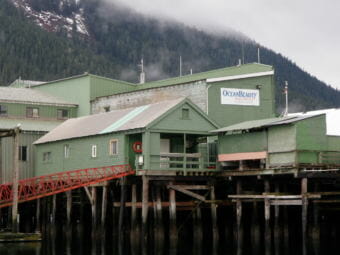
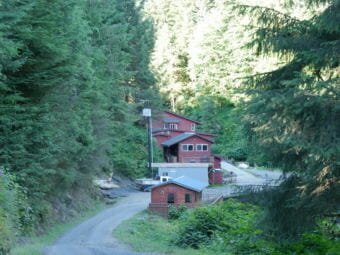
Ocean Beauty’s Petersburg plant did not can salmon in 2017 or 2018. (Photo by Joe Viechnicki/KFSK)
Ocean Beauty Seafoods will permanently close the company’s Petersburg cannery.
Company president and CEO Mark Palmer said in an Aug. 2 letter to Petersburg borough that Ocean Beauty’s facilities at Excursion Inlet, Cordova and Kodiak provide it with adequate canning capacity to meet customer demand.
The processor invested money in its Excursion Inlet plant, about 40 miles west of Juneau and will focus on more fresh and frozen processing.
The letter also mentions a multi-year agreement with a floating processor vessel Ocean Fresh.
“Our new configuration provides us the most flexibility and efficient business model to deal with the extreme fluctuations that have become the norm for the pink salmon harvest,” Palmer said in the letter.
Petersburg’s borough assembly briefly discussed the closure at its Aug. 6 meeting.
“They have been removing equipment out of the building for a few years, the can lines, an ice machine,” said Mayor Mark Jensen, who thought it’s been in the works for a few years. “It’s been coming.”
The cannery last operated in 2016, closing in 2010 and again in 2012, the year the state ferry Matanuska damaged the building.
The cannery employed about 200 seasonal workers.
The decision means Icicle Seafoods’ Petersburg Fisheries plant will be the only cannery in town.
Ocean Beauty will miss having a large presence in the community, Palmer wrote in the letter.
Some staff will stay in Petersburg to provide support to its fishing fleet.
A national food supplier is having shipping problems from Tacoma, Washington, and shelves in some Alaska community grocery stores are a little emptier than normal this summer.
The shortage is impacting the bottom line for a Petersburg grocery store during its busiest time of year.
Hammer and Wikan’s general manager John Mason says Minnesota-based wholesaler Supervalu, which supplies Hammer and Wikan Grocery, has been moving warehouses in the Seattle area and has been going through some challenges.
“Those challenges have resulted in product not getting on the barge, product not being sorted out and sent to the right location,” Mason said. “All these things have come together, drop ships not being dropped, containers not making it to AML (or Alaska Marine Lines) in a timely manner in order to make the barge, product missing the barge entirely, a tremendous amount of difficulty, which basically results in the fact that we cannot keep the shelves full because we can’t depend on the supply and the distribution from our major grocery supplier.”
Groceries are shipped to Petersburg and other island communities on Alaska Marine Lines barges.
Mason said Supervalu’s missed shipments have impacted most products in the grocery store from produce to meat to frozen food, deli and dairy products.
Mason said the supply problems started at the end of March and have gotten worse into the summer. He and others with the store have been fielding questions from customers.
“Most people who do make comments are wondering why we seem unable to get the shelves full or keep them full and I wanted the general public to understand that it has nothing to do with our lack or desire or resolve to make this happen but unfortunately some of these things if not most of these things are out of our control,” Mason said. “We can only do what we can do and the rest of it we have to depend on our suppliers for and that has proven to be a hard find.”
The issue impacts many stores in Southeast and Southcentral Alaska, Mason said.
His store is seeing a loss in revenue during the busy season when fishing boats, cruise ships and local residents are stocking up weekly.
Hammer and Wikan has secondary suppliers but those groceries have to come by air freight and Mason said the store is eating those extra costs.
“It’s had about $300,000 impact in sales since the first of the year and a considerable amount of profitability in what should have been our very best quarter of the year,” Mason said.
Hammer and Wikan became a customer of Supervalu a little more than a year ago when that company purchased another distributors called Unified Grocers.
A Supervalu company spokesman writes in an email, “We’ve experienced some challenges with shipments out of our Tacoma, Washington, distribution center as we transition out of another distribution center in that region. We’re working closely with our customers to address any disruptions they have encountered. This is a top priority for us and we are working diligently to resolve the issues as quickly as possible.”
Supervalu supplies a network of over 3,400 stores nationwide and bills itself as one of the largest grocery wholesalers and retailers in the U.S. with annual sales of $W14 billion.
The grocery supplier is in the process of being purchased by another company, United Natural Foods, based in Providence, Rhode Island.
(Disclosure: Hammer and Wikan is an underwriter of KFSK in Petersburg)
Zack Christensen helps his uncle, Lars Christensen, weed the strawberry patch at their house on South Nordic Drive, Petersburg. (Photo by Angela Denning/KFSK)
High school graduates from all over the state are taking the first steps into adulthood, whether that’s furthering their education, entering the workforce, or just exploring life.
One Petersburg graduate had to overcome several challenges to get to this point.
The lanky 18-year-old Zack Christensen lives with his uncle, Lars Christensen, on Petersburg’s main highway.
Weeds overrun their strawberry patch in one corner of the year.
Zack leans over and pulls out handfuls of green grass, as he and his uncle listen to music from speakers pulled out on to the concrete front steps.
Zach is no stranger to manual labor: staying active is actually the doctor’s orders for his cerebral palsy.
“[I] work hard so my body will build up a little bit there,” Christensen said. “Keep the muscles I need strengthened.”
Zack also goes to the gym to lift weights.
“Through my life, I’ve learned that I just got to keep proving people wrong, that I can do all these things that I want to do and go places,” Christensen said.
Zack has big plans. He wants to start a life in Marion, Montana. His extended family lives in the northeast Montana town of about 300 residents.
“I’m not a big fan of big crowds, big cities, or anything like that,” Zack said. “Just ask my mom. When I got to go through crowds, I just turn into a horrible person.”
Zack’s mom, Mali Christensen, agrees.
“He’s an outdoors boy, he doesn’t like the city,” Mali said.
When Zack was born, doctors told her he might not be able to do things like other children.
“He may not walk, he may not ever talk, he might be a vegetable,” Mali said. “He ended up defying all the odds.”
Zack Christensen poses with his mom, Mali Christensen, when he was a boy. (Photo courtesy Mali Christensen)
It hasn’t been an easy road.
Zack had seizures for the first six months of his life before medication ended them.
Fine motor skills, like writing, remain difficult. He’s relied on typing, and in school, he had an aide to whom he could dictate notes.
“Carrying a plate, having a drink in his hand, anything that requires dexterity has always been a huge challenge for him,” Mali said.
Growing up, Zack had all kinds of therapy — physical, occupational, speech.
In a town of 3,000, therapy wasn’t always close to home.
In the eighth grade, his mom flew him to Portland, Oregon, every week for nearly a year.
They’d fly down on Sunday, see doctors Monday, and return to Alaska on Tuesday.
“That was a really crazy year,” Mali said. “Zack got real burned out with flying.”
“It got pretty old,” Zack agreed.
Mali decided that traveling from Petersburg, where she had family support and Zack had friends, was better than moving for temporary medical care.
In the end, the therapy set him on a path to being more physically independent.
He wrestled and played baseball as a teenager.
He said the Petersburg school has been very supportive.
It showed the day he got his diploma. The crowd cheered loudly when his name was called at graduation.
“I really appreciate it, I might not always show it, especially with Ms. Fry,” Zack said. “She’s always on my back a lot about grades but I’m graduating high school, probably thanks to her.”
Cindy Fry has worked with Zack in the high school for three years through the special education department.
Zack has a tenacious determination, she says, not letting his disability get in the way of being successful.
“Zack does not let anything really stop him,” Fry said. “He gets his mind on a goal and he’ll make it happen.”
He enrolled in a 10-month vocational technical school, AVTEC, in Seward with the goal to move to Montana to be a diesel mechanic. Zack enjoyed tearing apart and rebuilding a lawnmower in his high school shop class.
“I’ve just always loved vehicles and working with my hands,” Zack said.
Fry has been in contact with the vo-tech school about Zack’s needs and says they have resources for him, like iPads for typing notes. He’ll also bring wrist weights for helping with stabilization.
Fry says the bigger challenge will be Zack advocating for himself.
“Part of the message as they get to seniors is, ‘Okay, so how are you going to advocate this as an adult? What are you going to do? What are you going to say? Who are you going to go to?’ and that’s one of the things that we work on,” Fry said.
Zack’s mom thinks he’ll do just fine.
“He started off life almost losing his,” Mali said. “When he got it back that gave him a determination to thrive and live.”
Back in the garden, Zack said after he finishes weeding he’s going to pack for a three-day camping trip with friends.
“Every kid needs to spread his wings, figure out where he’s going,” Zack said. “I’m excited. I’m ready to get out into the world, start the next chapter, see where life will take me.”
Zack will have some familiar company at AVTEC. Another Petersburg graduate is joining him there.
This summer though, Zack will be making money at a cannery in Kasilof.
Dave Strassman, left, and Ray Troll investigate a block of limestone crusted with fossil shells. (Photo courtesy Josef Quitsland)
Many in Alaska with a working knowledge of the plants and animals spend the long summer days exploring and collecting them.
One group of friends, mostly from Ketchikan, likes to travel an older, hidden version of this landscape.
Ketchikan-based artist Ray Troll was doing what expedition leaders do when they accept that they are off-track: reflecting next to the campfire.
“This morning we had a good day, didn’t we? But here we are on day two, and nothing, we’re skunked. We can’t find the spot,” he said. “You may think you know where the fossils are, but you know especially in Southeast Alaska, they are not easy to find.”
Self-described paleo nerd Troll spent his life drawing animals – living and extinct – and learning from the people who study them.
One thing he has learned is that all landscapes hold evidence of their geologic past.
Only, Southeast Alaska’s is hidden with trees and water.
“You gotta have a friend with a boat,” he said. “Or an airplane.”
Troll’s friend with a boat was Petersburg metalworker and artist Josef Quitsland, Also on the trip was Ketchikan UPS man, pilot and poet Tom Fowler.
Dave Strassman, who currently lives near Los Angeles, is another of their fossil-hunting friends.
These guys share an obsession with what some call “deep time.”
During the last weekend in June, the group retraces a trip Troll took with a paleobotanist a few years ago in the Tongass National Forest.
The group had to work around the tides.
Usually the rock layers that hold fossils are exposed along the shoreline.
An hour before low tide on the first morning, they hopped off the boat with a few hammers, a crowbar and a chisel to look for plant fossils from the Cenozoic era, or about 55 million years old.
This island was tropical then, with palm trees and “tiny horses,” Troll said.
“The horses would have been about the size of a beagle. The dinosaurs were extinct by then, but there were these large birds that stood maybe 8 feet tall,” he said. “There’s debate as to whether or not they were meat-eating birds or whether they ate anything they came across or whether they were plant eating birds.”
Everyone spread out at first, poking around different corners of the beach.
Fowler crouches down near a row of sandstone rocks near to the boat and taps the edges with his hammer.
“Sometimes, they break right in the right spot and there’s something phenomenal in there,” Fowler said as two pieces fall apart, revealing nothing. “Sometimes, it’s just like this. But you can see all the different layers and when you look, you know the whole floor here would have been just covered in forest debris just like in the forest over there.”
Further down the beach, the sandstone flakes off like paper, coated in black splotches — really old plant material. Finding something sturdier and better defined is the goal. At one point, everyone congregated around this one slab. The corner of a leaf was sticking out from between two layers.
Fowler and Dave Strassman’s son, Carson, work to make a clean break, while the elder Strassman cheers, “what do we got? What do we got boys? Look at that! It’s a forest floor! Look at that. Holy schmagoli.”
Tom Fowler of Ketchikan scrapes off a thin layer of sandstone to reveal the impression of an ancient leaf. (Photo courtesy Josef Quitsland)
It is legal to collect about 10 pounds of plant or invertebrate fossils in national forests.
This story does not include any of the names of locations because scientists and enthusiasts want to make sure that some of these fossils stay put.
Researchers a few years ago cut out a giant palm leaf that is part of a new Smithsonian exhibition.
The island they visited on the second day is where scientists found a fully intact fossil of a thallatosaur, a marine reptile.
They stand around the campfire, a little humbled after not finding the 250 million-year-old Triassic fossils that Troll knows were somewhere nearby.
He seemed to have almost as much fun imagining the world that created them.
“These rocks were actually part of an island chain and maybe even a subcontinent that was way over by Australia or Hawaii and beyond at least,” Troll said. “They were on a conveyor belt across the ancient Pacific Ocean that has come up against North America and gone under North America and there are shards that split off and oozed to the side, and that’s what this stuff is right here.”
He said each of the shards they visited showed up at different points in Earth’s history.
“It just drives home this idea of a dynamic, fluid changing planet with a deep, deep history that will just blow your mind,” Troll said. “You begin to look at this landscape and it almost melts before your eyes.”
This history still is unfolding.
Troll and Fowler disagree on some of the politics around climate change, although both agree that it is happening.
“We know that the world is changing rapidly right now. The weather systems are changing. We’re trying to understand it,” Troll said. “And the only way to know, really, is to collect all the data that you can, and there’s a lot of the data that we’re standing on right here, right now.”
The next day, they took the fossil-fueled boat to a different island, and found the remnants of animals that existed on the other side of the Permian-Triassic extinction, which scientists consider to be the largest in Earth’s history.
Troll co-authored “Cruising the Fossil Coastline,” a book about the geologic history of the West Coast from Baja California to Alaska. The book comes out in September.
A Southeast Alaska tribal government hopes to leverage a federal law to secure the return of human remains and burial objects removed from a remote cave more than 50 years ago.
Kake, in central Southeast Alaska. (Photo courtesy Alaska Community Database)
The Organized Village of Kake seeks to bring back a mummified infant and other items taken in 1961 from a cave on Entrance Island near Hobart Bay, about 70 miles south of Juneau.
“Any items we can get back to the community we’re welcoming back, whether it be human remains or artifacts,” Frank Hughes said.
The identities of the people who took the culturally significant items — now in museums and private collections — are unknown.
The Native American Graves Protection and Repatriation Act, or NAGPRA, requires publishing a notice in the federal register of the intent to return the items.
If no one else comes forward to object, the remains and burial items can be repatriated. The law also provides funding to identify items and return them to Alaska Native tribes and other indigenous peoples.
The infant, 6-9 months in age, was buried inside a painted bentwood box.
The remains have been at the Alaska State Libraries, Archives and Museum since 1961 and the museum doesn’t know their age, but they could date back to first contact with people from outside the area.
Another four burial items from Entrance Island resurfaced just last year, when an unnamed individual from California approached the U.S. Forest Service in 2017 with the intent on returning them.
The Organized Village of Kake also is working to recover other items too.
A shaman’s jawbone was taken sometime before 1910 and now at a museum in St. Joseph, Missouri.
Other artifacts have been found in Portland, Oregon and at George Fox University in Newberg, Oregon.
Hughes notes that Tlingit protocol on who is allowed to handle remains and artifacts is even stricter than federal law.
He said non-burial artifacts could eventually be put on display in Kake, if they are successfully returned.
“We always look forward to bringing them back,” said Hughes. the NAGPRA coordinator for Organized Village of Kake.
Hughes said the tribal government’s intention is to bury these items, just as they were.
“That’s again where the healing begins, when we could actually re-inter the body to where it came from and then put closure to it,” Hughes said. “Ceremonies would be done, songs would sang and again we’d walk away like we did any other time as proud people.”
While Hughes thinks it best to return the infant body to its original burial site, he said that will ultimately depend on the recommendation of Kake’s repatriation committee in consultation with the involved clan.
Repatriating human remains and culturally sensitive artifacts is a process that can take time.
The Entrance Island site is located on what is now national forest land.
“The Forest Service actually got notified that there were objects that a person had collected who now lived in California that he wanted to send back to Alaska,” said Theresa Thibault, heritage program manager for U.S. Forest Service. “You get guilty after a while. He wanted it to end up back in Alaska and he contacted the museum. And then the museum of course recognized that it probably came from forest land so they they contact the Forest Service. And then we initiate the whole tribal consultation process.”
Forest Service determines what tribes had traditional claim to the territory when repatriations take place.
Entrance Island site is within the traditional territory of the Kake people despite being a long way from the current day location of Kake, a community of about 600 people in central Southeast Alaska.
This kind removal of items from burial sites was pretty common before NAGPRA, Thibault said.
“There was a time when it wasn’t OK to collect human remains but it sort of was,” she said. “And so people did it. And they get to a point where I don’t know they have a change of heart, or they’re getting old and they realize that was really dumb and they send them back. Museums get that kinda thing all the time too.”
“They came into the museum long before I was around but there’s no record of them ever being on display,” said Steve Henrikson, the curator of collections at the Alaska State Archives, and Museum. “They were taken in and put into storage,” he added.
It was common for people to give collected artifacts to the museum, Henrikson said.
“I think that the museum has been around for over a hundred years, long before many of the federal agencies had developed capacity for law enforcement or archaeology and so there wasn’t a clear process for people who found artifacts or remains out in the field and wanted to do something with them,” he said. “Of course, the approach that we should take now is not to disturb anything like that but to report it to the agency that owns the land.”
Henrikson said the tribe is in the driver’s seat now, in terms of when and how the items are returned.
“We’re really happy that this is taking place and we’re awaiting instructions from the tribe on how to finalize this.”
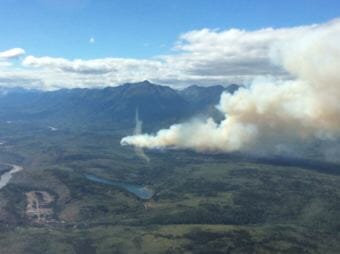
Smoky haze obscures the 9,077-foot Devil’s Thumb, about 25 miles northeast of Petersburg, this week. (Photo by Joe Viechnicki/KFSK)
Haze is obscuring Southeast Alaska’s clear skies this week.
National Weather Service meteorologist David Levin says the the smoke is coming from thousands of miles away.
“We went back and looked at some high resolution satellite from NASA,” Levin said. “We were able to track some of the plume at least all the way back to central Siberia a few days ago.”
Levin says the haze could be visible from Juneau down to Petersburg, maybe as far as Ketchikan.
“It looks like it got caught up into the upper level jet stream, traveled over the Arctic and came back down into the Yukon and B.C. and that’s where we’re seeing it today.”
He says mid-and high-level pressure is trapping dirt and particulates in the air trapped at lower levels in the atmosphere.
“You start seeing haze, except the air has got just kind of got a lot of stuff floating around in it.”
Levin thought the smoke plume could be pushed to the east of the area early this week, but high pressure is expected to return later this week and into the weekend.
Close
Update notification options
Subscribe to notifications
Subscribe
Get notifications about news related to the topics you care about. You can unsubscribe anytime.