KFSK - Petersburg

KFSK is our partner station in Petersburg. KTOO collaborates with partners across the state to cover important news and to share stories with our audiences.
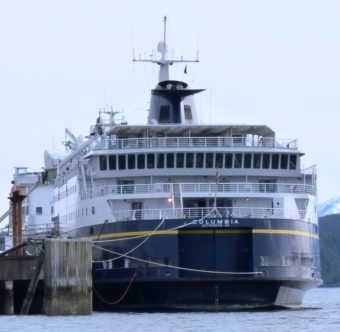
Ferry Columbia evacuated after docking in Bellingham

The state ferry Columbia will soon sail south for repairs to a damaged propeller. That will leave Sitka without marine highway service for two weeks. (Photo by Ed Schoenfeld/CoastAlaska News)
The state ferry Columbia, seen here in 2016, was evacuated Friday morning after crew found smoke onboard. The ship was docked in Bellingham, Washington. (Photo by Ed Schoenfeld/CoastAlaska News)

The Alaska state ferry Columbia was evacuated Friday morning after crew noticed smoke onboard after the ship had docked in Bellingham, Washington.

Black smoke was discovered but no flames in the bow thruster room.

“The vessel was docked at the Bellingham dock and the bow thruster is part of the mechanism (that) moves the ship left and right. So it’s used to dock,” ferry system spokeswoman Aurah Landau said. “The ship had already docked. Half of the passengers were off the boat. One of the crew members went back to the bow thruster room, opened the door, discovered the smoke and then sounded the alarm to do the evacuating and activate the fire-fighting system.”

The Bellingham fire department also responded to assist.

Passengers and crew were evacuated and no injuries were reported. The passengers were all disembarking in Bellingham. The bow thruster room was being ventilated Friday morning. Landau said the source of the smoke is not yet known.

“Well at this point we don’t know how the schedule will be impacted,” she said. “We don’t know what happened. We still need to investigate. When the Marine Highway System knows what the source of that smoke is then we’ll be able to understand what the impacts to the vessel and sailing will be.”

The 45-year-old ship was scheduled to sail north from Bellingham with about 300 people and a full car deck at 6 p.m. tonight. Passengers will be notified of any schedule changes. Updates will be posted online.

The Columbia is 418 feet long and can carry up to 499 passengers and 133 vehicles. The ship makes weekly runs between Bellingham and Skagway, stopping in Southeast Alaska communities along the way.

Family sues Petersburg in 2016 fatal van crash

A memorial for two killed in the July 4, 2016 van crash overlooks Petersburg’s South Harbor. (Photo by Joe Viechnicki/KFSK)

The family of a young woman killed in a van wreck two years ago now is suing the Petersburg borough and the driver of that van.

A lawsuit filed this month claims the borough ignored warnings about Chris Allen’s medical history that should have kept him out of the driver’s seat.

Two people died when a borough van crashed July 4, 2016. Allen also is scheduled to go on trial for criminal charges from that crash at the end of July.

The wrongful death suit was filed on behalf of the estate of Molly Parks, one of two passengers killed in the van wreck. The lawsuit names Petersburg borough and Chris Allen as defendants and seeks unspecified damages.

Parks, who was 18, along with Marie Giesbrecht, 19, the daughter of Petersburg’s borough manager, died in the crash the morning of July Fourth just south of downtown.

The driver, Allen, who was 23 at the time, survived, along with a third passenger Catherine Cardenas who also was 19.

All four were working for the borough’s Parks and Recreation Department.

They were setting up for a recreational running and walking race as part of the borough’s Fourth of July celebration and were in a borough van when it went off South Nordic Drive and flipped.

The lawsuit alleges that Allen has a seizure disorder and ignored doctors’ orders not to drive. It also alleges that the Petersburg borough knew about Allen’s seizures and ignored multiple warnings from doctors and from borough employees that he shouldn’t be driving.

The suit contends Allen was told to drive by his employers.

The civil suit also contends that Allen had been turned down for a job at the borough’s public works department because they knew he wasn’t supposed to drive.

It claims the public works director called supervisors in the parks and recreation department to ask why Allen had been hired when he wasn’t allowed to drive.

The lawsuit contends the parks and recreation department had taken steps after other seizures Allen had suffered at work in the months leading up to the crash. That department had a change-over in directors in the month before the tragedy.

Petersburg borough attorney Sara Heideman said in an email that the borough hadn’t yet been served with the lawsuit and wasn’t able to comment other than to say the contention in the lawsuit is incorrect.

“The borough will appropriately answer the suit after it has had an opportunity to review it,” she said. “The borough has cooperated fully with the investigation into this tragic accident and will continue to do so.”

Allen’s parents had no comment on the lawsuit out of respect to all parties. The attorneys bringing the civil action also declined comment.

While this civil suit has just been filed a criminal case against Allen is ongoing.

Trial is scheduled to begin July 30. Allen faces charges that include two counts of second-degree murder, two counts of manslaughter and additional charges.

His defense attorney Julie Willoughby in the criminal case isn’t representing him in the civil suit and had no comment on it.

However in the criminal case, Willoughby is asking the judge to dismiss the grand jury indictment for multiple reasons.

She argues that prosecutors made numerous errors in the grand jury presentation, including allowing hearsay in witness testimony and allowing people who aren’t medical professionals to diagnose that Allen has a problem with seizures.

In court filings, Willoughby claims it wasn’t until after the crash that doctors told Allen not to drive.

The defense attorney agrees Allen’s employer told him to drive the van but argues that the van simply slipped out of his control before flipping over.

State prosecutors contend that Allen had a long-documented seizure disorder and had been told not to drive by multiple doctors. They allege he suffered a seizure that morning and was unresponsive at the wheel, causing the fatal crash.

Attorneys in both the criminal case and the civil suit allege that Allen had consumed alcohol the night before and knew that drinking could trigger a seizure.

Tribes, communities monitor ocean acidification in near-shore waters

Petersburg Indian Association’s Brandon Thynes caps a bottle of ocean water at Sandy Beach. The sample is a part of Sitka Tribe’s efforts to study ocean acidification. (Photo by Alanna Elder/KFSK)

Southeast tribes are joining in research efforts to monitor ocean acidification in the waters closest to shore.

This coincides with data coming in from a ferry that for the past six months has been taking measurements along its regular route from Bellingham, Washington, to Juneau.

This information may one day give communities a better idea of what to expect from change in the ocean.

Petersburg Indian Association tribal resource director Brandon Thynes waded into the ocean on a Thursday morning at Petersburg’s Sandy Beach.

The tide was especially low, and a few people and dogs were checking out the creatures and debris it had washed ashore.

Thynes carried a beer bottle filled with seawater back to his box of equipment and took out another item he recycled for science: a parmesan cheese container with a tube of mercury inside.

He added three drops of mercury to the beer bottle and sealed it. The sample was ready to send to Sitka, where specialists will add it to a growing body of information about ocean acidification.

Esther Kennedy, who is with Southeast Alaska Tribal Ocean Research in Sitka, said this is a relatively new addition to a program that already monitors shellfish toxins and harmful algal blooms.

“Our partner tribes like Petersburg Indian Association now just collect a water sample once a week at one of their routinely monitored sites, preserve that sample and then ship it to me and then I will run it when I can and send back the results as soon as possible,” Kennedy said.

She has not been able to run any of these samples yet, because she is fine-tuning the Sitka Tribe’s Burke-o-lator, a machine many scientists are using to monitor ocean acidification.

“Once you open a discrete sample, you either need to analyze it or it is trash, so I don’t want to analyze anyone’s samples until I’ve worked out the kinks in our system,” Kennedy said.

Eventually, she hopes to send out data within one or two weeks of getting the samples from tribes.

The goal is to understand how ocean acidification, which is caused by higher levels of CO2 in water, is happening along the shoreline, where people live and harvest food.

Many Alaskans are concerned about these changes because they will prevent some marine animals from forming shells and threaten food sources for other species like salmon.

“What’s difficult to know, though, is how that’s actually going to map onto each individual community,” Kennedy said. “People are very worried, but we don’t have enough information to know which communities are most vulnerable, which communities are least vulnerable, and what the real timescale is where we might start seeing significant effects on subsistence shellfish and maybe a few other very important subsistence species.”

She added, up until a couple of years ago, most ocean acidification data for Alaska came from the middle of the ocean or the gulf.

There’s a lot more variability close to the shore, so it could take five to 10 years before it’s possible to read the data.

“That’s kind of a long time, so in the short term, we’re hoping to gain a lot of other insights from this data,” Kennedy said. “We are pairing it with our phytoplankton data, to see if in the short term we can even say anything about harmful algal blooms and the current water chemistry.”

A handful of organizations are using Burke-o-lators elsewhere in the state, including a hatchery in Seward that also tests samples from tribes.

Another player in this research is the state ferry Columbia, which has been collecting data along its route since October.

The ferry passes by many of the sites where tribes are taking samples, so Kennedy said she will be able to compare the two data sets.

Wiley Evans is a research scientist at the Hakai Institute on Vancouver Island and oversees the ferry monitoring system. Although it is too early to see long-term trends, he explains the data has shown seasonal patterns.

“So far, we’ve seen mostly just the transition from winter into summertime, which involves the spring bloom,” Evans said.

Kind of like on land, parts of the ocean become more hospitable as they get sunnier and warmer.

Phytoplankton and all the marine species that come with them change the chemistry of the water. The ferry allows Evans and his colleagues to map those seasonal changes across the region.

“Within that seasonal transition, (we are) seeing the bloom progress and its effect on the CO2 chemistry basically from the south to the north, which is what you’d expect, but in patches, where it’s kicking off in certain areas first and that sort of thing,” Evans said.

The system on the ferry has also had some technical problems.

The computer used to blink out during routine power surges, and for a few weeks this winter the ferry was held up for repairs.

But for a scientist like Evans, having this much information is a dream come true.

“It’s hard to just pick the highlights because it is such an amazing data set. I have never seen anything like this,” Evans said.

Evans got his PhD in Oregon, where shellfish farmers have been really interested in this kind of research for a while.

Farms in the Pacific Northwest were hit hard about a decade ago when the hatcheries they depended on for oyster seed couldn’t produce a thing.

The young oysters weren’t forming shells. Evans said there’s a motto for this research that comes from that time:

“It’s kind of like putting headlights on a car,” Evans said. “All of a sudden they can see how things are changing in their intake water and account for it.”

Alaska’s shellfish industry is relatively modest, and ocean acidification is a big issue for those who want to see it grow. There is hope that hatcheries can adapt. Some already treat their water.

Adaptation gets more complicated in a place like Sandy Beach, where there’s a stew of mysterious interactions happening offshore, and where people relate to the water in multiple ways.

Central Southeast king salmon following forecasts

2600 Crystal Lake Hatchery kings are forecast to make it back to Blind River Rapids and the Wrangell Narrows this summer. (Photo by Joe Viechnicki/KFSK)

For good and for bad, king salmon runs around Petersburg are coming in as forecast so far this year.

Anglers have only been allowed to keep chinook salmon in a limited few areas with hatchery kings for the first part of this month.

Much of the sport fishing effort in this area has been focused on the Wrangell Narrows and Blind Slough.

Anglers there are hoping to catch some of the 2,600 adult chinook forecast to return to the Crystal Lake Hatchery, about 18 miles south of Petersburg.

An average return is expected back to the slough this year.

“The fishery’s been open for two weeks now, or almost two weeks, since June 1st and the catch rates are about what we’d expect with that type of forecast,” said Patrick Fowler, area management sportfish biologist at Alaska Department of Fish and Game. “It’s probably a little bit slower than last year but some decent numbers coming out of there.”

Those hatchery kings are showing up in the fresh water of Blind Slough and are being caught by anglers from shore at Blind River Rapids as well as boats trolling in the salt water of the Wrangell Narrows.

In the Petersburg area, the only other spot that’s been open in early June is right around the mouth of City Creek near Frederick Point, about three miles from downtown.

Very few kings are expected back from that hatchery release this summer.

The bulk of those fish were lost in a fire at Crystal Lake Hatchery in 2014.

Fowler said only older 6-year-old kings and younger 4-year-old jacks are expected to show at City Creek.

However, he said last year did see a good return at the new release site.

“We actually had some surprisingly good numbers there, some good activity, some folks were harvesting,” Fowler said. “It seemed to be, that was really our first chance to get a good idea of how those fish are coming back since we started this release and yeah, it looked pretty successful.”

Prior to this month, anglers couldn’t keep kings on most inside waters in April and May to conserve wild-stock kings returning to Southeast rivers, which includes the Stikine River near Wrangell, where 6,900 adult kings were forecast to make it back to the river this year.

That’s well below the department’s goal for fish returning to spawn. And Fowler said so far it looks like that forecast is holding up.

“On the Stikine River we have a crew that’s catching adult king salmon as they return to Kakwan Point,” he said. “Their catch per unit effort is trending very close to what we saw last year, which was very close to what we forecasted. It’s going to be a very poor year. We don’t expect to meet our escapement goal. And that’s kind of exactly what our early indications of the adults returning to the river are.”

Typically by this time of year, about 60 percent of that run has made it to the test fishery site on the river and fishery managers have a pretty good idea of the run strength.

The waters of District 8 around Petersburg, Wrangell and the Stikine River remain closed to king salmon fishing until July 15.

Starting June 15, anglers can keep kings in district 10, the waters of Frederick Sound north of Beacon Point as well as other areas further away from the mouth of the Stikine.

Committee selects Petersburg police sergeant to be chief

Petersburg borough officials and a selection committee have chosen a local candidate to be the next chief of police.

Borough officials have tentatively agreed to a contract with Petersburg Police Sgt. James Kerr, 38.

He was one of four finalists for the position, the youngest of the four and the only local applicant.

James Kerr
James Kerr

Borough manager Steve Giesbrecht writes in an email that Kerr “did a wonderful job in the interview process and had a tremendous amount of support from the community.”

Kerr started work in Petersburg in 2013.

Prior to that, he worked in law enforcement in Arizona. In an interview earlier this week he said he’s hoping to increase the police department’s outreach and involvement in the community, both in uniform and off-duty.

“What’s worked for me at the police department is letting people know me outside the uniform,” Kerr said. “That’s been one of the major things and I wanna continue that with the other officers there. I think if the community knows them with the uniform and without the uniform … they’ll feel more comfortable approaching them.”

Kerr also wants to see more of a regular police presence at the schools and more dialogue with community members.

Three other finalists from Oregon and Colorado also interviewed for the position this week.

The borough is not releasing terms of Kerr’s contract until the borough Assembly considers it, which could be as soon as their next meeting June 18.

If he’s approved for the job, Kerr will replace Kelly Swihart, who plans to retire at the end of the month.

The police department is currently recruiting to fill one officer’s position and will have to fill the sergeant’s job as well if Kerr becomes chief.

Petersburg sees brief influx of March flies in May

March flies congregate on rocks and ice bergs near the Walker Glacier in Glacier Bay National Park in June 2017. (Photo courtesy John Hudson)

Large numbers of flies swarmed Petersburg end of last month. People speculated about the cause of the sudden influx.

March flies occasionally emerge in big swarms. They’re likely around in other years, one bug enthusiast says, but aren’t as noticeable in smaller concentrations.

The flies were hard to miss, the last week of May, bumping into bikers and walkers and getting stuck on car windshields but not biting.

They flew erratically, slowly and were easy to capture. John Hudson of Juneau responded with a definitive ID – March flies.

“They are quite unique and different from other families of flies,” Hudson said. “March flies are in the family of flies called bibionidaem which I love the way it rolls off the tongue and probably so named March flies because whomever identified them or noticed them first saw them coming out in March wherever they lived in the world. Here in Alaska I’ve noticed and in your case as well it seems like late May and in June is when they emerge.”

The former U.S. Fish and Wildlife Service biologist now works for the Southeast Alaska Watershed Coalition.

As a biologist he specialized in fisheries and aquatic ecology but he considers himself an amateur entomologist, someone who studies insects. Hudson has authored several books on dragonflies and aquatic insects.

Juneau had its own experience with swarms of the insects in 2012.

At this stage in their life cycle, they are emerging as adults to mate.

“When they emerge and they do so in mass, in mass numbers, and probably to avoid intense predation they just come off out of the ground in huge numbers, they’re doing so to swarm,” Hudson said. “These are mating swarms that people are seeing.”

One species of March fly in North America is called the love bug because males and females can stay connected while mating for days at a time.

Like other insects, or like salmon for that matter, the flies mate and then die off soon after.

The flies begin their lives from eggs laid in the soil. They hatch into larvae and survive by eating dead organic matter, such as leaves, along with plant roots through the fall and winter.

Hudson said along with fungi, bacteria and other invertebrates they’re an important recycler of that organic material.

After these flies emerge, mate and die, they become an important food source for birds in the spring.

“It’s just wonderful to think about that cycle of life from say alder leaves falling off the trees onto the ground, the March fly larvae consuming those leaves, emerging eventually in the spring as adults and after mating becoming a wonderful food source for migratory birds like warblers and things like that,” he said.

Hudson suspects the flies emerge in Southeast every spring, but not always in such noticeably large numbers.

He came across a localized emergence while on a rafting trip down the Tatshenshini River a year ago.

“And we stopped at Walker Glacier, which is a very kind of famous glacier to stop at on that rafting trip, and walked over to the glacier and there had been a mass emergence of March flies,” Hudson said. “We’d seen them during the days previous floating down the river and then we came upon this amazing density of them. They were so thick along the margins of the lake. They covered rocks and they were actually thickly congregated on icebergs, which made for an interesting sight to see all these lethargic half frozen insects.”

Hudson said temperature and weather conditions likely influence how many of the flies survive the Southeast Alaska winter and also trigger these springtime mating swarms.

He speculates that conditions were just right in Petersburg this winter and Juneau six years ago that large numbers survived to adulthood.

In adulthood they don’t eat and die soon after mating, so just weeks later they’re long gone.

Site notifications
Update notification options
Subscribe to notifications