KFSK - Petersburg

KFSK is our partner station in Petersburg. KTOO collaborates with partners across the state to cover important news and to share stories with our audiences.

For liveaboards in the Petersburg harbor, the rent is cheap and the water is fine

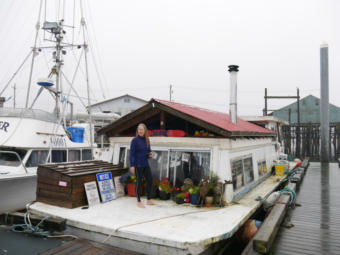
Pamela Speck on her boat’s back deck in Petersburg’s North Harbor. (Photo by Ari Snider/KFSK)

Throughout Southeast Alaska, many people make their home on boats. So-called “liveaboards” are motivated by a variety of factors: lack of affordable housing, a sense of adventure, or there are those who already work on the water.

Liveaboards are a longstanding part of the Petersburg community. Down in what most people know as Petersburg’s North Harbor, Pamela Speck said she has another name for it.

“I jokingly call it, especially at a really low tide, this is lower Petersburg,” she said. “When you get to the top of the ramp, then you’re in upper Petersburg.”

Speck’s home is actually more house than boat — it’s got a pitched tin roof, windows instead of portholes, and of course the flower pots on the stern deck, which is now essentially a porch. She bought the boat in 1993 while working at one of the canneries. She ended up staying, mainly because it was so cheap compared to shoreside housing.

“People think it’s hard now,” she said, “but back then, you know, you might have gotten an apartment beside (Petersburg bar) Kito’s which was a dump — not saying they’re dumps now — for like a thousand bucks a month or 800 bucks a month. And so it was just an exorbitant price.”

Exorbitant to her, but not uncommon. A one-bedroom apartment in Petersburg in “rough shape” could fetch around $850, according to the Peterbsurg Borough’s 2016 Comprehensive Plan. The plan also found that 36% of renter households were not living in affordable housing.

Speck came to Alaska via Ohio. She said she didn’t expect to stay very long, much less spend more than a quarter of a century in a floating house. But she said this lifestyle grew on her for a lot of reasons.

“It allowed me to pay my student loans off 10 years early,” Speck said. “It allowed me to save money and do investing. It allowed me to also be able to buy some property in Belize and build a house down there.”

Of course, living on a boat isn’t free. She pays for utilities and moorage fees, plus a $60-a-month liveaboard fee charged by the harbormaster’s office. But it’s still cheaper than most rentals in town. And with the savings, she can spend the cold weather months in Central America.

But that makes her an outlier.

Petersburg Harbormaster Glorianne Wollen stands in front of North Harbor before it reopened in May 2014. (Photo by Angela Denning/KFSK)

Petersburg Harbormaster Glorianne Wollen said the dock’s liveaboard community actually grows in the winter.

“We have a few less in the summertime. We rent about 20, maybe 22,” Wollen said. “And then it bumps up to maybe 30, 35 in the winter.”

Her office tracks liveaboards, and she’s not keen to see their numbers grow. That’s so there’s enough room for commercial vessels and boats passing through.

On the other hand, she said it’s nice to have a stable community down on the docks.

“Liveaboards are appreciated by many of the long-term stall holders, because they kinda keep an extra eye on things,” she said. “So there’s a pretty good relationship between liveaboards and the entire community down here in the harbor.”

One of the people keeping an eye on things is Frankie Christensen. He lives year-round on his 34-foot sailboat a few stalls down from Speck. He’s a boat mechanic and has been living in North Harbor for the last three years.

Christensen was attracted to the freedom of life on the water — the affordability doesn’t hurt either.

“Well, I’ll put it do you this way,” he said. “What a lot of people pay in one month, I pay for a year.”

Frankie Christensen at his boat in Petersburg’s North Harbor. (Photo by Ari Snider/KFSK)

His boat’s cabin is compact but spacious for a boat of its size, and the high ceiling allows you to stand comfortably. A big, diesel-powered stove sits in the corner, keeping the place warm.

Christensen said North Harbor is a neighborhood.

“It’s a small little community. Everybody shares everything. We’re always swapping food,” he said. “And I have a lot of boat captains that drop off fish and crab. It’s a very giving community.”

As if on cue, Pamela Speck walked past and told Christensen she’d take his trash up to the dumpster. She was headed up there anyway.

“OK Pamela, thank you!” he called up to her.

“See? People are nice,” Christensen said as Speck walked away. “She’s walking by and taking my garbage for me.”

Both Speck and Christensen said they plan to eventually settle on dry land. Christensen said he’d like to build a little cabin. Speck wants to live in Belize full time. But given Petersburg’s tight housing market, it’s possible that others could soon take their place.


This report is part of CoastAlaska’s Shelter series which examines short- and long-term housing issues across Southeast Alaska.

A relic from a century-old barge sinking has found a new resting place in Petersburg

A piece from the wreckage of the Colorado — a barge that hit a reef and sank in the Wrangell Narrows.
(Photos by Heather Thomas courtesy of the Petersburg Public Library)

A piece of Southeast Alaska history is now on display at the Petersburg Public Library. It’s part of a wooden barge that wrecked in a notoriously bad part of the Wrangell Narrows south of Petersburg at the turn of the last century. That area was later named after that shipwreck.

The wooden plank on display is from the 983-ton barge Colorado. According to the book “Alaska Shipwrecks” by Warren Good, it left Juneau April 20th, 1901 bound for Tacoma, Washington. The barge was under tow by the British steam tug Pilot when it hit a reef in the Wrangell Narrows opposite Anchor Point, about 14 miles south of Petersburg at 5:15 p.m. on April 22nd.

The barge, valued at eight thousand dollars was a total loss, as well as a portion of its cargo, listed as sulphurite concentrates.

The hull piece was recovered by Andy Mathisen in the 1970s. He passed away in 2008, but before that gave the piece to another local resident Doug Corl, who built the mount and donated it to the Clausen Museum.

Museum director Cindi Lagoudakis said the piece really adds to the maritime history of the Petersburg area.

“From looking back at some of the records, it looks like some of the surveys that had been done of the narrows actually were pretty poor, not too correct for that era,” Lagoudakis said. “The captain of that ship when the barge hit the reef claimed that the buoy was misplaced. And so whether or not that’s true, that vessel went down.”

There’s more space for displaying the piece at the public library, so it’s on long-term loan there. Corl, who donated the piece, thinks the wood from the barge is oak and all the fittings are copper, with green coloring marking the reddish boards, which also appear eaten away by time and tide.

“Alaska Shipwrecks” says the barge was built in Boston, Massachusetts in 1864 and it was registered to a company in San Francisco. It had a crew of seven but none were lost in the grounding. It had no insurance. It carried over a thousand tons of the concentrates with a total value of 40-thousand dollars.

Colorado Reef and a nearby creek were both named after the wreck, by no means the only vessel to run into difficulty there. Archived newspaper accounts detail some work to dynamite that reef and improve that channel during the spring of 1928 and note it as a well-known problem spot. Other newspaper notices warn mariners of strong tides and ice bergs that sometimes moved buoys in that area. Other dredging work happened there in 1963. The piece of hull is on display above the periodicals near the fireplace at the library.

Push to grow Alaska’s mariculture includes new how-to training for budding seaweed farmers

A close up of kelp. (Photo courtesy of the Petersburg Marine Mammal Center)
A close-up of kelp. (Photo courtesy of the Petersburg Marine Mammal Center)

There’s a new opportunity next February in three Alaskan communities for people interested in getting into the industry of farming seaweed.

The training is geared toward those in commercial fishing, tribal organizations or other coastal residents.

Julie Decker is executive director of the Alaska Fisheries Development Foundation, a non-profit founded in 1978. Over the past five years the foundation has spearheaded an initiative to grow mariculture in the state. Decker said there are more people looking to get a start in the industry, whether it’s shellfish or seaweed farming.

“We’ve also recognized that seaweed is sort of the entry point for the industry because it’s relatively cheaper gear so less capital needs to get involved,” Decker said. It’s also an annual crop so cash flow is a little bit easier.”

The training will include an online webinar and in-person workshops planned for ten people each in Kodiak, Ketchikan and Sitka along with mentoring for a select few. Decker said they’re looking for applicants who have experience on the water.

“So that we think they’ll be fairly successful from the get-go, since this is not a long workshop, you know there’s not a lot that goes into it but we think it’s enough to give people that have some skills working on the water already, give them an understanding of the application process and some other things about how to grow seaweed that would make them successful,” she said.

Seaweed farming is seen as a natural fit for those in commercial fishing, with the boats and gear that could be used to set up a farm and a fishing season that often cries out for off-season opportunities. It’s a well-established industry in other parts of the globe and one that’s just starting to take off in Alaska. But it is gathering momentum.

A Juneau company, Barnacle Seafoods, just won first place in the retail category for the Symphony of Seafood contest with a bullwhip kelp hot sauce. Four out of the 20 entries in that annual competition were seaweed products.

The training is free. But applicants from outside those three communities have to pay their own travel and lodging costs. Applications are being accepted online until Dec. 20.

Melissa Good is a marine advisory program agent in Unalaska for Alaska Sea Grant, a partner in the program.  She said the training is aimed at people who don’t know a lot about farming.

“We’re going to cover topics from seaweed species, their life cycles through what kind of gear they’re going to need and business plans, funding sources to get into that and really all of the steps it takes from going through your permitting process, identifying what you want to grow, to marketing,” Good said.

Good is also involved in researching what it takes to get a farm going in the Aleutian Islands. Alaska Sea Grant has partnered with the Aleutians East Borough to set up a pilot farm in Sand Point. Good said they hope to growing two different species of kelp next winter and harvesting in the spring of 2021.

“Our hope is that we develop an innovative type of farm that can withstand our weather conditions,” Good explained. “We are living within an extreme environment; they call it the birth place of the winds for a very good reason. So we need to show that this can be done here.”

In the first year the kelp grown at that farm will be donated to the community and any seafood processing companies that are interested in it.


After a prolonged drought, depleted Southeast Alaska hydroelectric lakes are still recovering

Crystal Lake on southern Mitkof Island is one of Petersburg’s hydropower sources. (Photo by Joe Viechnicki/KFSK)

Hydroelectric lakes in Southeast Alaska continue to refill this fall and are partially restocked compared to a year ago.

The Southeast Alaska Power Agency’s hydropower plants at Swan Lake and Tyee Lake provide some of the electricity for Ketchikan, Wrangell and Petersburg. Bob Lynn is Petersburg’s voting member on the SEAPA board and gave an update on those lake levels during a radio call-in show earlier in October.

“We’re looking pretty doggone good,” Lynn said. “I’d like to see a little higher here before this shuts off. If you give us another 10 feet in those reservoirs, I’d be quite happy for the winter.”

The two lakes are in the mountains on the mainland near Ketchikan and Wrangell. As of late October, the surface of Tyee Lake had risen to over 1,353 feet above sea level — that’s up nearly 100 feet from a low point last March, when SEAPA shut down the power plant and Petersburg was forced to rely on backup diesel generation for an extended time. The reservoir still has more than 40 feet before it’s completely filled.

Meanwhile, Swan Lake has topped 310 feet above sea level, 30 feet above its low point last year. The hydropower plants have also been generating electricity for the three communities while the lakes are refilling.

All three communities were forced to rely for an extended time on diesel power after a prolonged drought dropped those reservoir levels.

As temperatures drop, precipitation changes from rain to snow in the mountains. That snowfall is used for hydropower generation, but not until springtime thaws.

Can high school teams in Southeast Alaska compete with rivals on the North Slope? With esports, it’s possible.

Petersburg High School’s esports team, Solstice, competes against Angoon in a game of “League of Legends.” (Photo by Angela Denning/KFSK)

Esports is growing in many high schools across Alaska. Forty-five schools this fall have video gaming teams, and that’s expected to double in the spring. The sanctioned sport will see its first fall season state tournament.

It’s game time, and Petersburg High School’s esports team, Solstice, is competing against Angoon. Five Petersburg players are sitting around a table with their laptops open. They’re on the stage in the auditorium with a handful of people watching the video game projected on a big screen.

They’re playing the battle arena game “League of Legends.” The game noise is pretty quiet. Mostly what you hear are the players talking to each other.

Senior Jack Byrer is at the table, but he’s not playing. He’s the team’s coach, and he’s guiding freshman Malcolm Fry through his first competition. Few adults at the school likely have the skill set for this type of mentoring.

“You kinda do a little bit of math,” Byrer tells Fry. “Kinda think like, ‘OK, so it’s here, I can maybe do one or two.’”

Senior Jack Byrer coaches freshman Macolm Fry while freshman Jozef Myrick looks on. (Photo by Angela Denning/KFSK)

Fry says that joining the esports team has been fun so far.

“You actually get to sit down … and have a fun time,” he says.

He’s not the only freshman on the team. It’s Jozef Myrick’s first year too.

“I heard about it in eighth grade, and I was like, ‘This sounds like fun,’” Myrick says. “I’d played ‘League of Legends’ a long time before, back when I was in seventh grade, and yeah, I decided to come back to it for esports.”

As a freshman, Myrick is on the junior varsity team for this matchup with Angoon. Petersburg is in red and Angoon in blue. Each player has chosen their character from over 150 options, each with different skills.

Myrick explains that the characters can get banned by other players.

“That’s why it’s definitely recommended that you play multiple characters and you know how to use them in different ways,” he says.

Screenshot of the Petersburg High School Esports team’s League of Legends’ characters playing with Angoon’s characters. Each team chooses characters to play before the game starts. (Photo by Angela Denning/KFSK)

In “League of Legends,” players have skill rankings. For starting junior varsity players, it’s usually around the 10s and 20s — seasoned varsity players can be over 100.

Myrick says some players in the world are ranked over 1,000.

“Just because, what we quote, ‘They don’t have a life,’” Myrick says, chuckling. “Because they’re shut-ins, and they like to hide in their room or something like that and just play.”

That’s not the goal of these students.

“No, our goals are just to progress as much as we can and get better at the game,” Myrick says.

The 2019 Alaska esports championship team, the Petersburg High School Solstice, shown here in May 2019. From left to right: Tristan Enriquez, Jack Byrer, Caedmon Collison, Merrick Nilsen, Liam Demko, Trace Cook. (Photo by Angela Denning/KFSK)

Esports is about having a life as a high schooler. It creates a team environment for some students who otherwise aren’t connecting with their peers after school.

“We feel like it really has the potential to serve a bunch of students that, for whatever reason, none of our current offerings are really appealing to,” said Billy Strickland, the executive director of the Alaska School Activities Association.

“When schools start esports, usually right around 35-to-40% that get engaged weren’t engaged in any of your current offerings,” Strickland said. “This gives a student another reason to get involved.”

The ASAA sanctioned esports in April. That means, like other school activities, players need to keep good grades and follow other requirements to participate.

There are some technology challenges to esports. Broadband internet service with high bandwidth can be a competitive factor. Also, PC computers are more compatible with some of the games than Macs are, which some schools use.

Strickland said, in the future, those factors might determine classifications in the sport more than school size. But Strickland says the costs are minimal compared to other in-person activities.

“Technically speaking, in a few weeks we could have Petersburg playing Barrow, and there’s no cost of travel,” Strickland said.

Back in the Petersburg auditorium, Rita Byrer watches the game on the big screen. She’s Jack Byrer’s grandmother and says she watched the team’s games last spring too.

“I think it’s awesome,” she says. “Not all kids want to do sports activities, physical activities. This sport is for those kids that, you know, they’re good at computers and that’s where they’re expertise lies, rather than wrestling or basketball. So I think it’s great.”

For those keeping score, Petersburg ended up winning two games against Angoon.

Lightning strikes reported on two Alaska Airlines flights near Juneau on Sunday

Alaska flight 64 takes off from Petersburg airport in July of 2018. (Photo by Joe Viechnicki/KFSK)

Multiple Alaska Airlines flights were hit by lightning in Southeast Alaska Sunday.

Alaska Airlines confirms that flights 64 and 65 both had lightning strikes from storms that moved through the northern panhandle and likely knocked out power in the capital city Sunday.

Flight 65 was heading to Juneau from Petersburg.

“We were descending into Juneau when they flew through a big cumulus cloud,” said Leo Luczak, a passenger from Petersburg. “It started hailing, and then we saw the flash outside the window and heard a big boom from getting hit by lightning.”

That flight landed in Juneau soon after. Luczak said the pilot notified passengers of the lightning strike and said the plane needed to be inspected. Passengers disembarked and waited in the Juneau International Airport for a flight to Anchorage later that evening. Alaska Airlines said that plane was flown to Seattle without passengers for further inspection.

Juneau’s airport also lost power during the storm.

Meanwhile, Flight 64 was flying out of Juneau that day and also suffered a separate lightning strike. Instead of landing in Petersburg and continuing on to Wrangell, the plane diverted to Ketchikan. The airline says a maintenance technician inspected the plane and cleared it to continue flying. That flight continued on to Seattle. Passengers bound for Petersburg and Wrangell finished their journeys on Monday.

Daniel Hartsock, a meteorologist with the National Weather Service in Juneau, explained how Sunday’s storms moved into Juneau in the afternoon.

“They intensified over the Juneau area, where we definitely got quite a few lightning strikes with a fairly good-sized thunderstorm that moved across the Auke Bay and the airport and into the valley. And then another storm developed near downtown Juneau and kind of moved over Douglas and that area,” Hartsock said.

Juneau’s electric utility says they believe lightning caused the power outage throughout the capital city that day and said strikes were reported in other parts of Juneau.

Matt Miller at KTOO in Juneau contributed to this report.

Site notifications
Update notification options
Subscribe to notifications