KFSK - Petersburg

KFSK is our partner station in Petersburg. KTOO collaborates with partners across the state to cover important news and to share stories with our audiences.

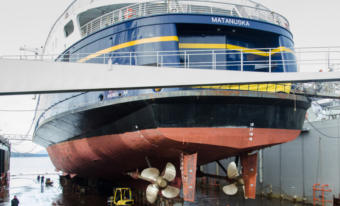
Ferry Matanuska sailings canceled through mid-April

First engineer Tom Robinson, of Wrangell, looks around the engine room of the Matanuska on Feb. 7 at the Auke Bay ferry terminal in Juneau. The ship is eventually headed to Ketchikan for repairs. (Photo by Rashah McChesney/KTOO)

Service on the state ferry Matanuska, the fleet’s sole operating mainliner this winter, has yet to begin. The Matanuska broke down last month, stranding hundreds of passengers, and it hasn’t yet made the trip to the Ketchikan shipyard for repairs.

State transportation officials have announced more cancellations through the middle of April.

The Alaska Department of Transportation and Public Facilities had said the Matanuska was projected to return to service on March 2. But the ship remains tied up in Juneau’s Auke Bay, and now travel agents are being informed that the March date was optimistic.

“We got a call from the Petersburg terminal with its cancellation notice of two sailings in March,” said David Berg, co-owner of Viking Travel in Petersburg, on Thursday. “And we were advised that there was nothing to book them on until perhaps the Columbia comes online in mid-April.”

Officials with the Department of Transportation didn’t immediately comment on the March cancellations Thursday.

Berg has been in the travel business for almost 40 years. He said ferries breaking down and sailings being canceled have long been common.

“But in this instance, there’s not another vessel that is ready,” he said. “This is certainly nothing that we’ve ever seen before.”

The ferry Tazlina is slated to return to service for sailings in Upper Lynn Canal and villages including Hoonah and Angoon.

But without a mainliner ferry, communities like Petersburg, Wrangell and Sitka join other coastal communities without service.

Vigor Alaska — which was contracted to service the Matanuska — says its technicians have been working to find the root cause of the failure since the fault was detected on Jan. 23. The company doesn’t know if the gear box failure is related to the company’s work or is due to defective parts from the state’s chosen supplier.

“As (a) longtime contractor to AMHS, we affirm our commitment to cooperatively seeking ways to return the M/V Matanuska to service as soon as reasonably possible,” wrote Jill Mackie, Vigor’s senior vice president for public affairs, in a statement Thursday.

“It is important to note, the components in question are custom built and parts are not readily available off the shelf,” Mackie added. “There is substantial lead time to get the necessary replacement parts.”

Transportation Commissioner John MacKinnon told reporters Wednesday that there’s “finger-pointing” between Vigor Alaska’s shipyard and the manufacturer of the defective equipment. In the meantime, he suggested the state’s hands were somewhat tied.

We’ve got to be careful of our involvement in it, because there’s warranty issues,” MacKinnon said Wednesday during a joint press conference with the governor, “and if we get too involved, we can void warranties and that could be a very expensive thing.”

Gov. Mike Dunleavy then added that his administration was committed to getting the ship back in service.

“We’re pushing them to get this thing repaired and fixed,” Dunleavy said Wednesday. “And we’re not going to accept excuses that they’re squabbling as our people are waiting for transportation. So we’re going to keep putting the screws on these outfits.”

Following a $41 million overhaul that included new engines, the Matanuska re-entered service late last year. Its breakdown left only the Lituya — a shuttle ferry running between Metlakatla and Ketchikan — as the only vessel running in the fleet.

That’s led to hardships across the region as communities are cut off. Shortages of food and other essentials are reported in remote communities with few alternatives to state ferry service.

Editor’s note: This story’s byline has been updated to include CoastAlaska reporter Jacob Resneck, who cowrote this story with KFSK reporter Joe Viechnicki.


Southeast Alaska has a new marine reptile fossil and it has a Tlingit name

Tlingit artist Robert Mills created this depiction of Gunakadeit joseeae in 2020. (Image courtesy of Sealaska Heritage Institute)

A fossil of a marine reptile in Southeast Alaska has officially been declared a new species and Tlingit elders have named it after a well-known creature in their traditional stories.

Nine years ago U.S. Forest Service geologist Jim Baichtal was walking with a group along the beach in the Keku Islands. The area is known for fossils that moved from the tropics in the Pacific Ocean to Southeast Alaska through tectonic activity.

It was a very low tide when they saw what looked like a black rockfish skeleton on a lighter gray background. Baichtal knew it was something special.

“We don’t have dinosaurs, we have Triassic marine reptiles,” Baichtal said. “That’s kind of our fossil here in Southeast Alaska.”

The fossil, about a foot and a half long, showed a reptile with a big tail like an iguana or alligator. But Baichtal needed an expert opinion.

“So, I set out on the outcrop and taught myself how to take a photograph on my old flip phone,” said Baichtal, laughing. “It’s the very first time I’ve ever taken a picture to send to Pat and describe to him what we were seeing.”

Geologist, Jim Baichtal (left) and paleontologist Pat Druckenmiller (right) lift out the slab of rock containing the reptile fossil in 2011. In February 2020, Tlingit elders named it after a well-known creature in their traditional stories. (Photo courtesy of Jim Baichtal)

Pat is Pat Druckenmiller, a paleontologist and director of the Museum of the North at the University of Alaska Fairbanks. He looked at the photos and recognized it as a Thalattosaur. He also noticed the unique pointy shape of the reptile’s head.

“We knew right away without a doubt that this was a new species,” Druckenmiller said.

But that was only the beginning of a very long process. They waited a month to remove the surrounding rock at the next low tide cycle. It took three years to remove the fossil from the rock in the lab. It took three more years to compare it to other similar fossils in the world in order to confirm that it was, in fact, a new species.

“We need to compare every single little gory detail of every bone to that of other species that are found elsewhere,” said Druckenmiller.

That meant trips to China where most of the Thalattosaur specimens are kept. In total, it took nine years for the fossil to be processed and peer reviewed before it was published as a new species, Feb. 4, 2020.

The scientists asked for permission to use a Tlingit word to name the new species. Dr. Rosita Worl, President of the Sealaska Heritage Institute, says they conferred with their Counsel of Traditional Scholars and checked in with elders in Kake near where the fossil was found. All agreed Gunakadeit was a good name. It’s likely the first time a fossil has been given a Tlingit name.

“I think this is part of the growing awareness and sensitivity about Tlingit culture so we very much appreciated that the scientists came to us,” Worl said.

“Gunakadeit comes from our oral tradition, so it’s already an existing name,” said Worl. She’s Tlingit and an anthropologist.

Worl says clans usually own names, but Gunakadeit is owned by all Tlingit people as part of their oral tradition. It’s a sea monster legend that helped keep kids safe.

“I just grew up hearing there was Gunakadeit, watch out, you know,” she said. “We were told these stories so that we would be careful and not wander off by ourselves and always stay within a group — otherwise you’re going to get caught by the Kushtaka or Gunakadeit.”

A second part of the name, joseéae, was added by scientists to honor the mother of Gene Primaky, who first saw the fossil along with Baichtal.

As for Gunakadeit joseéae, Druckenmiller says they can tell a lot about it just from looking at the bones. They used their pointy snouts to probe into little cracks and crevices in the reefs, searching out soft bodied prey.

“This animal had kind of an enviable lifestyle” Druckenmiller siad. “It lived in shallow marine environments, so coastal environments, on the edge of a tropical volcanic island.”

The fossil belongs to the State of Alaska because it was found in the intertidal zone. It’s currently on display at the Museum of the North in Fairbanks.

2019 was highest value year on record for Dungeness crab in Southeast Alaska

Portrait of a Dungeness crab. (Photo courtesy Kevin Cole/Wikimedia Commons)

The 2019 commercial Dungeness crab season in Southeast Alaska was the most valuable on record. The summer and fall fisheries brought in $16.3 million at the docks.

The end of the fall fishery is just wrapping up with a few fish tickets still being processed as of the end of January. However, it’s already obvious; it was a record-setting year.

5.3 million pounds of Dungeness crab were harvested, which is the third highest harvest on record. Yet, the price averaged $3.07 a pound making it the highest valued season ever recorded for Southeast.

The previous record for the most valuable year was in 2002. Seven million pounds were harvested but the price was only $1.25 per pound back then.

“It was pretty awesome that we  broke that record,” said Adam Messmer, a shellfish biologist with the Alaska Department of Fish and Game.

Messmer says the high harvest this year means the Dungeness crab population is remaining healthy. He says the timing for the fishery worked out well too.

“We didn’t have a whole lot of softshell, he said.

Softshell occurs during the crab’s molting cycle when Dungeness can’t be sold. In the springtime, most crab grow a new shell and lose the old one. But it takes a while for the new shells to harden up. Managers like Messmer hope that happens by the time the summer fishery begins in June.

“We have springs that are warm and springs that are cool and the Dungies just don’t always molt at the exact same time every year,” said Messmer.

Two hundred permit holders participated in the Dungeness crab season, which is above average.

Most of the crab were caught in the summer fishery, which is normal, because conditions are safer and more fishermen are participating. The summer harvest of 4.2 million pounds was the best in the last decade.

The fall fishery brought in 1.1 million, which is average for that fishery. The main areas were open for all of October and November. Most of the harvest was in three areas– District 8 near Petersburg and Wrangell, District 11 including Stevens Passage near Juneau, and District 6 including Duncan Canal and Level Island.

The summer fishery for Dungeness will open on June 15. Meanwhile, the next crab season in Southeast is for Tanner and golden king crab, which will open in mid-February.

Coast Guard notes VHF emergency radio dead zones in coastal Alaska

A map showing VHF signal coverage areas in Southeast Alaska.
(Graphic courtesy of U.S. Coast Guard)

The U.S. Coast Guard has released a list of communications towers in Alaska that may not be receiving VHF radio broadcasts and is warning mariners to bring back up communications systems.

Seven of the problem towers are in Southeast Alaska, including Duke Island, Sukkwan Island, Zarembo Island, Cape Fanshaw, Duffield, Althorp Peak and Deception Hills. The areas near those towers are dead zones where the Coast Guard won’t be able to hear distress calls on emergency channel 16.

Other sites in Alaska are Pigot Point, Bede Mountain, Raspberry Island and Cape Gull.

A map showing VHF signal coverage areas in Southcentral Alaska.
(Graphic courtesy of U.S. Coast Guard)

The Coast Guard has hired a contractor to do repair work.

“Specifically to Southeast, there’s some towers that we’re looking into and making repairs on parts of the towers to get them up and running, back to full running status,” said Matthew Schofield, assistant public affairs officer for the Coast Guard’s District 17 in Alaska.

One of the issues is getting power generators back up and running at the communication towers. Schofield said the fix is happening as soon as possible.

“I don’t necessarily have a timeline. I don’t want to assign something that isn’t 100% here for that, but at this point some of the sites are able to receive. They’re able to receive some of the signals and some of the calls, but they may not be able to transmit, so we’re also working that,” he said.

The Coast Guard this month warned that, even with a fully functioning system, it cannot hear all VHF calls in Alaska’s mountainous terrain. VHF radio is the cheapest means for emergency calls by mariners in distress. But the Coast Guard is recommending other communications systems as a backup, like satellite phones or texting devices, emergency beacons or even cellphones where there’s service.

“Any means that people can take when they’re out on the water to contact the Coast Guard is obviously recommended,” Schofield said. “But we’ll get to the calls the best we can, and we do want to ensure safe passage throughout the water and throughout the fishing season.”

Commercial fisheries are ongoing in Southeast through the winter. This winter has already brought hazardous conditions, with freezing spray warnings, strong winds and a deep freeze.

Southeast Alaska fishermen unite against designating critical habitat for humpback whales

Jim Martinsen of Petersburg testified at the NMFS meeting in Petersburg, Jan. 6. (Photo by Angela Denning/KFSK)

Fishermen from different gear groups united against a proposed federal rule to designate Southeast Alaska as critical habitat for humpback whales. Many of the fishermen voiced their opposition during a three-hour meeting hosted by the National Marine Fisheries Service in Petersburg, Jan. 6, 2020.

About 60 people crowded into the Petersburg borough assembly chambers and others overflowed into the hallway. Most were fishermen from Petersburg, Wrangell, and Ketchikan. A group from Ketchikan also testified by phone.

They had the same message for the federal government. They don’t want Southeast labeled critical habitat for whales.

“It bothers all of us and I think it’s wrong,” said Chris Guggenbickler, a commercial gillnetter from Wrangell.

The meeting was run by Lisa Manning, with the National Marine Fisheries Service or NMFS. She spent about an hour trying to convince the crowd that a critical habitat designation would not affect commercial fisheries.

“It’s not conceivable to think that you’re going to do anything differently than what you’re doing now,” she said.

Although there are state managed herring fisheries, the federal government prohibits federal fisheries for the whales’ main prey species. Manning said protections are already high for the whales and fisheries would not be more restricted from the designation.

But attendees were not convinced. “It makes me really nervous when the federal or the state decide to protect something that could affect our fisheries,” said long-time Petersburg commercial fisherman, Bud Samuelson.

Amy Daugherty is the Executive Director of the Alaska Trollers Association based in Juneau. She said critical habitat means one step closer to restrictions for them.

“Something can go from threatened to endangered and all of a sudden things get crazy,” said Daugherty. “All of a sudden we get a low count and we’re S.O.L.”

NMFS must designate critical habitat for species listed under the Endangered Species Act. The agency is proposing the critical habitat rule now because two groups of humpback whales that travel to Alaska to feed are showing low numbers. There is an endangered group of 1,000 whales from the Western North Pacific that feeds near Bristol Bay and the Aleutian Islands. And there is a threatened group of about 2,800 humpbacks from Mexico that goes north along the west coast to feed. Just a small portion of them– between 56 and 238 whales travel as far north as Alaska. The proposed rule would designate 22,000 square nautical miles in Southeast as critical habitat and about 79,000 square nautical miles along the Bristol Bay and the Aleutian coastline.

But it’s hard for Southeast residents to see past all the whales in their backyard. There is also a robust population of humpbacks that number around 11,000, which migrate between Southeast for feeding and Hawaii for breeding.

Russell Cockrum, a commercial fisherman of 44 years from Ketchikan, said the growth in Southeast’s whale population has been too much.

“Now, it’s beyond ridiculous,” he said. “And I don’t know how this process started but it falls under the same verbiage, it’s ridiculous also.”

Long-time commercial salmon seiner and longliner, Sig Mathisen of Petersburg, said whales have been in Southeast for decades and the region is not to blame for any low numbers.

Long-time commercial fisherman, Sig Mathisen of Petersburg, testified at the National Marine Fisheries Service meeting in Petersburg, Jan. 6, 2020. (Photo by Angela Denning/KFSK)

“I really feel Southeast Alaska for sure should be excluded from this critical habitat,” Mathisen said. “You’re talking about our whale population and any effect on it are happening somewhere else.”

There is a small area in Southeast proposed to be excluded from the designation for military reasons. There are two more areas in the western part of the state to be excluded due to economic impacts. Several fishermen at the Petersburg hearing asked if Southeast could also be excluded for that reason. One of them was Max Worhatch with the United Southeast Alaska Gillnetters, representing nearly 500 permit holders. He said the group disagrees with the economic analysis in the proposal and wants a new one.

“The costs are only figured for National Marine Fisheries Service to consider impacts to critical habitat,” Worhatch said. “There’s no consideration for other economic impacts to fishermen, processors and communities.”

Manning didn’t say whether they’d redo the economic analysis but she did say that an area can be excluded if the economic impact outweighs the conservation benefit.

She told the hearing attendees that critical habitat does not create preserves, sanctuaries, or closed areas. But it would make federal activities in the area more regulated—like projects or permitting through the Army Corps of Engineers including alternative energy projects. The rough timeline would have the designation activated by early November of this year.  The public comment period ends January 31.

Former Kake man, back in Alaska, arraigned on murder charge

A former Kake man is back in Alaska and has pleaded not guilty to a murder charge for a 2017 death in that Southeast Alaska community.

Isaac David Friday, 27, is facing one charge of murder in the first degree for the death of 19-year-old Jade Williams. An indictment by a Sitka grand jury alleges Friday caused Williams’ death on Aug. 15, 2017, in Kake.

Friday is in custody at Lemon Creek Correctional Center in Juneau. He was arrested in Washington state in December.

Friday was arraigned via telephone in Ketchikan Tuesday in front of Superior Court Judge William Carey. The judge appointed a public defender for Friday, who entered a plea of “not guilty” for his client. Carey agreed to keep Friday’s bail amount at $500,000.

The judge tentatively set another hearing date for Feb. 25.

Site notifications
Update notification options
Subscribe to notifications