KFSK is our partner station in Petersburg. KTOO collaborates with partners across the state to cover important news and to share stories with our audiences.
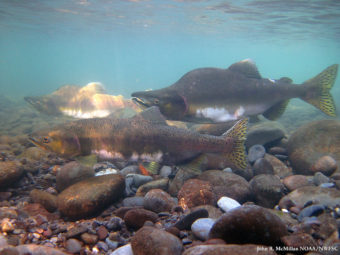
Pink salmon return to spawn every two years. The parents of this year’s fish returned in low numbers. Those fish also spawned during a long-term drought, which may have impacted the 2020 returns. (Photo courtesy NOAA fisheries)
Two years ago, the commercial catch of pink salmon in Southeast Alaska hit its lowest level in more than four decades. This year’s catch will be even lower.
Pinks are caught mostly by the purse seine fleet. Some seiners have finished for the summer, and others have headed to the Sitka area to chase hatchery chums.
Andy Piston is the Alaska Department of Fish and Game’s pink and chum salmon project leader for Southeast. He said the catch by late August had topped six million fish and was expected to finish around seven million pinks by the end of the season.
“It looks like it’s going to come in a little below the 2018 parent year harvest, which was about 8.1 million, and that’ll be one of the lowest harvests since the mid-1970s. So it’s definitely a historic very poor pink salmon harvest,” Piston said.
At that level, this year’s catch will be the lowest since 1976.
Scientists had predicted a poor return, with a point forecast of 12 million fish going into the season. Low numbers of returning pinks in the northern panhandle forced closed fishing areas again this summer, to allow fish to return to spawning streams. In management terms, those fish making it back to streams are called escapement.
Piston said most of this year’s catch came from the southern part of the region.
“Escapements in the southern districts generally looked pretty good,” he said. “As you moved north, though, things are considerably weaker, especially when you get into northern inside waters, north of Sumner Strait. And there we had very little fishing opportunity in northern inside waters. There was almost no harvest up there, so we were trying to get fish toward escapement. In some areas it sounds like there was a little bit of improvement over the parent year, but the overall pink return up there was still very low, and it looks like escapements are still going to be below management targets for a lot of stock groups up in that area.”
Pink salmon return to spawn every two years. The parents of this year’s fish returned in low numbers. Those fish also spawned during a long-term drought, which may have impacted the 2020 returns.
Two years ago, a bumper crop of hatchery chum salmon made up for the poor pink numbers. That’s not the case this year. 2020 may see one of the lowest chum salmon catches in decades.
In fact, catches for all salmon species in Southeast are lagging this year. Sockeye catches are 70% below last year’s and among the lowest ever. Coho catches are almost 50% behind last year. Catches of king salmon are the closest, just 14% off the pace from 2019.
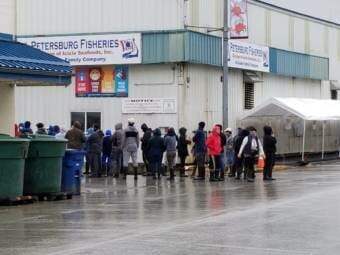
OBI workers entering the seafood processing plant (Corinne Smith/KFSK)
Hundreds of seafood processing workers come to Petersburg every year, creating a high-risk scenario for COVID transmission. Workers at the town’s two processing giants – OBI Seafoods and Trident Seafoods – live on a closed campus. But there are also Petersburg residents who work at the plants. So the local COVID testing program aims to identify and isolate positive cases before they can transmit from town into one of the plants.
At the beginning of the summer, seafood companies went to great lengths to safely fly the seasonal workforce to Alaskan towns like Petersburg. It took careful planning and millions of dollars to test and quarantine the workers.
“It could decimate the economy of the community and also impact the fisheries. We saw that in meat packing situations down south,” said Liz Bacom, manager of infection prevention at the Petersburg Medical Center. “And so they were very aggressive with getting a plan where they tested their seasonal workforce in Seattle before they came up here, and they were automatically quarantined for 14 days.”
As a result, two positive cases – one worker for Trident and one with Ocean Beauty Icicle Seafoods – were detected and isolated this summer.
But then the risk changed. With the vast majority of seasonal workers testing negative and restricted to a closed campus, the risk of COVID being transmitted into the plants came from Petersburg residents who worked in the plants. Fortunately, there have been very few cases of COVID in the community, so the risk has been low.
“If there had been an outbreak in the community, it would have been a very high risk for the cannery workers going back and forth,” Bacom said. “Fortunately our cases in Petersburg have been minimal, and there hasn’t been community transmission, and so we’re in a very fortunate situation as compared to other communities.”
In June, the Petersburg Borough Assembly approved just over $177,000 in federal CARES Act funding for regular COVID testing for the local resident seafood processing workforce.
Angela Menish is the Director of Patient Services at the Petersburg Medical Center and oversees the testing program, which happens every two weeks.
“Friday morning we head down with our supplies and PPE,” explained Bacom. “We have two people checking people through and getting their consent, and then they come over to the little swab station, which is a little protected area with plexiglass, and they test themselves.”
Workers swab their own nostrils. It’s a newer type of test, not the deep nasal swab that used to be common and could be painful. The tests are sent to a lab in Bellingham, Washington, and results take about 2-4 days.
“If someone were to have symptoms, that would be a different story,” Manesh said. “They would be tested through the respiratory screening clinic, and they would definitely quarantine until the results were back.”
The medical center estimates that about 177 local workers from OBI and Trident get tested each week.
But the medical center relies on the seafood companies to identify their local workers who need to be tested. The companies also do their own workforce testing, but neither OBI nor Trident answered KFSK’s requests for comment about them.
Plant workers are required to wear masks and maintain social distancing, and they’re screened for COVID symptoms each day when they start work. KFSK spoke with several seasonal workers who reported they’re satisfied with the protocols and feel safe working at the plant.
For Tonka Seafoods, a small processing plant with about 19 employees — half seasonal and half local residents — management has made asymptomatic COVID testing optional. They said they adhere to COVID protocols and require masking of employees and customers, and they told KFSK they’re aware testing is available.
Infection preventionist Liz Bacom says the seafood processing companies have been doing a good job with COVID protocols, and every effort counts.
“We have people flying in from all over, and you know, there’s always that possibility. So we just really can’t let our guard down,” Bacom said. “Things can change very quickly, and I just don’t want to have that happen here.”
The Petersburg Medical Center has federal CARES Act funding to continue the testing program for local resident seafood processing workers through September, with the possibility of an extension. But the Petersburg Borough says that will depend on whether state or federal funding is available.
Erin Michael is the public health nurse in Petersburg. (Photo/KFSK)
Erin Michael runs the public health clinic in Petersburg. Usually she spends her time doing well-child exams, immunizations, screenings and family planning. She also serves the community of Wrangell, on a nearby island.
But the COVID-19 pandemic shut down her travels this spring, and Michael’s job changed this summer when she started contact tracing for the state.
“Every day is a unique and special day,” Michael said. “I’m learning lots about all over Alaska.”
Michael interviews people from any part of Alaska. She’s mainly doing what they call “index tracing” for people who have tested positive for the virus. She says that conversation is in depth and can last for some time.
“That can be quite extensive, sometimes that can be a couple of hours long, depending on how busy these people are and how many people they’ve been around,” she said.
One thing Michael has learned through dozens of interviews with people who have had the virus is that people are not always limiting their social bubbles.
“The big thing that I see is people maybe not keeping their social bubbles small,” Michael said. “They may be going to large events and they’re just not keeping that six-foot distance.”
Contact tracers like Michael will ask people about possible symptoms, preexisting medical conditions, where they live, their household members, coworkers and other contacts in order to track possible virus transmissions. She says they will never ask for financial information.
“We’re never going to ask for a credit card or money from anyone,” she said. “So, if you get a call and somebody is asking you for credit card information or money or a check, that’s a scammer. That’s never going to be us.”
Michael isn’t alone. There are two other nurses in Petersburg helping her in contract tracing, plus many more throughout the state. An important detail they try to identify is what resources are available for people where they live, which can widely vary. Overall, she says they are very grateful that people are willing to share their information.
“Very appreciative that people are willing to talk to us and give us this information so that we can give them the tools they need to properly quarantine or isolate depending on if they are positive or not,” said Michael. “Then also reach out to people that they’ve been around so that they can protect themselves so that we can hopefully slow down and eventually stop this COVID.”
Michael hopes that an effective vaccine will become available soon, which could protect the general public. Until then, she’s asking people to keep following health recommendations of frequent hand washing, social distancing and wearing facial coverings when around non-household members indoors.
Public Health Nursing in Petersburg has free reusable masks for people who need them. They can be picked up from the office in the health center complex, usually Monday through Friday from 8:00 a.m. to 4:30 p.m.
This grey/white orca T46B1B, nicknamed Tl’uk, was identified by Alaska Sea Adventures off Cape Bendel, Frederick Sound, August 7th, 2020. (Photo courtesy of Stephanie Hayes)
A rare, white orca named Tl’uk has been seen for the first time in Alaska waters.
A Petersburg-based whale watching and charter company documented the white orca in the Inside Passage this summer. It’s been sighted frequently in British Columbia and Washington state as well.
Dennis Rogers, owner of Alaska Sea Adventures, was on a charter trip with eight guests, cruising along Kuiu and Kupreanof islands west of Petersburg. He said they spotted three orcas, including the white one, along Kupreanof Island on August 7th.
“It sure made spotting him easy. When they went down underwater, usually they disappear and typically are very hard to follow. But having a white one under the water, you could see him an easy ten feet below the surface, this big white shape moving along there.”
His boat, the Northern Song, was able to stay with the whales. Stephanie Hayes is first mate and a doctoral candidate at the University of Alaska Fairbanks. She got some good photographs for identification.
“I saw kind of a glow under the water and I’m thinking, wow that’s an awfully white killer whale, that’s doing something funny,” Hayes said. “And no, it was just genuinely the white killer whale. And it popped up and you could hear an audible gasp from everybody on the bow, going oh my gosh what are we seeing here. It was really incredible.”
This orca was born in 2018. Researchers assigned it catalog number 46B1B based on its lineage. But it’s nickname is more poetic. It’s called Tl’uk, a Coast Salish word for “moon.” Tl’uk is a greyish moon color, without the typical black and white pattern. It also has some intricate markings visible near its dorsal fin, which help to identify it.
Scientists call animals like this “leucistic,” which is a different inherited condition from albinism.
Jared Towers, a killer whale researcher with Fisheries and Oceans Canada said Tl’uk “is not quite pure white and it doesn’t have the pink eyes that would indicate albinism. There’s a possibility that it has some kind of rare condition which includes partial albinism, but I think it’s probably more so a lack of pigment, which is much more common.”
Still, Towers calls this animal quite rare, with just two currently alive and five or six documented in this whale population in the last 80 years or so. Others have been documented closer to Russia.
This whale’s mother and grandmother have ranged up and down the Pacific coast. The family is more commonly seen around Vancouver Island. Towers believes it’s the first trip for this 2-year-old into Alaska waters.
“I think it’s great that the little guy has been seen up there,” Towers said. “He seems to be healthy every time I’ve seen him, he’s looking pretty good and again, not surprising that he has shown up. The family has a long sightings history in that area, as well as BC and Puget Sound, Washington and even as far south as Oregon.”
He notes killer whales travel quickly, and it’s likely this group could be seen back near Vancouver Island in just a couple weeks.
There are multiple, distinct types of orcas, which eat different foods. Resident whales focus on fish. Rare, offshore orcas are shark eaters. But this animal belongs to the meat eaters, or Bigg’s killer whales, also called transients. They feast on porpoises, dolphins, sea lions and seals.
This pod was also observed swimming the shoreline of Mitkof Island near Petersburg. The Northern Song’s Hayes was able to get more photographs, closer to Petersburg, and observed some feeding.
“So right outside Sandy Beach the pod was making a kill, presumably on seals,” Hayes said. “And then right off of City Creek, we were able to watch the pod make what looked like another kill, another hunt in that area also.”
Sightings have continued near Petersburg, drawing photographers and whale enthusiasts to the Frederick Sound shoreline.
Students with the online Tlingit class met every weekday evening in July via Zoom to practice and listen (Photo: Corinne Smith/KFSK)
On a Wednesday evening in July, students in the new online Tlingit language course log on to Zoom. Elders are often given the floor, sharing stories, memories and songs while their adult children listen and provide tech support.
Tonight the class begins with a student sharing a story about her day — observing a hummingbird, enjoying the sunshine in Juneau and looking forward to the Tlingit class.
The online class has been offered every weekday evening in July, with days for beginner lessons, intermediate and advanced conversation. Each night between 50 and 120 students log on to speak, study and listen.
Families with children sit together on sofas, around laptops. Others appear on Zoom from kitchen tables, bedroom desks and living rooms. Students participate from across Alaska and North America.
Many Alaska Native languages, including Tlingit, were in jeopardy before the pandemic. According to the Sealaska Heritage Institute, in 2017 there were only about 40 fluent Tlingit speakers out of an estimated 100 speakers at various levels.
The class instructor, X’unei Lance Twitchell, teaches Alaska Native languages at the University of Alaska Southeast. He says the goal of language revitalization is to support new students and current speakers.
Map of Tlingit language area (Image: Tlingitlanguage.com)
“I tell learners, you’re going to learn this language,” Twitchell said. “And then you’re going to be able to talk to some of these really old people, who are the remaining speakers, and they’re going to be able to share things with you that they can’t share with anybody else in the world right now, and then you’re going to get to know them in this very special way, and then you’re going to lose them.”
That’s how Twitchell learned Tlingit, from spending time with his elderly grandfather. He says it’s impactful for elders too and can contribute to generational healing.
“They’ve lived their whole life, just seeing decline, decline, decline, decline,” Twitchell said. “And toward the end, they get to see some younger people that they can actually talk with, and we’ve seen the impact. We’ve seen tears of joy, we’ve seen incredible moments that wouldn’t have happened if folks didn’t put in that hard work.”
As recently as a generation ago, elders say they were punished as children for speaking their language, especially at school. Stories and cases document violent assault on students, harassment, and other acts to erase Native culture, like cutting their hair.
Twitchell interviewed an older woman in Tlingit who recounted a teacher who sought her out every day with a sinister warning.
“And she said, well they never really hit me for speaking my language,” Twitchell said. “But I had this one teacher who would call me over every day, when she saw me, and I was just a little kid. And she’d say, ‘You think you people are just as good as us, but you never will be, you’re second-class citizens.’ And this is a school teacher talking to a child.”
Throughout the 20th century, eradication of Native culture was a widespread, systematic effort. It’s a dark side of American history that Twitchell says few are willing to acknowledge.
“A lot of people don’t want to do that,” Twitchell said. “They’ll get really upset, or say it was a long time ago. I didn’t do that. I don’t know why we’re talking about this, everything is better now.”
In fact, government policy, religious institutions and schools all had roles in trying to eradicate the Tlingit language — and more than 20 other Alaska Native languages and cultures. Twitchell says revitalizing the language helps address that history of systemic racism and marginalization of Native people.
“Some people will say, well they fell out of use. They don’t have uses in the modern world. And this is the way people might convince themselves that these things have happened,” Twitchell said. “And not that, children were tortured for being who they were, and that America committed this massive and orchestrated and intentional genocide of entire populations. Hundreds of languages.”
Investment in Native language learning is an investment in reviving the culture, customs and places of Native people. Twitchell says that process – and countering that erasure – could address the increased rates of addiction, violence and suicide seen in Alaska Native communities today.
“Now we have to decidedly move against it in order to have a different result,” Twitchell said. “Because a lot of people will talk about Indigenous peoples in the past tense — ‘oh they did this, they used this’ — it’s like no, they do that now, they use that now.”
Twitchell says Tlingit language learning opens up a window into 15,000 years of how people lived in the Southeast Alaska and Western Canada region.
The language is evolving, too, and Tlingit speakers are collaborating to come up with new words needed for today. At one point the class discusses the Tlingit words for “popcorn” and “parking lot.”
This summer, Sealaska Heritage Institute partnered with Outer Coast in Sitka to offer the online class for free. In a survey of participants, they say more than 600 students expressed interest, from all over North America — New Mexico to the Aleutian Islands.
“It’s been wonderful to see the numbers,” Twitchell said. “To see families there, to see lots of people and to see people trying. It’s really exciting to see.”
The language revitalization effort is modeled after Hawaii’s successful program, with the goal to offer Native language in all Alaska schools, from pre-kindergarten to college.
The Tlingit language class is continuing via Zoom, for free, for anyone interested. You can find information about the class, language resources and recordings of past classes at Tlingitlanguage.com.
Julie and Gig Decker with their two children, Siguard and Helen, who died in a Monday car crash on Mitkof Island. (Photo courtesy of United Fishermen of Alaska)
Four people have died in a vehicle wreck south of Petersburg. It’s believed the late model SUV went off Mitkof Highway sometime Monday night.
Tuesday morning, Alaska State Troopers received a report that a group that headed to Blind Slough on Mitkof Island the day before was overdue to return. While troopers were responding, they were informed of a wreck near 27-mile of Mitkof Highway. Alaska Wildlife Troopers arrived and confirmed that all four occupants of the vehicle were deceased.
Petersburg Volunteer Fire Department’s Dave Berg was on the scene.
“We got there we found a large SUV, late model SUV that had gone off the road sometime late last night,” Berg said. “When we got there we were able to access the car by climbing down the bank and we found four occupants of the car that perished at the time of the crash.”
Scene of the accident that killed four on Monday night in Petersburg. ( Petersburg Volunteer Fire Department)
Troopers identified those killed as Siguard Decker, 21 and his 19-year-old sister Helen Decker, both of Wrangell. Ian Martin, 29 of Petersburg and Dennis Lord, 37 of Elmira Heights, New York were also confirmed dead.
The site is south of the Greens Camp camping area, and the group was traveling southbound. Berg said they apparently missed a left-hand curve, and their Ford Excursion went off the highway over a steep embankment.
“We noticed some tire tracks on the road, some skid marks, not very many though,” Berg said. “It looked like the driver may have tried to correct with over speed to correct too much around the turn and lost control of the vehicle. It went off the road and went approximately 200 feet into the trees alongside the road, along the length of the road but down the steep embankment and we envision that it probably turned, rolled a couple of times, hit a large tree, spun around it and finally came to a stop.”
The deceased were transported to the morgue at Petersburg Medical Center.
Bob Thorstenson Jr. manages the two seiners — F/V Magnus Martens of Juneau and F/V Vigilant of Petersburg — that the crew had been fishing on. He says the Decker siblings were close family friends that had just wrapped up purse seining on Sunday in some of the roughest weather he’d ever seen.
“I’ve never seen a brother and sister team, ever, in the world of fisheries,” he said Tuesday evening. “They were like the Michael Jordan and Vanessa Williams together — that’s how rockstar they were.”
He says the crew had come into Petersburg to meet a marine mechanic after one of their vessels had engine trouble.
“Otherwise we wouldn’t have been on this island with this godforsaken highway, you know,” he said, “it’s just that highway has gobbled up a lot of people over the years.”
An initial investigation by state troopers shows the vehicle left the road at high speed and hit a number of trees. Troopers say the occupants were wearing seatbelts, and the airbags deployed.
Troopers are continuing to gather evidence at the scene on Wednesday, spokesperson Megan Peters said.
“Investigation indicates that speed and alcohol are factors,” she wrote in an email Wednesday. “Toxicology tests will be a part of the autopsy; results take awhile to come back. The troopers haven’t confirmed to me yet which individual was driving. They are out on scene again today doing follow up.”
CoastAlaska’s Jacob Resneck contributed to this story.
Close
Update notification options
Subscribe to notifications
Subscribe
Get notifications about news related to the topics you care about. You can unsubscribe anytime.