KFSK - Petersburg

KFSK is our partner station in Petersburg. KTOO collaborates with partners across the state to cover important news and to share stories with our audiences.
Scientists look for invasive crab ‘fingerprint’ in Alaska waters

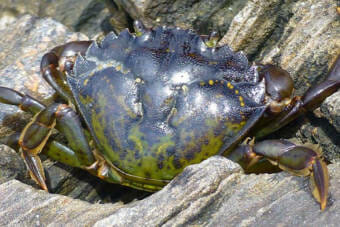
A European green crab. (Photo by Emily Grason/Washington Sea Grant)

Scientists are on the lookout for an invasive crab species expected to move north into Alaskan waters. This year in Southeast Alaska, they added a new tool to the monitoring effort for European green crab, which is a threat to the state’s shellfish and salmon.

European green crab or shore crab have been expanding their range north along the Pacific coast. But this year they were discovered just south of the Alaskan border.

“This Haida Gwaii occurrence last summer puts them very close to us,” said Linda Shaw, invasive species coordinator for the Alaska regional office of NOAA Fisheries. “I really wish I could say we don’t expect them, but prudence dictates that we say, yes, we think it’s a matter of when, not if.”

In July, natural resources managers found male and female adult green crab in Haida Gwaii, formerly called the Queen Charlotte Islands.

The species is native to northern Europe but has expanded its range to North and South America, Africa, Asia and Australia. The crab species was first found on the east coast of the U.S. in 1817 and the west coast in in San Francisco in the 1980s. Initially they may have been transported in ship ballast or by other human means. But some of the northward expansion in the Pacific may be drifting young crab on oceans currents.

Shaw said this animal ranks highly on the list of invasive threats for Alaska.

“They’re one of the top, at least marine, invasive species that we’re concerned about, and we’ve been tracking them for many years because they’ve been on the west coast already. They’re in Oregon and Washington and have been moving up the coast of British Columbia,” Shaw said.

On the east coast, these hardy crustaceans are known as aggressive eaters and have meant millions of dollars lost in fisheries for clams, mussels and scallops. The crab are destructive to eelgrass beds, which are important to young fish. They’re also known to eat juvenile salmon and could compete with native Dungeness crab.

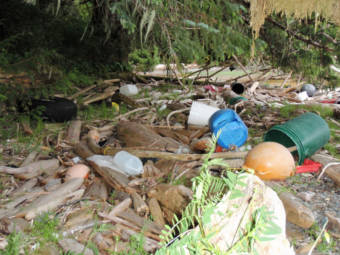
Charlie Waters prepares eDNA samples for transport to Auke Bay Laboratory. (Photo courtesy of NOAA Fisheries/Dave Nicolls)

These green crab have expanded their range northward during times of warmer water conditions from El Nino events. Scientific models predict warmer water from climate change could also help the spread of the species.

The typical way to monitor for this invader is using fish traps in targeted spots. But this past year Shaw and Alaska Sea Grant fellow Meredith Pochardt came up with a plan to combine trapping and water sampling in multiple spots. The water testing could produce environmental DNA, left behind by the crab in skin, shell or excrement. Scientists describe this eDNA, as its called, like a biological fingerprint. Shaw said this is a relatively new method that seems well suited to monitoring for invasive species.

“So maybe we have a broader net to cast,” she said. “Just collecting the water samples, which are filtered down, and then the eDNA is analyzed for the potential presence of that organism.”

That wider net helps on Alaska’s expansive coastline. But the plans for the expanded monitoring were derailed by travel restrictions from the global pandemic. Instead other scientists working at Little Port Walter on southern Baranof Island south of Sitka obtained the testing equipment and took the first water samples for green crab. Results aren’t back yet from that testing. Shaw cautioned that even if DNA is detected, follow up trapping is still needed to confirm the presence of that species in Alaska.

The scientists also secured funding to work with the Metlakatla Indian Community to join the monitoring effort.

“They are positioned ideally down there on Annette Island close to our southern Southeast Alaska border to be able to intercept green crab that might be coming north towards Alaska. And they were very interested in this project.”

The Alaska Department of Fish and Game provided fish traps that were sent to Metlakatla and set in several spots. No crab turned up there, or in traps set at Little Port Walter. The eDNA water sampling could start up in Metlakatla in 2021 and scientists may look to add other spots. They plan a full sampling season next April through September.

Petersburg Assembly takes up discussion about Southeast Alaska’s landless Native communities

Ohmer Creek south of Petersburg on Mitkof Island shows signs of low water in July. The creek usually brings in a variety of salmon to spawn. (Photo by Joe Viechnicki/KFSK)

The Petersburg Borough Assembly may take a position on proposed legislation that would transfer national forest land to five new Native corporations sometime next year. That’s after hearing again from supporters and opponents of the bill.

The legislation, introduced by Alaska’s congressional delegation this fall, would grant over 23,000 acres each to five new urban Native corporations, in Petersburg, Wrangell, Haines, Tenakee and Ketchikan.

Alaska’s senators and congressman say the bill will fix the omission of those communities from the Alaska Native Claims Settlement Act. The landmark 1971 law awarded nearly one billion dollars and 44 million acres to Alaska Natives and called for formation of village and regional corporations.

The legislation has been introduced before, but the latest version includes specific land selections. Near Petersburg, it identifies parcels from the Tongass National Forest on Mitkof and Kupreanof islands, along with Thomas Bay on the mainland. Some of those selections also include roads, forest service cabins and other public infrastructure.

Some opponents are concerned about losing access to national forest land and the potential for logging those parcels. And Petersburg resident David Beebe, who opposes the measure, questioned the cost of the transfer.

“Given the amount of public infrastructure certainly measured in the tens of millions of dollars in these land selections, it would be good to know what the taxpayer has forfeited to these five brand new Native corporations should this bill pass,” Beebe told the assembly.

Supporters of the legislation also weighed in.

Cecilia Tavoliero is president of the Southeast Alaska Landless Corporation, which sent the assembly a letter about the legislation. She and others would be shareholders of a new Petersburg urban corporation that would use the land for economic development and other uses. They say the 1971 land settlement and a cash payment in 1968 were not a good deal, and they’re asking for a tiny fraction of the land that was once theirs.

They also say the corporations will look for other ways to make money off the land other than logging, like carbon credits or tourism.

Nicole Hallingstad, granddaughter of Petersburg civil rights leader Amy Hallingstad, said the parcels in the legislation weren’t chosen with logging in mind.

“We did not select these parcels because of timber development,” she said. “We selected many of these parcels because they were the only lands available for selection at that time.”

Hallingstad also said the legislation ensures ongoing public access, unlike the 1971 law.

“This particular Alaska Natives Without Land bill preserves public access to all of the lands proposed to be conveyed to the new urban corporations,” she said. “It guarantees in perpetuity that the land shall remain open and available to subsistence uses, non-commercial recreation hunting and fishing and other non-commercial recreational uses by the public.”

The bill does have allowances for “reasonable restrictions.” Those include public safety and minimizing conflicts between recreational and commercial uses. The legislation would phase out U.S. Forest Service outfitting and guide use of the lands.

Also calling into the meeting this month was anthropologist Chuck Smythe, one of the authors of a 1994 report that looked at whether Congress had inadvertently denied the five communities eligibility to form village or urban corporations with their own land. Instead, members of the five communities were enrolled as at-large shareholders of the regional Native corporation Sealaska.

Areas in red show proposed land selections on Mitkof and Kupreanof islands near Petersburg. (From U.S. Forest Service maps presented to the U.S. Senate Energy and Natural Resources Committee)

The report, which is cited by both supporters and opponents of the current legislation, found nothing in ANCSA or its supporting documents that clearly explained why the communities were left out.

But Smythe, who now works for the Sealaska Heritage Institute, said Alaska Natives from Southeast villages may have been treated differently because of prior cash settlements in court cases over Native land claims. At the same time, though, a court had determined that earlier settlement did not extinguish all aboriginal claims in the region.

Smythe also said the 1971 law included a special provision to allows four other communities that were not small rural Native villages — Juneau, Sitka, Kodiak and Kenai — to gain eligibility for urban corporations.

“This provision was introduced by Senator [Ted] Stevens in the final bill during its consideration by the conference committee,” Smythe said. “No one objected to the four communities gaining eligibility at the last minute, but as stated in the report, the sense of the conference committee was that no more communities would be accepted for urban corporation status.”

Representatives from three of the five communities left out — Tenakee, Ketchikan and Haines — appealed their eligibility status but were denied. An appeal board ruled the law had “created an exclusive list of eligible villages in Southeast Alaska which cannot be added to.”

Assembly member Jeff Meucci, who asked to have the topic on the assembly’s agenda this month, asked to continue the discussion on the new legislation.

“I guess my original intent here was to — if this legislation was moving forward in a faster pace than everybody was comfortable for —  at least have a conversation about it,” Meucci said. “It seems like we’re going to have an opportunity hopefully in the month of January or so, to have a wide ranging conversation to answer these questions and have more dialogue.”

The legislation has been introduced in both the U.S. House and Senate, but it will have to be reintroduced if it’s not passed by the end of this year.

After 2020’s dismal catch, next year’s Southeast pink salmon harvest could be close to average

Ava Daugherty, of Juneau, grabs a chum salmon from Sara Gering, of Juneau, as the two work to offload more than 40,000 pounds of salmon from the fishing tender San Juan on July 19, 2018, in Juneau, Alaska. (Photo by Rashah McChesney/Alaska’s Energy Desk)

Next year’s catch of pink salmon in Southeast Alaska could come in a little below average, although that would be an improvement following several years of weak returns.

The Alaska Department of Fish and Game is forecasting a harvest of 28 million pinks in the region next summer. Andy Piston, the department’s pink and chum salmon project leader for Southeast, said that would still put the catch a little below the recent 10-year average.

“That forecast for 28 million harvest for 2021, that’s actually for an odd year that’s quite a bit below what we’ve seen in most recent years with the exception of 2019,” Piston said. “And in 2019, the parent year for 2021’s return, that was the first year in a long time where we saw a really poor odd-year harvest.”

Pink salmon spawn two years after they’re born. Southeast has been in a cycle of weak returns for even years but better numbers in the odd years. This year’s catch wound up at 8.1 million pinks, roughly the same harvest from two years ago. The region hasn’t seen catches that low since 1976.

Fish and Game’s forecast is based in part on trawl surveys that catch young pinks heading to sea each year. Those are conducted in partnership with NOAA Fisheries researchers in the northern panhandle.

Piston notes that the forecasts for five of the past six years have overshot the actual catches.

“What we’re doing with these trawl surveys is we’re basically measuring what survived all that fresh water and early marine mortality,” Piston explained. “So we’re just measuring the survivors that are making it out to the ocean. But once they’re past that, if you have factors out in the open ocean, you know once these fish got offshore, that increases mortality, that could result in us over forecasting.”

Unknown factors could include unusually warm waters the Gulf of Alaska has seen in recent years that have coincided with low returns. However, water temperatures this year have been closer to normal for the pinks heading to out sea this past spring.

“Right now if you look at sea surface temperatures in the Gulf, they’re pretty close to normal all through, off Southeast Alaska and through a lot of the northern Gulf, they’re within a half a degree or so of normal and there’s even a few patches of below normal water temperatures,” Piston said. “So hopefully, that gives me some hope that these fish are experiencing something a little more closer to average out there and hopefully we’ll see some improvements in marine survival with these fish.”

Inside waters in the northern panhandle especially have had poor returns for many recent even years as well as the parent year in 2019. The forecast assumes that won’t continue into next year. The parent year harvest in 2019 was 21.2 million fish.

Pinks are targeted by the region’s purse seine fleet, and many are canned or frozen. The value of this year’s catch was the lowest in decades, fetching just over six million dollars at the docks. Communities have asked the state to seek a disaster declaration for low salmon returns and low prices paid for those fish.

Correction: The caption of this photos has been updated to label the salmon being lifted out of the hold correctly, they are chum. 

Petersburg extends health mandate for passenger ships, but only through February

The Safari Quest tied up in Petersburg in 2018 (Alanna Elder/KFSK)

Besides approving COVID-19 mandates on testing and masking Monday, Petersburg’s assembly also extended a health order for cruise ships docking here. That measure requires pre-approval before cruise and other passenger ships can tie up. But the assembly stopped short of a much longer continuation.

The rule, known as health mandate five, has been on the books since last spring, with multiple extensions since late April. The community saw no visits this past summer from the overnight small boat cruise fleet, though more than one company tried to come up with COVID protocols that would work for Southeast towns in 2020.

Dave Berg is co-owner of Viking Travel and represents some of the companies that call here. He said in a radio call in show that cruise lines are selling trips to Alaska for 2021.

“They’re going ahead with the idea that they’re going to have a handle on COVID testing and approaching the community with a plan that they presume will be approved by the EOC here in Petersburg,” Berg said.

The mandate gives the borough’s public health officer the authority to approve or deny passengers disembarking from a ship based on health conditions on that vessel.

A number of local residents calling into this week’s meeting opposed health mandates, including the cruise extension.

Donna Marsh called the nearly year-long extension for mandate five “absurd.”

“Pushing these COVID restrictions out to the end of the third quarter 2021 will thoroughly decimate already struggling charter, sightseeing, passenger service businesses as well as the hospitality industry here in Petersburg,” Marsh said. “We cannot survive on government bailouts, they are not the answer. Letting people run their lives and businesses as they see fit is the appropriate thing to do. I would urge you to let this thing expire and be done.”

As proposed, the mandate would have stretched until the end of next October, putting it in place for cruise season all next year.

Assembly member Dave Kensinger wanted a shorter extension, only through the end of February. He wanted to be part of a regional discussion on the 2021 season and thought the mandate would exclude Petersburg from that.

“If we could provide some level of consistency between all the different communities in the region, like have one policy for the entire region it’d make it a lot easier for these operators to operate,” Kensinger said. “I think we all want to, most of us want to see them, be able to come back to town again this next summer.”

Others on the assembly were happy to take up the cruise mandate every few months, based on changing conditions of the pandemic. But assembly member Jeff Meucci called for the full extension to cover next year’s season.

“I am really comfortable with this Petersburg borough public health mandate number five for vessel docking and disembarkment,” Meucci said. “This gives us total over control vessels sailing into Petersburg. They have to run their plan through our health officer. There’s protocols they all have to abide by. I don’t want to lose that control.”

Meucci was the only vote against shortening the extension to the end of February and it passed 6-1. Mayor Mark Jensen voted against the mandate with that change, but it passed 6-1 as well.

After record rainfall, large landslide heard south of Petersburg

The slide is visible above the Kupreanof Island shoreline across from Mitkof Highway. (Joe Viechnicki/KFSK)

Some residents of Mitkof Island heard a large landslide Sunday across the Wrangell Narrows on Kupreanof Island about 7-8 miles south of downtown Petersburg.

Witnesses who heard the slide say it happened after dark, around 6:40 or 7 p.m. Sunday, November 1st. A sizeable portion of the hillside above Mountain Point on the Kupreanof shoreline has been cleared of trees and mud.

Local resident Ed Wood wrote that it sounded like a squadron of fighter jets taking off, and he thought it lasted for five minutes or more. Another Mitkof Island resident, Britni Birchell, lives near seven mile of Mitkof Highway and also wrote that it sounded like a jet flying over. Kellie Jones described hearing the rumbling outside her home but couldn’t tell if it was on the Mitkof hillside on across the water on Kupreanof.

The slide happened on a record setting day of rain. The National Weather Service says Petersburg recorded 4.12 inches of rain Sunday, a new daily record for November 1st, besting the old mark set in 1969. The day before set a daily record as well with 2.06 inches. That beat a record for the 31st of October dating back to 1976.

Petersburg’s three day total for rain for Saturday, Sunday and Monday was 7.55 inches.

Petersburg School District to require COVID-19 testing for in-state travel

Screening and testing tents set up outside the Petersburg airport early this fall. (Angela Denning/KFSK)

The state does not require testing for in-state travel, so the Petersburg School District decided to come up with its own policy for staff and students. The policy mirrors the state’s mandate for out-of-state travel requiring five days of isolation in addition to at least one negative test result.

Superintendent Erica Kludt-Painter said she supported the new requirement because of the rising COVID numbers around the state.

“Everything we’re doing is trying to do the very best that we can to keep our kids in school,” said Kludt-Painter. “It’s not perfect — this is not perfect. I keep thinking of it as a sieve, a little colander. There are still little leaks all over the place, but we are doing the very best we can with the information we have.”

The policy is for travel by any means off Mitkof Island — by plane, boat or ferry. It strongly recommends a second test after one week of isolation, but that’s not required for returning to school. There is also an option for a two-week quarantine instead of testing.

Initially, Board Member Jay Lister wasn’t sold on the policy because he said he didn’t want to confuse the public with more rules.

“I worry a little bit about the confusion,” he said. “You’ve got all these different travel restrictions from all these different places and you’re trying to figure out who is supposed to quarantine where. You’ve got six different set of rules.”

Board Member Megan Litster said the policy would actually make it easier on people because all the travel requirements would be the same for in-state and out-of-state travel.

“By us implementing this, it would actually smooth that out a little bit because it would make it consistent for the school across the board,” said Litster.

Board President Sarah Holmgrain said she received a lot of feedback from the community supporting a new policy. She said she supported it because it would help keep the schools open and could prevent problems if people aren’t being careful.

“If you had a whole family that left and had kids in multiple grades and didn’t follow the protocols and came back in, then you have potentially all three schools shut down,” said Holmgrain.

The policy includes an exemption for travel under 72 hours like the state’s policy for out-of-state travel does. That addition helped gain the support of two school board members — Cheryl File and Katie Holmlund — who were concerned about medical trips for staff and students.

The 72-hour exemption would also cover short travel by school groups or others doing personal trips.

Kludt-Painter said that she didn’t think the school district should monitor small boat trips to nearby communities.

“So if someone is leaving to go on a hunting trip to Prince of Wales Island somewhere on their own boat, I’m not particularly interested in managing that,” she said.

The school board also discussed testing availability in Petersburg. Same-day rapid tests are limited to people with symptoms and some travelers. There is a shortage of rapid testing equipment all over the country, and the Petersburg Medical Center cannot get as much as it wants.

PMC’s other test results currently have a three-to-five-day turnaround time. Asymptomatic testing through SEARHC on the weekends has a four-to-five-day turnaround.

The new school board policy is an administrative regulation, which means it went into effect immediately and can be changed much more quickly than regular board policies. The board plans to review it every few weeks.

Site notifications
Update notification options
Subscribe to notifications