KHNS is our partner station in Haines. KTOO collaborates with partners across the state to cover important news and to share stories with our audiences.
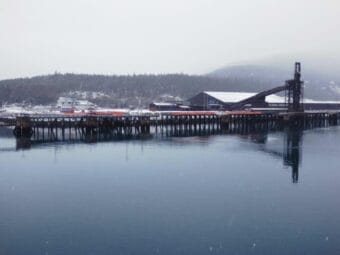
A suspension bridge to the Canyon City historic area on the Chilkoot trail. (Photo courtesy of National Park Service)
The U.S. portion of a historic, 33-mile hiking trail between Skagway and British Columbia has been off limits to backcountry explorers since 2020.
But that’s about to change, with one key caveat.
The National Park Service said Wednesday that the U.S. segment of the Chilkoot Trail will open for the first time in years, starting in June.
About half the trail is on the U.S. side of the border. Much of that has seen long closures due to the pandemic and flood damage.
The National Park Service eventually opened up the first several miles of the U.S. trail after preliminary repairs. But the rest has remained closed until now.
“We are excited to reopen the Chilkoot National Historic Trail for the season here on June 1, 2025 after a long hiatus,” Angela Wetz, superintendent of the Klondike Gold Rush National Historic Park, said in an interview.
That means hikers will be able to hike to the Canadian border from Dyea, a gold rush ghost town near Skagway.
Will hikers be allowed to cross the border?
Less certain is whether they’ll be able to cross the border and continue on to Lake Bennett, in British Columbia. Wetz said the Canadian Border Services Agency is currently reviewing a proposal by the National Park Service and Parks Canada and will decide if visitors will be able to enter the country on the trail.
The U.S., for its part, has already made up its mind.
“U.S. Customs and Border Patrol will not allow hikers to enter the US on the trail this year, as it’s not a designated port of entry,” Wetz said.
Previously, hikers were able to walk the entire length of the trail in either direction. But Canada’s decision will affect the most hikers — Wetz said the vast majority start in the U.S. and end in Canada.
The trail, which was recently designated a National Historic Trail, carries significant meaning in the region. For millennia, it served as a trade route for the Tlingit people, between the Inside Passage and the headwaters of the Yukon River.
In the 1880’s, several expeditions used the trail, and it later became a major transportation route to the Yukon goldfields. Eventually the trail was replaced by the White Pass and Yukon Route Railroad.
“It’s called, sometimes, the world’s longest museum,” Wetz said. “There’s all sorts of artifacts that you can see and signs from the past, of the uses on that trail.”
U.S. Senator Lisa Murkowski, R-Alaska, speaks with reporters at the Juneau International Airport on Wednesday August 16th, 2023 (Mikko Wilson/KTOO)
Hundreds of people came to Haines last weekend for the Great Alaska Craft Beer and Home Brew Festival — including Sen. Lisa Murkowski.
Friday evening, as people streamed into town, she gave a wide-ranging interview that touched on issues from school funding to canceled FEMA grants and Haines’ troubled Lutak Dock project.
Murkowski said she is particularly concerned about looming cuts to Medicaid. The U.S. House of Representatives passed a tax and spending bill on Thursday that would pay for sweeping tax cuts in part by reducing federal spending on Medicaid, among other programs.
The bill would do so by imposing strict work requirements and requiring states to verify some recipients’ eligibility more often. Both changes would increase costs for states. Murkowski said that’s a concerning trajectory in Alaska, which is heavily reliant on the insurance program and already wrestling with a strained budget.
“If what ends up happening is more costs are pushed to the state, the state can’t absorb it, those individuals will be dropped,” she said. “If they’re dropped, then it doesn’t make them any less sick. It just means that they’re going to defer their care until they have to go to the emergency room. And then we all pay for it.”
Alaska Congressman Nick Begich, a fellow Republican, voted for the bill. He told reporters last week that the legislation is “great” for Alaska because it would keep taxes low and “drives more accountability” for social safety net programs.
Murkowski was more optimistic about the trajectory of Secure Rural Schools. That’s a U.S. Forest Service program that provides funding for schools, roads and other municipal services, including in Southeast Alaska.
Congress failed to renew the funding earlier this year, leaving major holes in school district budgets. Just one example: the Chatham School District, which is home to the Klukwan School. The Chilkat Valley News reported in March that the district saw a $245,000 cut in Secure Rural Schools funding.
Murkowski said the budget bill could provide some relief, at least in the near-term.
“The House just passed this budget reconciliation over there. It does include an extension. It’s just a one year extension, which is not what we want. We need it to be longer,” she said. “But it recognizes that it’s a priority.”
Murkowski said it’s likely the Senate will move in the same direction. That’s the case, she said, given support from both the chair and ranking member of the Senate Finance Committee – which plays a major role in the budget reconciliation process.
The senator said she has also been tracking the Trump administration’s effort to downsize the federal government and what that means for Haines, Skagway and Klukwan.
That includes the $20 million grant the Federal Emergency Management Agency awarded to Skagway – and then cancelled. That money was meant to help mitigate rockslides above a cruise ship dock. Murkowski also mentioned cuts to the Institute of Museum and Library Services, which resulted in the Klukwan library losing the vast majority of its funding.
“We’re seeing the immediate impact of that. Klukwan library, the hours, dramatically cut and with no real relief in sight,” Murkowski said.
But Murkowski also spoke about FEMA more broadly. The Trump administration has ordered state and local governments to take more responsibility for natural disasters. But Murkowski said that won’t work in Alaska, which is plagued by a long list of catastrophes and often has to fend for itself when one does hit.
“When you’re here in Alaska, you’re a long way from your neighbor, and so we don’t really have the ability for the mutual aid that you do in other states,” Murkowski said. “So, to say, ‘state of Alaska, you’re just going to have to absorb all this yourself,’ that’s a really heavy lift.”
“I’m not convinced that that is the answer here, to just push everything to the state,” she added.
Murkowski also weighed in on a major infrastructure project in Haines known as the Lutak Dock. The dock is the entry point for most of the borough’s cargo, but it’s been crumbling for years, and along the way it’s become a major source of controversy.
The borough received a $20 million federal grant to repair the dock back in 2021.
But the project has stalled over disagreements about the dock design and legal disputes with the contractor. Murkowski says the situation isn’t ideal for the community or federal funding partners.
“We want our federal partners to look at the community and say, OK, they know what’s going on. We’re here to help. We’re all going to make this happen. And so the greater certainty and clarity that they have, it’s just easier for them,” Murkowski said.
“You don’t want them to think that you’re not ready, because it’s really easy to go on to the next one,” she added.
A cruise ship docks in Haines at the start of the 2025 season. (Avery Ellfeldt/KHNS)
The cruise industry is suing Skagway over a new policy that makes a controversial change to how the borough taxes excursions sold by cruise companies.
Skagway charges local sales tax on tours that start and finish in the borough. Historically, that excluded commission fees that cruise lines slap on top of tour prices in exchange for arranging the excursion.
But late last year, Skagway approved an ordinance to tweak its tax code to collect taxes on the full price that tourists pay – including the commission.
The borough said at the time that the aim was to tax all tours consistently, regardless of whether they’re booked in Skagway, online, or from a different location entirely.
But the industry says the ordinance violates both state and federal law. The Cruise Line International Association, or CLIA, one of the industry’s largest trade groups, filed a lawsuit against the borough in Alaska state court over the issue earlier this month. Skagway’s borough manager and treasurer are named as defendants in the suit.
The group said in a statement that the ordinance risks “double taxation and placing undue financial strain on cruise guests and Alaska businesses alike.”
When asked for comment, CLIA referred KHNS to Steven Mahoney, an Anchorage-based tax attorney who is not involved in the litigation.
“Under Alaska law, we believe that the Skagway ordinance is illegal. It’s not appropriate, and it should be reversed,” he said.
Mahoney said the lawsuit is rooted in Skagway’s attempt to tax the industry’s commission fees, even on tours that are booked from other locations. A European customer could, for instance, purchase a Skagway kayaking tour online from Europe. The Skagway ordinance would tax the commission fee on that sale even though neither the transaction nor the service of booking the tour occurred in Skagway.
“So the person who sat in their office made all the arrangements, made sure the communications occurred, made sure the company understood what was going on, the little bit of margin they take there is now subject to sales tax. And that’s problematic,” he said.
The industry argues the U.S. and Alaska Constitutions say municipalities can only tax activities that have a “substantial relationship to that community.”
Mahoney said the U.S. Constitution also prohibits states or localities from interfering in interstate commerce. So when an entity does business between two locations in the U.S. on a vessel, typically, that transaction can’t be taxed locally, either.
The industry group’s lawsuit requests that the ordinance be lifted and that CLIA get compensation for its legal fees.
Skagway Borough Manager Emily Deach, for her part, said in an email that she is not aware of other communities with the same sales tax code – but that the borough’s goal is simple.
“The bottom line is that Skagway made this change to treat tour sales by the cruise lines the same as other sales of products and services within the municipality,” Deach said.
The policy has met with local support. Deb Potter, a Skagway assembly member, welcomed the move at a December meeting.
“I think this is great work on the part of our staff to modernize and streamline a way of collecting sales tax from tours that better reflects a modern day tourist,” Potter said.
At least one resident who spoke in favor of the change at the December meeting also emphasized that the multibillion dollar industry has deep pockets. She added that cruise lines have a responsibility to support the small community, which hosted more than 1.2 million cruise passengers last year.
The law firm that represents Skagway did not respond to a request for comment.
A crowd watches the unveiling of a Chilkoot totem pole during the “Discover Deishú” launch event. (Avery Ellfeldt/KHNS)
On a recent Friday night, people streamed into a wood-paneled building on a dock overlooking the Lynn Canal. A local performance group, the Chilkat Dancers, performed a Tlingit song and dance while the crowd looked on.
The space sat empty for years. But now the building is at the center of the Chilkoot Indian Association’s new effort to launch a tourism brand to bring in extra dollars – and to reduce their reliance on the federal government.
“It has taken us 10 years. But I would like to say thank you. Thank you everyone for being here to support us in our next step toward sovereignty,” Harriet Brouillette, the tribal administrator, said during the event marking the effort’s launch.
The tribe has dubbed the business venture, “Discover Deishú.”
Deishú, the traditional name of the Haines townsite, has a dual meaning: the beginning of the trail and the end of the trail. It’s a nod to the trade routes that Alaska Natives have used for millennia to transport goods – including hooligan oil – between the coast and the interior.
James G̱ooch Éesh Hart, president of the Chilkoot Indian Association, pictured above on May 20, 2025. (Avery Ellfeldt/KHNS)
James G̱ooch Éesh Hart is the tribal council president. In an interview, he called Discover Deishú a “beacon of hope” that has been in the works for years.
“I feel like we have this opportunity to really grow and create something of our own,” Hart said.
The initiative is made up of several businesses. First there’s the dock itself. It’s been used as a port by a private ferry for the last several years, and more recently by small cruise ships. There’s also an outdoor tour business and gear and apparel store, which the tribe started operating this year.
But the restaurant, named “Taste of Deishú,” is the centerpiece. It’s a two-story building with big windows that look out over the fjord and Chilkoot mountains. Upstairs, there’s a seating area with tables decorated with Tlingit art.
The restaurant is downstairs. Its menu will feature locally sourced ingredients and traditional foods. During the opening night reception, guests queued up to order. Halibut and black cod chowder were on the menu. Drinks included locally made beverages such as spruce tip soda and chaga root beer.
The plan, Hart said, is to take a similar approach to the entire initiative.
Haines residents line up to order at the Chilkoot Indian Association’s new restaurant, Taste of Deishú. (Avery Ellfeldt/KHNS)
“My hope and my goal is that we Indigenize it into a way that it seems relevant for us, and we’re able to share our way of thinking and way of doing things,” he said.
The restaurant is part of a larger effort that aligned with the Chilkoot Indian Association’s desire to rely less heavily on the federal government.
Hart said that’s especially the case given the Trump administration’s efforts to drastically downsize the government, including by making cuts to funding for tribes and Native organizations.
“Here we are in a place and a time where we can start steering our ship and work towards giving ourselves opportunities to live the way we would like to, on our traditional homelands, and not have to rely on grants,” he said.
The restaurant’s official opening date is still uncertain, but Hart said tourists and locals should be able to eat there soon. The dock, for its part, has already hosted multiple smaller cruise ships this season.
Haines pilot Paul Swanstrom spotted this massive landslide on the Lamplugh Glacier near Glacier Bay on June 28, 2016. (Photo courtesy Paul Swanstrom)
Sen. Lisa Murkowski introduced a bill last week that would reauthorize funds for landslide monitoring work across Southeast Alaska, including in Haines.
At issue is the National Landslide Preparedness Act. The legislation was originally passed in 2020 and has provided millions of dollars each year to agencies including the U.S. Geological Survey for landslide-related work.
But the funding was only approved through 2024. So Murkowski is working to reauthorize it, but this time through 2035.
“We must do everything we can to safeguard our communities and protect Alaskans from fatal natural disasters, and that is why I will continue to advocate for the reauthorization of this bill,” Murkowski said in a statement.
State officials say the original funding has played a major role in fueling Alaska’s efforts to respond to landslide risk, which is intensifying with climate change. Southeast has seen four fatal landslides over the last decade, including one that killed two people in Haines in 2020.
With the exception of some dollars from FEMA, “pretty much the entire” state landslide program is funded by the USGS, said Jillian Nicolazzo, the acting manager of that program, which is within the state Department of Geological and Geophysical Surveys.
“Without the USGS funding, we don’t have another pot of money to use,” Nicolazzo said.
The state has taken on a range of projects as a result of the national funding. Perhaps most important is a statewide inventory on where landslides have happened. Nicolazzo said that project is nearly complete, and will feed into a broader, national database.
Nicolazzo said it’s an important first step toward better understanding where landslides have already happened – and where they’re more likely to take place in the future.
“If we can see that a certain soil type, or a certain slope angle with a certain soil type have had more landslides, then maybe we can say the susceptibility is higher in those conditions,” she said.
The federal funding has also fueled work focused on Southeast weather stations.
Most towns already have weather stations at their airports. Those are critical for aviation purposes but insufficient for monitoring landslide risk across a broader area. Take Wrangell, where a landslide killed six people in 2023.
“People who lived by the Wrangell landslide said there was a lot more rain than what had been recorded at the airport,” Nicolazzo said. “And they suggested that the weather patterns had also been different than what had been recorded at the airport.”
The program helps maintain existing weather stations, including several in Haines. The station on Beach Road, for instance, needs maintenance. Nicolazzo said it looks like some animals have nibbled on wires, and that a bear may have disrupted some solar panels.
But the program also funds the construction of new stations. Nicolazzo said that could happen in Ketchikan and Petersburg this summer.
The reauthorization bill has been introduced in both the U.S. Senate and House of Representatives. The House Natural Resources Subcommittee on Energy and Mineral Resources is set to hold a hearing on the legislation this coming Tuesday.
The Klukwan Library has reduced its hours from 35 to four and canceled all future events amid federal funding cuts. (Photo by Jamie Katzeek)
For thirty-five hours each week at the Klukwan Library, people study, check out books, and take workshops on everything from paddle making to Chilkat weaving.
Or at least they used to. The Trump administration recently notified the tribal library that it was canceling two grants that account for the vast majority of its budget. That left the staff no choice but to cancel all future events – and dramatically reduce their hours.
“The letter said that our grant is, unfortunately, no longer consistent with the agency’s priorities, and no longer serves the interest of the United States,” said Jamie Katzeek, the library’s co-director.
The money comes from an agency known as the Institute of Museum and Library Services, which provides funding to communities across the country, including libraries in Native villages. In Alaska alone, the agency awarded library-related grants to dozens of tribes over the last two years.
It’s not yet clear how widespread the cancellations are across Alaska – or the country more broadly. But Theresa Quiner, the president of the Alaska Library Association, has been doing her best to track what’s happening.
“My perception is that most people who are Native American Library Services grant recipients, I have a feeling that most libraries have gotten the cancellation notice at this point,” Quiner said.
Library hours go from 35 to 4 in Klukwan
The Chilkat Indian Village in Klukwan was among them. In 2023, the tribe was awarded a two year grant – called an enhancement grant – of nearly $150,000. The money helped fund a project that aims to both reclaim and sustain traditional knowledge.
Then, in 2024, the tribe also received a much more common, $10,000 basic grant, which can be used to pay for staff hours and other budget items.
But in mid-March, President Donald Trump signed an executive order aimed at eliminating the agency. The order dubbed it – alongside six other federal entities – an “unnecessary” element of the federal bureaucracy.
By early April, the large grant was canceled even though the library still had nearly $100,000 to spend. Three weeks later, the smaller one was terminated, too. That left the library with just one source of funding: an annual $7,000 grant from the state that’s set to wind down next month.
That means Katzeek will work four hours per week until the end of June. She said she will likely use that time ensuring the library spends down the rest of the state grant according to their application.
It all means the library will no longer be able to offer programming and events meant to preserve traditional knowledge – or provide library services to students and other community members during the weekdays and weekends.
“The biggest loss is probably the programming that we offered. We would partner with other organizations and offer instructors for paddle making, moccasin making, beading, Chilkat weaving,” Katzeek said. “A lot of those programs were important to the people that live here in Klukwan, even people from town.”
The cancellations also threaten the library’s ability to apply for the state grant in the next round, given that it typically uses federal funds to meet a state matching requirement.
“That basically makes us ineligible to apply for the next PLA grant, which is supposed to start July first,” Katzeek said.
Library cuts have big impacts in small communities
At least five other tribes that have received IMLS funding could not be reached for comment. But Quiner, of the Alaska Library Association, provided a few additional examples of libraries that have lost funding so far.
Among them is the Kuskokwim Consortium Library, where Quiner serves as library director. She said the library partners with the Orutsararmiut Traditional Native Council in Bethel to get the same $10,000 grant as Klukwan. And they got the cancellation notice, too.
It’s a smaller sum than the agency’s much larger enhancement grants, which go to fewer recipients but often exceed $100,000. But they still matter, Quiner said, particularly in places where $10,000 can be the difference between having some library services or none at all.
“I did hear from the Pedro Bay Village Council that they’ve had to lay off a library worker because of this grant cancellation,” Quiner said. “And so it’s a small amount of money, but it has a pretty big impact in a small community.”
Other libraries, such as the Tuzzy Consortium Library in Utqiaġvik, aren’t as reliant on federal dollars.
The library is part of Iḷisaġvik College – Alaska’s only tribal college – and supports the school’s students and staff. It also provides public library services to seven communities across the North Slope Borough.
Teressa Williams, the library’s director, said the library has received the $10,000 grant for each community for years. And as is the case in Klukwan and Bethel, those grants were cancelled.
She said the loss is a “significant hit” to the library. But she emphasized that the federal grant amounted to just 7% of her overall budget, which means the library won’t be as affected as others. She added that she also doesn’t have to worry as much about the matching requirement for the state grant.
“Thankfully, I’m able to use my local funds to be able to afford the match,” Williams said.
Still, she’s concerned about the broader ramifications of Trump’s effort to dismantle an agency that so many libraries rely on for funding. That’s especially the case, she said, given Alaska’s low literacy rate – and the role libraries play in getting early literacy resources to families in rural areas.
“Libraries provide not only just books, though,” she said. “There’s people in communities that don’t have internet at home. They don’t even have a computer at home. When they need services to apply for the PFD, to file their taxes, where are they going to go, if not the library?”
Further complicating the picture is a federal judge’s decision last week to halt the executive order amid ongoing litigation. Even so, neither the Klukwan Library nor the Tuzzy Library have received any indication that their grants may be reinstated.
In Klukwan, Katzeek said she’s working with the tribal administrator to appeal the cancellations. But for now, her options are limited.
“We don’t yet know what the what it’ll look like for the library after June 30,” Katzeek said. “But we may have to close temporarily.”
Close
Update notification options
Subscribe to notifications
Subscribe
Get notifications about news related to the topics you care about. You can unsubscribe anytime.