KHNS - Haines

KHNS is our partner station in Haines. KTOO collaborates with partners across the state to cover important news and to share stories with our audiences.
$28M state contract kickstarts Cascade Point ferry terminal despite local pushback

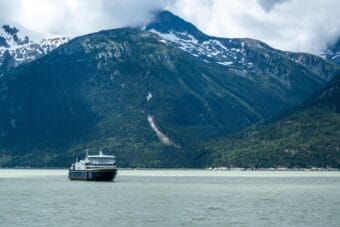
A blue-and-white Alaska ferry traveling through an inlet, with steep forested hills in the background.
The Alaska Marine Highway System ferry Hubbard approaches the dock in Skagway on July 28, 2024. (Eric Stone/Alaska Public Media)

The state of Alaska is pressing forward with a controversial plan to build a ferry terminal it says will streamline service in the Upper Lynn canal.

But communities in the area that depend on the ferry system aren’t on board. They say they need more information about the project, known as Cascade Point, and are concerned the new terminal could make getting to and from Juneau even more complicated than it already is.

“I think we’re all looking for the same thing, which is some definitive answers before we start on construction of this,” Haines Borough Mayor Tom Morphet said during an assembly meeting in July.

The state Department of Transportation signed a $28.5 million dollar contract last week that kickstarts a plan to build a new ferry terminal about halfway between Juneau and Haines, the Anchorage Daily News reported last week.

The contract went to K&E Alaska Inc. and will pay for the first phase of the project. According to the state’s request for proposals, the first phase will entail design work plus the construction of an access road to the terminal site, a new bridge over Cascade Creek, a gate and an upland staging area – but not the ferry terminal itself.

The company should be able to begin the design phase this summer, with construction starting next summer and stretching into September of 2027, DOT spokesperson Sam Dapcevich said. The terminal will be located on land owned by Goldbelt Inc., a Juneau-based Alaska Native corporation.

Cascade Point is roughly 30 miles farther north of Juneau than the current terminal in Auke Bay. That in theory could cut about two hours off the round-trip ferry ride, but passengers would then have to drive or take a bus to Juneau from Cascade Point.

Haines, Skagway and the ferry advisory board all question the plan

Community leaders and a ferry system’s advisory board say the state has yet to make a strong case for the project – and that it’s premature to be awarding contracts.

Among them: the Alaska Marine Highway Operations Board, an advisory body created to consult with the Alaska Marine Highway System on short- and long-term planning, and to ensure the system adheres to those plans. The group’s concerns have centered around what they say has been the state’s failure to demonstrate why the project is necessary and how it will work.

Board Chair Wanetta Ayers said in an interview last week that it’s crucial a project of this scale is carefully thought out to avoid spending millions of dollars on a terminal that may not benefit customers.

“We don’t have the time or the money for misfiring – doing projects that either don’t come to fruition or don’t really contribute to service levels, meeting the needs of Alaskans,” Ayers said.

The Haines assembly, for its part, voted in July to send a letter to Gov. Mike Dunleavy that says they cannot support the project absent more information. Their concerns include how walk-on passengers will get from the terminal at Cascade Point to downtown Juneau.

Notably, Goldbelt has committed to running a bus service to transport passengers between Cascade Point and Juneau. A commitment letter sent to DOT in May said the service would be available for every ferry arrival and departure. Drop-off points would include the Valley Transit Center, the Auke Bay Ferry Terminal, the Cascade Point Terminal and “other possible locations.”

Officials in Skagway, meanwhile, sent DOT a letter in June that said the project has not been integrated into the ferry system’s draft long-range plan – and questioned why the state hasn’t released a feasibility study or economic analysis justifying the project.

The letter also questions how the facility will be staffed and operated and why the department is pursuing a brand-new terminal, given the state’s ongoing budget shortfalls and the reality that existing terminals and infrastructure are in what the letter calls “urgent need of repair.”

DOT says a new terminal fits the ferry system’s long-term goals

DOT responded to the letter within two days. The department emphasized that the Cascade Point project is being funded through dollars appropriated years ago for the broader “Juneau Access Project” – not from a more general pool used for existing infrastructure.

The letter notes that DOT has been conducting engineering feasibility studies and design work on Cascade Point for 18 months, but adds that cost-benefit analyses can be “limited in capturing the full community and economic benefits unique to coastal Alaska.”

Asked for comment on critics’ concerns, Dapcevich, of DOT, said one of the top issues seems to be how walk-on passengers will get from Cascade Point to Juneau. As he sees it, that shouldn’t be a problem, given Goldbelt’s commitment to operate a ticketed bus service.

“Right now, if you’re from Haines or Skagway and you take the ferry to Auke Bay, there’s no bus service there. You gotta call a cab or you gotta walk,” Dapcevich said. “And with Cascade Point and Goldbelt’s commitment, you would have bus service from the ferry terminal to town.”

Dapcevich said the public will be able to weigh in on project design during future public meetings and comment periods. He added that the department has considered other operational questions, such as terminal staffing and where vessels will be homeported, but that those details are speculative at this stage. He did say the state anticipates adjusting current snow plowing priorities to be sure drivers’ vehicles can make it to and from the terminal in the winter.

As to concerns about the ferry system’s long-range plan, Dapcevich said that while the plan may not focus specifically on Cascade Point, it does focus on the broader goal of shortening routes and boosting efficiency.

“Cutting a couple hours off of each run in each direction, it reduces the wear and tear on the machinery, it reduces the fuel costs,” Dapcevich said. “We see potential for improved service as other parts of the long-term strategy fall into place.”

He’s referring in part to a separate-but-related project called the Chilkat Connector, which has also been referred to as the Juneau Access Project. The department in March announced a study to examine the feasibility of building a road from Haines along the west side of the Lynn Canal along with other infrastructure.

There are several different ways that could take shape. But the idea is that a passenger could start in Haines and drive south along the canal to William Henry Bay. At that point, they would cross the canal on a ferry to Cascade Point and then drive to Juneau.

Dapcevich acknowledged that the journey would be more complicated not only for Skagwegians but also for those traveling without a vehicle.

“The Chilkat connector is a separate thing at this point,” he said. “There’d be a lot of permitting and securing funding. Lots of pieces to that puzzle, too.”

Losses mount for timber companies in Alaska amid China’s import ban

Logs being moved from the road system to water on Kupreanof Island near Petersburg in 2013.
Logs being moved from the road system to water on Kupreanof Island near Petersburg in 2013. (Joe Viechnicki/KFSK)

The Trump administration’s tumultuous relationship with China is proving to be a major issue for some companies in Alaska’s forest products industry. That includes in Haines, where a timber sale that was supposed to kick off this spring has stalled amid China’s ban on U.S. log imports.

China announced the ban in March, citing concerns over pests like bark and longhorn beetles in U.S. shipments. The move came the same day that China imposed retaliatory tariffs on certain U.S. agricultural products amid President Donald Trump’s global trade war.

The decision has had sweeping effects on companies that harvest logs in Alaska and ship them overseas.

“We’re severely impacted by it. There’s no doubt about that,” said Eric Nichols of Alcan Timber, a Ketchikan-based company. Nichols also serves as vice president of the Alaska Forest Association, a Southeast nonprofit.

Nichols said about half of his company’s volume typically would go to China. As a result of the halt on imports, he said, the company has had to shut down at least one of its operations and make a range of other changes.

Those include shipping to other markets, including Washington, South Korea and Vancouver, British Columbia. Alcan has also shifted its focus away from harvesting areas that are best suited for the Chinese market.

Those changes have come at a steep cost.

“We’re at pretty big losses on going to other markets, just because of the transportation differential from what we’re used to,” Nichols said.

In Haines, meanwhile, Oregon-based company NWFP Inc. had been planning to move forward with a sale in May that’s been under contract since 2021. The so-called Baby Brown sale would be the area’s first major timber sale since the 1970’s.

But the company could not move forward with the sale this spring due to the loss of the Chinese market, Haines State Forester Greg Palmieri said in an email. He added that the company is seeking other markets for the sale, both within the U.S. and overseas.

“I expect that as soon as they have the ability to market the timber, operations will move forward with the sale currently remaining under contract,” Palmieri wrote Tuesday afternoon. “They are continuing the processes to obtain the required permits from State and Federal agencies to move the logs to markets as originally planned.”

The trade disputes have also hit Canadian lumber company Transpac Group. The company in March largely shut down its site on Afognak Island, just north of Kodiak, citing the ban and failed efforts to divert its product to other markets.

“We’ve been trying very hard since the announcement,” Transpac CEO Charles Kim said in an interview at the time. “And it has all failed.”

A spokesperson confirmed this week that the situation hasn’t shifted in the time since.

Nichols, of Alcan, says his company will have to weigh similar decisions if nothing changes.

“We have to make decisions, you know, a little bit like Afognak, whether we’re going to stay in business or not,” Nichols said. “The question is how long can we hold these logs before we have to sell them and generate the losses they’re going to generate here.”

In Haines, child care and housing shortages are forcing some younger residents to leave

Backpacks and children's boots in wooden cubbyholes
One of Haines only preschools closed last year, leaving many families scrambling to find childcare. It’s set to reopen this fall. (Avery Ellfeldt/KHNS)

Haines is Alaska’s oldest borough. A recent survey of residents under 40 years old provides a clearer picture of why.

Haines Borough Mayor Tom Morphet sent out the survey this winter to gauge how young people are faring and what they need to succeed. After reviewing nearly 90 responses, he said they underscore problems that could have major implications for the town’s long-term well-being.

Respondents outlined a long list of factors that make it increasingly difficult for younger people to live in the small Southeast community, ranging from scant housing and child care options to polarized local politics.

“The lack of progress on these issues — daycare, child care, housing — are starting to breed resentment among our younger population,” Morphet said. “I think it’s something the government should be aware of.”

State data indicates that Haines’ population has dropped between 1% and 2% on average each year between 2021 and 2024. At the same time, Haines has the highest median age — 49.8 years old — of any borough in Alaska.

Morphet paid for the survey via the mayor’s discretionary fund. The Chilkoot Indian Association and Haines Chamber of Commerce sponsored the effort. For now, there aren’t plans to use the survey aside from capturing sentiment among younger residents, a demographic Morphet said is “not always present or prominent at our government meetings.”

“What gives some weight to the responses, in my opinion, was that the respondents were in Haines in February,” he added in a June email to members of the Haines Borough Assembly. “These are folks who want a stake in our town.”

Housing and child care shortages send young people Outside

Dacotah Russell is 33 and has two young kids. She said in an interview that Haines’ limited child care options are the number one challenge that her family — and nearly all other young families — contend with.

She said the shortage became even more dire last year, when one of Haines’ few preschool options, a nonprofit, shut down. It’s set to reopen this fall, but the closure underscored the dearth of options, particularly as her toddler approaches preschool age.

“If the preschool wasn’t going to open, I’m not sure what we would do. I probably would have to quit my job,” said Russell, who works as an accountant for the borough. Her husband, Travis Russell, is a local police officer.

She was among those who said the child care shortage — combined with a lack of well-paid, full-time jobs — has left most families no choice but to operate on one income.

“A lot of people are moving out because they can’t afford to live off one income here and still raise children,” she said.

The survey suggests that housing is another top issue for younger residents. By Morphet’s count, nearly half of the respondents mentioned housing and rent.

Joe Aultman-Moore was among them. He came to Haines in 2014 as an outdoor tour guide but settled here full-time in 2017. He’s 35, and he says he and his friends have consistently struggled with housing whether they’ve hoped to rent, build or buy.

“I have been in the situation of being like, days away from basically living, you know, in a tent surrounded by boxes of my stuff because I could not find anything at all,” Aultman-Moore said during an interview this week at the local library, where he works.

The Haines Borough Assembly recently considered addressing the issue by allowing homeowners to build small apartments on their properties that could be used as rentals. The proposal generated pushback from some homeowners concerned about overdevelopment.

The assembly ultimately tabled the proposal, the Chilkat Valley News reported early this month.

Aultman-Moore says that’s just one example of a relatively straightforward policy change that would seriously benefit young folks and the borough writ large.

“We need to have more diverse ages around here in order to really have a healthy workforce and a healthy community,” he said. “And we are moving in the opposite direction right now, and that’s going to hurt us economically and socially.”

Respondent and resident Sarah Elliott spoke to the value of government funding for community services and assets that benefit families — things like the local pool, nonprofits and school. She was born in Haines in the 1980’s, is 40 now, and has two teenage kids.

She said all of the above are crucial for families’ well-being but often get caught up in annual budget talks and political crosshairs.

“I just think that if you want young families to stay in town, then you need to support the things that young families want,” Elliott said.

Morphet, the mayor, said many respondents also raised concerns over a lack of inclusivity, including toward the LGBTQ community, and voiced desire for a more functional local government.

“The drivers of the community, the people that take chances, the people that build the community, are younger, and we need them,” he said. “We absolutely need them, and we can’t afford to be losing good ones.”

Weeks after raid, Haines wildlife center’s owner urges state to retrieve animals that were left there

A dimly lit cage with a wooden nesting box and branches leaning at all angles. It appears to be empty.
An empty animal enclosure at the Kroschel Films Wildlife Center in Mosquito Lake, near Haines. (Avery Ellfeldt/KHNS)

It’s been three weeks since the Alaska Department of Fish and Game seized dozens of animals from a popular wildlife attraction outside Haines. But a number were left behind, and now the owner is now calling on the state to return to the property and retrieve them.

Fish and Game reported removing 39 animals from the Kroschel Films Wildlife Center in late June amid ongoing concerns about the facility and the animals it houses. But a recent inventory lists closer to 60 animals, which leaves about 20 unaccounted for.

The discrepancy is the latest dispute in a years-long saga between the agency and the center’s owner, Steve Kroschel, over animal welfare and permitting concerns at the popular tourist destination.

The facility has been closed for nearly a year after losing its required permits. Fish and Game and Alaska Wildlife Troopers raided the center last month after executing a search warrant that indicated Kroschel is under investigation for animal cruelty. Two animals died during the operation.

“We’re working on just going back through and double-checking to determine how many of each species still remain there,” said Ryan Scott, who directs the department’s division of wildlife conservation.

Kroschel, for his part, is calling on the agency to retrieve the rest of the animals as soon as possible.

In a Wednesday email exchange with Fish and Game seen by KHNS, he raised concerns over animals that were left behind – and about others he thinks escaped, including several weasels and an arctic fox.

“What is important is that you and those under your direction finish what you have started,” he wrote. “Animals require care 24 hours a day 7 days a week.”

Reached via text on Thursday evening, Kroschel reiterated that point.

“How the heck do they think I am supposed to maintain freezers, phone, time, care, etc without any revenue for a year now?” he wrote, in a nod to the revocation of his federal permit to operate last summer.

Kroschel is not currently at the facility. He said he is in Russia working on a documentary, but that another staff member is on site and caring for the animals.

The agency says it’s working to resolve the discrepancy and always planned to return for the rest of the animals.

Asked why that hasn’t happened yet, Scott, of the wildlife conservation division, said, “there’s more at play there that I can’t discuss.”

He said he doesn’t have any information about animals escaping, adding that staff were “extremely careful” during the operation to avoid that.

Scott also said that as he sees it, it’s Kroschel’s responsibility to take care of any remaining animals.

“We took over two-thirds of the animals, so that leaves a whole lot of resources for what he has left,” Scott said. “In my opinion, it’s his responsibility to maintain care for them until we can get there to take them.”

The agency said earlier this week that 37 animals have been temporarily placed in three Alaska facilities: The Alaska Wildlife Conservation Center in Portage, the Alaska Zoo in Anchorage and Bird TLC in Anchorage.

The agency added that some of the animals will remain in those facilities permanently. Others could be moved elsewhere, such as educational facilities in Washington, Minnesota, Colorado and Canada.

An Alaska Wildlife Troopers spokesperson said the investigation is ongoing and no charges have been filed.

Klukwan wants to build more housing. Intensifying landslide risk is getting in the way.

Chilkat Indian Village environmental staff and outside researchers stand on the 23 mile slide area during a site visit in June.
Chilkat Indian Village environmental staff and outside researchers stand on the 23 mile slide area during a site visit in June. (Avery Ellfeldt/KHNS)

Decades ago in the Chilkat Valley, heavy rains would spark mudflows that tumbled down the Takshanuk Mountains, over an international highway and into the Native village of Klukwan.

Dan Hotch remembers it well. The slides in the late twentieth century that flooded and damaged buildings would routinely deposit a slurry of rocks and mud under his family’s home.

“Growing up as a kid, we hated August and September weather because we knew the rains were coming, and we knew the water was coming down. And there was no way to really stop it,” said Hotch, who is now an environmental specialist with the Chilkat Indian Village.

Then, about 25 years ago, a community member built a berm high in the foothills to divert the debris down another slide path and away from the village.

For decades, it worked. But now that’s starting to change. As the slide path evolves and sediment builds up, rocks and mud have started surging out of that channel – and heading in a concerning direction.

“That migration has caused it to start to point debris flows more towards the village again,” said Josh Roering, an Oregon-based geologist researching geohazards across Southeast Alaska.

The situation has major implications for the village’s safety – and long-term future.

The tribe wants to build more housing not only for current residents, which the 2020 census put at 87 people, but also to make it possible for tribal members who don’t live in the village to move there.

But that’s complicated by the fact that Klukwan is sandwiched between two geohazards that are intensifying with climate change: to the east, landslides from the Takshanuks, and to the west, erosion and flooding from the Chilkat and Tsirku Rivers.

Dan Hotch swaps the SD card out of a infrasound sensor that’s monitoring wind, rain, rockfall and more as part of a regional geohazard research initiative. (Avery Ellfeldt/KHNS)

“With these extreme high temps in the summers, and then the atmospheric rivers in the fall and winters, a lot more flooding is happening here,” said Jess Kayser Forster, who has consulted for the Chilkat Indian Village on environmental issues for more than a decade.

That means the village has two options for development: further north, up the valley, or east, across the highway and into the foothills — which would mean building in areas with intensifying landslide risk.

In response, the tribe has joined a region-wide research project to better understand the threat and develop accordingly.

“It’s kind of hard to expand this way if we wanted to, knowing the fact that (mudflows) could come and take out everything that you’re trying to do,” Hotch said.

Studying the risk 

It’s an issue playing out across the region, state, country and world. Communities are expanding into wilderness at the same time as rising temperatures are fueling less predictable and more severe wildfires, floods and landslides.

That has triggered a global reckoning over how to model extreme weather, protect communities and develop new ones without putting more people in harm’s way. 

“You can see it all over Southeast Alaska, my home included,” Kayser Forster said. “We’re all built in these areas where these hazards are.”

That reality is top of mind in Klukwan. In 2018, the tribal council kicked off a climate resilience planning process. Then, in 2020, an atmospheric river triggered a devastating landslide that killed two community members in Haines.

The 2020 Beach Road landslide, pictured above in June 2025. (Avery Ellfeldt/KHNS)

“We realized that we were underprepared if an event like that were to happen in Klukwan. It highlighted a lot of our needs, and a lot of our risks. But it also highlighted the community’s desire to build those capacities,” said Shawna Hotch, who serves as the tribal liaison for Klukwan’s Tribal Emergency Operations Center.

By 2022, the village had joined a regional research project that aims to help tribal governments to do just that.

The effort is called the Ḵutí Project, which means “weather” in Tlingit. The project, which is run out of the Sitka Sound Science Center using a five-year federal grant, is fueling research in Klukwan, Skagway, Hoonah, Yakutat, Craig and Kasaan.

The main goal is to ensure communities have the data and tools they need to grapple with – and prepare for – weather events that are typically sparked by heavy rains. Roering, the University of Oregon-based researcher, emphasized that the geography, geology and risk are unique in each community. That means on-the-ground research is, too.

Planning for the future in a changing landscape

Klukwan, for its part, sits in the shadow of fractured cliffs further weakened by rain, frost and snow that are crumbling into a catchment below. During heavy rains, water and gravity carry the material downhill.

“When the debris flows get too big to stay in the current channel, they’ll do what’s called an avulsion,” Roering said. “That means they basically jump out of the banks, go over the banks, and follow a new path.”

The village of Klukwan sits alongside the Takshanuk Mountains, north of Haines. (Avery Ellfeldt/KHNS)

Particularly interesting is that state geologists have recently discovered permafrosthigh up on those mountains. Roering said it’s too soon to say whether melting permafrost – another climate impact – could be contributing to instability. But research in other parts of the world suggests it’s possible.

Studying and addressing those processes has taken several forms. First, the project is funding the installation of a brand-new weather station, to ensure more accurate local forecasting.

The project has also funded lidar collection and analysis, which provides insight into existing slidepaths and how they’re changing. Finally, it made possible the installation of cameras and sensors high up in the mountains.

On a recent field visit to Klukwan, Roering walked through a dense patch of forest, and pointed them out.

“These are called infrasound sensors,” he said. “They’re recording things that we are not hearing but are happening in the environment.

Think: wind, rain and rockfall. That data, combined with camera footage, provides crucial context about what triggers rockfalls and mudflows, and when those flows are more likely to avulse out of the main channel – and potentially surge toward the village.

For now, Roering said the goal is to develop a baseline of what exactly is happening on the hillside, and why. But even that is complicated.

“This is going to be a long term project,” Roering said. “That channel is going to keep changing, regardless of a berm that gets built next summer, or the summer after.”

Even so, the tribe will ideally be able to use the information for a few purposes. First, planning new berms to divert the slides away from the village, and supporting grant applications to fund the work.

And second is safe community development. Hotch, of the tribe’s environmental staff, said that could encourage tribal members to move home. He himself moved back to Klukwan about a decade ago after spending years in Oregon, first for boarding school and later for work.

“It’s great to be home,” he said. “We need more people back at home.”

State seizes 39 animals from a wildlife facility outside Haines

The entrance to the Kroschel Films Wildlife Center, pictured above on June 27, 2025.
The entrance to the Kroschel Films Wildlife Center, pictured above on June 27, 2025. (Avery Ellfeldt/KHNS)

Steve Kroschel over the last two decades has offered tens of thousands of visitors close-up views of animals including wolves, moose – and a brown bear named Kitty.

But on a walk through the Kroschel Films Wildlife Center in Mosquito Lake on Friday morning, the property was quiet. The animal enclosures appeared empty. Save one – it held a mink.

The critter, it seemed, was left behind after Alaska Wildlife Troopers and the Alaska Department of Fish and Game arrived at the property on Thursday, executed a search warrant and seized 39 animals. No charges have been filed, but a copy of the warrant provided to KHNS by Kroschel’s attorney indicates he’s under investigation for crimes including animal cruelty.

Dennis Seifert, who lives down the road and sometimes helps out at the center, stopped by on Friday at the request of center staff.

“I’m just feeding the weasel that the cops missed,” Seifert said, after tossing a dead quail into the enclosure and filling a water dispenser. “We didn’t think they were going to get them because there’s underground tubes that run all around the property for them to travel in.”

The raid comes amid a years-long saga between Kroschel and the state of Alaska – namely, the Department of Fish and Game.

The facility has been around since the early 2000s. By Kroschel’s count, it draws between 8,000 and 10,000 people every year.

Once inside, visitors are greeted by decorative piles of bones, and enclosures fastened with fencing, posts and hand-written warnings. Wooden planks on the moose enclosure, for instance, read: “Stay Back! Will Kick!” and “Do Not Touch Moose.”

A recent inventory report from Kroschel said he had 59 animals. But the state of Alaska is ultimately responsible for managing wildlife – including captive game. In fact, some were placed at the facility by Fish and Game, including a moose calf in 2022 and two minks in 2023, an agency spokesperson said.

But Fish and Game staff say they’ve been concerned about the facility for years, and more recently have asked Kroschel to address everything from what they say are inappropriate feeding practices to insufficient enclosures.

Kroschel, meanwhile, says he’s complied with the requests and that his facility is safe for both humans and animals.

“The [Alaska Department of Fish and Game] has wanted to get rid of me, and shut me up and shut me down for years. Three years,” Kroschel said in a phone interview on Monday.

“But I’ve been doing this for 24 years here in Haines, licensed and operating. No one’s ever gotten bitten, and there’s not been anything egregious has happened,” he added.

An empty animal enclosure at the Kroschel Films Wildlife Center in Mosquito Lake, near Haines. (Avery Ellfeldt/KHNS)

Animal welfare, feeding, hygiene concerns

Kroschel acknowledges that there have been some incidents. In 2023, for instance, a moose escaped from its enclosure and wandered off the property. And in 2021, a bear broke into the facility and killed two moose.

Then, last August, Kroschel’s federal license lapsed. The Chilkat Valley News reported at the time that it was later reinstated, but in the meantime, Fish and Game revoked his state educational permit. The agency did so on the grounds that he didn’t have the required federal license – and pointed to a long list of other concerns.

“The underlying problems have to do with animal welfare, basic care and feeding, hygiene, those kinds of things. And also security,” Mark Burch, who serves as the assistant director of Fish and Game’s Division of Wildlife Conservation, said in an interview in mid-June.

Kroschel contends he’s done everything the regulators have asked him to do – from fixing and expanding enclosures, to adding new fencing and more.

In April, Kroschel reapplied for the state permit. But in a May 2 letter seen by KHNS, Fish and Game said staff had reviewed the new application and identified more concerns.

Among them: Kroschel reported using pool treatment chemicals to clean animals’ drinking water, which the department said could be toxic if consumed regularly.

“I encourage you to realistically assess if you can meet the requirements listed below, and if not, please advise us of that. If the issues are not corrected by June 15, 2025, I will not issue a 2025 permit,” Fish and Game Commissioner Doug Vincent-Lang wrote in the letter.

Michelle Bittner, an attorney who has been working with Kroschel on permitting issues, said she and Kroschel responded to the agency’s concerns in late May. That included by clarifying that Kroschel had used small amounts of chlorine dioxide to clean water receptacles, and by submitting a positive report from a veterinarian, who visited the property earlier that month.

When Bittner followed up on the status of the permit on June 21, Vincent-Lang replied that the Fish and Game was coordinating with other agencies and would have a decision soon, according to an email exchange seen by KHNS.

Bittner said that was the last communication from the commissioner before state wildlife troopers and Fish and Game staff arrived at the property on June 26, executed the search warrant and seized the animals.

A moose enclosure at the Kroschel Films Wildlife Center sits empty after two state agencies removed 39 animals from the Kroschel Films Wildlife Center. (Avery Ellfeldt/KHNS)

An ongoing investigation

Alaska Department of Public Safety Spokesperson Austin McDaniel said he can’t comment further on the warrant, which is confidential, or potential charges mid-investigation.

But the warrant indicates the troopers were there to gather evidence related to animal abuse. It also says animals seized included Kitty, Kroschel’s brown bear, a moose, three wolves and three lynx.

Kroschel said that when he returned to the property after the fact, he found a range of animals had been left behind – including the mink, and an injured fox. He added that the warrant has some inconsistencies.

“Where the hell did they get three lynx? There’s two lynx. So either they don’t know how to even identify a species, or they can’t count,” he said.

Fish and Game spokesperson Shannon Mason declined to answer a list of questions earlier this week about the decision to remove the animals, and where they are now.

But the agency said in a statement on Tuesday that it had relocated 39 animals from the facility – and that some were left behind. The animals were then transported to Anchorage. Two animals died during the operation – a wolf, before transport, and a snowy owl, which was euthanized once in Anchorage “due to pre-existing health conditions,” the statement said.

Kitty the bear has reportedly been transferred to the Alaska Zoo. Reached in Anchorage by phone on Wednesday, Kroschel said he visited the zoo and saw Kitty in an enclosure.

McDaniel, with the public safety department, directed all animal-related questions to Fish and Game. He added that troopers did not relocate any animals during their search for evidence and that he can’t provide a timeline for the investigation.

Kroschel, for his part, is still processing the raid – and potential criminal charges. He said the animals are his family and that he will continue working to protect them.

“How would you feel if your family was torn away from you and you didn’t even know where they went, how they are almost a week later?” he said.

In an aim to make some money in the interim, he’s working to launch a new tour attraction in Skagway. Pending permit approval, he said tourists will be able to purchase a ticket and spend 30 minutes with his reindeer. Unlike the other animals, they’re considered livestock – and aren’t managed by Fish and Game.

Skagway Borough Manager Emily Deach said in an email that commercial tourism activities in the borough’s industrial zone require a conditional use permit. Kroschel has submitted a permit application for the “feeding and viewing of reindeer for tourism.”

Deach said the Skagway Planning and Zoning Commission will review the permit application July 10.

Site notifications
Update notification options
Subscribe to notifications