KHNS - Haines

KHNS is our partner station in Haines. KTOO collaborates with partners across the state to cover important news and to share stories with our audiences.

‘Amazing to see it happening’: Team Rubicon volunteers help with Haines storm cleanup

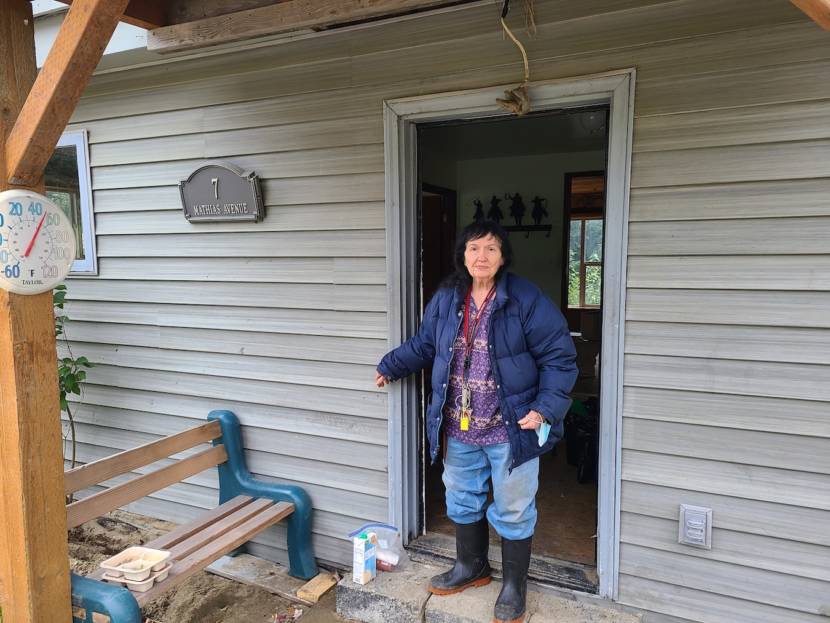
Lemmie Spradlin, 83, wants to return to her home (Corinne Smith/KHNS)

83-year-old Lemmie Spradlin has lived in Haines for 20 years. Since her husband passed away more than a decade ago, she’s lived alone in a two-bedroom house on Mathius Road.

Last year, on Dec. 2, she woke at 2 a.m. with water pouring through her front door. She says she’s felt numb since then.

“That numbness has not left me yet,” Spradlin said. “A deep numbness inside. Something was going on that I had no involvement with and had no idea what to do about.”

Spradlin’s home was effectively destroyed by water and mud. Ever since, she’s been living in a converted garage with rental assistance and support through local non-profits.

Nine months later, volunteers with Team Rubicon, known as “grey shirts,” hammered in flooring reinforcements and began final cleanup on Spradlin’s house.

“It’s essentially becoming a brand new house in a way,” Joshua Strange said.

It’s his first deployment with Team Rubicon, which is mostly veterans and first responders volunteering their time to do disaster recovery missions around the world. He leads the way to the ground floor, now stripped to the studs and cleared out.

“So the bottom floor, we totally deconstructed,” Strange said. “And we ripped out all the insulation, all the ceilings, we pulled up all the flooring because it was just totally moldy and full of muck.”
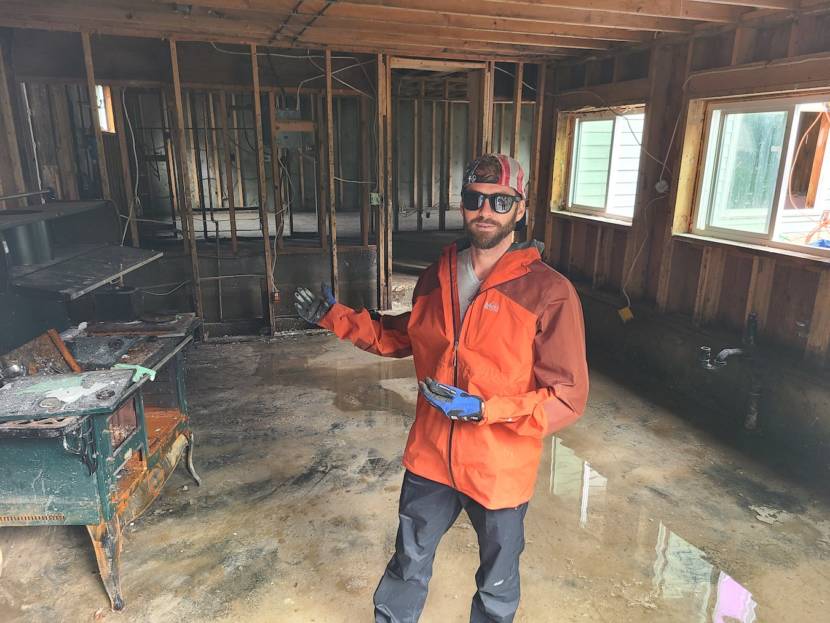
Joshua Strange shows off the progress made on the ground floor of Lemmie Spradlin’s home, which had been flooded with water and debris up until last week (Corinne Smith/KHNS)

Strange is a 10-year veteran of the US Air Force from San Diego, California. He decided to volunteer after finishing college and before starting a new job. He’s one of 11 volunteers that traveled to Haines.

He says he’d signed up to help with earthquake recovery in Haiti but was deployed to Alaska. For the past week, he and the group have been removing debris  — 43,760 pounds of it — from nine properties, then loading it up and dropping it off at the dump.

Strange says it feels good to be a part of a mission.

“I came out here, I didn’t know what to expect,” Strange said. “But most of these guys are veterans, and they’re all very hard working. It was incredible to join the team and just be part of something, where you actually see the difference that you’re making.”

Brian Rougie is a veteran of the Army National Guard and was deployed in Iraq in 2003. He lives in Haines and says he’s been  interested in volunteering with Team Rubicon for a while. But this was his first time.

“It was daunting. You walk in and like, oh man, this is going to take forever. But with a lot of people, you just keep moving,” he said. “I feel lucky to help out and pitch in locally, so that’s pretty cool.”

The Southern California-based organization was invited by the Haines Long Term Recovery Group to help with debris removal, which has been a top priority since the deadly December storms. It’s part of a federally funded project, and residents have up to Sept. 18 to collect debris for removal.
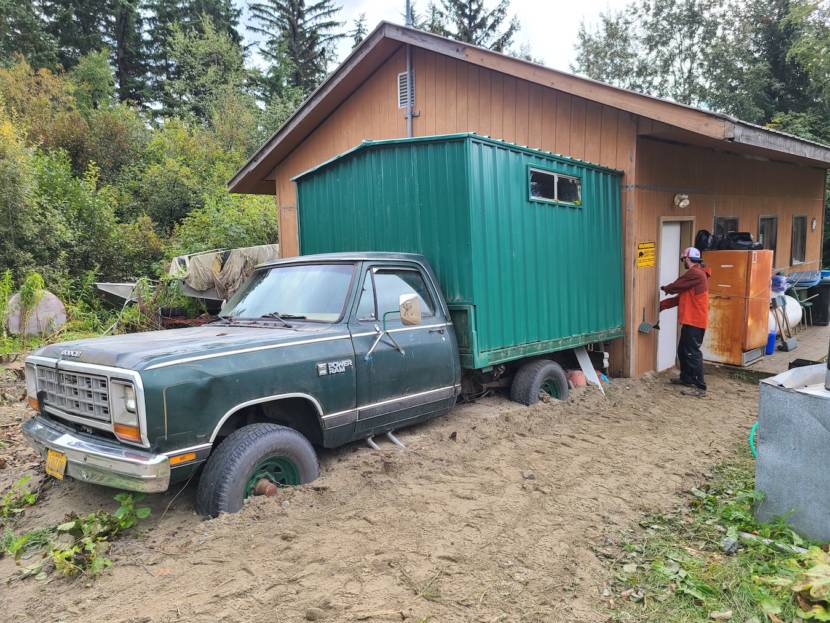
Lemmie Spradlin’s truck and garage were flooded during last December’s storms (Corinne Smith/KHNS)

Haines Long Term Recovery Group coordinator Sylvia Heinz says it’s a major step forward.

“It’s just amazing to see it happening, because since the snow melted, it just seemed impossible,” she said.

For Spradlin, the work had been too much to tackle alone. After the snow melted, she began catching the senior bus to her property most days to try to clean things up, but she couldn’t afford the labor or dump fees.

She says she’s grateful to Team Rubicon and just wishes she could have made them a meal.

“Any of them wander back to town, as long as I got a floor space they’ll have a place to get in and shelter,” Spradlin said. “As long as I’ve got food around, they’ll have some belly waddin, and that’s just how it is. The Rubicon guys will always be welcome.”

Her home is stripped to the studs now, and there’s no running water, but it’s ready for construction. And there’s still power. Spradlin says she needs a culvert dug to divert the water, new flooring, walls and appliances — then she’ll move back in. It’s her home.
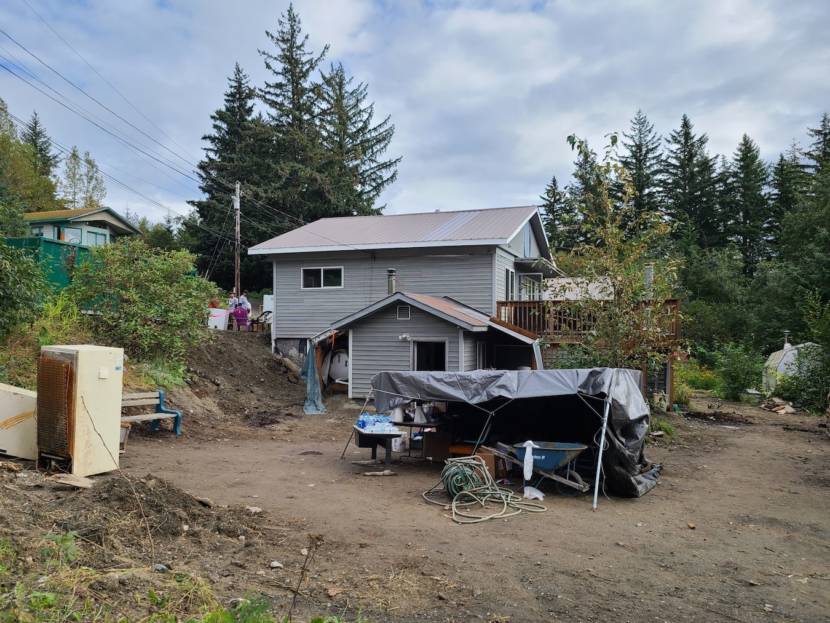
Spradlin’s home is about half a mile uphill from Haines’ Main Street. Team Rubicon mucked out the house, cleared natural debris from the property, and sorted and salvaged items into dry storage (Corinne Smith/KHNS)

The volunteers with Team Rubicon are about done with a final cleanup of her property, and they’re ahead of schedule by a few days.

“We’ve been able to exceed expectations, and that’s a good thing,” said Craig Dickerson, the group’s incident commander.

So now the team gets to play tourist. They’re headed to Haines Hammer Museum.

“We’re really excited about that,” Dickerson said. “We checked the map, saw that was a thing here, and just have been over the top. So big thanks to them for opening up for us.”

The group departed Haines last Sunday. But they say they’ll be back if needed.
Southeast Conference blends virtual and in-person events for Haines summit

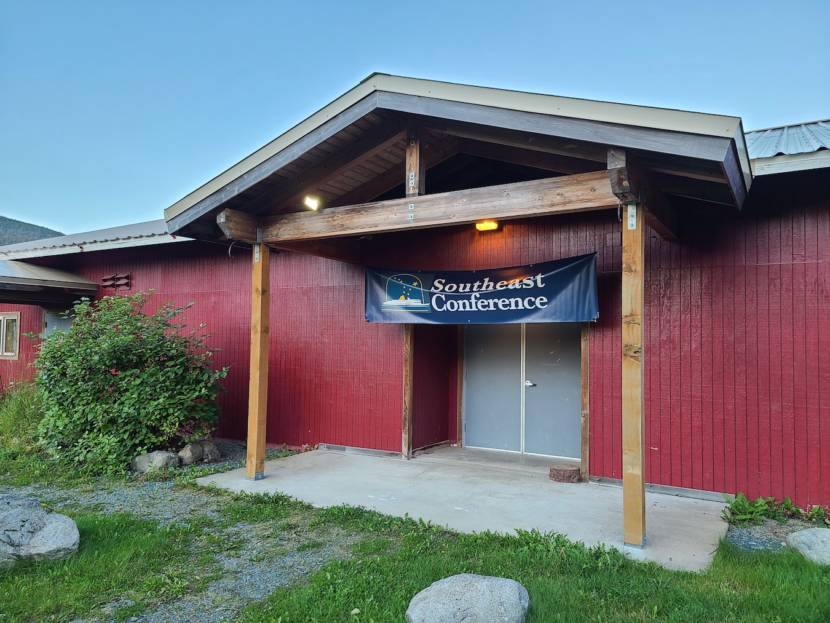
Southeast Conference events in-person will take place at Harriet Hall, on the Southeast Alaska Fairgrounds in Haines (Corinne Smith/KHNS)

Southeast Conference’s annual summit bringing together civic and business leaders from across the region opened on Tuesday in Haines. This year’s event will be a mix of in-person and online sessions, with COVID protocols for those who show up in person.

Panels will feature political and industry leaders from across Southeast Alaska gathering to discuss economic development and the future of the region.

Southeast Conference’s executive director Robert Venables says they’re expecting about 150 to attend in person in Haines.

“We’re expecting everyone that shows up to have been vaccinated or tested negative before arriving in Haines,” Venable said. “We’re going to mask up throughout the event. And for the most part, we’re sequestering on the fairgrounds. So we’re going to use local caterers to bring food in. And, you know, make sure that we’re as safe and sequestered as possible.”

Venables says participants’ tables will be spaced out at the conference venue at Harriet Hall, with handwashing stations provided and hall doors open for airflow. The usual after-hours events and social mixers have been canceled. He said if participants do contract COVID while in Haines, they’ve made special arrangements.

“We’ve worked out an arrangement with airlift Northwest that they will come and extract any of our attendees that may test positive during the 60-hour event that we have there in Haines. So we have a provision so that we can address that,” he said.

Elected officials, industry and tribal leaders will meet to discuss a wide variety of economic development issues from rebounding tourism, health care and broadband internet, to President Biden’s infrastructure bill, mariculture and mining development. Speakers include Alaska’s Congressional delegation, Angela Rodell, CEO of the Alaska Permanent Fund and Sealaska’s CEO Anthony Mallott.

Venables said finding accommodations for participants in town has been challenging, but he hopes the in-person and virtual format of the conference aims to be inclusive.

“This hopefully will serve to help others figure out how to have meaningful events and get business done, and bring the causes and the resources together. We have quite a number of individuals and agencies coming that’s going to really be helpful to Haines and the region in rebuilding after a very disastrous year.”

Southeast Conference begins in Haines and online on Tuesday, Sept. 14 through Thursday, Sept. 16. There’s more information on how to register on the Southeast Conference website.

Bear killed after Haines police chief accidentally wounds it in museum’s historic apple tree

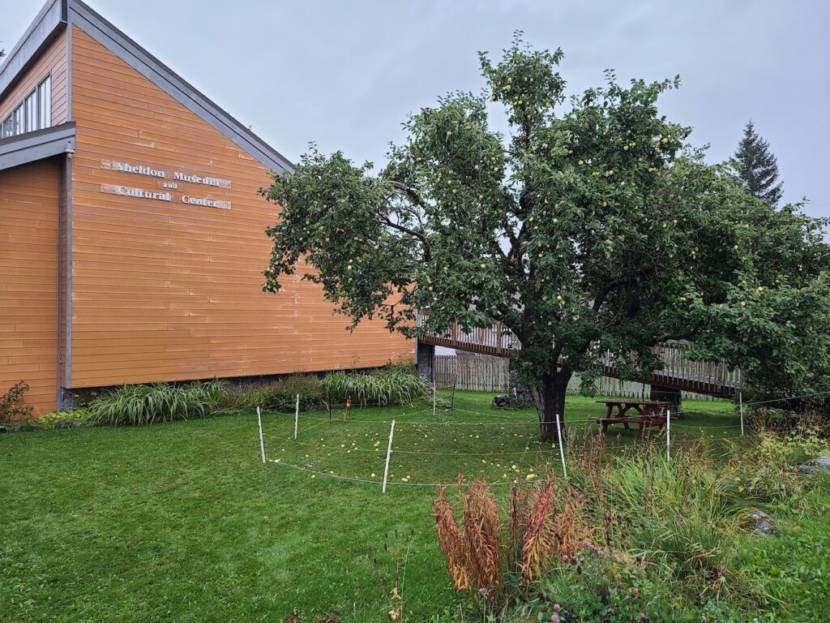
An electric fence was put up around the museum apple tree after the bear was put down, and the museum board has pledge to keep one there moving forward (Corinne Smith/KHNS)

More details have emerged about circumstances surrounding the Aug. 31 killing of a bear outside the Haines Sheldon Museum. The Alaska Wildlife Trooper on the scene has suggested the Haines police chief may have accidentally wounded the bear, leading to it having to be put down.

An adult male black bear had been grazing outside the Haines museum and eating from an historic apple tree out front. A sign by the tree says it’s “a yellow transparent apple tree planted 100 years ago by Charles Anway for the children of Haines.”

Sheldon Museum staff had secured a loaner electric fence to put up around the 100 year old tree, but it was stolen from the porch the day before. Museum Board President Kelleen Adams says museum employees had seen signs of the bear a few days before.

“It wasn’t something that had been going on for a month and no one had done anything about it. The bear had actually started showing up a couple of days prior just, we would see bear scat around the tree,” Adams said.

The bear was ultimately euthanized by the Haines police chief and an Alaska Wildlife Trooper on the morning of Aug. 31. In his report released to KHNS, Scott says he’d attempted to haze the black bear from the top of the museum apple tree using cracker shells and beanbag rounds.

Wildlife Trooper Colin Nemec was also there. He says one of the chief’s shots injured the animal, which fell out of the tree.

“One of the rounds that the chief shot at the bear either penetrated or broke a bone or something like that and injured the bear,” Nemec said. “I’m not going to speak directly at the condition of the chief’s firearm, because it was his firearm, and he needs to be the one to speak about the condition of his own weapon.”

In other words, he couldn’t say what type of round had injured the bear. Nor would his agency be looking further into the incident.

Scott has declined several times to be interviewed. He released a written statement saying they were concerned about the significant safety risk posed by the bear. He said they considered waiting for the bear to come down or forcing it down, but both options risked coming into conflict with community safety.

“With each of these options the animal is in direct control of the outcome. Unfortunate the one option we can control is the animal’s euthanization,” Scott wrote.

Nemec said Friday that once the bear had been injured, it was decided that law enforcement had to  finish it off.

“I did not want to be having to chase an injured bear around town, or somebody gets injured, because we had an injured bear in town. So I told them to dispatch it,” he said. “Ultimately, he wasn’t able to dispatch it. And I ended up dispatching the bear.”

When asked what happened with his firearm, the police chief said that he did shoot the bear with a “less lethal round.”

“The round unintentionally over penetrated and wounded the animal, once wounded it had to be put down,” Scott wrote in an email Friday.

There’s nothing in Scott’s official report that suggests the bear had been accidentally wounded. He wrote that officers were concerned with the pedestrian traffic in the area on Main Street and First Avenue as a potential threat to public safety. Scott reported he made four attempts to haze the bear from the tree with less lethal munitions, which were unsuccessful, and the bear was then “put down.” He noted the potential reasons for the incident as the animal had been “feeding on human food previously,” and the “animal had lost fear of people.”

The bear had been in the area, apparently attracted by the ripe apples in the tree.

The day before the bear was killed, museum accountant Burl Sheldon — who is also a KHNS DJ — picked up a loaner electric fence from the local Fish and Game office but left it outside the museum, where it was stolen.

“At about six I came back expecting to open and assemble and put up this electric fence, and somebody stole the electric fence off the front porch, the green duffel bag and everything that was in it,” he said.

Then he filed a police report and went home.

“I don’t have a fence at six o’clock, Fish and Game is closed. You know, if I happened to have one in the back of my car, I’d have put it up. But I didn’t have one,” he said.

In hindsight, Sheldon says he regrets not putting the fence up sooner and says in the future the museum should put up a fence in the first week of August. Because the next day, the bear was back in the apple tree.

Alaska Department of Fish and Game wildlife biologist Carl Koch says he can’t comment on the decisions taken by law enforcement. He reiterated that the public can only legally kill a bear out of season in defense of life and property.

“Technically this is termed an agency kill versus defense away from property, which is often a lay person,” he said. “People who have a bear on their property, or they’re out in the wilderness, and they have to defend themselves.”

Nemec, the wildlife trooper, says his agency is not investigating the circumstances of the bear’s death. But he will be conducting firearms drills with the Haines Police Department in the coming weeks.

“So I’m going to conduct a training with the police department with just updating and refreshing everybody on how to use hazing rounds, and kind of what’s the best practices for hazing bears,” he said.

Nemec says the Haines borough, law enforcement and Fish and Game offices are all working together to mitigate bear problems. Last year was a banner year for bear problems in the community with 26 killed outside the hunting season.

One of those included a bear shot and killed outside Scott’s garage. State officials are continuing to investigate the circumstances of the Oct. 9 killing of that mature brown bear.

Kelleen Adams says the museum will maintain an electric fence there moving forward.  She says she wishes there were other means of handling the situation so that the bear could have lived.

“It was unfortunate, we’re very, very sad that it happened that way. And we do not want this situation to happen again. So we’re being very diligent in keeping that tree protected. For the tree itself, which is a 100 year old tree, and for the community and for wildlife,” she said.

The hide and skull were turned in to the local Fish and Game office, as per state law, and the meat was donated to a local family as other charity organizations were unable to take the animal, according to the police report.

Adams said the museum will be hosting a community apple picking event in the coming weeks.

Skagway overhauls trail system as part of economic stimulus plan

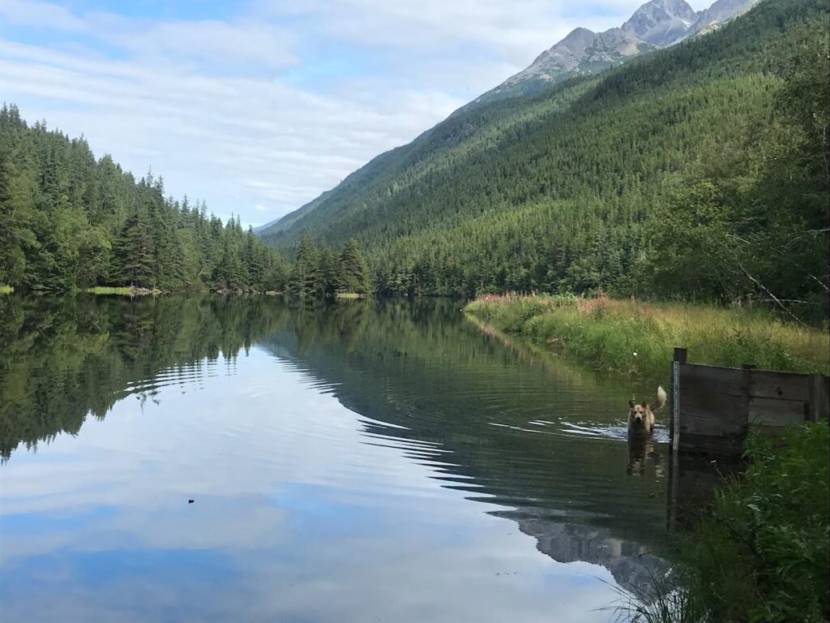
View of Lower Dewey Lake looking north. (Mike Swasey/KHNS)

After the pandemic ground Skagway’s cruise ship traffic to a halt, municipal officials began looking for ways to put its unemployed residents to work and attract independent travelers to the remote Alaska community.

One concept was to improve the municipal trail system. Between a series of grants and money pulled from municipal coffers, several projects were green-lighted. Those included flagging a trail to the Denver Valley, brushing the trail to Lost Lake, and improving the Lower Dewey Lake trail system. A total of $215,000 has been set aside over the last two years as part of the manager’s economic stimulus program.

A Packer Expeditions crew led by former mayor Tim Bourcy was awarded the $25,000 contract to help rework the backside of the Lower Dewey Lake Loop trail. And that project has turned into more than just making a great trail.

“There’s a lot of down and dead timber up here. So it’s a pretty major fire hazard. So part of this process, we’re trying to reduce the fuel load as much as possible and distribute wood to different campsites,” Bourcy said.

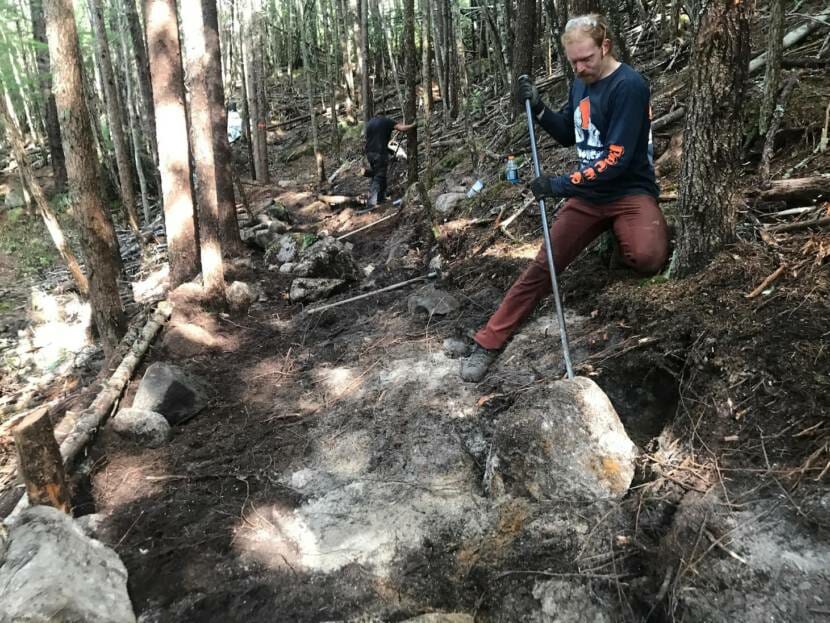
Trail crew members Josh Colosky (foreground) and Rory Jacquot (background). (Mike Swasey/KHNS)

And the crew has found evidence of an old forest fire near the south end of the lake.

“This is actually all ash from a previous fire,” crew member Josh Colosky said. He was wielding a rock bar and unearthing large rocks to clear the way for a smooth trail surface. “I mean, a lot of this was burned in that area. So I’m finding rocks here with burn marks in them.”

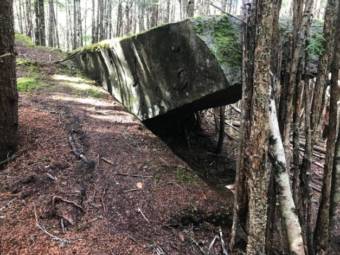
The improvements to the trail include adding new elevation to the backside of the loop and bringing the trail close to features like a rock configuration that resembles a deadfall trap. The project will also bring new bridges, steps and signage.

“The backside of lower lake is gonna be completely redone,” Bourcy said. He expects to be finished by the end of this week.

Rock feature that resembles a deadfall trap. (Mike Swasey/KHNS)

Skagway’s Ad Hoc Trail Committee is currently working on the part of the comprehensive trail plan that includes the Dewey Lakes trail system from Sturgill’s Landing north to the Canadian border, including the Denver and Laughton Glacier areas. Then they’ll tackle the region from Yakutania Point up through AB Mountain and north over to International Falls.

“After that, we’ll focus on the trails on the west side of the valley. So West Creek, Dyea, Norse Valley, and that whole area,” said committee chair Nicole Kovacs. She said they are working on connecting existing trails like the Devil’s Punchbowl to Sturgill’s Landing and making a trail from the Lower Lake Loop to a nearby waterfall. They also have wish list trails to add to the plan.

“There are dream trails like ones that are a little further out there, like a trail to the Katzehin or Paradise Valley, and things of that sort,” Kovacs said.

There have been discussions about adding a cabin or hut system, which haven’t been approved yet.  There’s also consideration for more mixed-use trails, like cross country skiing, horseback riding, snow machining and mountain biking. But those projects are still in the early stages.

“Things like cabins or establishing tent sites, fire rings, helicopter landing areas, those are definitely things that also come along as we look at the trails,” Kovacs said.

The Ad Hoc Trail Committee says it encourages public input and invites the community to participate in the process of expanding Skagway’s trail system. Their next meeting will be at 4:30 p.m. Wednesday, September 15 at AB Hall on Broadway Street in Skagway.

Local officials look for housing solutions while seasonal workers do the Skagway shuffle

The Garden City RV Park in Skagway in April, 2021. (Mike Swasey/KHNS)

It’s called the Skagway shuffle. During busy cruise ship summers, seasonal employees show up to work with no place to live.

They might crash on somebody’s couch or split a room until they eventually find a job that offers reasonable housing. Some end up sleeping in their cars parked on side streets or sleeping in tents in the woods.

Some employers will cram a dozen people into bunk rooms, others have seasonal housing that has no heat.

Some seasonal workers have found their best option was to live in an RV at one of the local campgrounds.

“Especially when you’re married and you have a dog, you don’t want to live with a bunch of other people, you just want to have like your own little space. You know,” said Raymie Eatough, a local tour operator.

Eatough used to live seasonally in Garden City RV park. She and her husband Joe both own small businesses and travel to the Lower 48 in the winter to find work.

“It’s not like there’s a lot of jobs in the winter. So we choose to leave so that we can still bring in an income into our lives,” Eatough said.

That leaves them with the unenviable position of trying to find a place to live each summer. And in May, municipal officials closed Garden City RV park to seasonal housing.

The couple is in a rental now, but they say it won’t be available to them next summer.

“We’re having a hard time finding seasonal housing, we’ve been here for 25 years. Think about how it’s going to be for people that haven’t been here this long and don’t know as many people as we know,” Eatough said.

Borough Manager Brad Ryan says the goal of the RV park is to host traffic from the Klondike Highway. That traffic is expected to rebound faster than cruise ship traffic once the pandemic-related Canadian border restrictions are lifted and more independent travelers arrive.

But the estimated costs of repairing electrical issues plus water and sewer upgrades at Garden City RV park are as high as $500,000.

The municipality purchased the RV park in 2013 from a church group for $1.2 million. It plans to keep it open for nightly visitors next summer but also wants to develop a long-term plan.

Assemblyperson Sam Bass says now is the time to take action.

“What we’ve done is we kind of used a Band-Aid fix, which is an RV park where people have started to use that as their seasonal housing, which I don’t think that ever was the intent,” Bass said.

In 2020 the Assembly drafted plans to subdivide the property into up to two dozen 50-by-100-foot lots. But then the pandemic put that on hold. Bass says there are opportunities to tackle both the seasonal housing problem and the lack of affordable homes for sale in Skagway.

“We’re looking at duplexes, triplexes, maybe even a condo setup, depending on how it’s developed. But somehow some way to develop and make available more housing for both seasonal folks and for year-round people. Because we need both of those,” Bass said.

The assembly has discussed plans to put a new RV park near the solid waste dropoff and composting facility ,on land already owned by the municipality on the north end of town. But that site doesn’t have water and sewer access.

Bass says the site doesn’t need those. And he wants to get started on both projects while admitting not much will likely be completed before workers arrive for the 2022 cruise season.

“If we’re not willing to make the sacrifice now, we’re just going to keep kicking that housing issue down the road. And eventually, it’s going to get very, very bad where there’s no year-round housing, and there’s no more seasonal housing because it’s all full, then what do we do? We’re stuck,” Bass said.

The assembly had granted a waiver from the regulation forbidding RV rentals on privately owned residential property, but that resolution expired on May 1, leaving people who want to live seasonally in their RV with no legal options other than to move from campground to campground every two weeks.

Skagway’s tribal government trades butter and eggs to fight invasive plant species

Yellow toadflax in Skagway. (Photo by Mike Swasey/KHNS)

Skagway’s tribal government is working to control the spread of invasive plant species around town. Their latest project involves members of the community pulling the butter-and-eggs plant, then bringing those plants into their office and walking away with actual butter and real eggs.

Yellow toadflax, commonly called butter-and-eggs, gets its nickname from the coloration of the flowers, a bright butter-colored petal with a darker yolk-like center. The plant was originally brought to the U.S. as an ornamental perennial but has also been used to make yellow dye and it’s been used in folk medicine as a laxative, diuretic, and as a treatment for dropsy.

So, yes, it’s lovely. And yes, it’s useful. But it is also very good at taking over ecosystems and drowning out native plant species. Reuben Cash is leading the fight against the spread of invasive plants in Skagway, he’s the environmental coordinator for the Skagway Traditional Council.

“It’s really hard to control once it’s been established. Because, you know, not only does it spread through its seed, but it also has those creeping rhizomes,” Cash said.

Creeping rhizomes are vine-like roots that spread out underground up to 10 feet from each plant. So when you see a patch of Yellow Toadflax, you’re actually seeing a bunch of plants sprouting from the same root system.

“So it’s all considered one plant. So that’s how you can get 30,000 plus seeds out of a single plant is because it has all of these daughter plants that are all connected to it,” Cash said.

The butter-and-eggs plant thrives on distressed soil and windy places. Skagway has plenty of both. The seeds look like little replicas of Saturn and are both lightweight and oily. Their light weight allows them to float through the wind, their oily covering allows them to float on the water, so rivers transport them just as well as the south wind.

They also tend to like snowy areas.

“Because those stocks stay erect after everything senesces dies off in the wintertime. And those pods open up and then the snow will fall. And they’re really effective at skittering across the surface of the snow. that’s a really efficient way for them to distribute themselves around,” said Cash.

This is the first year of the battle against Yellow Toadflax in Skagway and the STC is hoping to stop the spread more than eradicate the plant because it’s already gained so much ground. As an incentive in the battle this year they are offering a bounty. The STC will give away a pound of butter and a dozen eggs for every four pounds of the plant that’s brought in.

“We figure for a single person, you know, 15 to 30 minutes to be able to get four pounds of it,” Cash said.

According to Cash, it’s important to get as much plant out of the ground as possible, but you won’t be able to get the entire underground vine.

“Grab it at the base and try and, you know, work it out so that you’re working out some of that underground biomass,” Cash said.

In the future, Cash says he hopes to have drone footage of the entire region that can pinpoint areas of spread. They will likely target those areas by planting native grasses that have shown some success choking out the resources that the Yellow Toadflax relies on.

Store your plants in plastic trash bags so the seeds don’t accidentally escape. Then, bring those bags to the STC environmental lab, which is the blue building with the white garage door just east of the main building on 11th Avenue and Broadway Street in Skagway. Drop off dates are Wednesday, Sept. 1 and Friday, Sept. 3 to collect your bounty.

Site notifications
Update notification options
Subscribe to notifications