KHNS - Haines

KHNS is our partner station in Haines. KTOO collaborates with partners across the state to cover important news and to share stories with our audiences.

What you need to know about coming out of quarantine, according to a Juneau nurse

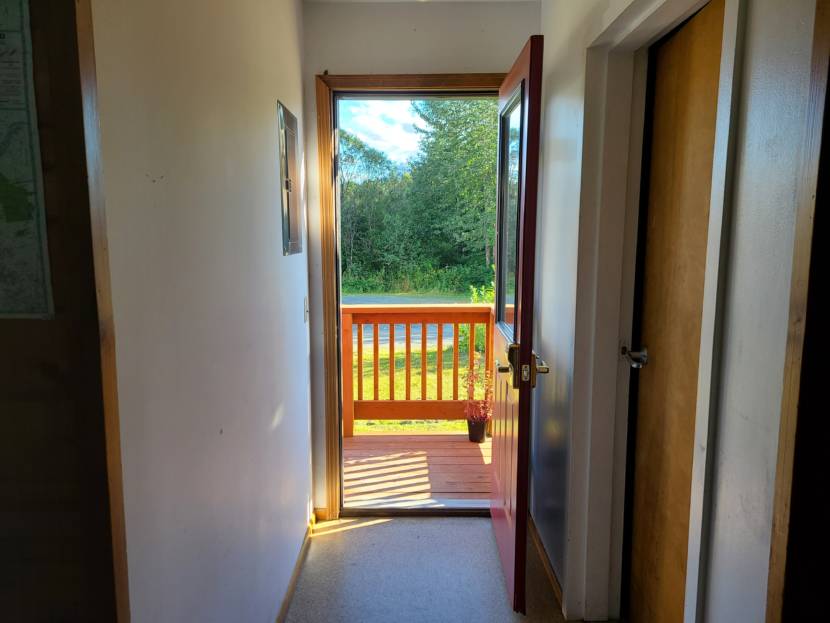
An open door at a home’s entryway. The Centers for Disease Control has three guidelines for ending a COVID quarantine: You can be around others 10 days after onset of symptoms, 24 hours with no fever and when other COVID symptoms are improving. (Corinne Smith/KHNS)

COVID is re-surging across Alaska and the U.S., and communities are grappling with the virus, quarantine and recovery. KHNS’ Corinne Smith checked in with Elaine Hickey, a public health nurse based in Juneau, to discuss the health protocols for those recovering and getting out of a 10-day quarantine.

Listen:

The following has been edited for length and clarity.

Corinne Smith: Can you speak to our listeners who may be sick and in quarantine right now, what are some best practices for taking care of yourself?

Elaine Hickey: When people are having symptoms, one of the best things they can do is get rest, as much rest as they need. We ask people to stay really well hydrated. A lot of times, dehydration can set in pretty easily. We hear a lot of decrease in appetite. Try to eat, keeping your strength up is really helpful. Any medications or things people take to treat the symptoms that they’re having are okay to do as long as they’re not contraindicated for other health reasons or other underlying medical conditions. But you know, any medications or treatments would be fine to do to treat your symptoms. You know, we just ask people to try to really isolate themselves away from others in the home that maybe are not positive cases at this point. You want to stay separated, and really try to protect the others around you.

Corinne Smith: Generally, for those people who are coming out of quarantine after 10 days, what are the best practices? What should people know, coming out of quarantine?

Elaine Hickey: Yeah, so coming out of quarantine is determined off of improvement of symptoms, we know from data and research from CDC guidance is that, you know, after 10 days of time, as long as symptoms have improved, they may not be completely gone, but as long as they are improved, and that there’s been no fever for 24 hours prior, you know, to that 10th day, that people can be released from isolation, they’re no longer considered infectious at that point, the viral load will be low enough, if not gone from within the body that they are not considered infectious to other people at that point in time. Symptoms may not be completely gone, someone might have a lingering cough, some of those body aches might linger. Fatigue is a big thing that we often see, that can linger for a little bit of time, along with you know, that sense of taste and smell, sometimes that can be a little while before it comes back or just improve slowly. Just because those symptoms are still present, doesn’t mean someone’s infectious, they are okay to be released after they hit that 10 days of time, they are okay, on the 11th day to be released for isolation or no longer infectious.

Corinne Smith: So it’s okay for people to go back to work to rejoin their families and kind of resume activities after those 10 days.

Elaine Hickey: Yes, that is true. That is definitely true. You know, you’d still recommend, you know, wearing your mask in public places and tight quarters, whether you’re vaccinated or you’re not. When you’re in indoor locations, you can’t maintain that social distance, things like that, that you know, continue to wear those masks. And if not vaccinated, like really please consider getting vaccinated is the best protection we have.

Corinne Smith: There’s been a lot of discussion that having COVID is kind of like its own booster shot. What can you say about people’s immunity from people who have recovered from COVID?

Elaine Hickey: The research is being put out by CDC and information regarding that. So the latest that we have been informed of is that they feel that someone who has both vaccine and has then developed COVID, and had been positive with the infection, has a very strong immune system for the future from being able to become reinfected again. And it’s stronger than someone and has better protection than just someone who is, you know, just vaccinated. You have a little bit more extra protection from having been positive. People that are not vaccinated right now, what the guidance is, is that it’s felt that they have a three-month time frame of natural immunity that they will not could not become reinfected again in that three-month timeframe. But after that, you know, they certainly could be reinfected if re-exposed.

Corinne Smith: Is that the same for children as well?

Elaine Hickey: Yes, it is.

Corinne Smith: And after a case of COVID, people will not necessarily test negative, can you say more about that?

Elaine Hickey: That is true, once they have that positive COVID test, you do not receive another test for three months timeframe. They know that there’s, you know, the immunity for three months timeframe. someone can still have a positive test for weeks out after being tested for COVID and having a positive test. And it’s because the virus is still like kind of floating around in the body that it can be picked up on that test. But it’s just not in volumes high enough to be considered infectious. And especially if you’re asymptomatic, right, so if you’re not having any symptoms, and you get that test, it’s dead virus still shedding out of the body, and it’s not infectious at that point.

There might be a time where if you did actually in that three-month timeframe, become sick again, and feel like you had a flu or the cold like symptoms and became sick, you know, you would definitely consult with your, with the doctors call it clinic get evaluated, and you know, they would make a determination or whether you should actually get another test within that three-month timeframe. If you are having symptoms again.

Corinne Smith: Thank you so much, Elaine.

Elaine Hickey: Oh, you’re welcome. Thanks for reaching out.
Former Haines resident faces federal child exploitation charges

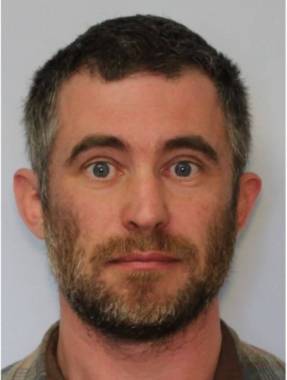
Christopher Panagiotou-Scigliano (FBI photo)

The FBI has re-arrested a former Haines resident nearly a year after he was arrested at Chilkat Lake and extradited to Idaho on child pornography and sexual abuse charges. Now, federal agents want to bring him back to Alaska to face new federal charges.

Shortly after 39-year-old Christopher Panagiotou-Scigliano was arrested in Haines last November, the Chilkat Valley News spoke with his Chilkat Lake neighbors, who said he and his wife lived in a trailer at the Covenant Life center before moving to a property at the lake.

Federal court documents allege that while he lived at Chilkat Lake, Panagiotou-Scigliano recruited minors to visit Haines that he had previously groomed for exploitation while living in Idaho. Prosecutors also say they seized his cell phone and that it contains evidence of his sexual abuse of at least one of those minors.

Investigators also say they have a laptop containing more images and videos of child exploitation that were downloaded from the internet.

Two adults and one minor approached law enforcement in Idaho to discuss alleged abuse by Panagiotou-Scigliano early last year. Their families lived off-grid and participated in organic farming and church services with the suspect. Investigators say the three young men wanted to make sure Panagiotou-Scigliano didn’t continue his pattern of abuse.

The investigation conducted by the Bonner County Sheriff’s Department in Idaho wrapped up last September. Haines police, assisted by a Bonner County detective, arrested Panagiotou-Scigliano without incident on his property at Chilkat Lake.

Haines Police Chief Heath Scott says there are still some loose ends to his department’s investigation into the suspect’s activities over the five years while he was in Haines.

“I would say this is somewhat (of) a complex investigation dealing with multiple regions, one being Bonner County, Idaho, the second being Haines, Alaska, and then the third being the FBI, from a more federal side. We are very close to completing that investigation and submitting our findings to our district attorney out of Juneau,” said Scott.

Panagiotou-Scigliano was transferred from Haines to Lemon Creek Correctional facility in Juneau.

While in custody he petitioned the court to allow him to be released into a third-party custody arrangement due to COVID-19 concerns. The defense asked that he be given an electronic location monitor and be remanded into the custody of Benjamin Herndon, a member of the Covenant Life center in Haines. He cited close ties to the religious community where he attended church and ate meals.

His request was denied.

Panagiotou-Scigliano was then extradited to Idaho to face state charges of child exploitation last November. About five months later, an Idaho judge ordered him released on $105,000 bond into the custody of Rick Phegley. As a condition of his release, he wore a location monitor and had to be constantly supervised.

When federal agents learned that Panagiotou-Scigliano was out of jail, they moved ahead quickly with their investigation and re-arrested him at the residence he was confined to on July 23, arguing he’s a serial predator. As of Aug. 19, he was being detained in Idaho by U.S. Marshals, who plan to bring him back to Alaska to face federal charges brought by the U.S. Attorneys’ office in Anchorage.

On July 28, Panagiotou-Scigliano’s defense attorney made yet another plea to have his client remanded to third-party custody. It’s the same chaperone Panagiotou-Scigliano was released to in Idaho, Rick Phegley. Phegley has offered up his condominium in Las Vegas, Nevada for a place to stay while Panagiotou-Scigliano awaits trial.

Calls and emails to his Anchorage attorney John Cashion were not returned.

However, according to Bonner County investigators, the Idaho judge has issued a no-bail bench warrant because Panagiotou-Scigliano missed a recent court appearance in Idaho while in federal custody. That means he likely won’t be released to house arrest without being re-arrested in Bonner County.

Investigators in Idaho say they worry that because Panagiotou-Scigliano has a long history of living off-grid, he’s a flight risk.

Corrine Smith contributed additional reporting.

If you or someone you know is a victim of child exploitation, you can find help at:

A trip through Canada’s newly reopened border: ‘So empty for so long’

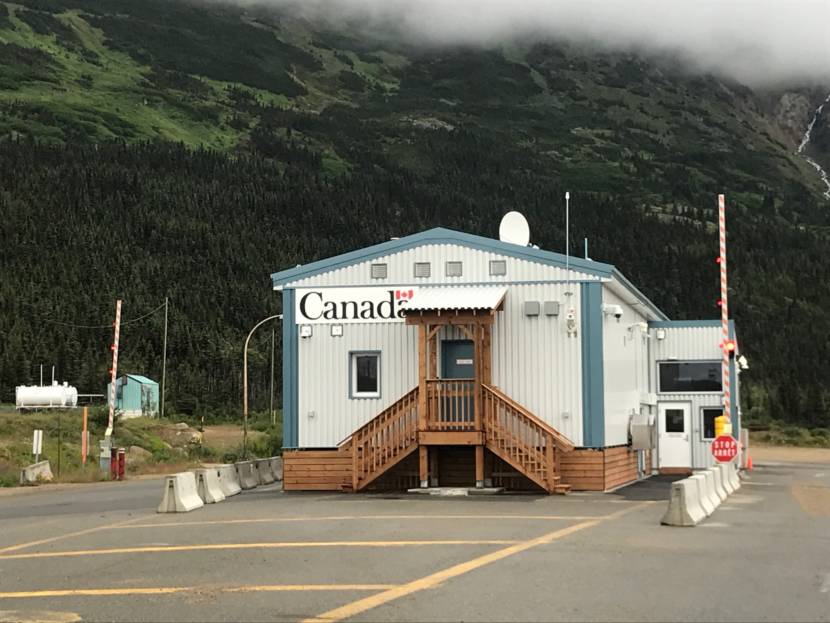
The new border station at Fraser, B.C. (Mike Swasey/KHNS)

The South Klondike Highway from Skagway to Whitehorse is one of the prettiest stretches of road in North America, but it’s been off-limits to most Americans since the pandemic-related border restrictions were announced last spring. Beginning on Aug. 9, though, fully vaccinated U.S. travelers are now allowed to cross into Canada.

Once the weekend arrived, I packed up my camper truck, grabbed my passport and vaccine card, loaded up my adventure dog Charley and hit the road.

When I arrived at the border station in Fraser, B.C., the Canadian border guard asked me questions about my job, where I live and what kind of bear protectant I had. I had everything in order, so he let me through after about 10 minutes

Downtown Carcross was our first stop, and I didn’t get out of the parking lot by the visitor center before I ran into Michelle Phillips, a dog musher from Tagish.

“This place has been so quiet and so empty for so long. It’s really nice to drive into Carcross today and see all the cars and the campers and different license plates and see people walking around,” said Phillips.

Apparently, Yukoners are just as excited to get to Skagway as I was to get to Canada.

“I would love to go see friends in Skagway and go to Starfire. I miss Skagway. So yeah, I really hope they open the border,” said Phillips.

And there’s something to that cross-border food craving. Phillips was craving Thai food from Starfire in Skagway, and I was excited for sushi in Whitehorse.

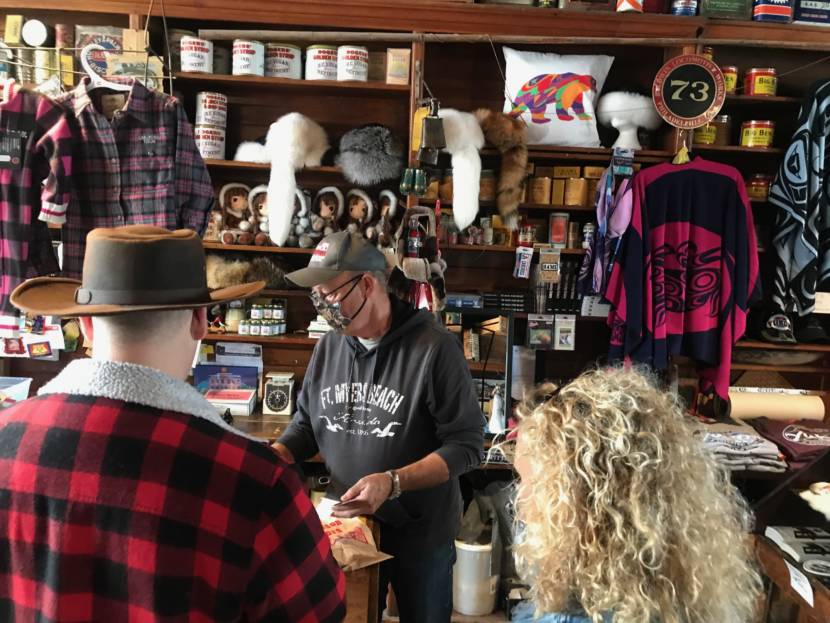
Ron O’Conner inside Matthew Watson General Store in Carcross, YT. (Mike Swasey/KHNS)

I stopped into Matthew Watson General Store and talked with co-owner Ron O’Conner who was working his first shift since the fall of 2019.

He said his wife and daughters had been running the store, but the girls took the weekend off, so he had to cover.

“This is our Discovery Day weekend. Monday is the holiday but there’s a lot of people from British Columbia and Alberta up here visiting right now. And then the Whitehorse crowd comes out here on the weekends,” said O’Conner.

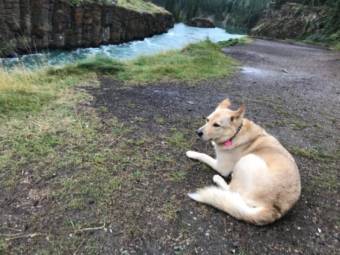
Charley the adventure dog at Miles Canyon in Whitehorse, YT. (Mike Swasey/KHNS)

I said my goodbyes and headed up to Whitehorse, where I ran into Tom Ely from Haines who was driving the Golden Circle. The loop goes from Haines to Skagway via ferry, a drive to Whitehorse, then down to Haines.

“Well, I’ve been waiting since the border closed to get back to the Yukon and see my friends and do some mountain biking,” said Ely.

He says flashing his passport, negative test result and vaccination card was pretty straightforward.

“So it’s pretty much about five minutes to cross. It was great,” said Ely.

I asked him what he was most excited to bring home.

“My thing is the hot banana pepper rings and Bix, dill pickles the extra garlic ones, minis,” said Ely.

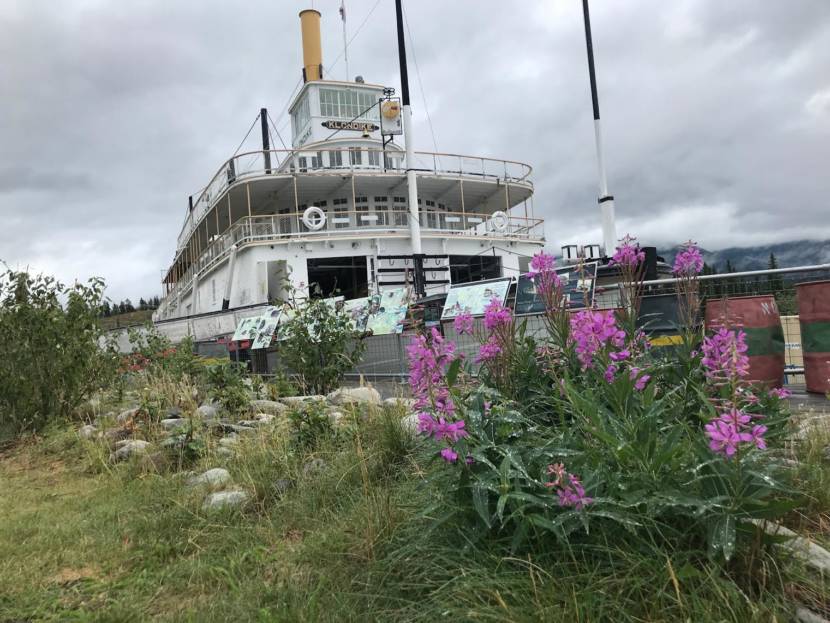
Charley dog and I camped on a friend’s property, and on Sunday we went to visit the SS Klondike — the old sternwheel steamboat that used to run freight along the Yukon River.

The S.S. Klondike in Whitehorse, YT. (Mike Swasey/KHNS)

That’s where I met Terri Bishop from Vero Beach, Florida. She stopped with Boone, her Rhodesian Ridgeback,  on her way to Interior Alaska. She says she had to Google where to get a test in Montana before she could cross into Canada.

“If you did it on Friday, and then they don’t give you the results until Monday, like that’s 72 hours right there. So it was like, okay, how’s this gonna work? But it worked,” Bishop said.

To get through the border, you’ll need your passport, your vaccination card, proof of a negative COVID test within 72 hours and a completed ArriveCan application.

When coming in, the app asks you to say where you’ll quarantine if necessary. Because Bishop is traveling in a tricked-out Sprinter van, she used the border station address. She says the Canadian border guard had a laugh at that.

“And the only thing he asked me was, ‘Do you have any weapons?’” she said.

There have been some changes in the Yukon since I last visited: a new Canadian border building, the Westmark Hotel is now the Sternwheeler Hotel and some of my favorite restaurants have changed. But some things always stay the same. Tim Horton’s had Timbits, and Canadian Tire had long lines and good dog toys.

Many of the people I met wondered when the U.S. border will open to Canadians, but there’s still no official word on when that might happen.

Conservationists challenge old-growth timber sale in Haines State Forest for a second time

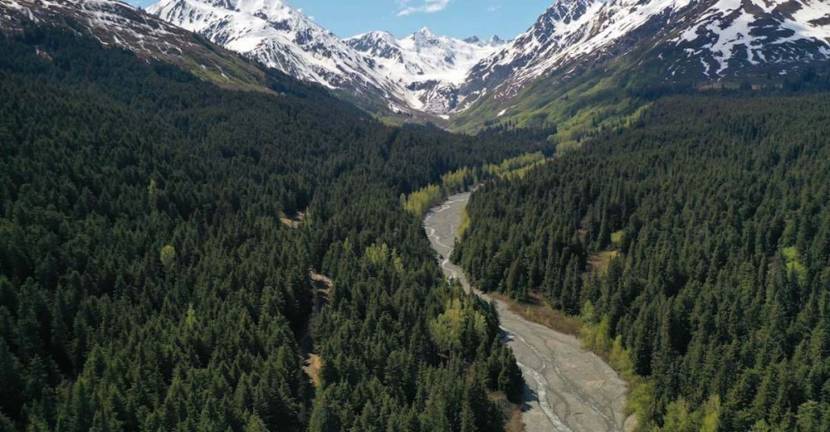
The Baby Brown and Glacier Side timber areas, left, are south of Glacier Creek, a main tributary to the Klehini River (Courtesy of Derek Poinsette)

Conservationists are challenging one of the state’s largest old growth timber sales in Haines State Forest in more than 20 years. It’s the second challenge to the Baby Brown project, which opponents say threatens biodiversity in upper Chilkat Valley.

Lynn Canal Conservation is leading a group of environmental organizations that allege the state failed to provide proper public notice before authorizing the logging of more than 1,000 acres of Haines State Forest. And they’re calling for the state to cancel the timber sale, says Executive Director Jessica Plachta.

“Our economy depends on an intact landscape, our fishing, our tourism,” she said. “90% of local people utilize subsistence resources, primarily salmon, and salmon is dependent on on intact forests. So the importance of this landscape really can’t be overemphasized, and Baby Brown is an integral part of this landscape.”

In 2017, the Baby Brown sale was canceled after Lynn Canal Conservation successfully argued that the state Division of Forestry didn’t create a land use plan for the entire harvest area.

This spring, the forestry division awarded Baby Brown to an Oregon-based timber company, Northwest Forest Products, for a bid of $423,455. The company has five years from the date of signing to harvest timber, roughly to early 2026.

This time they also included a second site, Glacier Side #2, of about 150 more acres of forest for logging. Lynn Canal Conservation says bundling the two parcels together under one formal plan without public input isn’t legal.

“They’re cutting corners on the public process to benefit the purchaser,” Plachta said. “And in this case, the purchaser is an out-of-state logging company that plans to raw-log export our forest, and it doesn’t benefit local people. It doesn’t even benefit the state. It costs the state more to offer these sales than it gets in timber receipts.”

She says public comment is a required safeguard for the management of state lands.

Deputy State Forester Tim Dabney says his office combined the two sites through an amendment for the convenience of the logging company. He says the tracts added later had already been previously authorized for logging, but that contractor defaulted.

“And without having done anything on the sale, and since Glacier Side #2 harvest units are adjacent to the Baby Brown harvest units, the decision was for us to combine both of those sales into one sale, which is totally fine,” Dabney said.

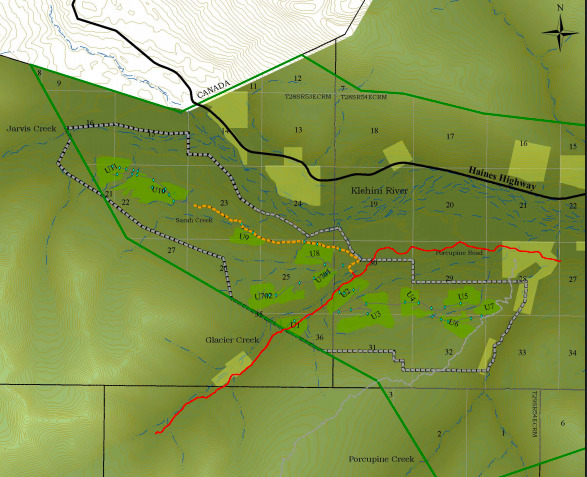
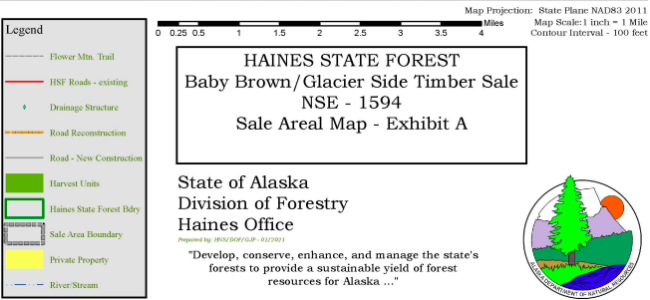
Baby Brown / Glacier Side timber sale (Alaska Department of Resources)

Dabney says his office has received the appeal and is considering their request to cancel the sale. He says the agency doesn’t know when it will rule on the challenge, but state attorneys and the Natural Resources commissioner’s office are reviewing whether the bundled timber sale was improper.

“We’re considering their request,” he said. “And I have really no information beyond that we’re in consideration of their request.”

Plachta says the entire Haines Forest region at the headwaters of the Chilkat Valley is critical habitat and should not be disturbed.

“I think it’s 13 miles of new roads, building a couple of new bridges, a whole bunch of new culverts. And, you know, that’s a lot of damage to what’s otherwise intact growth, transitional forest, which is really important,” she said. “Turns out the United States has less than 3% of its original old growth forest, and so it might feel abundant here, but it’s really not.”

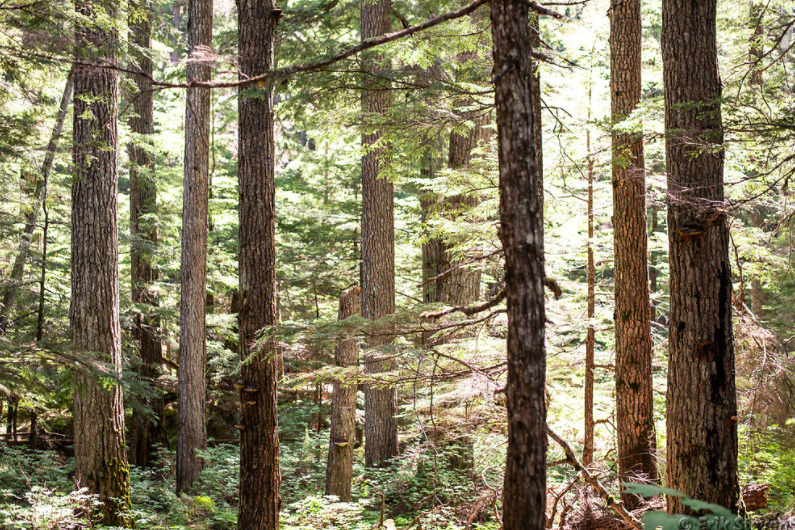
The project proposes logging spruce and hemlock trees (Photo courtesy of Erik Stevens)

Plachta says there are telltale signs the old growth forest will not grow back as promised by state authorities, citing heavy logging in the Upper Chilkat Valley decades ago, which she says contributed to the decline of the king salmon runs.

“Where a lot of us are going to go blueberry picking this September, those are 50-year-old clear cuts,” Plachta said. “And those 50-year-old clear cuts are not regrowing, they’re not turning into the new old growth that the state forest predicts that we’ll be having. Those are blueberry fields with a lot of alder and the occasional coniferous tree.”

The bidder is listed as Northwest Forest Products of Baker City, Oregon. That’s a relatively new company in Alaska. But its principal has been through this before. The outfit is owned by Stan Runnels, a former Astoria Forest Products executive. The Astoria company had been the high bidder on the Baby Bear timber sale that was shelved in 2017 after environmentalists objected to the process.

Southeast Alaska State Fair wraps up after 4 days of festivities in Haines

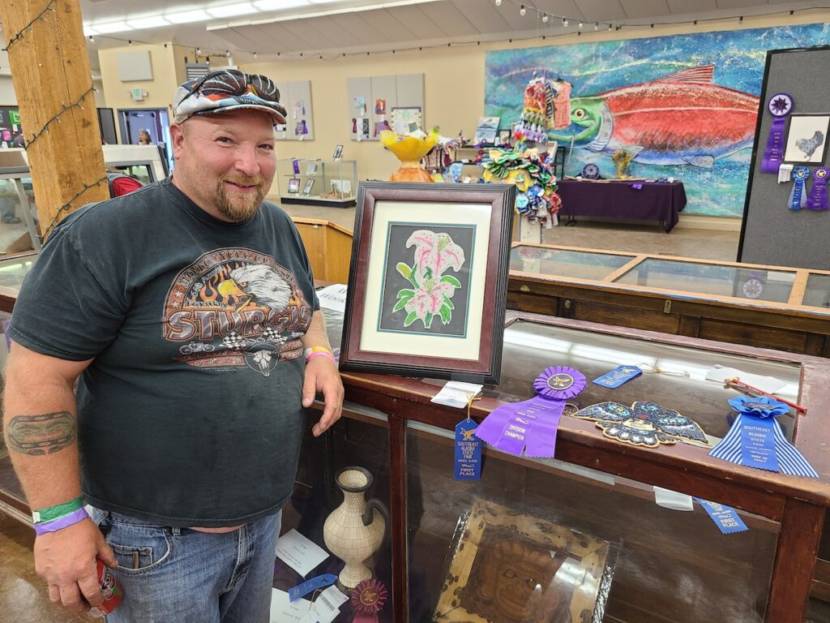
Darrel Jerue with his two beadwork pieces which won Division Champion and First Place at the Southeast Alaska State Fair (Corinne Smith/KHNS)

The Southeast Alaska State Fair wrapped up its four-day run of festivities this weekend. Despite rising COVID-19 cases and border restrictions, people from across the region came together for a weekend of fun and community.

It was the first fair since the pandemic led to last year’s cancelation. Organizers recommended masking and social distancing, but very few people appeared to take those precautions. Attendees were also asked to jot down their names and phone numbers at the entrance in case contact tracers had to get in touch later.

The crowds were thinner on Sunday, the final day of the fair. But kids were back at the carnival games and rides, families flocked to the food court and high schoolers play a fast paced volleyball game.

At Harriet Hall, artists and makers of all ages from across Southeast Alaska and the Yukon displayed their work. Purple, blue and red ribbons adorned wall displays of photography, quilts, cases of jams and wearable art pieces some that went down the runway the day before.

Exhibitor Darrel Jerue of Klukwan won division champion and first place for two beadwork pieces — his first entries at Southeast’s fair.

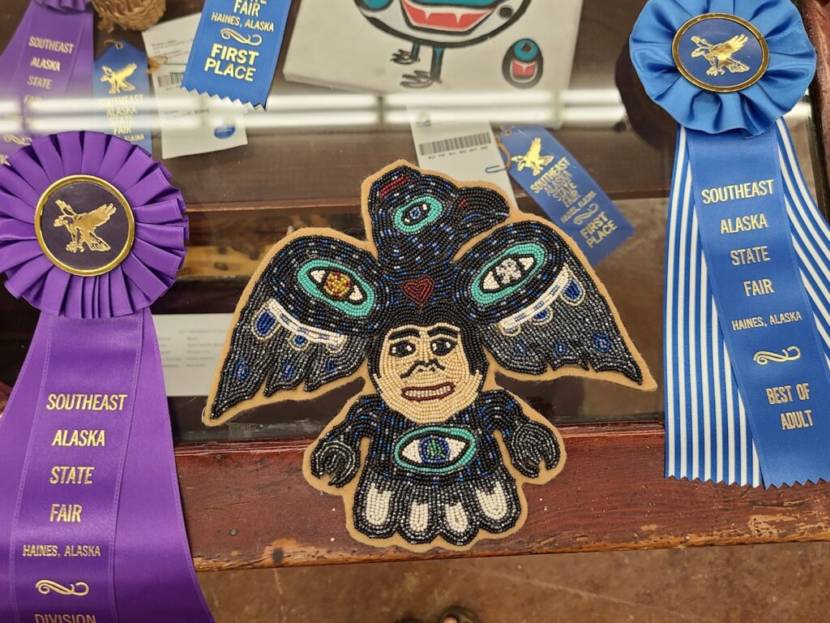
“I’ve got a stargazer lily, about four by six (inches). It takes about six months to do each piece that large. And also have the wet raven. It has the sun, the moon and also the Earth in there,” he said.

Darrel Jerue’s piece, “Wet Raven.” (Corinne Smith/KHNS)

Jerue says he learned beading from his mother, Sally Burattin, who passed away last March.

“She taught me how to do all this,” he said.

He says the public reception at the fair has been overwhelmingly positive, but still, he’s missing her. So he’s unsure where his beadwork will go next.

“Right now, I put myself in a predicament where I can’t touch a needle until probably next year, after the one year mark on my mom’s death. It’s hard for me to start a project because she was always there for me, to say there, it’s good,” he said. “She was always a mentor for me.”

The raven piece will be incorporated into a traditional blanket that was started by his mother, which will be completed by several family members and then displayed at the Jilkaat Kwaan Heritage Center in Klukwan.

Outside the hall, the disc golf tournament wrapped up with awards and cash prizes. TeoLani Baker of Haines is seven months pregnant and won the women’s division for the second year in a row, while her husband Colton Baker won the men’s.

“The luck, I guess,” she said. “I think that’s what makes it the most fun. You can’t ever get too good that you might not lose.”

As the fair winds down, volunteers with Haines Friends of Recycling sorted compost and recyclables as part of the fair’s zero-waste effort. Food vendors were required to use compostable plates and utensils.

Haines Friends of Recycling chair Melissa Aronson says the initiative has had a huge impact in diverting waste and saving money at the dump. She says that each year she sees improvement.

“They used to bring a great big Conex in here and fill it up, you know, sometimes more than once over the course of the fair. This year they just brought one bear-proof canister,” she said. “So that seems to be really improving, people are paying attention.”

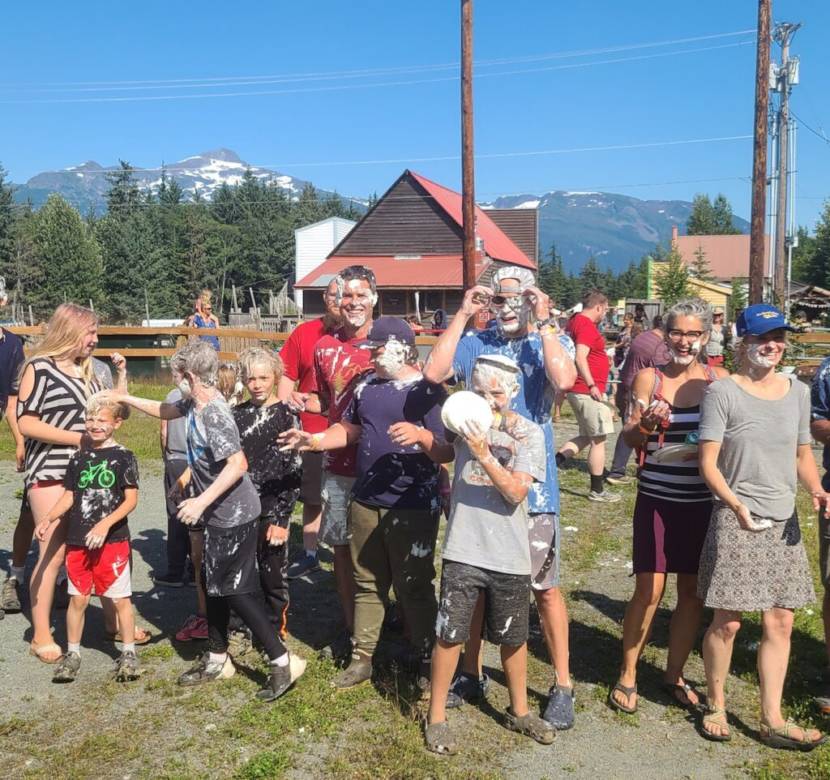
The last event of the fair weekend was a pie fight in Raven’s Arena. The fair’s theme this year was “Live Free, Pie Hard.”

The free-for-all pie fight was the finale to the fair weekend (Corinne Smith/KHNS)

Within minutes, kids and adults were covered in pie as a crowd cheered from the stands. And with that, the Southeast Alaska State Fair was over.

Organizers haven’t released the number of ticket sold this year. They estimate past years have reached 11,000 people, but this year saw a significantly smaller crowd.

The Southeast Alaska State Fair is on for this weekend, with COVID precautions

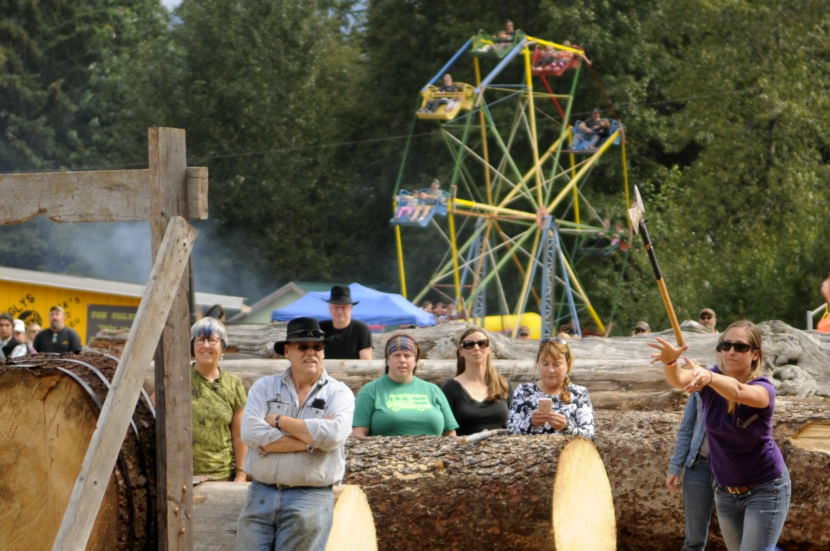
A woman competes in the axe throwing contest during the logging show at the 2016 Southeast Alaska State Fair. (Photo by Jillian Rogers/KHNS)
A woman competes in the axe throwing contest during the logging show at the 2016 Southeast Alaska State Fair. (Jillian Rogers/KHNS)

The Southeast Alaska State Fair will go on as planned this coming weekend. Fair organizers say they are taking steps to ensure the safest gathering possible even as COVID-19 cases spike across Southeast Alaska.

Last year there was no fair due to the pandemic. One of the fair organizers, Madeline Witek, says she’s expecting a fun-yet-safe event this year.

“The beauty of the Southeast Alaska State Fair is almost all of it happens outside, which is the CDC is recommending to if you’re going to hold an event, have it be outside. So that’s really in our favor,” Witek said.

But there are a number of activities that won’t be on the schedule this year as part of the mitigation plan.

“There won’t be a bounce house. And we won’t have the joust, which is the inflatable kind of warrior, knock people off of a pedestal thing for lack of a better word,” Witek said. “It’s an inflatable arena, and you hit people.”

The Southeast Alaska State Fair typically draws hundreds of people from communities like Whitehorse in Canada’s Yukon Territory, Juneau, Sitka, Skagway, and Haines. The event features music shows, vendors and a slew of activities and games for all ages.

There will be some changes: no beer sold and no live music at the Klondike Stage. But there will still be a horseshoe tournament, she said

“There will not be alcohol for sale with the horseshoes, which I know is a disappointment for some but I think that we’ll be able to move forward with the horseshoe tournament without beers in our hands,” Witek said.

One of the biggest changes fairgoers will see is the sign-in sheet at the entrance to track attendees.

“That’s really the only way that we are able to keep track of who is attending. And in the very, we feel, unlikely event of any outbreak and the need to do contact tracing, that’s how we’re going to be able to do it,” Witek said.

Another big change will be shorter hours.

“We will not be having a late-night program, we will be wrapping up for the evening at around eight or nine o’clock depending on the day. That’s always, you know, people hang out in the beer garden later. And the late night music, everybody kind of comes together to dance. Part of our COVID mitigation strategy is to avoid that,” Witek said.

Organizers will make free masks available at the entrance, there will be hand-washing and sanitizing stations located throughout and social distancing is encouraged.

There is a long schedule of events available at Seakfair.org, culminating in headlining acts like Diggin Dirt, a funk band out of California on Friday night, and The Lack Family on Saturday. The final event of the weekend will be a free-for-all pie fight at 3:30 p.m. Sunday afternoon.

“We have a lot of whipped cream and Dreamwhip. And we are making whipped cream pies. And it’s a no-rules pie fight,” Witek said.

Transportation options include the Alaska Marine Highway System, Alaska Fjordlines, the Haines-Skagway Fast Ferry and options from Alaska Seaplanes.

Site notifications
Update notification options
Subscribe to notifications